by Lee Fang
Marc Morial, president of the National Urban League, convened a panel of civil rights leaders last month to assail President Donald Trump’s executive order on “ending illegal discrimination and restoring merit-based opportunity.” The so-called anti-DEI order, Morial claimed, was an effort to “reverse the gains of the last seventy years.”
Marc Morial: His National Urban League has adopted the very types of discriminatory racial practices that were once condemned by early civil rights leaders seeking a truly colorblind society -- notably Dr. Martin Luther King Jr. in his March on Washington (top photo).
AP Photo/Jacquelyn Martin
“Diversity, equity and inclusion are aligned with American values,” declared Morial. To any critics claiming that DEI represents “some sort of preference program” that “divides Americans,” Morial scoffed. “We say, absolutely not.” Morial then argued that the organizations gathered there would crusade to protect DEI and “the notion that everyone has an equal opportunity.”
This response of the civil rights establishment was more than simply a vow of resistance to the Trump order; it reflected opposition to a long-cresting sea change in racial politics in America.
In 1963, the Urban League was one of the groups that participated in Dr. Martin Luther King Jr.’s March on Washington, where King envisioned a nation for his children not “judged by the color of their skin but by the content of their character.” During this period, non-white Americans faced legal and cultural barriers to full participation in civic life, from school segregation to rampant discrimination in employment and housing opportunities.
Trump's
anti-DEI order: rooted in legal tradition, but countering a new form of discrimination.
whitehouse.gov
Much has changed over the years. The Trump executive order was issued to counter a new form of discrimination as the pendulum has swung in the opposite direction. Many organizations, in an attempt to address anger about historical injustices, have fostered bias against groups perceived as privileged – particularly white and Asian men – and have developed explicit policies designed to advantage those perceived as disadvantaged.
The Supreme Court found that a bid to achieve diversity-related goals, Harvard had illegally engaged in racial discrimination. The Trump order builds on that.
AP
Over the last decade, Morial’s Urban League has adopted the very types of discriminatory racial practices that were once condemned by early civil rights leaders seeking a truly colorblind society. A few years ago, for instance, the Urban League helped administer a $10 million grant program that excluded applicants by race. The program was limited to “500 Black-owned businesses.” More recently, the Urban League defended a venture capital firm that ran a black women-only grant program that was found in violation of civil rights laws over its exclusion of Americans based on immutable characteristics.
Such overtly discriminatory programs have pervaded society, from education to health care to hiring practices. SSM Health, a Catholic health system, for instance, developed a scoring system to award doses of Regeneron, the antibody treatment for COVID-19, using racial demographics. Those identifying as “non-White or Hispanic” race were awarded seven additional points on the twenty point scale that determined those eligible for treatment.
Christopher Rufo: The Justice Department needs to get more heavily involved, says the conservative activist. "Investigations, enforcement, and legislation” are essential.
RCP
These patterns of discrimination faced a major rebuke in the historic Students for Fair Admissions lawsuit against Harvard University. The litigation exposed rampant bias against Asian applicants, who faced special barriers based solely on race, which Harvard attempted to disguise using a “positive personality trait” category. In 2023, the Supreme Court ruled in favor of an activist group and found that the university, in a bid to achieve diversity-related goals, had illegally engaged in racial discrimination in violation of the Equal Protection Clause of the 14th Amendment.
The court ruling against affirmation action, though seen as a major victory in the march toward a race neutral and merit-based society for many critics, could be just the beginning.
While much of the news around the anti-DEI executive order has focused on government agencies shuttering websites devoted to diversity officers or closing down racial affinity groups for federal workers, many corporate leaders have struck a defiant tone since the election.
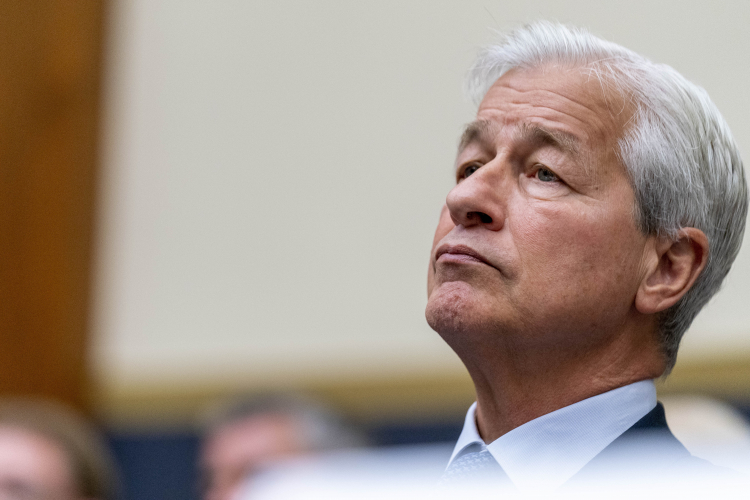
Jamie Dimon: “Bring them on,” the JPMorgan Chase boss says of challenges to his DEI policies. But now that carries much greater risk.
AP
Sophie Bellon, the chief executive of Sodexo, the food and facilities management conglomerate, told investors her company is “intensifying our initiatives on diversity, equity, and inclusion.
When asked last month whether Delta Airlines would rethink its DEI programs, Peter Carter, an executive vice president at the company, was resolute.
“No, we are not,” said Carter, speaking on an investor call. “We are steadfast in our commitments because we think that they are actually critical to our business.”
Delta and Sodexo are among the many corporations that have embraced DEI. In 2020, Delta Airlines established metrics for “equitable outcomes for talent” by setting sweeping race-based hiring goals and promised to double its spending on black-owned businesses.
However, change could be coming for virtually every major corporation, foundation, and university if they segregate, hire, or preference customers based on racial identity.
The Trump executive order, which builds on the Harvard ruling, could be radically more far-reaching than what has been originally reported. The order utilizes a carefully plotted legal strategy that will ripple across America’s institutions.
Christopher Rufo, a conservative activist who has advised the initiative, is pushing for greater involvement of the Department of Justice in combatting discriminatory practices. “The executive order is a step in the right direction but will not solve the problem in its entirety. It will need to be supplemented by investigations, enforcement, and legislation,” Rufo noted.
The Peril of the False Claims Act
Meanwhile, an increasing number of attorneys around the country have reacted with alarm at a little-noticed provision of the order. The anti-DEI order included a line disclosing that federal contracts and grants will soon carry a new certification stipulating that firms doing business with the government must adhere to colorblind policies. Failure to abide by these rules will run the risk of violating 3729(b)(4) of Title 31 of federal law, the order further notes.
That statute refers to the False Claims Act, an anti-fraud statute in place since the Civil War. The law provides significant damages to firms found in violation of federal contracting rules. Whistleblowers that assist the government with fraud investigations may be eligible for up to 30% of the monetary value of a settlement.
Craig Saperstein, corporate lawyer: “This is a pretty sweeping executive order, and it’s something that, whether you’re a company, whether you’re a nonprofit, whether you’re a college or university, you need to be taking a look at your policies."
pillsburylaw.com
These penalties are far heftier than those of Title VII of the 1964 Civil Rights Act, which has a $300,000 compensatory and punitive damages cap for corporations over 500 employees. The False Claims Act, in contrast, has no such cap and defendants can face triple penalties, incur civil penalties, and potentially lose access to federal programs in the future.
“This is a pretty sweeping executive order, and it’s something that, whether you’re a company, whether you’re a nonprofit, whether you’re a college or university, you need to be taking a look at your policies,” noted Craig Saperstein, an attorney with Pillsbury Winthrop Shaw Pittman, on a webinar last month, explaining the administration’s new executive orders.
“Any contractor or grant recipient that currently maintains a DEI program should especially take note, as the [executive order] directly links the maintenance of future DEI programs to False Claims Act (FCA) liability,” noted the law firm Venable in a client alert about the order.
The risks for FCA liability extend directly to firms such as Delta Airlines and Sodexo, both of which are federal contractors. Delta Airlines provides personnel and cargo flights for the Defense Department, among other agencies, while Sodex manages facilities for several government agencies.
The order further instructs government agencies to identify nine potential civil compliance investigations, explicitly urging a focus on “foundations with assets of 500 million dollars or more, State and local bar and medical associations, and institutions of higher education with endowments over 1 billion dollars.”
In other words, the order will not only upend the federal contracting system, which touches thousands of private firms, but will also spark Department of Justice civil rights investigations of major foundations, colleges, and publicly traded companies. The broad purview of the investigation could ensnare major foundations, such as the Ford Foundation, financier George Soros’ Open Society Foundation, and the Tides Foundation, groups with multibillion-dollar endowments that are well known for pursuing DEI ideology in grantmaking.
Such a probe would likely impact the major donor groups to the pro-DEI civil rights establishment. The Urban League, for instance, received a $1 million donation from the Ford Foundation in October 2020.
The DEI executive order may turn out to be one of the most pivotal Trump administration moves to reshape social policy in the twenty-first century. For decades, presidents have wielded executive orders as a powerful but often overlooked tool to advance their policy agendas.
The strategy dates back to World War II, when President Franklin D. Roosevelt issued Executive Order 8802, prohibiting racial discrimination in the defense industry. This order set a precedent for using federal contracts as a mechanism for social change. Presidents Harry Truman and Lyndon Johnson followed with their own executive orders to compel anti-racial discrimination policies.
The Trump order may go down as a major corrective force, veering America back onto the colorblind path after years of so-called “racial reckoning” policies.
While the order does not change the terms of any existing contract or grant, it directs revisions as soon as 90 days or until April 25, 2025. The Office of Management and Budget will soon develop guidance for procurement agencies to implement the new anti-DEI rules.
A number of corporate executives have struck defiant tones, claiming they will oppose any move against DEI initiatives.
“Bring them on,” J.P. Morgan chief executive Jamie Dimon said on CNBC at the World Economic Forum in Davos, Switzerland, in response to a question over whether the firm would respond to activist and investor pressure and back down from DEI policies.
As the deadline for implementation approaches, the tension between corporate DEI commitments and federal contracting requirements sets the stage for what could become one of the most significant battles over anti-racial discrimination policies in recent American history.
“Any corporation that is actively supporting discriminatory DEI policies should be investigated, fined, and, if necessary, placed under a federal consent decree,” noted Rufo.
“That is what it will take to get to colorblind equality in America,” he added.
https://www.realclearinvestigations.com/articles/2025/02/07/why_trumps_anti-dei_order_is_both_radical_and_rooted_in_civil_rights_law_1089775.html