Search This Blog

Thursday, March 13, 2025

'Influencers make big money selling leftover videos — ones not yet posted online — to train AI'

 A new company wants to give pay cash for your private videos — to train artificial intelligence.

Now that AI companies have scraped virtually every corner of the internet for content their models can learn from, Austin-based Troveo is buying up “dark content” left on the cutting room floor. Since launching a year ago, the company has doled out some $5 million for 1 million hours of content.

“If you have public content out there, your content is already being used to train models, so the question really is, do you want to opt in and extract that value?” CEO Marty Pesis explained. “The more you lean into it, the more you can actually control the terms of how [AI companies] are using your content.”

Marty Pesis is the founder and CEO of Troveo and formerly worked in growth for Cameo.

More than 1,200 approved individuals are uploading to Troveo — including filmmakers, talent agencies, YouTubers and vloggers who tend to be sitting on a treasure trove of unused video scraps.

Users give Troveo exclusive rights to use their footage for AI training purposes in return for a passive income stream. Footage typically sells for $.75 to $3 a minute.

The value of the content depends on how visually diverse it is — a video of a YouTuber just talking to a camera can only teach AI so much — or how well it fits a particular need.

One Troveo client was in the market for 50,000 hours of dog videos, because the dogs generated with their model kept coming out with the bodies of cats.

Troveo purchases dark footage to train artificial intelligence models.

One creative who decided to take the bank is YouTuber and a cappella singer Peter Hollens.

When Hollens makes a video for his 3 million subscribers, he ends up scrapping 50 minutes of footage for every one minute he actually uploads — meaning the byproduct of a three-minute music video is 150 minutes of dark footage.

“I’ve always thought that was not worth anything, then I realized, oh holy crap, all of these terabytes are actually worth hundreds of thousands if not millions of dollars depending upon who you’re talking to,” Hollens said. 

Peter Hollens uploads unused footage from his YouTube videos to Troveo to make extra cash.Peter Hollens/YouTube

His first paycheck from Troveo was for $13,000.

But he first had to weigh the question many creators are grappling with: Is this feeding the very beast that will replace them, or just cashing in on an inevitable innovation? 

Hollens was convinced to cash in after finding out that 32 of his YouTube videos had already been used to train AI without his consent.

“If Pandora was in the box and we had the ability to keep it closed, I would be on the side of not doing this, but it’s already too late… unless you’re a hermit, you’ve been trained off of,” Hollens explained. “This is an incredible opportunity to at least cash in.”

Jared Brick has been able to invest in his video company and pay off debt thanks to Troveo earnings.Courtesy of Jared Brick

Jared Brick, the CEO of Brick House Media, produces talking-head informational videos for industry leaders — and decided to hand Troveo thousands of hours of content that had piled up on hard drives over 13 years in business.

“There’s always been modernization in our industry whether it was taped to digital, or virtual to streaming,” Brick told The Post. “Every time you resist technology, you lose.”

He’s been able to monetize 900 hours of video so far, valued at roughly $0.80 to $.90 per minute — meaning he’s made well over $40,000 from footage that would otherwise have wasted away.

Jared Brick’s footage — more than a decade’s worth — was an unexpected source of passive income.Courtesy of Jared Brick
While it’s low-hanging fruit for content creators, there’s also potential for a broader audience. Most people do, after all, have hundreds of private videos living in the cloud.

Said Pesis: “iCloud libraries and Google Photos are less valuable than the high quality content, but it would be wrong for me to say that there’s no value there,” Pesis said.

https://nypost.com/2025/03/13/tech/this-company-will-give-you-cash-if-you-let-them-train-ai-with-your-private-videos/

EPA Head Says Border Sewage Crisis "Unacceptable", Tells Mexico To Honor Commitments

 by Jane Yang via The Epoch Times,

The U.S. Environmental Protection Agency’s new chief expressed outrage over the Tijuana River sewage pollution that has for decades affected San Diego border communities and generated health hazards, recently causing a record of more than 1,000 consecutive days of beach closures.

“I was just briefed that Mexico is dumping large amounts of raw sewage into the Tijuana River, and it’s now seeping into the U.S.,” said EPA’s Administrator Lee Zeldin in a post on the social media platform X on the afternoon of March 8.

“This is unacceptable. Mexico MUST honor its commitments to control this pollution and sewage!” Zeldin wrote.

A few hours after Zeldin’s post, a transboundary flow of wastewater mixed with heavy stormwater was reported entering the U.S. side starting 1:30 a.m. on March 9, according to the U.S. Section of the International Boundary and Water Commission (USIBWC), the federal agency responsible for implementing boundary and water treaties between the United States and Mexico.

In a follow-up press release on March 10, USIBWC said that it had several meetings with Mexican officials, and preliminary information showed that “multiple unforeseen construction issues” at a project to replace a wastewater pipe in Tijuana resulted in the accidental flows.

“I have made it very clear to Mexico the importance of avoiding future transboundary flows to the greatest extent possible during this very complicated construction project,” said USIBWC Commissioner Maria-Elena Giner, who was appointed to head the agency in August 2021, in the statement.

“We appreciate EPA Administrator Lee Zeldin’s attention to this issue and will keep him as well as all our stakeholders informed of Mexico’s progress,” the commissioner added.

The agency said the transboundary flows stopped mid-afternoon on March 9.

The ongoing project aims to replace Tijuana’s largest wastewater conveyance pipe, which has been plagued by leaks that have caused pollution flows in the past, according to the USIBWC. The project is funded by the United States, Mexico, and a Mexican bank, and is under construction by the Mexico Ministry of Defense.

USIBWC spokesperson Frank Fisher told The Epoch Times in an email that the USIBWC is in regular close contact with its Mexican counterparts at all levels. But for the new regular meetings, the focus will be exclusively on the pipe replacement project and monitoring any problems.

“We continue to work on four fronts to tackle the transboundary issue: Repairs to the South Bay plant; expansion of the plant; monitoring Mexico’s commitment on projects in Minute 328; and taking urgent action to ensure zero transboundary flows during the dry season,” Fisher said.

Minute 328 is a binational agreement signed in July 2022 by the United States and Mexican federal agencies to reduce wastewater in the Tijuana River watershed and Pacific Ocean through a suite of infrastructure projects on both sides of the border.

Trash builds up along the Tijuana River outside of San Diego, Calif., on Sept. 19, 2024. John Fredricks/The Epoch Times

California Leaders Ask EPA Chief for Help

John McCann, Mayor of Chula Vista, a south bay city in San Diego County, which declared a state of emergency last November due to the Tijuana River sewage crisis, told The Epoch Times through email that he had asked “a few South County leaders who are former colleagues of Zeldin” to convey the message and escalate the Tijuana River sewage crisis “to the highest level at the EPA.”

“The ongoing Tijuana sewage crisis is an urgent environmental and public health issue that requires immediate action. Accountability on the part of Mexico is essential,” McCann said in the email, “But we have to recognize that fully solving the crisis depends on a cooperative, binational approach.”

He said the most important first steps in tackling the crisis include securing at least $630 million of federal funding needed for infrastructure repair and expansion and persuading Mexico to act responsibly.

At the Jan. 16 senate hearing on the nomination of Zeldin to be administrator of the EPA, the newly elected Sen. Adam Schiff (D-Calif.) asked whether Zeldin would review a proposal that was rejected by previous EPA leaders.

Schiff asked, “Will you agree to review EPA’s January 7 decision to deny request to investigate the Tijuana River Valley for a potential Superfund designation? ... Will you agree to review it and consider whether a different judgment should be reached?”

Zeldin answered “Yes.”

The Superfund site designation petition was initiated by San Diego County Supervisor Terra Lawson-Remer last October. One of the co-signers was Mayor Paloma Aguirre of Imperial Beach, the city most heavily affected by the sewage crisis.

The petition requested the EPA to investigate and assess the hazardous materials in the Tijuana River Valley area in San Diego for its eligibility for inclusion in the EPA’s Superfund program, which could help bring federal resources to clean up hazardous materials in heavily contaminated regions.

Aguirre also sent two letters to Zeldin, one on Jan. 22 after the Senate hearing and another on March 3, after Zeldin was sworn in on Jan. 29 as the 17th EPA head. In both letters, Aguirre asked Zeldin for a new review of Tijuana River Valley’s Superfund designation.

“I was heartened by your agreement in your confirmation hearing to CA Senator Schiff’s request to review the EPA’s recent denial of Superfund designation for this environmental crisis,” she wrote in the letters. Aguirre also invited Zeldin to visit the region to see the disaster firsthand.

The Epoch Times has reached out to Schiff, Lawson-Remer, and Aguirre for comment on Zeldin’s post but did not hear back before publication.
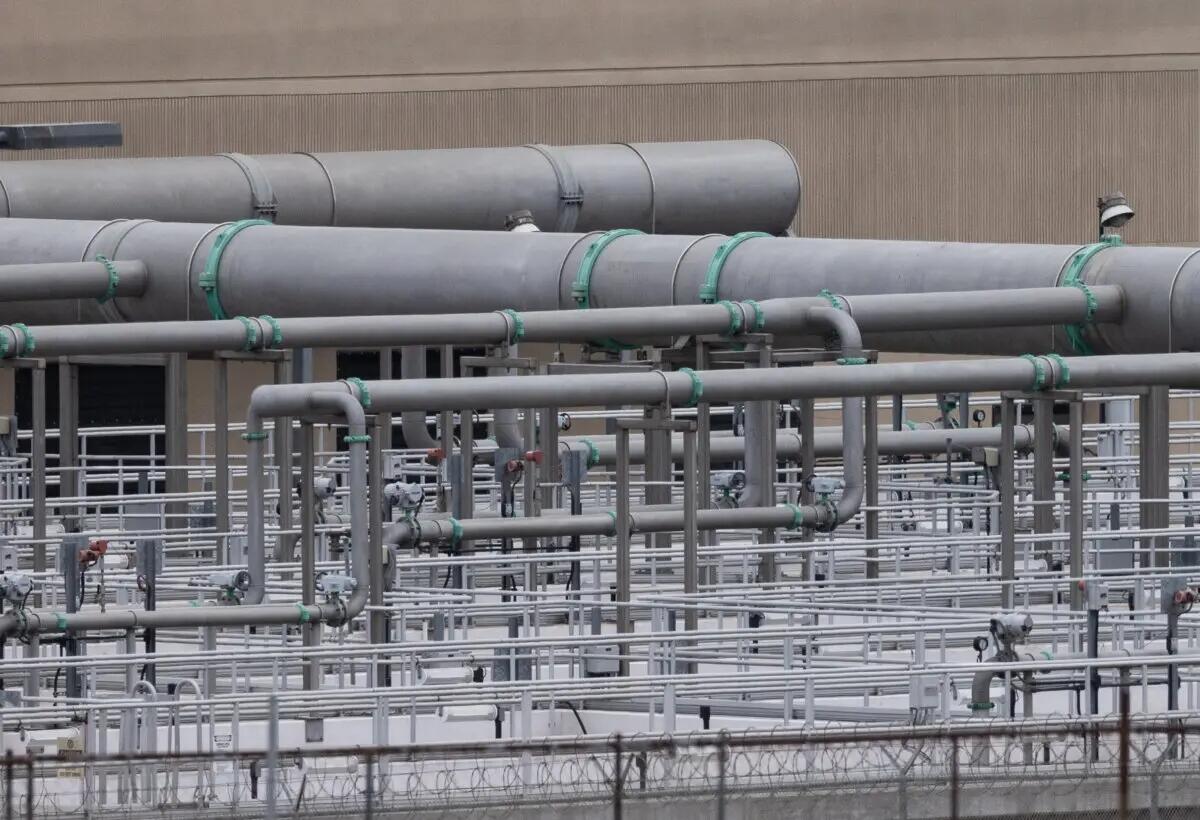
A sewage treatment facility pumps in water from the Tijuana River outside of San Diego, Calif., on Sept. 19, 2024. John Fredricks/The Epoch Times

A Decades-Long Crisis

The majority of the Tijuana River’s 120-mile course is within the northern Baja California state of Mexico, and only about five miles of its lower end crosses the border from Tijuana to San Diego and empties into the Pacific Ocean.

The Tijuana River pollution has gone on for decades, but the crisis has only become worse in the past few years with Tijuana’s fast-growing population, as well as the deterioration of water treatment infrastructure, said Phillip Musegaas, executive director of the non-profit San Diego Coastkeeper, in an article dated May 2, 2024, on the organization’s website.

In the past five years, over 100 billion gallons of pollutants have been discharged into the Tijuana River, raising major concerns about water quality and public health in the San Diego region, according to a recent Community Assessment for Public Health Emergency Response (CASPER) report by the Centers for Disease Control and Prevention, performed in October 2024 and released in January.

California leaders at federal and local levels, as well as community advocates and organizations, have in recent years pushed to generate momentum to tackle the complex transboundary pollution issue by introducing new legislation, securing federal funding, filing lawsuits, giving out air purifiers to residents in affected communities, and other means and proposals.

https://www.zerohedge.com/political/epa-head-says-border-sewage-crisis-unacceptable-tells-mexico-honor-commitments

J&J, Legend Pump $150M Into Manufacturing in Bid to Double Carvykti Production


Johnson & Johnson and Legend Biotech hope to hit blockbuster status for Carvykti this year.

Legend Biotech is building a new $150 million manufacturing plant, with its partner Johnson & Johnson, with the goal of doubling the production of its CAR T therapy Carvykti this year, Legend CEO Ying Huang revealed in its fourth-quarter earnings call on Thursday.

Approved in February 2022, Carvykti is a CAR T treatment that targets the B cell maturation antigen, a protein commonly found on B cells. The cell therapy was originally indicated for patients with relapsed or refractory multiple myeloma who had undergone at least four prior lines of therapy. But in April 2024, the FDA agreed to push up its use to the second-line setting.

“While the expansion of Carvykti in the second-line setting and approval of Carvykti in additional geographies will dramatically expand the number of patients who are eligible for Carvykti treatment, we think the number of available commercial manufacturing slots will be the primary driver of revenue . . . over the next 12 months,” William Blair analysts wrote in a note to investors on Thursday.

Legend will use the $150 million to expand its cell therapy facility, called Tech Lane, in Belgium. The biotech expects to start clinical production “in the coming weeks,” according to Huang, building up to commercial production later this year. Legend and J&J will “jointly” invest in the Tech Lane project, which has received approval from both companies’ leadership teams.

In 2024, Carvykti hit $963 million in sales, falling just shy of blockbuster status. Legend wants to earn that distinction in 2025, Huang said during the Thursday call, and the manufacturing investments will help the biotech get there.

Jessie Yeung, Legend’s interim chief financial officer, said the company has already started on engineering and design work for this project, which the biotech expects to complete in 2028.

The Belgium boost comes nearly a year after Legend entered into a supply deal with Novartis. That agreement, which runs from March 27, 2024, through December 31, 2029, has Novartis providing contract manufacturing services for Legend and J&J, providing them with clinical and commercial supply of Carvykti out of its production facility in New Jersey.

Also to boost its Carvykti supply, J&J and Legend in October 2022 poured an additional $250 million into their joint production plant in Raritan, New Jersey.

“From a manufacturing standpoint, we’re very comfortable with the supply network that we’ve built,” Alan Bash, Carvykti president at Legend, said during the call on Tuesday. Production at the Novartis site “is coming online right as we speak,” Bash noted, adding that the biotech will continue to invest in “step ups” and a “physical plan expansion” for its Raritan facility, slated for the latter half of 2025.

https://www.biospace.com/business/j-j-legend-pump-150m-into-manufacturing-in-bid-to-double-carvykti-production

CNN: 'Dems first big chance to check Trump may make them look even weaker'

Washington Democrats finally have a first point of leverage against President Donald Trump – but it comes with a dilemma that could leave them looking even more hapless than they have so far in his second term.

The pressure point arises over a temporary government funding bill that could provide cover for the president’s anti-government purge and as Democratic voters pine for their lawmakers to show some fight.

Ahead of a critical Senate vote, Democratic leaders face a paradoxical choice: Should they shut down the government to try to save it? That gamble could come with a significant downside, as shuttered agencies and thousands of furloughed federal workers could be left even more vulnerable to the metaphorical chainsaw wielded by Elon Musk.

Democrats’ choices will play out against a backdrop of mounting frustration from progressives, whose despair after the 2024 election has turned to horror as Trump has turned Washington upside down in his first 50 days in office and set about fracturing the liberal world order that has prevailed for 80 years.

Democrats were widely mocked for their ineffectual protests that underscored their impotence during Trump’s joint address to Congress earlier this month, when some wore color-coordinated dress and others held up paddles bearing anti-Trump slogans.

Pennsylvania Democratic volunteer Bobbi Erickson wants her party’s leaders to be far more aggressive in taking on Trump. “We are watching the Constitution burn. We are watching the country that we love be systematically dismantled,” Erickson told CNN’s Eva McKend, whose recent trip to the commonwealth revealed extreme impatience among grassroots Democrats.

Back in Washington, party leaders have a chance to show some steel.


History shows that Republicans usually get the blame for the kind of partial government shutdown that will begin at midnight Friday unless the Senate approves new spending to keep it open.

But Trump and Musk, with their stunning moves to shred the federal machine, have scrambled political logic, leaving both parties gaming out novel calculations that have changed the politics of shutdown dramas.

The House of Representatives set up the one-two GOP punch by passing a bill to freeze spending at current levels until the end of September — while adjusting where money is allocated to prioritize Trump’s priorities, such as border enforcement. The House then promptly left town, leaving the mess for the Senate to sort out.
DOGE may win whatever happens

Democrats fear this stopgap bill will simply provide another six months for Trump and Musk to widen the Department of Government Efficiency’s plan to fire thousands of workers and close entire federal departments. But in theory, they can block it by refusing to give the GOP probably eight votes needed to reach a filibuster-proof majority in the Senate. The need for 60-vote thresholds for most bills is the only lever the Democrats can pull in the capital to slow or moderate Trump’s actions.

“I’m going to vote against what came over from the House Republicans to the Senate last night because I don’t want to give my vote to support what Trump and Musk are doing,” Delaware Sen. Chris Coons told “CNN News Central” Wednesday.

But if Democrats take this path, they’ll be closing down the government at the very time Trump is trying to destroy it.

Sen. Mark Kelly, an Arizona Democrat, told CNN’s Kaitlan Collins on Tuesday that he’d not yet decided how to vote. But he sees downsides to a shutdown that go beyond inflicting even more hardship on federal workers. “If it shuts down, what is Elon Musk going to allow to open back up? That’s a big concern of mine,” Kelly said. “How many more veterans is Elon, and this administration, going to fire? So, there’s not a good option here.”

Senate Democratic Minority Leader Chuck Schumer sought to break Democrats out of their unenviable political box on Wednesday, warning that the 60 votes needed to pass the funding bill do not yet exist. He called for a separate one-month extension with identical spending allocations as those currently in force to allow for bipartisan negotiations. “We should vote on that. I hope, I hope our Republican colleagues will join us to avoid a shutdown on Friday,” Schumer said on Wednesday.


But there’s no chance the GOP, basking in its monopoly on Washington power, will “join” with the minority party. So, it’s fair to ask whether Schumer is taking a stand for effect in the expectation that enough of his members will eventually vote to keep the government open — while allowing the bulk of his party to cast a symbolic but politically useful vote against Trump.

Republicans are relishing the spectacle after setting their trap.

“Chuck Schumer has a big decision to make. Is he going to pass the bill to keep the government open? Or is he going to be blamed for shutting it down,” House Speaker Mike Johnson told Fox News on Wednesday. The Louisiana Republican held his tiny majority together to pass the stopgap bill in a feat that demonstrated Trump’s huge influence. Johnson is obviously enjoying flinging exactly the same lines at Democrats as he and his GOP colleagues have faced for years in shutdown sagas.
‘I hate’ the bill

The next two days will be deeply painful experience for Democrats. “I hate the House bill,” Sen. John Hickenlooper told CNN’s Manu Raju. But the Colorado Democrat was leaning toward voting for the measure despite warning that it would give Trump more time to jam through the sweeping government cuts that are “exactly what we’ve been fighting against.” However, on Wednesday evening, he said in a video on X he had decided to vote against the Republicans’ short-term funding extension, arguing it would give Trump more power to undermine spending authority granted to Congress by the Constitution.

The arguments for mounting a Senate blockade even at the risk of a government shutdown are mostly rooted in the opportunity for Democrats to show some resistance to the most disruptive first 100 days in modern presidential history.
A vote to stall the bill in the full knowledge that the government would be shuttered would represent a bet that despite their bullishness, Republicans would still pay a political price for a shutdown — as vital workers toil without pay, thousands more are furloughed and critical services such as airport security and public health risk being disrupted.
If they frustrate the Republican plan, the Democrats will at least be doing something that they can show their restless voters.

Democrats would also be hoping to put pressure on Johnson and to make him face a backlash for sending his members home. They’d hope either to gain some concessions that could slow the Trump juggernaut or to open fissures in the tiny GOP House majority that could be important in later, more critical fights.
As well as the possibility that they’d be inadvertently putting some government departments at risk, the party would be complicit in causing pain to the very federal workers it is trying to protect.
A shutdown could be yet another shock to an economy that is already showing signs of distress, as consumer demand ebbs and trauma widens over Trump’s trade wars.

Pennsylvania Sen. John Fetterman is one of the few Democrats to openly argue for passing the stopgap bill – after previously irking some grassroots members of his party by accommodating some of Trump’s policies and nominees.

“If you shut it down, you will impact and hurt millions and millions and millions of Americans, and you run the risk of slipping us into a recession or even all kinds of other things,” Fetterman told CNN’s Manu Raju on Wednesday. “Remember what you were voting for. You were voting to shut the government down, and that will absolutely punish millions, millions of Americans,” Fetterman said.

Fetterman’s attitude will look like an abdication to many Democrats who have been demanding tougher action from their representatives in Washington. But it also underscores one unpalatable fact the party is constantly forced to face: It lacks the power to make a real impact. The earliest that can change is the midterm elections in 2026, when Democrats hope historical precedents will hold firm and they’ll recapture the House and the power to check the incumbent president.

But their odds of overturning the GOP’s current 53-47 edge in the Senate are problematic, with only two Republican-held seats, in Maine and North Carolina, sure bets to be competitive, and with several incumbent Democrats looking vulnerable. The equation became even more daunting Wednesday when Sen. Jeanne Shaheen of New Hampshire — a state that only narrowly went to Democrats in the 2024 presidential election — announced she will not run for reelection, opening a competitive race for her seat.


https://www.cnn.com/2025/03/13/politics/senate-democrats-budget-shutdown-dilemma/index.html

Covid Vaccine Trials: Failures in Design and Interpretation


Jay Bhattacharya   Martin Kulldorff

Submitted: Oct 14, 2024| Published: Jan 30, 2025 | DOI: https://doi.org/10.70542/rcj-japh-art-lx5ggg

Abstract


For the Covid vaccines, the fundamental goal was not to prevent mild infections but to prevent deaths, hospitalizations, and transmission. Despite this, the randomized controlled trials evaluated short-term reduction in symptomatic Covid infections while failing to address important public health issues. This result was due to badly designed trials. Despite lacking key data, public health agencies made unsubstantiated vaccine claims, published unscientific vaccine recommendations, and imposed unethical vaccine mandates. As a result, vaccine hesitance has increased while the trust in public health has deteriorated.

After contrasting them with the polio vaccine trials in the 1950s, this article outlines the fundamental design flaws in the Covid vaccine trials and describes how they could and should have been designed to generate the critical public health information on their ability to reduce hospitalizations, mortality and transmission.