Search This Blog

Thursday, March 13, 2025

Escobar: Made in China 2025 – Revisited

 by Pepe Escobar,

The Two Sessions, part of the Chinese People’s Political Consultative Conference, held last week at the Great Hall of the People in Beijing, were a pretty serious deal.

Not only because the sessions set the framework for Beijing to confront serious economic challenges ahead.

But also because of the stellar performance by Foreign Minister Wang Yi, who forcefully imprinted in the collective psyche of the Global Majority how China should be regarded as a premier source of stability in this extremely turbulent geopolitical juncture, standing firm “in the right side of History”.

So let’s start with the key Wang Yi takeaways – which translate as de facto setting the tone for Beijing’s diplomacy throughout 2025.

US-China: Beijing is ready to engage with Trump 2.0 on the basis of mutual respect. Yet “if the US continues to contain China, we will resolutely counteract.” It’s “fully possible” for US and China to become partners. But this should be seen as the paramount concept: “No country should fantasize that it can suppress China and maintain good relations with us at the same time.”

The Global South: That is a “key force for maintaining world peace, driving world development and improving global governance”. These developing nations, accounting for over 40 per cent of global GDP, “hold the key to bringing stability to the world and making it a better place.” Wang Yi emphasized once again how China is “a natural member of the Global South.”

Russia – and Ukraine conflict: Russia and China’s“mature and resilient relationship (…) will not be swayed by any turn of events or be affected by any third party.” Wang Yi defined Beijing’s position on the conflict as “objective and impartial” – and crucially did not call for Europe – or Ukraine – to be included in the upcoming US-Russia negotiations. His major point – which echoes Russia’s analysis: “Security is mutual and equal; the security of one country cannot be built on the insecurity of others.”

Gaza: No Chinese endorsement of the Trump Gaza Riviera Resort and Casino gambit: “Gaza belongs to the Palestinian people”. And “changing its status by forceful means will not bring peace but new chaos”. Beijing supports the Egyptian peace plan. Once again, Wang Yi made it clear that “the crux of the cycle of the Palestinian-Israeli conflict lies in the fact that the two-state solution is only half achieved.”

Europe: Wang Yi praised the “capacity and wisdom” of EU-China to “deepen strategic dialogue and mutual trust.”Beijing, at least in theory, believes that Europe could become a trusted partner. The EU and the European Commission (EC) in Brussels may have other – belligerent – ideas.

South China Sea: Wang Yi went straight to the point on the manipulation of Philippines by “external forces”: “Infringement and provocation will backfire, and those acting as others’ chess pieces are bound to be discarded.” Yet he stressed the South China Sea remains “stable”, because China and ASEAN want it to remain so.

Taiwan: Wang Yi forcefully stated that “Taiwan has never been a country (…) It was not in the past, and it will never be in the future.” Moreover, “seeking Taiwan independence is doomed to backfire, and using Taiwan to contain China will be nothing but a futile attempt. China will realise reunification, and this is unstoppable.”

Made in China 2025 On Overdrive

Now let’s focus on China’s extremely complex domestic equation. At the opening of the Two Sessions, Premier Li Qiang came up with a rallying call for the whole nation to rise up to a series of “very challenging” goals, including growth of 5% in 2025 (it was 4.9% last year).

Essentially, to revitalize the economy, Beijing will issue 1.3 trillion yuan (around US$182 billion) in ultra-long special treasury bonds. The deficit-to-GDP ratio was set at around 4%.

The official policy of “opening up” will reach the internet, telecoms, healthcare and education industries – meaning more opportunities for foreign investors and possible partnerships up and down the industrial supply chain.

All those moving parts of the ambitious Made in China 2025 tech project will be on overdrive: AI, smart terminals, the Internet of things, 5G, plus a new mechanism set up for “future industries” to support hi-tech domains,including biomaterials manufacturing, quantum technology, embodied intelligence and 6G.

Premier Li enthusiastically praised the role of regional growth drivers such as the Greater Bay Area – the super high-tech cluster in Guangdong province linked to Hong Kong. Predictably, he extolled the “one country, two systems” model and the further economic integration of both Hong Kong and Macau.

Arguably this is the best analysis anywhere not only of why Hong Kong-based CK Hutchinson had to get rid of its port operations in the Panama Canal, but also because it offers a crisp Chinese evaluation of the “three powers” behind Trump 2.0: Wall Street, heavy industrial capital (energy, steel, mining) and Silicon Valley.

CK Hutchison Holdings, founded in Hong Kong by notorious tycoon Li Ka-shing, essentially had to sell 80% of Hutchison Port Group, a subsidiary that owns 43 container ports in 23 countries, including a 90% stake in the Balboa and Cristobal docks at either end of the Panama Canal, because of hardcore geopolitics. Hutchison will continue to control its ports in China, including Hong Kong.

President Trump made a huge fuss about the BlackRock-led deal. The view in Hong Kong is more pragmatic. Hutchinson was not eager to engage in a furious court battle in US courts – not to mention potential sanctions. So they chose to opt for a “strategic exit”.

Finding Shelter From the Coming Storms

Premier Li noted how consumption in China now is “sluggish” and, somewhat euphemistically, how there were “pressures on job creation and income growth”. Enter a promised “vigorous boost” to household demand, plus the creation of 12 million new urban jobs, with help focusing on fresh university graduates and migrant workers.

In parallel, Beijing will expand its military budget by only 7.2% in 2025, reaching roughly 1.78 trillion yuan (US$ 245 billion). That’s not much compared to the Pentagon budget.

It’s quite enlightening to observe the proposals of the Two Sessions – and the tone-setting by Wang Yi – in relation to the analysis by a certified Asian star such as former Singaporean ambassador to the UN Kishore Mahbubani.

Kishore once again resorts to Sun Tzu, explaining how Chinese rulers always privilege the best way to win as not fighting kinetic wars. What matters is to coordinate expansion – epistemologically, educationally, economically, industrially, techno-scientifically, financially, diplomatically, militarily – under the aegis of deterrence.

The bottom line is that Beijing will not be trapped by any possible, bombastic provocation coming from Trump 2.0. Once again, it’s all about “coordinated expansion”.

Example. The Australian Strategic Policy Institute, partly funded by the Australian military, and frankly Sinophobic – and Russophobic – at least did something useful by developing a Critical Technology Tracker of 64 current, critical technologies.

This is their latest report, fromAugust 2024. It shows that between 2003 and 2007, the US led in 60 of 64 technologies. China led in only 3. Cue to between 2019 and 2023: the US led in only 7, whereas China led in 57 – including semiconductor chipmaking, gravitational sensors, high-performance computing, quantum sensors, and space launch technology.

All that is inextricably linked to the successful planning – and achieved targets – of Made in China 2025. Talk about two five-year plans back to back (Made in China was conceived in 2015).

So this is what China 2025 will be all about: serious investments coupled with lots of partnerships with the whole Global South. Once again, in a sort of Sun Tzu framework tweaked by Bruce Lee, China is bound to use Trump 2.0 and the coming mix of confrontation, competition and periodic negotiation as a trampoline to expand its global reach even further.

That might be one of the unstated meanings of what Xi Jinping told Putin in Moscow nearly two years ago: “Changes unseen in a century.” Beijing will be sure to find shelter from the storm – any storm. And without having to fight a single kinetic war.

https://www.zerohedge.com/geopolitical/escobar-made-china-2025-revisited

China tells lenders to boost financial support for consumption

 China's financial regulator urged institutions to boost support for consumption, promising in a statement on Friday to relax consumer credit quotas and loan terms as it offers long-term backing to make available large sums.

The National Financial Regulatory Administration (NFRA) added that it encouraged financial institutions to provide loan renewal support to eligible borrowers of personal consumption loans. 

https://www.marketscreener.com/news/latest/China-tells-lenders-to-boost-financial-support-for-consumption-49332134/

China, Iran, Russia kick off talks in Beijing over Iran's nuclear issues

 Senior diplomats from Iran, Russia and China gathered in Beijing on Friday for talks on Tehran's nuclear issues, Chinese state broadcaster CCTV reported, days after Iran rejected U.S. "orders" to resume dialogue over the Iranian nuclear programme.

In 2015, Iran reached a deal with the United States, Russia, China, Britain, France and Germany and agreed to limit its nuclear programme in exchange for the lifting of international sanctions. But in 2018, Donald Trump, a year into his first term at the White House, pulled out of the pact.

Last week, Trump said he had sent a letter to the Iranian leadership suggesting talks with the Islamic Republic, which the West fears is rapidly approaching the capability to make atomic weapons. But Iranian President Masoud Pezeshkian said he would not negotiate with the U.S. while being "threatened" and that Iran would not bow to U.S. "orders" to talk.

https://www.marketscreener.com/quote/currency/US-DOLLAR-RUSSIAN-ROUBLE--2370597/news/China-Iran-Russia-kick-off-talks-in-Beijing-over-Iran-s-nuclear-issues-49332135/

Columbia University Human Rights Fellow Convicted For Having A Slave

 A British jury convicted United Nations Judge Lydia Mugambe on Thursday of forcing a Ugandan woman into domestic servitude after luring her to the U.K. under false pretenses.

Mugambe, who also serves as a high court judge in Uganda, brought the victim to Britain under the guise of securing her a job in a diplomatic household — only to make her work as an unpaid maid and nanny. She confiscated the victim’s passport and visa, leaving her trapped until she was able to contact a friend, who alerted authorities, according to a Thames Valley Police statement.

“Lydia Mugambe used her position to exploit a vulnerable young woman, controlling her freedom and making her work without payment,” Eran Clutliffe, an attorney for the Crown Prosecution Service’s Special Crime Division, said.

The 49-year-old judge, who was studying for a doctorate at the University of Oxford at the time, according to her profile on the U.N.’s website, was found guilty on four charges, including forced labor, an immigration offense and conspiracy to intimidate a witness. Mugambe is also listed on Columbia University’s website as a fellow in their human rights program. Prosecutors argued she “exploited and abused” the victim’s lack of knowledge about her rights to keep her in a state of servitude.

Mugambe leveraged her connections within the Ugandan High Commission in London to secure a visa for the victim, presenting it as an official employment opportunity, according to court testimony. Instead of placing the woman in a diplomatic household, however, Mugambe brought her to her private residence and forced her to work without pay.

The case shocked observers, with audible gasps heard in the courtroom as the verdicts were delivered at Oxford Crown Court, according to the Associated Press. Mugambe reportedly appeared  distressed and unwell following the decision, prompting the judge to clear the courtroom.

Mugambe, who was appointed to a U.N. international court in May 2023, denied all changes. She is now scheduled for sentencing on May 2.

https://dailycaller.com/2025/03/13/columbia-university-human-rights-fellow-convicted-for-having-a-slave/

Will the Fed Ride to the Rescue?

 by James Rickards

The stock market has topped out and is headed down.

The Dow Jones Industrial Average peaked at 45,014 on December 4, 2024, and was at 41,911 by March 10, 2025, down 3,101 points or 6.9% in just over three months.

The S&P 500 Index peaked at 6,130 on February 18, 2025, and was at 5,614 on March 10, 2025, down 516 points or 8.4% in less than one month.

The NASDAQ Composite Index peaked at 20,174 on December 16, 2024, and was at 17,468 on March 7, 2025, down 2,706 points or 13.4% in less than three months and technically a market “correction” (defined as a 10% or more decline from a previous peak).

None of those index performances is a full-blown crash nor do they represent a market panic. Stock market indices are volatile, and they may partially bounce back by the time you read this. Still, down is down. We have to look at the reasons for this and use our predictive analytical techniques to see where the markets go from here.

A Crash Can Be Profitable

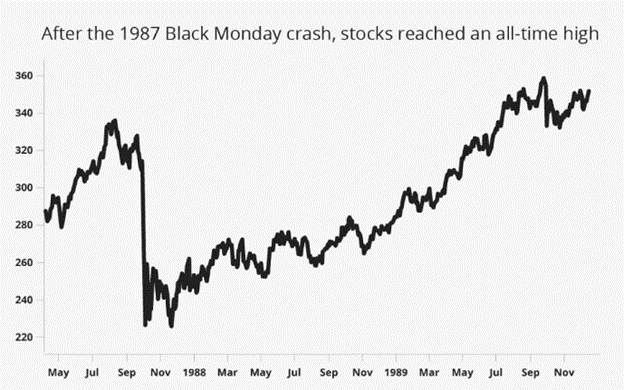
While investors worry about a market crash such as a one-day crash of over 20% (this happened on October 19, 1987) or a one-month crash of over 30% (this happened in March 2020), those are not necessarily the worst outcomes for investors.

image 1

The losses from the 1987 crash were almost 60% recovered in two trading days and were 100% recovered in less than two years. Losses from the 2020 crash were fully recovered in four months making it the fastest recovery of any crash in the past 150 years. Buying stocks in the aftermath of a crash can turn out to be a very good trade.

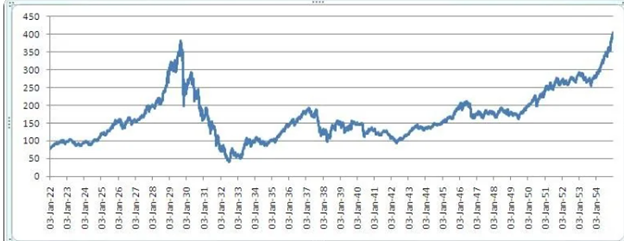
To be clear, not every crash has such a rosy recovery. The 1929 stock market crash took 25 years to recover from its 1932 low. Stocks took 6 years to recover from the 2000 dot.com crash.

image 2

A Long Slow Grind Down Is Worse

What is worse than a crash and quick recovery is a long, slow grind down. That does not mean a one-day crash of 10% or more. It could mean a slow grind down perhaps 20% or 30% over six months or even longer. A quick crash can recover quickly. With a slow grind, many investors tell themselves it will come back or “buy the dips” or hang in there. Then it will grind down some more until the retail investor finally capitulates with large losses.

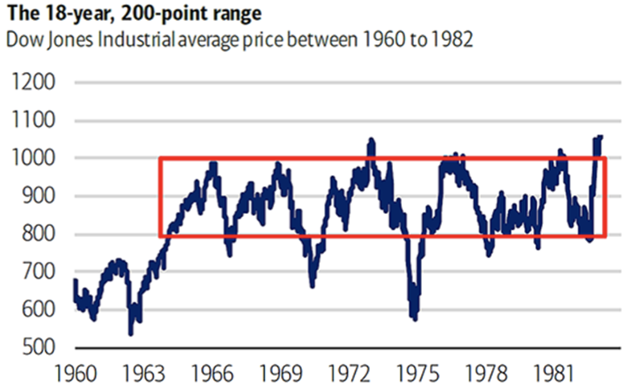
The most striking example of this is the stock market behavior during the lost decade of the 1970s. The Dow Jones hit an all-time high over 1,000 in 1969. From there, stocks fell during the 1969 recession, rallied in the early 1970s, crashed again in 1974, rallied back and then fell sharply in the 1981-82 recession. In fact, from 1960 to 1982, the Dow stayed in a 200-point range for 18 years!

image 3

Stocks leveled off with the Dow around 800 in 1982 at which point a rally began and the Dow again hit 1,000 for the first time since 1969. In terms of index points, stocks took 13 years to regain the old high despite volatility along the way. Adjusted for inflation, the new high of 1,000 was worth only 50% of the 1969 high in real terms. While waiting for the index to recover, investors permanently lost half their money in terms of purchasing power. That 13-year episode is what we mean by a long, slow grind down.

Will The Fed Ride to the Rescue?

The Fed actually doesn’t care about the stock market unless it becomes “disorderly.” We’re not there yet. Down is not the same as disorderly. If markets crash as they did in March 2020, the Fed probably will activate the Powell Put and cut rates. But the Fed won’t do anything specific to help stocks in the slow grind scenario. That’s not their job.

The Fed will “pause” again at their next meeting on March 19. There will be no rate cut and no rate hike. The Fed did cut rates beginning last September, but they paused the rate cut cycle in January. The Fed doesn’t turn on a dime. Even though inflation cooled lower than expected in this morning’s inflation report, the Fed need to see a few months of evidence that inflation is under control and unemployment is the bigger problem.

The Fed will return to rate cuts by their May meeting but not yet. Fed Chair Jay Powell will focus on the dual mandate of low unemployment and price stability. He’s required to do so by law. But the Fed can juggle which part of the mandate (jobs or inflation) takes precedence at any point in time.

Lower Rates: Be Careful What You Wish For

Trump says he wants lower rates, but he won’t intentionally sacrifice the stock market to get them. Still, stocks and bond yields may both go down on their own for reasons having very little to do with Trump or the Fed and everything to do with slower growth and possible recession in the U.S. When stocks go down, Trump will simply blame the Fed for not cutting rates more and sooner.

Rates going down is a case of “be careful what you wish for.” Most people think of lower rates as “stimulus.” They’re not. Lower rates are associated with depression and recession. In a strong economy, rates actually go up a bit because higher returns are available, and entrepreneurs compete for funds.

Right now, the signs of recession in the U.S. are everywhere. The Federal Reserve Bank of Atlanta GDPNow tracker just collapsed. Its Q1 forecast for GDP growth was +2.3% (annualized) on February 26. By March 7, it showed -2.4%. That’s a shocking decline in growth and a shocking collapse of 4.7 percentage points in just over a week.

Recession Signs Are Everywhere

Analysts blamed this showing on a surge of imports in February intended to beat the Trump tariffs being imposed now. Imports increase the trade deficit, which hurts GDP. There’s some substance to that take, but it’s not the whole story.

Retail sales and consumer confidence are also down. Labor force participation, a measure of the number of people in the economy actually working (whether technically “unemployed” or not) is also declining. New hiring hit a wall months ago and now layoffs are beginning. Major retailers such as Walmart, Target and Best Buy have all warned that their revenues and profits are slowing.

These recession signs are not limited to the United States. Germany, the UK, Japan and Canada are all in recession or close to it. China’s growth is slowing rapidly. Officially, the Chinese government reports 5.0% growth but the reality is closer to 2.0% once wasted investment is stripped out. Even the Chinese may be headed for recession.

Unemployment in the U.S. has risen from 3.4% in April 2023 to 4.1% today. That’s not a high level or a huge increase but the trend should be disturbing. Inflation has risen from 2.4% (annualized) in September 2024 to 3.0% today. Again, that’s not an out-of-control level but the trend should also be disturbing.

The Fed’s Dilemma

The Fed is between a rock and a hard place. Right now, the Fed is more concerned about inflation. By May, they will be more concerned about jobs. They cannot cut rates to fight unemployment and raise rates to fight inflation at the same time. That’s why they’re basically throwing up their hands and doing nothing. None of this has much to do directly with stock market performance.

The Fed could hardly be less relevant now, but it does have symbolic significance in the minds of everyday investors and market media.

The Fed will not be abolished in the current wave of DOGE demolishing the Deep State. But there is a case heading to the Supreme Court on the ability of Trump to fire the head of a so-called “independent agency.” The court may surprise observers by upholding Trump’s right to fire any agency head on separation of powers grounds. If that happens, there’s no reason why the Fed would be exempt from that ruling.

At that point, Trump would hold the Sword of Damocles over any Fed Chair. I would expect Jay Powell to resign as a kind of protest at which point Trump could appoint a friendly face and it would be Trump’s Fed to all intents and purposes. That will make headlines but, again, it’s of limited relevance to stocks.

Investors should lighten up on equity exposure to reduce losses during this stock market decline.

https://dailyreckoning.com/will-the-fed-ride-to-the-rescue/

No Fats, No Hippies: Hegseth Orders Review Of Military Standards

 US Secretary of Defense Pete Hegseth has ordered a review of the US military's fitness standards and grooming requirements.

In a March 12 memorandum, Hegseth directed officials to compile the current physical fitness, body composition, and grooming standards for various military departments for evaluation.

According to Hegseth, the under secretary of defense for personnel and readiness must also outline how the standards have changed in the last 10 years, and provide any insight into why those standards have changed - as well as what impact they have had.

"We must remain vigilant in maintaining the standards that enable the men and women of our military to protect the American people and our homeland as the world’s most lethal and effective fighting force," Hegseth said.

"Our adversaries are not growing weaker, and our tasks are not growing less challenging. This review will illuminate how the Department has maintained the level of standards required over the recent past and the trajectory of any change in those standards."

Hegseth has previously criticized the military for its sliding standards, as well as allowing women to serve in ground combat roles which began in 2013.

"Since women cannot physically meet the same standards as men, the military has two options—both bad," Hegseth wrote in his book, "The War on Warriors."

"They can lower the standards for everyone to ensure more women meet with infantry or combat standards. Or they can return to gender-based standards, and allow women to enter the infantry with lower standards than men. They have tried both."

During his confirmation hearing, Hegseth said he wanted to restore trust in the military and "revive the warrior ethos."

https://www.zerohedge.com/political/no-fats-no-hippies-hegseth-orders-review-military-standards

Russia seeks to exclude key Trump envoy from Ukraine talks, sources say

  Russian officials have communicated to their counterparts in the United States that they do not want Russia-Ukraine envoy Keith Kellogg involved in top-level discussions aimed at ending the Ukraine war, according to a U.S. official and another source with knowledge of the matter.

Kellogg has been personally absent from some high-level discussions in recent weeks, including a meeting involving U.S. National Security Adviser Mike Waltz and Secretary of State Marco Rubio with a Ukrainian delegation in Saudi Arabia on Tuesday. He was also absent at a high-level meeting with Russians in Saudi Arabia in February.

It was not immediately clear if Kellogg's absence was linked to the Russian officials' request, and it was not clear when the request was made.

The U.S. official said the request had not been heeded, citing the fact that Kellogg sent a high-ranking member of his staff, Eli Rosner, to attend the latest Saudi meeting.

The Russian embassy in Washington did not immediately respond to a request for comment.

National Security Council spokesperson James Hewitt said Kellogg was playing a crucial role in bringing the Ukraine war to an end.

"President Trump has utilized the talents of multiple senior administration officials to assist in the bringing the war in Ukraine to a peaceful resolution," Hewitt said on Thursday evening.

Russia's expanded invasion of Ukraine in February 2022 has left hundreds of thousands of dead and injured, displaced millions of people, reduced towns to rubble and triggered the sharpest confrontation for decades between Moscow and the West.

The U.S. and Ukraine agreed to a 30-day ceasefire in principle during their meeting in Saudi Arabia earlier in the week. But Russian President Vladimir Putin suggested on Thursday that the ceasefire bid needs serious reworking.

The Kremlin's request to exclude Kellogg, first reported by NBC News, comes as some high-ranking former Russian officials have complained that Trump's envoy is, in their view, too sympathetic to Kyiv.

A retired lieutenant general, Kellogg has at times been more critical of Russian aggression in Ukraine than other administration officials. For instance, he sharply criticized Russia for a large-scale Christmastime attack on Ukrainian population centers.

"Christmas should be a time of peace, yet Ukraine was brutally attacked on Christmas Day," Kellogg wrote on Dec. 25 on X. "Launching large-scale missile and drone attacks on the day of the Lord's birth is wrong."

Still, Kellogg has consistently defended Trump's positions on the Ukraine war, including a recent decision to pause some intelligence sharing with Kyiv.

Kellogg served as the chief of staff to the National Security Council during Trump's 2017-2021 term and as the national security adviser to then-Vice President Mike Pence.

He met with President Volodymyr Zelenskiy in Kyiv in February, and has met with a number of NATO leaders throughout Europe.

While some Trump supporters have privately argued Kellogg is too hawkish for their liking, others have said it benefits Trump to have advisers and envoys with different profiles and ideological backgrounds.

https://www.usnews.com/news/world/articles/2025-03-13/russia-seeks-to-exclude-key-trump-envoy-from-ukraine-talks-sources-say