Search This Blog

Thursday, August 7, 2025

Fintiv Sues Apple on Alleged Theft of Mobile Wallet Tech Used to Create Apple Pay

 Fintiv, Inc., a global leader in patented, digital wallet ecosystems, announced today the filing of a civil lawsuit against Apple, Inc. in the Northern District of Georgia, Atlanta Division, alleging violations of the Racketeer Influenced and Corrupt Organizations (RICO) Act, Georgia's RICO Act, The Defend Trade Secrets Act, and Georgia's Trade Secret Act. The lawsuit, filed by Kasowitz LLP, alleges that Apple engaged in a pattern of racketeering activity, including wire fraud and trade secret misappropriation, in furtherance of a scheme to steal Fintiv's proprietary mobile wallet technology and trade secrets that Apple used to create Apple Pay, a service that generates billions in annual revenue and has been a major force in growing Apple's market valuation to more than $3 trillion.

As alleged in the complaint, Apple approached CorFire (Fintiv's predecessor) more than a decade ago under the pretense of forming a mobile payment business partnership. Between 2011 and 2012, it is alleged, Apple attended multiple meetings with CorFire representatives and received confidential technical information under non-disclosure agreements (NDAs). The purpose of those meetings was to enter into an agreement in which Apple would license CorFire's mobile wallet technology, for which CorFire would receive licensing fees, according to the complaint. Instead, it is alleged, Apple stole Fintiv's confidential information and later hired away key CorFire employees, before launching Apple Pay in 2014. Fintiv asserts in the court filing that Apple Pay's core features including secure element technology, NFC technology, and trusted service management platform were based on CorFire's innovations.

The complaint further alleges that Apple, in order to convert Fintiv's stolen mobile wallet technology and trade secrets into cash, set up a fence by forming an association-in-fact enterprise with leading credit card issuing banks, like JP Morgan Chase and Citibank, and payment processing networks, like Visa and Mastercard, for the purpose of enabling and processing the billions of transactions and trillions in payments that Apple Pay users engage in annually. By utilizing Fintiv's stolen mobile wallet technology and trade secrets in Apple Pay, it is alleged Apple and the other RICO enterprise members earn tens of billions each year servicing the Apple Pay transactions.

"The scale of Apple's unlawful conduct has been staggering," the complaint alleges. "By modifying Apple Pay for use on four separate categories of its devices, Apple has repeated and compounded its theft by knowingly utilizing Fintiv's stolen technology in the hundreds of millions of iPhones, iPads, Apple Watches and MacBooks it has sold worldwide," the complaint alleges.

As further alleged in the complaint, "Apple Pay is the engine" that drives the RICO Enterprise. "Without the on-going benefit of Fintiv's stolen mobile wallet technology and trade secrets," the ability of Apple "to generate billions utilizing Apple Pay would be severely compromised."

The complaint further alleges, "Apple's theft of Fintiv's technology is part of a pattern and practice that Apple has engaged in for years – falsely pretending to partner with companies in order to steal confidential and proprietary information under the guise of a working relationship, and thereafter hiring away key employees, all in order to steal the company's valuable intellectual property and use it to commercialize the business on its own."

As examples, the complaint cites "a similar pernicious scheme" to steal trade secrets from Masimo Corp. "which had developed non-invasive technology related to blood oxygen monitoring which Apple believed was key to overcoming performance issues with its Apple watch." Apple, it is alleged, perpetrated a similar scheme against a biotech company named Valencell Inc., where it entered into discussions and negotiations under the guise of seeking to license Valencell's active heart- monitoring technology. Apple's alleged scheme was – as with Fintiv and Masimo – not to partner or license with Valencell, but to steal Valencell's technology and incorporate it into Apple's own products, which Apple then marketed and sold on its own without paying a nickel to Valencell," according to the complaint.

Likewise, according to the allegations in the complaint, Apple never licensed Fintiv's trade secret and proprietary mobile wallet technology but has realized tens and tens of billions of dollars in value and revenues from Apple Pay.

Marc Kasowitz, Fintiv's lead lawyer, calls Apple's alleged theft of trade secrets from Fintiv and its on-going racketeering, as the complaint alleges, "a colossal case of wrongdoing that is one the most egregious examples of corporate malfeasance I've seen in 45 years of law practice. By this action, Fintiv intends to hold Apple responsible for the full extent of its alleged illegal activities."

https://www.businesswire.com/news/home/20250807231105/en/Fintiv-Files-RICO-and-Trade-Secret-Misappropriation-Suit-Against-Apple-Stemming-from-Alleged-Theft-of-Mobile-Wallet-Technology-Used-to-Create-Apple-Pay

FDA makes it easier to set up US manufacturing sites

 The FDA has launched a programme to make it easier for drug companies to set up manufacturing facilities in the US and reduce the country's reliance on imported medicines.

Today, the regulator revealed FDA PreCheck, which introduces a two-phase approach to getting approval for new production sites, the first promising to provide quicker responses from the agency on start-up tasks like facility design, construction, and pre-production.

The second phase is based on a pledge by the FDA to 'streamline' the chemistry, manufacturing, and controls (CMC) section of new facility applications with the help of "pre-application meetings and early feedback."

The move ties in with President Donald Trump's ongoing campaign to drive medicines manufacturing to the US from overseas, a push that has already resulted in big investment commitments from a string of big pharma groups, including AstraZeneca, AbbVie, Roche, Novartis, Eli Lilly, and Johnson & Johnson.

Trump has relied on the threat of pharma tariffs on imports as a lever to encourage companies to reshore or onshore plants to the US, boosting domestic manufacturing, reducing imports, and creating new skilled jobs.

In May, Trump issued an executive order (number 14293) that specifically sought to address the length of time it takes to build or upgrade pharma manufacturing facilities in the US, put at between five and 10 years, which he blamed on a "myriad" of federal, state, and local requirements ranging from building standards and zoning restrictions to environmental protocols.

The order directed the FDA to streamline review of domestic pharmaceutical manufacturing and eliminate unnecessary regulatory requirements while maximising review timeliness and predictability.

"Our gradual overreliance on foreign drug manufacturing has created national security risks," said FDA Commissioner Marty Makary, who pointed to data showing that more than half of pharmaceuticals distributed in the US are manufactured overseas. The US is also heavily reliant on overseas sources for active pharmaceutical ingredients (APIs), with only 11% of them made by domestic producers.

"The FDA PreCheck initiative is one of many steps FDA is taking that can help reverse America's reliance on foreign drug manufacturing and ensure that Americans have a resilient, strong, and domestic drug supply," added Makary.

The new system encourages manufacturers to provide a comprehensive facility-specific information through a type V drug master file (DMF), a voluntary submission to FDA that may be used to provide confidential detailed information about facilities, processes, or equipment used in medicines production.

The FDA said that submission might include site operations layout and description, pharmaceutical quality systems, and quality management maturity practices.

The agency is planning to hold a public meeting on 30th September to discuss the details of the FDA PreCheck framework.

https://pharmaphorum.com/news/fda-makes-it-easier-set-us-manufacturing-sites

Trump Taps Miran As Fed Governor, Replacing Kugler: Dollar Dumps, Gold And Crypto Surge

 The dollar dumped, and gold and crypto jumped on a bloomberg report that Trump is preparing to nominate Stephen Miran, current Chair of the Council of Economic Advisers, to serve as a Federal Reserve governor. 

Miran, who has already been confirmed by the Senate before taking over as chairman of the Council of Economic Advisors thus speeding up the process, is only expected to serve a term that expires in January, according to the person, who requested anonymity to discuss internal deliberations. As such the nomination is expected to fill the short-term void in the seat vacated by Governor Kugler.

Trump said Wednesday he would likely nominate a temporary governor to fill the seat, rather than a successor-in-waiting for Jerome Powell, who - let's face it - can't wait for his term to be officially over.

The dollar, which was already having a bad session, dumped on the news...

... while gold

... and crypto jumped...

... on expectations that Miran will push for Trump's dovish agenda. 

https://www.zerohedge.com/markets/trump-appoints-stephen-miran-fed-governor-replacing-kugler-dollar-dumps-gold-and-crypto

GOP, Dems flock to Israel during recess

 by Dave DeCamp via AntiWar.com,

Israeli Prime Minister Benjamin Netanyahu said on Wednesday that he hosted a delegation of House Republicans who were in Israel on a trip organized by the pro-Israel lobby group AIPAC, as members of Congress are flocking to the country amid their August recess.

"Prime Minister Benjamin Netanyahu, yesterday evening, met with an AIPAC-organized delegation of Republican members of the US Congress," Netanyahu’s office said in a statement. "The Prime Minister briefed the members of Congress on the war in the Gaza Strip and commented on the issue of the humanitarian assistance and the mendacious campaign being waged by Hamas against the State of Israel."

Netanyahu hosting a delegation of US Republican lawmakers. Photo released by Netanyahu’s office.

AIPAC Tracker, a group that tracks donations to US lawmakers from pro-Israel lobby groups, identified 20 House GOP members from a picture posted online by Netanyahu’s office. US House Speaker Mike Johnson (R-LA) is also in Israel this week and visited illegal Jewish settlements in the Israeli-occupied West Bank, including one where he dined with Netanyahu.

According to Punchbowl Newsabout 20 House Democrats are also headed to Israel during the recess on an AIPAC-sponsored trip. The strong show of support for Israel from so many US lawmakers comes as Israel is regularly massacring over 100 Palestinians a day in Gaza, including many desperate people seeking aid, and Palestinians are starving to death in Gaza every day due to the US-backed Israeli blockade.

weeklong educational seminar in Israel...

The 20 House GOP members identified in the photo with Netanyahu include

House Majority Whip Tom Emmer (MN), Harriet Hageman (WY), Michael Baumgartner (WA), Julie Fedorchak (ND), Jeff Hurd (CO), Craig Goldman (R-TX), Josh Brecheen (OK), Randy Fine (FL), Marlin Stutzman (IN), Brandon Gill (TX), Abe Hamadeh (AZ), Derek Schmidt (KS), John McGuire (VA), Mark Harris (NC), Brian Jack (GA), Guy Reschenthaler (PA), Troy Downing (MT), Tony Wied (WI), Bob Onder (MO), and Jefferson Shreve (IN).

Johnson is leading a smaller delegation that includes Reps. Michael McCaul (R-TX), Nathaniel Moran (R-TX), Michael Cloud (R-TX), and Claudia Tenney (R-NY).

Members of the US Congress travel to Israel more than any other country by a huge distance. In fact, they take "more trips to Israel than to the entire Western Hemisphere and the continent of Africa combined." —journalist Glenn Greenwald

According to Punchbowlthe Democrat delegation will be led by House Democratic Caucus Chair Pete Aguilar (CA) and Rep. Steny Hoyer (MD). Arkansas Governor Sarah Huckabee Sanders is also visiting Israel and joined Johnson in his visit to West Bank settlements.

Trump Orders New Census To Fix 2020's Rigged-Count Favoring Democrats

  by Matt Margolis via PJ Media,

President Trump is putting America first again. This time, he’s going after the rigged system that counts illegal aliens in the U.S. Census, skewing congressional representation and rewarding sanctuary states with more power. On Thursday, Trump announced he’s directing the Department of Commerce to conduct a new, corrected census - one that actually counts American citizens and excludes those here illegally.

I have instructed our Department of Commerce to immediately begin work on a new and highly accurate CENSUS based on modern day facts and figures and, importantly, using the results and information gained from the Presidential Election of 2024,” Trump announced in a post on Truth Social. “People who are in our Country illegally WILL NOT BE COUNTED IN THE CENSUS. Thank you for your attention to this matter!”

Naturally, the mainstream media isn’t thrilled. CNN described Trump’s proposal as “a dramatic shift from longstanding census practices” while insisting that the census “has historically counted all residents regardless of immigration status.”

But, this is hardly just about illegal immigration. In fact, this move is long overdue. 

The 2020 Census, overseen by the Biden administration and its Deep State allies, was an unmitigated disaster - and the fallout is still being felt. Even the Census Bureau itself - hardly a bastion of conservative thought - admitted that its 2020 Census was incorrect in at least 14 states.

According to the Bureau’s own Post-Enumeration Survey (PES), eight states were overcounted while six were undercounted. But here’s where it gets truly absurd: The Census Bureau claims it can’t identify which groups were miscounted or where the errors occurred, citing “sample sizes within most states do not support such estimates.” Translation? They know it was wrong, but they can’t — or won’t — say how or where.

This isn’t just bureaucratic bungling; it’s a dereliction of duty. And it’s exactly why President Trump is right to call for a new, citizen-focused census. If the federal government can’t even tell us who they miscounted or where, how can anyone trust the results?

These weren’t random clerical errors, either. They were systemic failures that just so happened to benefit Democrats. Florida was robbed of not one, but two congressional seats. Texas lost out on another. Meanwhile, blue states like Minnesota and Rhode Island held onto seats they should have lost — and Colorado was gifted a seat it was never entitled to. The fix was in.

The Heritage Foundation:

To put the scope of these mistakes into perspective, contrast the errors in the Census Bureau’s latest recount (the 2020 Post-Enumeration Survey, or PES) with the recount from a decade ago (the 2010 Post-Enumeration Survey)—in which there was a net overcount of a mere 0.01 percent (36,000 people), a statistically insignificant error.

“The harms flowing from these mistakes impact more than just congressional representation, which also affects the number of electors from those states since they are calculated by the number of Senators and Representatives in each state,” explains the Heritage Foundation. “Because the Treasury and other federal departments will continue to use the original, official Census numbers (and not the new numbers contained in the PES), these errors will affect $1.5 trillion in funding received by states in federal appropriations during the next decade in disbursements that are distributed based on the population of each state.


How Ethereum Treasury Companies Could Spark 'DeFi Summer 2.0'

 by Andrew Fenton via CoinTelegraph.com,

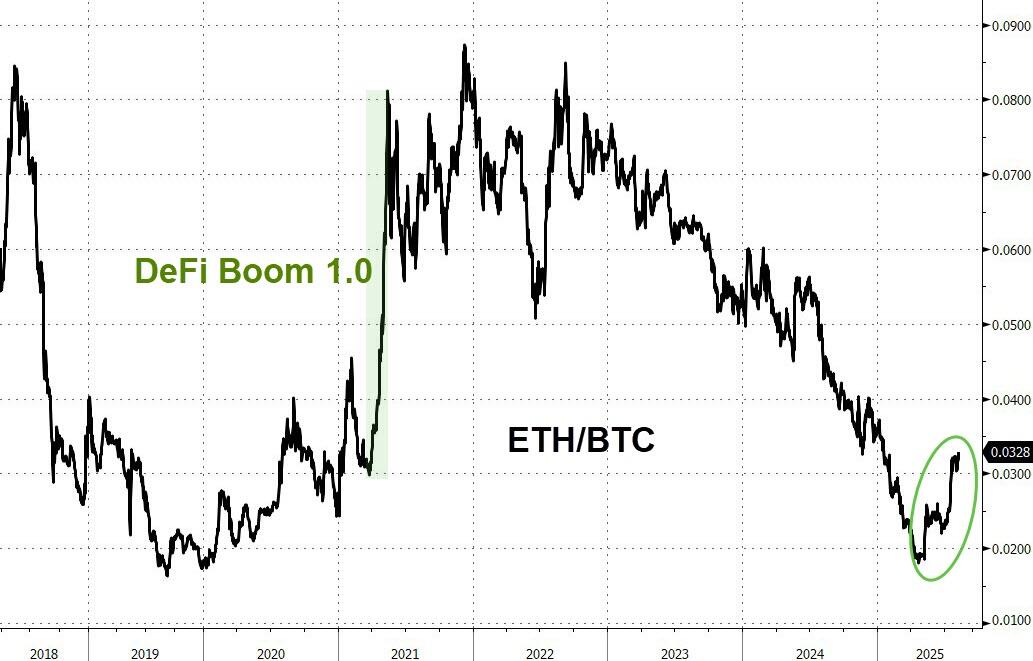
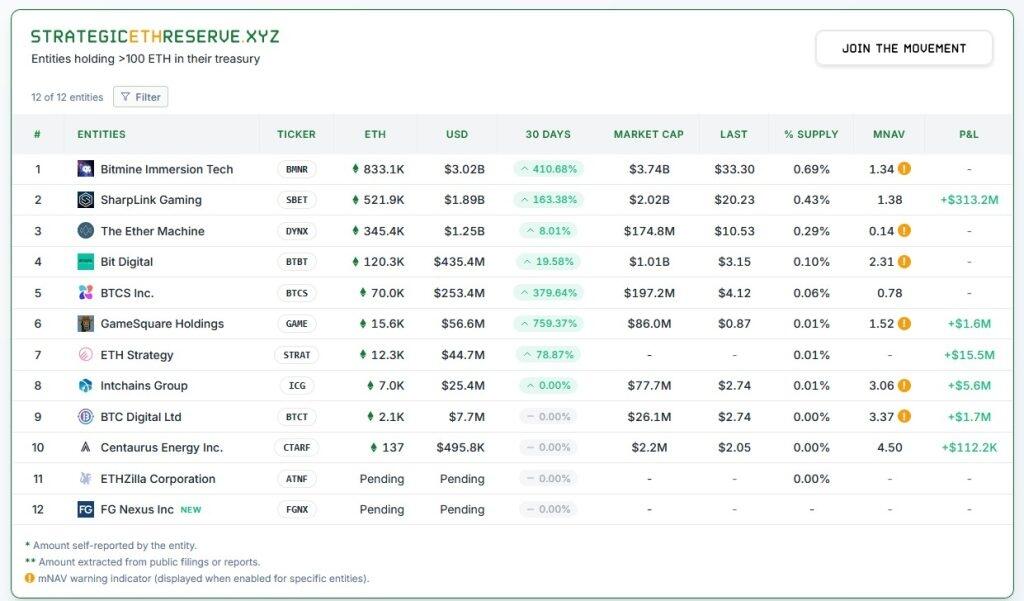
Since they emerged from stealth mode two months ago, a dozen Ethereum treasury companies have bought 2 million ETH between them, with Standard Chartered analysts estimating they’ll add another 10 million to that pile over time.

There’s growing excitement that billions worth of that ETH could flow into DeFi protocols as firms compete to chase yields greater than the 3%-5% on offer from staking and re-staking.

Etherealize’s Vivek Raman tells Magazine “healthy competition” between treasury companies for yield could light a fire under the DeFi sector before the end of the year.

"I’m actually pretty excited to see it. This could be the stimulus needed for DeFi Summer 2.0 — but on the institutional scale and bigger and better.”

GameSquare Holdings, BTCS, BitDigital, The Ether Machine and ETHZilla have all announced plans to juice ETH yields via DeFi, while Tom Lee’s BitMine Digital and Joe Lubin’s SharpLink Gaming are staking and restaking their ETH for now, while they refine their DeFi plans.
John Chard, vice president of operations for SharpLink, tells Magazine that he sees “selective DeFi participation as a natural next step beyond staking, leveraging Ethereum-native infrastructure not only to preserve value but also to grow it.”

“We also feel that, as more companies adopt ETH as a balance sheet asset, they will realize, sooner than later, DeFi isn’t just a curiosity — it’s a competitive edge,” he says.

This is how they make Ether. (The Ether Machine)

GameSquare targets up to 14% return from ETH in DeFi

GameSquare Holdings is a successful digital media, entertainment and technology business that’s currently sixth on the ETH treasury leaderboard. It’s partnered with Ryan Zurrer’s Swiss crypto investment firm, Dialetic, to help grow its ETH treasury 5x its current size to $250 million.

Rhydon Lee, from GameSquare’s advisory board, tells Magazine that the 3% return from staking ETH can be considered the risk-free rate of return — akin to buying treasuries in traditional finance. But GameSquare is setting its sights much higher.

"We’re targeting 8%-14% yield generation on just our Ether alone — whether it’s other theses within Ethereum, such as digital NFTs, Web3 gaming, prediction markets, digital identity, stablecoins.”

Unlike parking money in an ETH ETF, investing in some of the more aggressive Ether treasury firms is more like hiring a DeFi portfolio manager to try and grow your holdings. The more successful they are at doing so, the more attractive their stock becomes to investors.

Dialectic uses an algorithmic trading system called Medici that monitors the activity of successful yield farmers to find the best risk adjusted returns across different liquidity pools and protocols. It can automatically enter and exit hundreds of positions at a time. 

“There’s a whole team of devs that operates that for Dialectic that’s programmatically allocating to specific pools based on specific parameters or based on even things like watching smart money wallets and where they’re going into it.”

GameSquare even swapped equity for a CryptoPunk, which Lee believes can multiply returns, given blue chip NFT prices tend to go up in ETH, even as ETH goes up in USD terms.

“If we have 10 Ether, I hope we can have 11 Ether next year,” Lee says. “And based on the returns that Dialectics has had over the last four years, I think that’s achievable.”

ETH treasury companies are more than they seem

ETHZilla, which emerged on Ethereum’s 10th birthday with a $425-million raise, is pursuing a similar strategy. It partnered with DeFi asset manager Electric Capital on a “differentiated, onchain yield generation program” to generate between 3% and 10% annually.

Let’s just hope the flywheels don’t come off. (Charles Allen)

BTCS, meanwhile, is the oldest listed crypto company in the US, having gone public in 2014. It shifted from Bitcoin mining to Ethereum infrastructure in 2017-2018 and now runs validators, analytics and block building.

BTCS CEO Charlie Allen told “The Milk Road Show” podcast that running its own solo ETH validator nodes or via Rocket Pool provides “about a 40% increase on the earnings” it could make using third-party staking. It’s also employing some arcane strategies in DeFi that may seem risky to some.

Allen revealed the company recently deposited $100 million in ETH to Aave for its flywheel strategy. It borrows USDT against the ETH collateral and uses it to buy more ETH, which is then staked via “solo or Rocket Pool nodes to kind of maximize yield.”

Bit Digital’s “alphamaneuvers

Another former Bitcoin miner, Bit Digital operates a cloud infrastructure business for generative AI with $100 million in contracted revenue, as well as blockchain validator infrastructure and custody services.

CEO Sam Tabar said on “Bankless” that Bit Digital is already looking at “more alpha maneuvers” and intends to be “a little bit more aggressive on the risk curve to make sure that our yields are above average.”

He also committed to publishing Bit Digital’s monthly returns on its website.

“I would like to call out the other companies and see if they could show their yields… and see who is generating more yield for their ETH.”

Tabar believes that only a handful of top ETH treasury companies will survive over the long term, with valuations based on their ability to acquire more ETH.

Ethereum treasury of The Ether Machine

The Ether Machine takes its very name from its mission “to produce additional Ether,” says founder Andrew Keys, formerly of Consensys.

Its head of DeFi is Dairus Pryzdzial, a core contributor to the OG DeFi protocol Synthetix. 

At this stage, it’s not YOLOing into weird strategies in DeFi, preferring instead to stake and restake most of its ETH. Keys characterizes the firm’s “eventual” DeFi strategy as being “measured” and focused on “battle-tested blue chip DeFi protocols.”
This will be out of date by the time you read this. (Strategic ETH Reserve)

Risks and opportunities with staking and DeFi

However, brokerage firm Bernstein cautions that even just staking ETH to secure the network is more difficult to manage and riskier for treasury companies than simply holding Bitcoin. 

It can cause liquidity issues due to the uncertain length of the staking exit queue, and the further companies get into DeFi, the riskier things become.

“More complex yield optimization such as restaking (such as Eigenlayer restaking model) and DeFi-based yield generation would involve managing smart contract security risk,” Bernstein’s analysts noted.

As a result of the additional risks, Raman expects the majority of Ether raised will simply be staked.

“3% on $1 billion of treasury is $30 million a year,” he says. “So, I feel like they don’t have to take as much risk.”

But he believes that up to 30% could move into DeFi as firms compete to grow their Ether holdings per share.
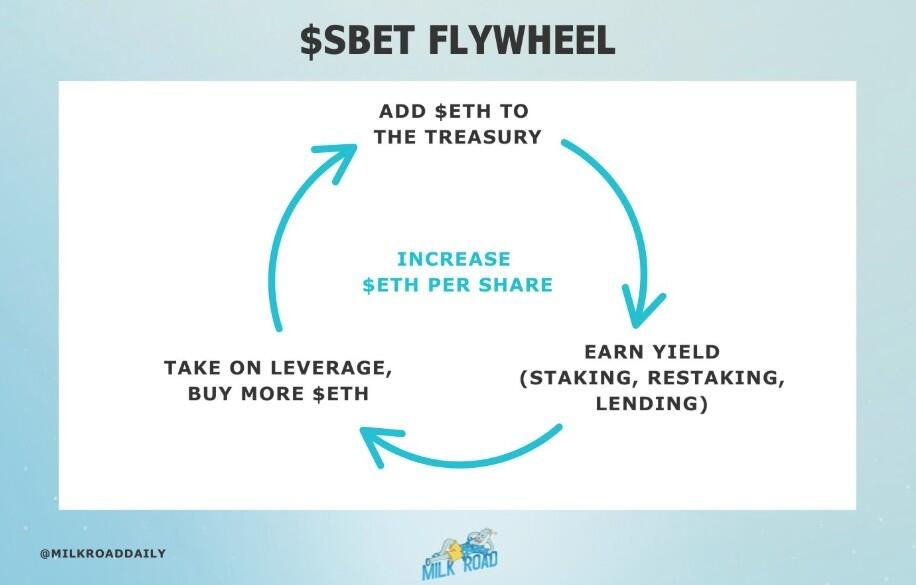
The leverage part is the risky bit of the flywheel. (MilkRoad)

The risk of ETH treasury companies blowing up chasing yield in Defi

Chasing higher yields in DeFi means taking on higher risks, says Lee.

“Higher rates of return maybe require more automation, more esoteric markets and a kind of better understanding. The more efficient a market is, maybe the less return that’s possible there,” he says.

But he says a well-run company with good DeFi risk management strategies wouldn’t allocate more than 0-30 bps of its assets to a single pool, mitigating the risk to the treasury company from a loan getting liquidated or a protocol getting hacked. In that case, he says:

"I would think that the likelihood of a blow up would, you know, hopefully be low.”

BTCS’s Allen anticipates there will “definitely be companies to go out of business” but plans to minimize the risks to his own firm by keeping the loan-to-value ratio below 40% and sticking to battle-tested platforms like Aave. 

“I don’t think we’re overleveraged, but we’re definitely leveraged,” he said.
Lee argues the bigger threat to listed treasury companies is raising significant amounts of money on the stock market as USD debt but having the firm’s crypto assets crashing in price below the value of the dollar denominated debt.

"So, if you have a mismatch, you know, dollar-crypto liability-asset, I mean, to me, that is the bigger scenario of a blow up then hopefully single-digit bps in liquidity pools.”

Will DeFi tokens pump as a result of ETH treasury companies?

To what extent all this new activity will help pump the prices of DeFi tokens is debatable. 

DeFi lending and borrowing giant Aave already has more than $50 billion in total value locked, which is greater than Standard Chartered’s prediction for the total amount of ETH that treasury companies will eventually amass.

If simply sticking extra billions into Aave pumped prices, Aave’s token wouldn’t be languishing at number 30.

But over and above the raw numbers, treasury companies will also play an important role in introducing Wall Street to the potential of DeFi.

SharpLink’s Chard says the ETH treasury companies will demonstrate in real time “that onchain finance can outperform legacy rails.”

“We’re talking about sustained, long-term liquidity from institutionally driven actors. If the first cycles of decentralized finance were driven by innovation and grassroots experimentation, this next evolution will be shaped by regulatory clarity, security frameworks and the integration of traditional financial infrastructure onchain,” he says.

“We believe treasury participation can anchor the next evolution of onchain growth, bringing legitimacy, volume and new forms of capital coordination.”

And as Keys points out, every quarterly report and earnings call for The Ether Machine will advertise DeFi to TradFi analysts.

“When we have quarterly guidance calls with the public markets, we’re going to be educating: ‘What is DeFi?’ And we’re going to explain ‘What is Aave?’ and ‘What is staking?’ and ‘What is restaking?’” he said. “Half of this is the ability to explain what Ethereum is, institutionally.”

Etherealize’s Raman says the institutional legitimacy bestowed on Ethereum will be priceless. 

“I think it’s legitimacy and by funneling more assets and just showcasing those use cases, it’s shown that these protocols are pretty battle-tested and resilient. They can have real volume and scale,” he says. “That’s going to be really powerful.”

"I’m sure all the DeFi tokens will start doing well as well.”

Goff Capital’s Lee also believes it could provide a nice price bump for DeFi protocols.

“I would think it would be positive for prices. But I think it has to be enduring activity.”

https://www.zerohedge.com/crypto/how-ethereum-treasury-companies-could-spark-defi-summer-20

'Israel To Take Control Of All Of Gaza, But Netanyahu Claims Not Forever'

 There have been reports all week which have said that Israel is now intent on conquering and occupying the whole of the Gaza Strip, and when asked about it Tuesday Presdient Trump responded, "It is going to be pretty much up to Israel."

In a fresh Thursday report, Axios writes that Trump "does not oppose Israeli Prime Minister Benjamin Netanyahu's plan to launch a new military operation to occupy the entire Gaza Strip, U.S. and Israeli officials say." There's been some nuance in Netanyahu's position, however, as he's sought to distance himself from claims that he's planning a permanent occupation by Israeli forces.

Source: Israeli army via Reuters

"We intend to," Netanyahu affirmed to Fox News when asked if he aims to take over the whole the strip. But then he said it would eventually be given over to a responsibly governing entitiy

"We don’t want to keep it. We want to have a security perimeter. We don’t want to govern itWe don’t want to be there as a governing body," he said.

Also, Netanyahu's office has told Axios, "We are not willing to remain in the current limbo and we are not willing to surrender to Hamas' demands — so essentially only one option is left, to take a drastic step. This is the last card we have left."

Critics and skeptics have said Israel has long been deceptive at many points about its war aims. The whole counter-Hamas operation was launched with limited goals initially articulated, centered on taking out Hamas leadership and gaining the liberation of all captives - but the scope of operations have clearly shifted and been extended.

Military leadership has taken a more cautious approach, warning that efforts to permanently control Gaza would be falling into a "trap" - as we reported earlier.

Kan News public broadcaster previously stated "The prime minister's direction is to go and conquer the Gaza Strip." 

The Israeli military's (IDF) chief of staff, Lt.-Gen. Eyal Zamir, has argued in a closed-door cabinet meeting that this "will significantly endanger their lives and cause the army to burn out." 

Aerial view showing utter destruction of the Gaza Strip...

The past year has seen Netanyahu clarify to political allies and opponets alike that he's opting for a military solution. Criticis have said he's putting the remaining hostages in danger.

As for what group might one day take over, it is entirely doubtul that any Palestinian body - such as the Palestinian Authority - will actually be allowed to step in and govern by Israel. This is indeed a recipe for permanent occupation and annexation. 

https://www.zerohedge.com/geopolitical/israel-take-control-all-gaza-netanyahu-claims-not-forever