Democrats and the media are doing everything they can to slow the momentum of President Donald Trump by attacking the “One Big, Beautiful” law’s Medicaid provisions.
While Democrats want to weaken Medicaid by giving taxpayer-funded benefits to illegal immigrants and allowing able-bodied adults who don’t work to game the system, Republicans actually strengthened Medicaid by passing the One Big, Beautiful Bill into law.
Last week, Senate Minority Leader Chuck Schumer, D-N.Y., came to the Senate floor to spread blatant lies about the Republican agenda. I immediately took to the Senate floor to set the record straight about how the Republicans’ “One Big, Beautiful” law strengthens Medicaid.
Here’s what I said:
I just heard the minority leader once again come to the United States Senate chamber and cry wolf. This time it’s about Medicaid reform.
Let’s be very clear: We need to strengthenMedicaid, and we did that in the bill that we just passed and was signed into law. But the minority leader once again puts fear above the facts.
He’s upset because Republicans are asking able-bodied adults to work if they want to receive taxpayer-funded health care benefits. He also is upset because Republicans think that illegal immigrants should not receive Medicaid benefits.
Let me set the record straight: Medicaid is for the vulnerable. It was never meant to cover able-bodied, working-age adults who refuse to work. Nor was it meant to cover illegal immigrants, which the Democrats continue to embrace.
Today, there are more than 1.2 million illegal immigrants receiving Medicaid benefits. Today, there are 4.8 million able-bodied, working-age adults who refuse to work who are on Medicaid. That doesn’t strengthen Medicaid. It strains it. It weakens it. It makes it harder for the people who need Medicaid, those who Medicaid was designed for.
It also wastes taxpayer dollars.
Work requirements are common sense. They used to be bipartisan. Democrat President Bill Clinton signed that into law in the 1990s. Democrat President Obama defended it in 2008. Obama said work must be the “centerpiece of any social policy.”
Democrats today don’t believe that. They think Clinton was wrong. They think Obama was wrong. They’re for laziness, and they’re for illegal immigrants. The Democrats today are defending dependency, rather than independence. That’s what they’re doing today. That’s what Schumer did on the floor of the United States Senate.
Republicans believe in a safety net—a safety net to help people reach their full potential, to get back up on their feet. We believe in hard work. We believe in work as part of somebody’s identity—their dignity, their self-worth, how they view themselves, a role model for their children.
If you’re healthy and refuse to work, it’s a choice you may want to make. But don’t expect the taxpayers to pay for it. No child, no pregnant woman, or disabled person will lose coverage. But what the Democrats want to do is remove work requirements and continue to fund Medicaid for illegal immigrants. That’s just not fair to everyone else.
I came to the floor to talk about a different topic. But listening to the minority leader, I couldn’t help but talk about just how far to the left the Democrats have gone. So, it’s no surprise that they are at their lowest level ever in the polls.
The front page of The Wall Street Journal this weekend: Democrats at an all-time low in the history of polling in terms of people who identify with the Democratic Party and reject the Democratic Party. Only 1 in 3 accept what the Democrats are preaching. Sixty-three percent of the American people do not identify with that at all.
That’s no surprise, given the Democrats’ goals, including raising taxes and continuing to recruit more illegal immigrants to this nation.
John Barrasso is a four-term Republican senator from Wyoming and Senate Majority Whip.
Throughout 2025, the science establishment has warned that the Trump administration poses a lethal threat to “American science expertise as we know it.” The alarums have been overwrought and misleading—until now. The administration’s 2026 budget request for the National Science Foundation does raise legitimate concerns about funding cuts. Yet in other respects, the reforms decried by Big Science have not gone far enough.
Congress created the National Science Foundation in 1950 to “promote the progress of science; to advance the national health, prosperity, and welfare; [and] to secure the national defense.” The foundation disburses up to $9 billion annually to support university researchers in physics, engineering, computing, biology, and chemistry. It boasts an unmatched record of seeding Nobel Prize–winning science.
Before the 2026 budget release, the foundation had already terminated more than 1,700 grants, totaling $1.4 billion. It hadcapped the amount of overheadthat it will henceforth pay universities at 15 percent of a research grant, though it was immediately blocked by the usual federal court injunction. (See “Racist—But Underfunded?,” Spring 2025.) The foundation had embraced a reorganization plan that consolidates divisions and demotes high-level bureaucrats to nonexecutive positions.
Trump opponents cried foul. “The American people deserve a scientific enterprise free from political interference,” California Democrat Zoe Lofgren, ranking member of the House Committee on Science, said in a press release. The termination of grants will lead to the “complete gutting of America’s scientific enterprise,” Sarah Spreitzer, vice president of government relations at the American Council on Education, told Inside Higher Ed. A Columbia University psychologist and NSF grant recipient asserted to the New York Times that the cuts will cede “American leadership in science and technology to China and to other countries.” Science wrote that the reorganization plan plunged an “already battered” NSF into “deeper turmoil.” The restructuring would leave the agency vulnerable to White House pressure to “fund research that suits its ideological bent,” unnamed sources told the magazine.
The claim that the Trump administration might push the NSF to fund research with an “ideological bent” was rich. The NSF has been supporting ideologically driven research for years, much of it through its Directorate for STEM Education. The directorate’s $1.15 billion budget in 2024—a full ninth of the foundation’s $9.2 billion budget and much higher than funding for biology, computer science, and engineering—is just a starting point for gauging how much the NSF spent on education projects. Other directorates, nominally focused on hard science, also distributed education grants.
The NSF’s education grant-making has been focused on racial victimhood. The education directorate plays a key role in boosting the NSF’s diversity metrics. Its program managers—who approve and oversee grants—are disproportionately minorities, especially minority women. Grant recipients also tend to be disproportionately minority. This imbalance may reflect the composition of the applicant pool for once, since America’s schools of education, the feeders for NSF education program managers and education awardees, are themselves disproportionately minority. This skew is even greater in STEM-related education specialties, and not just because those specialties are devoted to formulating racism-based explanations for the underrepresentation of minorities in STEM. These education fields serve as a safe harbor for STEM graduates who opt out of STEM careers, and this category, too, is disproportionately minority.
NSF grant recipient James Holly Jr. is a typical case. In 2023, Holly received nearly $600,000 from the NSF’s Division of Engineering Education and Centers—part of the Directorate for Engineering, illustrating how education-related spending extended beyond the NSF’s Directorate for Education. Holly earned an M.S. in mechanical engineering from Michigan State University in 2014 and then pivoted to education, completing a Ph.D. in engineering education at Purdue University in 2018. Whatever his strengths as a mechanical engineer, his command of antiracism discourse is impeccable.
The abstract of Holly’s NSF project, “Learning from Black Intellectualism: Broadening Epistemic Foundations in Engineering Education to Empower Black Students and Faculty,” deserves an extended excerpt, since it epitomizes what had been the NSF’s education portfolio:
The current discourse around the minimal presence of Black people in engineering is framed in terms of underrepresentation—the disparity between Black people’s demographic representation in the general populace and within the discipline. However, this narrative preserves Whiteness by passively neglecting the culture of racism in engineering. A discourse centered on who can be physically included without engaging the implications of power in knowledge production neglects the ways Black people are forced to give meaning to their experiences through the lens of Whiteness. Recent scholarship within engineering education suggests a need for (1) a modern, reparatory framework for helping engineering faculty and students understand political implications of engineering knowledge; and (2) an equity-focused resource to foster constructive evaluation of teaching. . . .
This CAREER project will 1) examine the effects of recasting engineering knowledge through the legacy of Black intellectualism, and 2) advance educational justice by countering the epistemic violence within engineering and its sense-making practices. The anticipated outcomes of this study will equip engineering faculty with tools for equitable instruction, and more importantly, enhance Black students’ sense of belonging by bridging the gap between their engineering learning and social reality. Fugitive pedagogy will be used to investigate engineering faculty epistemic norms and explore ways to reconstruct disciplinary knowledge through Black intellectualism. The project will implement a social design experimentation methodology to study how engineering education can be transformed toward epistemic equity. Epistemic equity is operationalized through the idea of re-politicizing—grappling with cultural and political implications of technical systems—engineering courses and curriculum. The overarching question guiding the research plan is: How can Black intellectualism be used to re-politicize engineering pedagogy? Engineering faculty will develop a schema (Phase 1), engage in revising a course based on the schema (Phase 2), and develop a teaching evaluation tool to assess the outcomes (Phase 3). Phases 2 and 3 will be repeated in an iterative cycle three times, centering faculty and student voice is the hallmark of the integrated research and education plans.
When Big Science proclaimed throughout spring 2025 that Trump’s budget cuts would devastate American scientific prowess, especially vis-à-vis China, “Learning from Black Intellectualism” was what the science establishment was referring to.
The following features of the Holly abstract were standard. It ignores blacks’ on average rock-bottom mathematical skills. It is this skills gap that causes black underrepresentation in engineering, not “Whiteness,” a “culture of racism,” or “epistemic violence.” (The number of black 12th-graders who are advanced in math nationwide is a statistical zero; 60 percent of black 12th-graders do not possess even basic 12th-grade math skills. The average black score on the math SAT in 2023 was 440 on an 800-point scale, compared with Asians’ average 629 math score.)
The abstract places all responsibility for increasing the representation of blacks in engineering on everyone and everything besides black students and their families. Engineering pedagogy must be “re-politicized” with “Black intellectualism.” Engineering education must be “transformed toward epistemic equity.” Not a word about cracking the books and completing problem sets.
Holly uses scientistic and hothouse rhetoric—“fugitive pedagogy,” “social design experimentation methodology,” “schema” and “phases” “repeated in an iterative cycle three times”—to create the illusion of exacting research protocols.
Multiply “Learning from Black Intellectualism” several hundredfold for a picture of the projects that the NSF had started to shed in the spring.
On April 18, the NSF announced that it would no longer fund projects that “give preference to some groups [based on] protected class or characteristics”—in other words, based on race and sex. On May 9, the NSF announced that it was disbanding its most concentrated source of racially ideological grant-making: the Division of Equity for Excellence in STEM, housed within the Directorate for STEM Education. By May 21, it had cut off funding for 1,752 grants in progress, including Holly’s. Naturally, the press played the race card, noting that the cuts “reduced the diversity of NSF’s pool of funded scientists,” as Science put it. Blacks suffered the heaviest blow, according to Science, with a cancellation rate four times higher than their representation among total NSF grantees. Such a disparity is hardly surprising, given that racism-themed grants serve as a vehicle for increasing black representation among NSF awardees.
Getting rid of the Division of Equity for Excellence in STEM was a good start, but the education directorate contains three other divisions as well: Graduate Education, Research on Learning in Formal and Informal Settings, and Undergraduate Education. All should be eliminated.
Like the Division of Equity for Excellence, those three additional divisions are mere extensions of education schools, whose effect on the transmission of knowledge has been disastrous. The main purpose of graduate schools of education is to obscure a basic truth: student learning results from self-discipline, demanding coursework, and unbending expectations from teachers who are masters of content. Education schools conceal that truth with vast clouds of verbal squid ink. Dip randomly into the remaining portfolio of the Directorate for STEM Education, and you come up with grant solicitations such as the following:
The first goal of this funding opportunity is to encourage the scientific study of theories, frameworks, and models for the translation and diffusion of knowledge, especially between fields and across contexts and levels-of-analysis (e.g., biological to cognitive/socioemotional to behavioral; individual to classroom to broader demographic variables; lab to classroom to school to district). . . . Proposals may also address the leveraging of effective classroom practices toward the enrichment of foundational research, constructs and models. We note that bi-directional movement across boundaries is a mutually beneficial reciprocal process. . . . The outcome of such a project would lay the methodological, theoretical, empirical, design, or social foundation for conducting systematic work at the next stage of development or at the next level of analysis.
The NSF has no business funding such vapidity; it contributes nothing to our knowledge of nature’s laws. The whole education directorate should go.
The NSF’s Directorate for Social, Behavioral, and Economic Sciences is another source of grant-making premised on academic leftism. Consider the aforementioned Columbia University psychologist who lamented that the U.S. is ceding scientific ground to China. His terminated grant—from the Division of Behavioral and Cognitive Sciences within the Directorate for Social, Behavioral, and Economic Sciences—focused on how “social inequities such as gender and racial disparities” are shaped by facial stereotypes and other “learned stereotypes” about race and gender. It’s doubtful that China is directing its science funding toward combating race and gender stereotyping. Rerouting U.S. taxpayer dollars away from such studies would strengthen—not hinder—our ability to compete scientifically with China.
The NSF disburses up to $9 billion annually to support university researchers in physics, engineering, computing, biology, chemistry—and, until recently, racial victimology. (JHVE Photo/Alamy Stock Photo)
Such was the state of play before the FY 2026 funding request: the science establishment was crying bloody murder because the NSF had begun lopping off some of its most egregiously politicized grants. The establishment portrayed those grants as key to future scientific progress, relying on the public’s ignorance about their content and the press’s unwillingness to reveal it.
Enter the 2026 budget, released on May 30, 2025. Funding for research and related activities has been cut 61 percent, or $5 billion. The NSF’s total budget has been cut 55 percent, or $5.12 billion. Sadly, the education and social-sciences directorates survived the budget ax, even if they now exist in a much diminished state. The education directorate went from a $1.15 billion allocation in 2024 to $288 million in 2026, a 75 percent drop. The Directorate of Social, Behavioral, and Economic Sciences went from a $290 million allocation in 2024 to $94 million in 2026, a 67 percent drop. The biggest surprise is that the Division of Equity for Excellence in STEM within the education directorate has been exhumed, presumably in response to yet another federal court order, this time out of San Francisco, blocking the Trump administration from laying off any government employees. True, the division’s budget has been cut nearly 80 percent—from $214 million in 2024 to $43 million in 2026—but that $43 million can do a lot of mischief.
Most bracingly, the 2026 budget zeros out nearly the entirety of a category of grants known as “Broadening Participation.” These grants represented the culmination of Congress’s decades-long mania for imposing nonscientific goals on the foundation. In 1980, the Science and Technology Equal Opportunities Act, sponsored by Senator Edward Kennedy, established that it was U.S. policy to ensure that “women and minorities have equal opportunity in science and technical fields.” In 2010, Congress forbade the NSF from evaluating grants solely on scientific merit. Instead, according to the America COMPETES Reauthorization Act, scientists would have to justify their research according to its “broader impacts.” Any notion that the NSF would focus exclusively on basic science became a relic of a distant age. Insufficiently rousing “broader impacts” statements have torpedoed otherwise vital scientific proposals.
The broader-impacts mandate gave rise to the Broadening Participation portfolio. Most of NSF’s Broadening Participation portfolio consists of the predictable racial and gender equity grants. They are gone, with these exceptions: grants to faculty and undergraduates at HBCUs (Historically Black Colleges and Universities) and to tribal colleges. Those categories are required by statute.
But the Broadening Participation portfolio contains another type of grant—those designed to spread science funding around on the basis of geography. These so-called EPSCoR (Established Program to Stimulate Competitive Research) grants are dearly beloved of Congress, for they allow representatives to brag of bringing the science bacon home, regardless of whether their district’s colleges are likely to make breakthrough discoveries.
EPSCoR grants came out relatively unscathed, compared with identity-based Broadening Participation grants. But anti-meritocratic diversity policies are no more acceptable when diversity is defined by geography than when it is defined by race and sex.
While the cuts to the education and social-science directorates were too timid, cuts to the hard-science directorates were arguably too sweeping: biological sciences is down 71.5 percent; mathematical and physical sciences, which includes chemistry, physics, and astronomy, is down 67 percent; engineering is down 75 percent, and computer and information science and engineering is down 65 percent. Some major projects have been eliminated entirely. The NSF will stop funding Hawaii’s Thirty Meter Telescope, in favor of the Giant Magellan Telescope, planned for Chile. An astrophysicist (and Trump supporter) laments: “We would appear to be handing over a century of world leadership in astronomy back to our European competitors. At least for a generation or two.”
Part of the science reductions can be explained by the NSF’s intention to cap its reimbursements for the indirect costs of research (if the courts allow it to do so). Another part can be attributed to the administration’s overzealous animosity toward climate and clean energy research, though the budget does not spell out the extent of those climate and energy cuts. It is also true that “equity” and its offshoot, “sustainability,” have infiltrated the hard sciences. A 2022 White House report recommended that scientific research focus on “research questions, samples, and settings that reflect the diversity of the U.S. population.” A lawsuit filed on May 28 by 16 state attorneys general against the NSF’s DEI cuts provides an example of such research: a project to integrate the “knowledge” of “Indigenous communities” into the science of protecting the Great Lakes ecosystem. It’s hard to believe that such silly grants make up the bulk of the hard-science portfolios, however, even after the Biden administration’s diversity push.
Two additional things may be going on: a determination to cut as an end in itself; and a preference for the latest applied technology over basic discovery research.
The government cannot fund everything, obviously, and there is no reason to think that previous levels of funding represented a Platonic ideal. The Trump administration’s science advisor, Michael Kratsios, claimed in May that federal science funding is seeing diminishing returns. Money spent does not correlate with scientific impact, Kratsios said. But cuts on the order of 70 percent to core fields, even taking into account indirect cost caps and climate-related cuts, risk X-ing out breakthrough findings.
The May 30 budget request reads like a prospectus for a tech startup. Its “prioritized” activities are artificial intelligence, quantum information science, and the Directorate for Technology, Innovation, and Partnerships, the last akin to a tech incubator for small businesses. These “investments” have not been cut, explains the budget proposal, because they “complement private-sector R&D and offer strong potential to drive economic growth and strengthen U.S. technological leadership.” Other favored areas are advanced manufacturing, microelectronics and semiconductors, and advanced wireless, presumably because they, too, help “harness the full power of American innovation by empowering entrepreneurs and unleashing private-sector creativity.”
But however much Congress itself has been imposing “broader impacts” mandates on the NSF, it would be as much of a mistake to reorient the agency toward research perceived to be economically useful as it was for the agency to adopt social-justice goals. The private sector is already moving full-speed ahead on high-tech research and applications. It has less incentive to fund curiosity-driven research into the laws of the universe. There is no such thing as too much knowledge, as long as it is pursued through objective means, free from political assumptions and open to falsification.
The administration could fight more worthwhile battles. It should persuade congressional Republicans to provide the White House with an unambiguous charter for its reform efforts. Congress should strip all identity-politics language from NSF budgetary authorizations and reject the notion that researchers must justify their work on nonscientific “broader impacts” grounds. As long as that “broader impacts” and “broadening participation” language remains in the statutes, lawsuits like the one filed by the 16 state attorneys general are likely to succeed.
Congress should also extricate the NSF from all teacher training and education research. While the foundation’s original charter did establish a Division of Scientific Personnel and Education, the “education” in question referred to graduate-level study. According to the 1950 charter, the division’s role was to oversee programs “relating to the granting of scholarships and graduate fellowships,” with selections made “solely on the basis of ability.” The original drafters could hardly have imagined the assault on meritocracy that would follow.
The Trump administration should launch a campaign to treat scientists like adults again. It should invite nominations for the most burdensome or insulting bureaucratic requirements and restore discretion to project managers and researchers. University of Southern California chemistry professor Anna Krylov provided a harrowing description in April of the clerical demands associated with a simple single-researcher project. Only 15 pages of Krylov’s 64-page proposal related to her project—computer-modeling the interaction of molecules with X-rays—and even those 15 ostensibly science-based pages included the usual broader-impacts section. The proposal also included a mentoring plan, a list of Krylov’s “synergistic activities”—such as editorial work or conference organizing—a data-management plan, and a conflict-of-interest spreadsheet listing collaborators and former associates. Preparing the proposal took the assistance of three USC administrators over many days.
The White House has started a long-overdue shake-up in Big Science and Big Academia. While it might have proceeded more surgically, it will now need to be better armed against the end-of-times prophesying arising from those intertwined establishments. It should make the case that federal science funding should not go to social or economic impact, “equity,” or any particular worldview, but only to the unleashing of human genius in its confrontation with natural mystery.
Gilead Sciences (NASDAQ:GILD) shares ticked up after the company raised full year sales and profit outlook, helped by growing demand for its HIV products.
The California based biotech raised its full year adjusted profit to a range between $7.95 per share and $8.25 per share from a previous range between $7.70 per share and $8.10 per share. Consensus for the year by analysts is of $8 per share.
\It also lifted its 2025 net product sales outlook to the range between $28.30B and $28.70B, above the prior range between $28.20B and $28.60B versus consensus of 28.73B.
The company reported Q2 revenue of $7.08B, beating consensus of 6.96B. It recorded adjusted profit of $2.01 per share, above analysts' estimate of $1.96 per share.
"Our strong growth this quarter was driven by Biktarvy, Descovy, Trodelvy and Livdelzi, reflecting the diversity of our portfolio," CEO Daniel O’Day stated.
Gilead's HIV product sales rose 7% to $5.1B in Q2, compared to the same period in 2024.
They knew it could spark a geopolitical catastrophe. They did it anyway.
Let’s dispense with illusions: Vladimir Putin is not misunderstood. He is an autocrat. He lies, he invades, he suppresses dissent, and he trades ruthlessly in realpolitik. His regime has poisoned opponents, jailed journalists, and bombed civilians.
He has aligned himself—out of both strategy and necessity—with the Chinese Communist Party, America’s chief geopolitical adversary.
In short, he needs no fabrication to appear villainous—his record speaks for itself.
But that’s what he got. According to the recently declassified Durham annex, senior U.S. officials weren’t content to let Putin’s record stand on its own.
They sought to amplify it—to demonize him alongside Donald Trump and turn the Russian president into a political cudgel. The aim was to hang Putin like a leaden albatross around Trump’s neck as part of a broader strategy to bring Trump down.
This was a multi-pronged operation—inside and outside the government—with a domestic objective at its core: to destroy Trump before he could win or govern, by laundering a phony narrative through the Steele dossier and fabricated claims of collusion.
And by their own words, Putin was in the crosshairs too.
Which raises significant questions: What exactly were they trying to provoke? Were they attempting to drive U.S.-Russia relations into permanent hostility? A new Cold War—while risking a “hot” one?
To goad a nuclear adversary into miscalculation? Or were U.S.-Russia relations simply collateral damage—acceptable fallout in a calculated effort to legitimize a manufactured Trump-Putin narrative and politically cripple their chosen target?
Perhaps there was a hierarchy of objectives, undoubtedly with Trump’s destruction at the top. But the targeting of Putin was not incidental. It was deliberate, and it cannot be dismissed.
The Durham annex makes that crystal clear.
One of the most revealing suspected emails cited in the declassified Durham annex didn’t come from an intelligence officer.
It came from Leonard Bernardo, a top official at George Soros’s Open Society Foundations, reacting to internal Clinton-camp discussions about how to frame the Russia narrative.
Julie says it will be a long-term affair to demonize Putin and Trump. Now it is good for a post-convention bounce. Later the FBI will put more oil into the fire... Anyway, things are ghastly for US-Russian relations. —Leonard Bernardo, July 25, 2016 email (Durham Annex, pp. 9-10) [emphasis added].
The annex itself notes that “Julie” appears to refer to Julianne Smith, a foreign policy advisor to Hillary Clinton’s 2016 campaign.
At the time, Smith was Director of the Transatlantic Security Program at the Center for a New American Security, where she served from 2014 to 2018. She later served as President Biden’s Ambassador to NATO from 2021 to 2024.
Let that sink in. As early as July 2016, a Soros-linked operative was acknowledging—privately—that the Clinton operation would weaponize intelligence, politicize federal law enforcement, and court geopolitical blowback—all to score a fleeting post-convention bounce, while openly admitting it was just the start of a long-term political operation.
And they knew the “ghastly” consequences it could have for U.S.-Russia relations.
The Durham annex notes that certain analysts and officers interviewed by the Special Counsel’s office assessed the Bernardo email—and others—as “likely authentic.”
While Bernardo later denied some details, he reportedly acknowledged that describing U.S.-Russia relations as 'ghastly' was something he might say.
To grasp the recklessness of this operation, consider what Russia brings to the table:
A rapidly advancing arsenal of hypersonic missiles—including the Avangard, Kh-47M2 Kinzhal, and RS-28 Sarmat (NATO codename: Satan II)—engineered to bypass U.S. missile defenses and strike with near-unstoppable speed.
A fully modernized nuclear triad, comprising ICBMs, submarine-launched ballistic missiles, and long-range strategic bombers.
A cyberwarfare force that has already disrupted NATO allies, global financial systems, and critical infrastructure.
Russia is not a country one antagonizes casually—least of all by fabricating evidence that its leader colluded with a U.S. presidential candidate.
Yet that’s precisely what Clinton allies—with Barack Obama’s tacit blessing—did.
And the Kremlin was watching. Russia had the memos. Given the timing and the content, it's reasonable to assume they had real-time or near real-time visibility into the fraud America’s political class was unleashing—not just on its citizens, but on the world.
So while American voters were being told that Donald Trump was a Russian asset, the actual Russians were watching U.S. officials knowingly promote disinformation about them.
They watched a sitting American president allow his agencies to be turned into political weapons against Trump.
And they realized something breathtaking: America’s political class was more corrupt—and more unstable—than they had imagined.
This was an elite political operation that weaponized the intelligence community, torched its credibility, and shredded America’s vaunted republican ideals and constitutional norms in the most Machiavellian way imaginable.
The very institutions entrusted to defend liberty and safeguard peace were commandeered for one purpose: raw political power.
It wasn’t the Kremlin destabilizing American democracy. It was the political leadership at Langley. Foggy Bottom. McLean. And 1600 Pennsylvania Avenue.
They injected deliberate disinformation into America’s political bloodstream. They turned national security into a domestic weapon. And they did it knowing the global consequences could be catastrophic.
Russia didn’t need kompromat on Trump. They had something far more damning: evidence that America’s ruling elite would jeopardize international stability to cling to power.
That is the real revelation of the Durham annex. Not just that Hillary Clinton greenlit the smear. Not just that Obama knew. Not just that the FBI and CIA leadership ran with it.
Those were long-held suspicions—now confirmed and surpassed by the disclosures themselves.
What’s new is this: They knew the risks were existential—and they did it anyway.
Because in their calculus, none of it mattered—so long as Trump lost or was destroyed.
On the extreme end of possible outcomes, they risked World War III. Yes—nuclear war. Armageddon.
And the irony is almost too rich to process: It was Democrats who warned—loudly and wrongly—that Trump’s election might lead to global war.
And yet it was they who risked exactly that, in their desperate effort to stop him from winning.
They knew the stakes. They knew the risks. They knew the consequences.
They likely assumed the Russian government knew—or would soon find out. And it did.
After all, Moscow had the memos—and its intelligence services were more than capable of tracing the fingerprints of the Clinton-Obama-Soros operation straight back to Washington.
This wasn’t just reckless. It was peril unhinged—a devil-may-care plunge into geopolitical chaos, so long as they achieved their ends.
Simply put, it is hypocrisy, corruption, and treachery on a scale that should disqualify them from public office—and tarnish their legacy.
Forever.
Charlton Allen is an attorney and former chief executive officer and chief judicial officer of the North Carolina Industrial Commission. He is founder of the Madison Center for Law & Liberty, Inc., editor of The American Salient, and host of the Modern Federalist podcast. For media inquiries or speaking engagements, please click here. X: @CharltonAllenNC
I have been getting just enough email about “birthright citizenship” to suggest that there are some key misunderstandings about the concept and the implications of the Fourteenth Amendment to make one more exploration of the idea worthwhile. So as your resident “splainer,” I’ll try to ‘splain it for you.
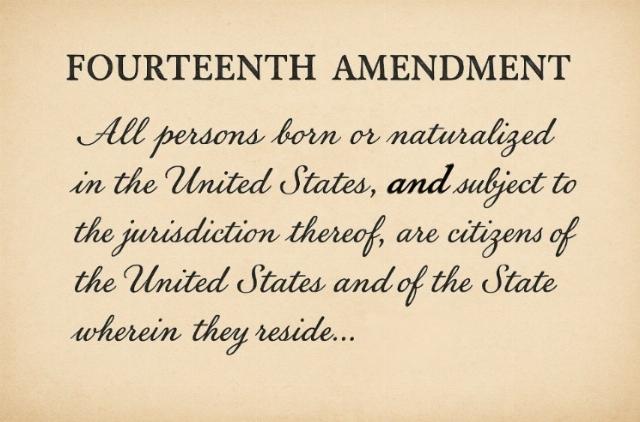
The Fourteenth Amendment was adopted on July 9, 1868. It was the final product of a process that Illinois Senator Lyman Trumbull began in 1866. His Civil Rights Act of 1866 stated that “all persons born in the United States and not subject to any foreign power…are hereby declared citizens of the United States…”
President Andrew Johnson didn’t like the bill, so he vetoed it, but Congress overrode his veto. The Fourteenth Amendment changed the language very slightly to “born or naturalized in the United States and subject to the jurisdiction thereof,” but it kept that all-important conjunction, which I’ve highlighted.
Image created using AI.
That three-letter word means that there are two (another three-letter word) conditions that have to be met. They aren’t the same thing. That three-letter conjunction is the source of all the legal arguments. So that you can clearly understand it, let’s look at a unanimous Second Amendment decision called Caetano v. Massachusetts.
The Caetano case dealt with a lady who protected herself from an abusive boyfriend by acquiring a stun gun (similar to a Taser). The Supreme Court ruled that for Massachusetts to ban her stun gun, it had to be both dangerous and unusual. There’s that little three-letter “and” word again.
The state could ban it only if both conditions were met. Matching one wasn’t enough. If it was unusual but not dangerous, sorry, Charlie. Do not pass Go, do not collect $200. Your statute goes directly to Second Amendment jail.
As things turned out, because the stun gun was not unusual, the Supreme Court said they didn’t even need to ask if it was dangerous. It failed the “unusual” leg, so it didn’t matter if it was dangerous. There was no way it could be both if it flunked one of the tests.
Let’s look at Senator Trumbull’s work again. He wasn’t satisfied with just getting his Civil Rights Act passed. He also pushed the Fourteenth Amendment through the committee and finally to the full Senate on June 13, 1866. This was a key part of his legacy, and you may be dead certain that he wasn’t about to contradict himself.
So, when the final draft of the Amendment said that persons “born in the United States and subject to the jurisdiction thereof” were citizens, it meant exactly the same thing as “born here and not subject to any foreign power.” In fact, Senator Trumbull did the ‘splainin’ for me. His exact words were that the phrase meant “subject to the complete jurisdiction thereof” and “not owing allegiance to anybody else.”
The Founders were explicit in rejecting the idea that simply being born somewhere makes you a subject of that country. That key change was part of our great American experiment.
Being born in London used to mean that you were an English subject. But Americans weren’t going to tolerate being subjects anymore. They would forever after be citizens, with all the self-governing rights that status implied. And this is where modern Americans lose the plot. We simply don’t have the lived experience to automatically understand what was being said.
A lot of legal “experts” incorrectly assume that “subject to the jurisdiction” means that if you commit a crime, you can be punished for it. They push this error to eliminate those troublesome three letters by making the two separate and distinct qualifications into a single one. They don’t want to admit that there is a specific meaning for “and.” So they blindly push the idea that a baby’s first breath in the US makes it a citizen, even though the Founders and the authors of the Fourteenth Amendment explicitly rejected that concept.
At the same time, the Founders were willing to prosecute non-citizens. William Duane was one such defendant, although he avoided conviction. Pirates were also non-citizen defendants. And non-citizen immigrants were often prosecuted for minor crimes. Being “subject to prosecution” wasn’t the same as “subject to the jurisdiction” then, and it isn’t now. “Subject to the jurisdiction of a foreign power” means that you are a “subject of that foreign power” and owe your allegiance to that foreign country, not to the US of A.
Grammar is central to legal interpretation. Those three little letters mean that, just as with Caetano, the two specified items are different. Being in the US makes you subject to prosecution. If you smuggle cocaine across the border, your status as a Mexican citizen will be no help. The US legal system will determine your fate. As for birthright citizenship, the issue is different.
If you’re born here, you’re born here. That’s easy. But if your parents aren’t legally in the US, are you subject to the jurisdiction of the US? Most emphatically, no! You don’t owe any loyalty to the US, and that’s what the term means. Let me put that in words that even those in Rio Linda will understand.
If you’re a Mexican citizen, you owe your allegiance to Mexico. It doesn’t matter whether you are traveling to Australia, Russia, or the US. Your allegiance is to Mexico. You are “subject to the jurisdiction of” Mexico.
And if your baby is born in any of those places, it’s still a Mexican citizen because you are a Mexican citizen. This is the principle of jus sanguinus, “right of blood.” Another country may also choose to grant you citizenship, much as Ted Cruz received dual US/Canada citizenship by being born in Toronto with US parents. But the US, whether by law or Constitution, has not made that grant.
Before you throw those rotten vegetables, recall that I discussed the Supreme Court’s decision in Wong Kim Ark, showing that it does not settle the argument. Rather, Wong Kim Ark was a citizen because his parents had established a domicile—something no illegal alien can do—by creating a lawful permanent residence, business, and so on. Since the immigration laws were different then, he became a citizen by being born to lawful permanent residents.
The key issue in the argument is simple. Those three letters, A-N-D, mean that “subject to the jurisdiction” is not the same thing as “born here.” When the Supreme Court reviews the issue, if it looks at the origin of the Fourteenth Amendment and the discussions by its drafters, birthright citizenship will disappear.
Case closed.
Ted Noel is a retired physician who posts on social media as Doctor Ted. His occasional Doctor Ted’s Prescription podcast is available on multiple podcast channels.
In the annals of ideas whose time has come, it would be hard to find a better one right here, with President Trump tweeting about holding a new census in the wee hours of the morning.
He's right, and for a lot of reasons. Why should people who don't belong here be counted in the Census? They could be thrown out of the country tomorrow, which would negate the whole point of the Census.
President Trump said on Thursday that he had ordered the Commerce Department to begin work on a new census that excludes undocumented immigrants.
A new census would be a significant departure for a process stipulated by the Constitution to occur every 10 years. Historically, the census has counted all U.S. residents regardless of their immigration status, a process that helps determine both the allotment of congressional seats and billions of dollars in federal money sent to states.
“People who are in our Country illegally WILL NOT BE COUNTED IN THE CENSUS,” Mr. Trump wrote in a post on social media.
The push comes as Mr. Trump and his allies press Republican-led states to redraw their congressional maps to benefit the party. Congressional maps are redrawn after the census is completed based on the new data. The next census is scheduled for 2030.
Which is kind of a cynical take, basically calling it a power grab involving redistricting.
Where have they been in the last four years after Joe Biden's open borders let into the country tens of millions of unauthorized foreign nationals?
That was where the cynicism was -- Biden let in tens of millions to pad congressional districts and seats in Democrats' favor. One congressional district and seat amounts to about 700,000 people. Let in ten million illegals and that's at least seven extra seats for Democrats, whose dwindling numbers in these illegal-heavy districts (known as 'dead' districts with very low voter turnout) end up electing radical leftists who'd never be electable otherwise.
That's a political game, a political project. Import millions of people who can't vote but who can be counted in the Census to create congressional districts, and Democrat operatives can take it from there. They don't need illegal alien voters for the most part, they just need warm bodies clustered in particular districts to give them the congressional seats they want. Who cares if only 10% of a congressional district votes because so many of the legal residents have fled blue-state high taxes, only to be replaced by non-voting illegals? Hain't they got the power?
It's such a cynical, abusive use of America's representative democracy, and for that matter, foreign nationals falsely invited in for political purposes, it would boggle the minds of the Founding Fathers who set up the Census and congressional districting system as it is. Yet it's the baseline for all Democrat power grabs, the foundational rigging.
Could the Founders have imagined one party importing tens of millions of foreigners illegally into the country in order to preserve and create congressional seats from them? I don't think they imagined any scheme so dishonorable. It's rigging so nakedly antidemocratic, it boggles the mind; power for its own sake to disenfranchise the citizens. And President Trump has their number.
Yet here the New York Times claims the Republicans are doing it to serve themselves and avoid congressional investigations should Democrats retake the House, as if nothing the Democrats did were particularly noteworthy and in severe need of a course correction.
I have no idea whether the Commerce Department will be able to get the new Census done before 2030, or court challenges by leftists will stop the process. We know there will be some from parties interested in blurring the lines between citizens and noncitizens for the sake of preserving their political power.
But I hope it works. Trump has diagnosed the Democrat power game correctly and moved to restore balance to the American people. With confidence in elections at an all-time low and several blue states operating as one-party states, it may be the antidote to these negative trends that destroy faith in our country