Search This Blog

Sunday, September 7, 2025

Md. To Deploy More Law Enforcement To Crime-Ridden Baltimore After Trump Threat

 Maryland Governor Wes Moore and Baltimore City Mayor Brandon Scott, both leaning left on the political spectrum, announced late last week that additional law enforcement resources will be deployed to support the crumbling Baltimore City Police force, which is suffering from a dangerous officer shortage after years of disastrous criminal justice reforms, including "defund the police" initiatives and other progressive programs that have backfired.

At a joint press conference on Friday, Mayor Scott declared, "We do not need an occupation. We do not need troops on our streets," adding, "We can do this ourselves." 

The state plans to deploy Maryland State Police and Transportation Authority officers into high-risk "no-go" zones controlled by violent gangs that have been allowed to flourish under City Hall's progressive regime, leaving the city plagued by violent crime, which only sparked a population exodus. 

What's alarming is that Gov. Moore and Mayor Scott only moved to bolster the city's police force after President Trump's recent threat to deploy federal law enforcement to restore law and order. 

Years of violent crime chaos, but no action? Why is that? 

"Chicago is a hellhole right now, Baltimore is a hellhole right now," Trump said earlier this month, adding, "I have an obligation .... this is a political thing."

Mayor Scott stated, "This announcement is about using government resources in a targeted, evidence-based way, in order to make our neighborhoods safer. We are grateful that Governor Moore has chosen to reinstate this partnership after it was eliminated by the previous administration. This is the kind of support we need for our violence intervention work, which has brought crime to record lows across the board. It takes all of us—state, city, and federal law enforcement, including the ATF, FBI, and DEA, community violence interrupters, and residents—to build on this progress and create the safer, healthier Baltimore we know is possible."

The confusing part is why far-left politicians running the state and city into the ground didn't act before Trump. Why did it take a strong leader in the White House to force state and city officials to respond finally? Shouldn't these local leaders be serving the people of Baltimore and prioritizing their well-being?

Yet the optics certaintly show that Moore might serve someone else besides Marylanders.

Sigh Moore... 

And Mayor Scott.

The chart Democrats in the state don't want the nation to see...
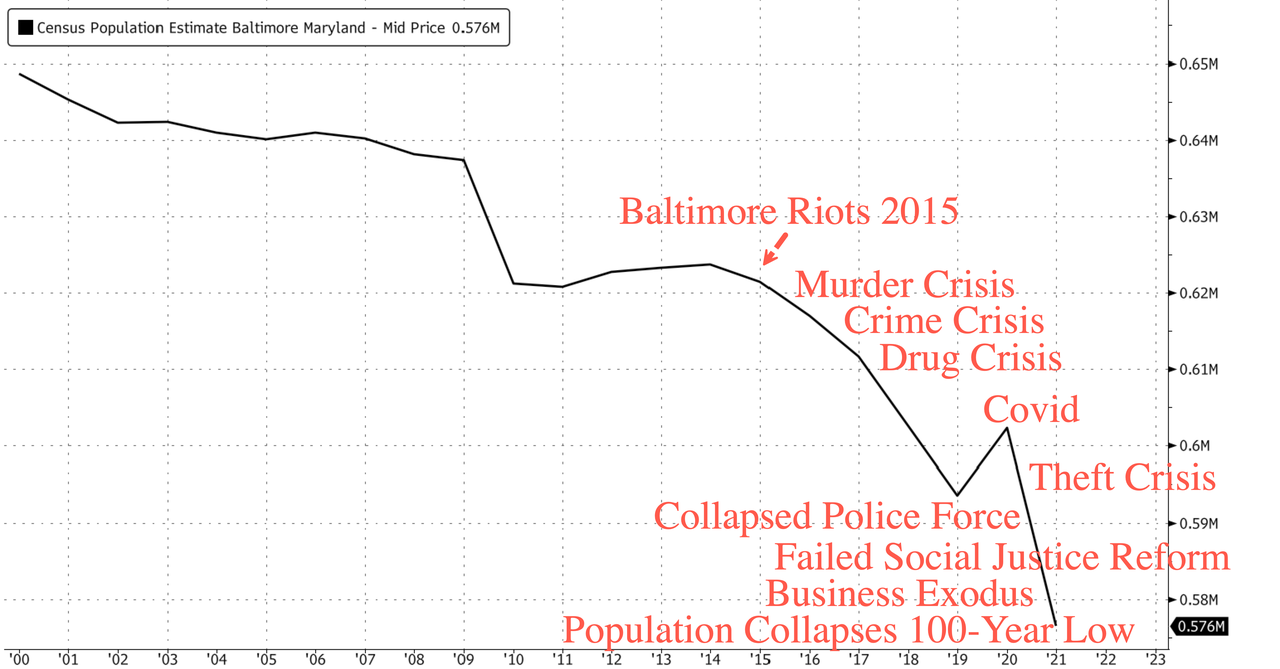
Baltimore is a crime-ridden hellhole. Everyone knows it. Democrats own it, yet there's been zero accountability for years of failed criminal and social justice reforms that plunged the city into an era of violent crime and death.

Another massive failure is the school system, which enriches leftist unions that, in turn, fuel the Democratic Party's machine while robbing youngsters of any chance at future success. Democrats preach diversity, yet once they seized power, they shun anyone with an opposing political view.

https://www.zerohedge.com/political/maryland-scrambles-deploy-more-law-enforcement-crime-ridden-baltimore-after-trump-threat

'Major report that tied moderate drinking to disease won’t be released, researchers say'

 A key government study about alcohol and its health harms will not be released publicly, despite several years of taxpayer-funded work and a growing body of evidence connecting drinking with disease. 

A final version of the Alcohol Intake and Health Study led by the Substance Abuse and Mental Health Services Administration will not be published, “to the detriment of the people’s health,” scientific review panelist Priscilla Martinez told STAT in an email Thursday morning. Another panel member confirmed that they have not heard from the Trump administration since submitting their work months ago.

https://www.statnews.com/2025/09/04/federal-alcohol-health-study-not-released-dietary-guidelines/

Daiichi-Merck’s advanced lung cancer ADC sees 48% response rate in registrational trial

 Partners Daiichi Sankyo and Merck & Co. are sharing new phase 2 data for their investigational antibody-drug conjugate, findings the partners think will help score accelerated approval in pretreated small cell lung cancer (SCLC).

“The important take-home message is that this is our registrational trial for the first approval of the drug I-DXd,” Daiichi’s R&D head Ken Takeshita, M.D., told Fierce Biotech Friday.

The primary analysis reveals an objective response rate (ORR) of 48.2% among 137 patients receiving 12 mg/kg of I-DXd, also known as ifinatamab deruxtecan, according to a late-breaking presentation shared at this year’s World Conference on Lung Cancer in Barcelona, Spain.

The ORR is down slightly from the rate seen in an earlier stage of the trial, in which the B7-H3-directed ADC was tied to a 54.8% ORR among 42 patients on the same dose level. Daiichi and Merck reported results from the dose-optimization stage of the phase 2 trial, dubbed IDeate-Lung01, a year ago.

In addition, the latest data demonstrate a median progression-free survival (PFS) of 4.9 months and a median overall survival (OS) of 10.3 months. Again, the figures are slightly down from the previously reported PFS of 5.5 months and OS of 11.8 months from the dose-optimization stage.

“We always get minor fluctuation in these numbers over time, and usually the numbers drift downwards a little bit based from the early data to more mature data,” Takeshita said. “What we see here is typical for most drugs—not just this one—but most drugs from other companies too.”

Takeshita underscored I-DXd’s durability in a population that doesn’t have many treatment options, with the data showing a median duration of response (DOR) of 5.3 months and a disease control rate of 87.6%.

“Traditionally, with these older drugs in small cell lung cancer, responses were good, but patients relapsed pretty quickly,” he explained. “Now, in this trial, what you see is that the duration of responses is reported to be about five [to] six months.”

Previously, two complete responses (CRs) were recorded in the dose-optimization portion of the trial. Now, the companies report one additional CR in the second stage for a total of three. 

Among all patients, 63 partial responses (PRs) and 54 cases of stable disease (SD) occurred.

In a subset of 105 patients in the third-line-plus setting, a confirmed ORR of 45.7% was reported. The three CRs occurred in the advanced-setting subpopulation, alongside 45 PRs and 41 cases of SD. 

“I wish we could get more of these complete responses in small cell lung cancer trials, and maybe we'll see, eventually, about these combinations with other agents, like the DLL3 bispecific drugs that we are also pursuing,” Takeshita said.

Daiichi and Merck are also working together on two other DXd ADCs, including a DLL3-targeting bispecific T-cell engager dubbed MK-6070. Merck acquired MK-6070 in its $680 million buyout of Harpoon Therapeutics in early 2024. The companies have said that they plan on assessing MK-6070 with I-DXd in certain SCLC patients.

When looking at I-DXd’s safety profile, findings were consistent with those seen in the dose-optimization stage, with no new safety signals reported, according to a Sept. 7 release from Daiichi.

Overall, 89.8% of patients experienced a treatment-related adverse event (TRAE), with 36.5% experiencing a grade 3 or higher event. Thirteen patients (9.5%) had a TRAE associated with treatment discontinuation, while six (4.4%) patient deaths were deemed to be related to treatment.

Considering the advanced nature of the cancer I-DXd is aiming to treat, Takeshita said Daiichi believes the risk-benefit analysis favors the investigational drug.

The presentation also included brain lesion data, with an exploratory analysis of 65 patients with brain metastases at baseline recording an intracranial ORR of 46.2%.

“Most cancer drugs don't have much activity in brain medicine, but this one does for we for reasons which we don't yet know, actually,” Takeshita said. “And so that's very important for patients.”

Daiichi and Merck are already in discussions with regulatory agencies about potential next steps, Takeshita said. 

“I'm pretty confident that these data will be sufficient for approval—accelerated approval— in the U.S.,” he said. “If I were the prescribing physician, I think I would say that this is a very nice, important addition to all the drugs that we have available to treat small cell lung cancer. Of course, the list of drugs available to really treat small cell lung cancer that are effective—it's not a long list.” 

In mid-August, I-DXd snagged a breakthrough therapy tag from the FDA, a designation that Takeshita said was based on the new phase 2 data. The designation applies to patients with SCLC progression on or after chemotherapy.

Daiichi and Merck are also currently running a phase 3 trial of I-DXd focused on OS, according to Takeshita.

“With limited advances over the last 30 years, there is a high unmet need for new medicines and novel mechanisms of action that could provide additional options to patients with extensive-stage small cell lung cancer,” Eliav Barr, M.D., Merck’s chief medical officer, senior vice president and head of global clinical development, said in the Sept. 7 release.

For Merck, SCLC is one of the tumor types where its blockbuster Keytruda fell short, prompting the pharma to invest in new candidates with the potential to tip the scales in the setting. 

https://www.fiercebiotech.com/biotech/daiichi-mercks-advanced-lung-cancer-adc-sees-48-response-registrational-trial

IDEAYA, Hengrui Positive Phase 1 Data for IDE849 in Small Cell Lung Cancer


IDEAYA Biosciences (NASDAQ:IDYA) and Hengrui Pharma presented positive Phase 1 data for IDE849, a potential first-in-class DLL3 TOP1 ADC for Small Cell Lung Cancer (SCLC) at WCLC 2025. The study showed impressive efficacy with a 77.1% overall response rate (ORR) in second-line SCLC patients and 73.2% ORR across all treatment lines at expansion doses.

Key highlights include a 6.7-month median progression-free survival across all lines, with median PFS not yet reached in second-line patients. The drug demonstrated particular efficacy in patients with brain metastases, achieving an 83.3% confirmed ORR at the 2.4 mg/kg dose. The safety profile was manageable, with a low 2% treatment-related discontinuation rate.

Trump ready for 'phase two' of Russia sanctions over Ukraine conflict

 U.S. President Donald Trump said on Sunday he is ready to move to a second phase of sanctioning Russia, the closest he has come to suggesting he is on the verge of ramping up sanctions against Moscow or its oil buyers over the war in Ukraine.

Trump has repeatedly threatened Moscow with further sanctions but withheld them as he pursued peace talks.

The latest comments suggest an increasingly aggressive posture, but Trump stopped short of saying he was committed to such a decision or what a second phase might entail.

Asked by a reporter at the White House if he is ready to move to "the second phase" of sanctions against Russia, Trump responded, "Yeah, I am." He did not elaborate.

Trump has been frustrated by his inability to bring a halt to the fighting after he initially predicted he would be able to end the war in Ukraine swiftly when he took office in January.

The White House did not immediately respond to an email on Sunday seeking comment about what steps Trump was contemplating.

The exchange was a follow-up to Trump’s comments on Wednesday defending the actions he had taken already on Russia, including imposing punitive tariffs on India’s U.S.-bound exports last month.

India is a major buyer of Russia’s energy exports, while Western buyers have cut back in response to the war.

"That cost hundreds of billions of dollars to Russia," Trump said on Wednesday. "You call that no action? And I haven’t done phase two yet or phase three."

© Reuters.

Treasury Secretary Scott Bessent said on Sunday that the U.S. and the European Union could heap "secondary tariffs on the countries that buy Russian oil," pushing the Russian economy to the brink of collapse and bringing Russian President Vladimir Putin to the negotiating table.

China is a major buyer of Russian energy exports.

https://www.investing.com/news/world-news/trump-ready-for-second-stage-of-sanctions-on-russia-over-ukraine-conflict-4227970

Trump issues 'last warning' to Hamas to accept hostage deal

 President Donald Trump issued his "last warning" to Hamas to accept his deal and release the remaining hostages or face the consequences.

"Everyone wants the hostages HOME. Everyone wants this War to end," Trump wrote on Truth Social. "The Israelis have accepted my Terms. It is time for Hamas to accept as well."

"I have warned Hamas about the consequences of not accepting," he continued. "This is my last warning, there will not be another one! Thank you for your attention to this matter."

Last month, Trump said the remaining hostages would only be returned when Hamas is "confronted and destroyed." At the time, Hamas was citing alleged progress in ceasefire talks.

In July, the U.S. and Israel pulled negotiators from Qatar after Trump’s envoy Steve Witkoff said Hamas showed a "lack of desire to reach a ceasefire" and was likely not negotiating in good faith.

On Aug. 26, Witkoff told Fox News’ Bret Baier on "Special Report" that he and Trump wanted the hostages home that week. 

"There’s been a deal on the table for the last six or seven weeks that would have released 10 of the hostages out of the 20 who we think are alive," he said, noting that he believes Hamas is "100%" to blame for the hold-up.

Trump and special envoy Witkoff meet in the Oval Office.

U.S. Special Envoy to the Middle East Steve Witkoff said late last month that he and President Trump wanted Hamas to release hostages held captive since October 2023. (Andrew Harnik/Getty Images)

Witkoff did not elaborate on what is delaying the hostages’ return, nearly two years after they were taken in the Oct. 7, 2023, attack on Israel.

Fifty hostages continue to be held by Hamas, only 20 of whom are assessed to still be alive. 

Trump previously predicted in late August that there would be a "conclusive" end to the war in Gaza within the next "two to three weeks," though he did not say how this would be accomplished. 

Israeli Prime Minister Benjamin Netanyahu has insisted that only a comprehensive ceasefire — one that ensures the return of all hostages and ends the war on Israel’s terms — will be considered.

Israel is preparing a new offensive in Gaza targeting Hamas, the Israel Defense Forces (IDF) said, as it expanded ground operations under Operation Gideon’s Chariots II.

IDF spokesperson Col. Avichay Adraee warned Palestinians in parts of Gaza City to leave ahead of an expected escalation. The warning included a map marking the area and highlighting one building the IDF planned to strike, citing "the presence of Hamas terrorist infrastructure inside or nearby."

https://www.foxnews.com/politics/trump-delivers-ultimatum-hamas-accept-deal-release-hostages-pay-consequences

Bavarian premier renews call to scrap EU 2035 combustion-engine ban

 Bavarian Premier Markus Söder renewed his call to scrap the EU-wide ban on new combustion-engine cars scheduled for 2035, arguing that the move threatens jobs and the German automotive industry.

"The internal combustion engine has a future with e-fuels and new technologies. The EU's 2035 ban endangers hundreds of thousands of jobs," Söder told the Sunday edition of the mass-circulation Bild newspaper.

The car would become the fate of the German industry, he said: "It is the heart of our economy – without cars, a collapse threatens."

Söder's appeal is reportedly part of his 10-point plan ahead of the IAA Mobility automotive industry show in Munich, which also calls for reduced carbon dioxide (CO2) targets, expanded charging infrastructure including for buses, stronger supplier networks, the development of autonomous driving, and reduced costs for driving licences.

Industry expert finds Söder's plan contradictory

Industry expert Ferdinand Dudenhöffer described Söder's demands as "more of a hodgepodge" than an action plan.

"Anyone who talks about a combustion engine ban now unsettles car buyers. Unsettled car buyers are bad buyers," warned Dudenhöffer.

He said he believes that those who are unsure whether the combustion engine or the electric car is more future-proof would prefer not to buy a car at all initially.

This harms manufacturers who are currently investing billions in the development of electric cars the most, he said. "So, not buying electric cars now? Very contradictory, what the Bavarian premier is demanding."

However, Dudenhöffer supported Söder's demand for a cheaper driving licence, but asked: "How does that work exactly?"

According to the expert, more charging stations, especially for buses, are also a sensible demand: "The municipal utilities will then build the charging stations. The suppliers have something to do, and for the German car manufacturers, it would be a pleasure to build the electric buses."

Merz plans meeting with automotive industry

Chancellor Friedrich Merz said he plans to invite German carmakers and suppliers to a summit on the future of the industry, which faces declining sales, competition from China, the shift to electric vehicles and a US tariff dispute.

Volkswagen chief executive Oliver Blume welcomed Merz's initiative, emphasizing flexibility in drive system development but underscoring that electric mobility represents the future.

Mercedes-Benz boss Ola Källenius said the industry stands at a decisive point regarding its future and jobs, and for Germany and Europe's competitiveness.

https://www.yahoo.com/news/articles/bavarian-premier-renews-call-scrap-122925066.html