Search This Blog

Thursday, October 2, 2025

Alberta Proposes New Oil Pipeline

 By Irina Slav of OilPrice.com

Alberta has proposed to build a new oil pipeline to the British Columbia coast that could carry up to 1 million barrels daily of crude oil, to be exported to Asian markets.

The Calgary Herald reported the provincial government was ready to commit C$14 million to early planning for the project, with Premier Danielle Smith expressing hope the project could get federal approval as early as next month.

Opposition, however, has been swift. The Premier of British Columbia said that “The problem that we have is Smith continues to advance a project that is taxpayer-funded, has no private sector proponent, is not a real project and is incredibly alarming to British Columbians, especially First Nations along the coast,” as quoted by Global News.

Indeed, a representative of several coastal First Nations said they would not support a new pipeline project “now or ever,” according to a report by CBC News. “This is not something that we would ever support,” Marylin Slett told the publication.

“There is no project that ... we would ever support the lifting of that moratorium,” referring to a ban on oil tankers for northern British Columbia ports.

“I think coastal provinces have a special obligation to be generous and make sure we’re creating access to ports for all of our products,” Alberta’s Smith said.

The Alberta government has been pushing for new oil pipeline capacity to expand Canadian oil’s access to international markets for a while now, but British Columbia’s government has been against it from the start.

“The only way that pipeline across the north gets built is if the government of Alberta and the federal government pony up tens of billions of tax dollars to build it,” B.C. Premier David Eby said in September, as quoted by Bloomberg, estimating the potential price tag of such an infrastructure project at some $C$60 billion, equal to around $43 billion.

https://www.zerohedge.com/markets/alberta-proposes-new-oil-pipeline

Putin: 'All NATO Countries Are Fighting Us' While EU Leaders 'Whip Up Hysteria'

 Speaking at the Valdai Discussion Group in the Black Sea resort of Sochi on Thursday, Russian President Vladimir Putin said his forces are advancing along the entire front in Ukraine, and warned that Moscow is now facing down all of NATO.

"All NATO countries are fighting us, and they're no longer hiding it," he said. "Unfortunately, there are instructors (in Ukraine), and they're actually taking part in combat operations. A centre was created specifically in Europe, and it essentially supports everything the Ukrainian armed forces do. It feeds information, transmits intelligence from space, and supplies weapons and gives training."

"The ruling elites of united Europe continue to whip up hysteria. It turns out that war with the Russians is practically on the doorstep. They repeat this nonsense, this mantra, over and over again," he continued. "They can't believe what they're saying, that Russia is going to attack NATO?... They're either incredibly incompetent if they truly believe it, because it's impossible to believe this nonsense, or they're simply dishonest." Earlier on Thursday it was widely reported that the White House has authorized intelligence assistance to striking long-range targets inside Ukraine.

AFP/Getty Images

"We simply cannot ignore what is happening. We have no right to do so for reasons of our own security. I repeat, our defense and safety. Therefore, we are closely monitoring the escalating militarization of Europe." He made clear that it's absurd to believe that Russia is looking to attack NATO. This had been frequently repeated by the Kremlin throughout the summer.

Putin said further: "Are these just empty words, or is it time for us to take countermeasures? ... Germany, for example, says that the German army should be the most powerful in Europe. Good. We listen carefully, understanding what is meant."

"I think no one doubts that such measures will force Russia to act, and Russia's countermeasures will not be long in coming. It seems (to me) that the response to these threats will be, to put it mildly, very convincing."

As for the United States and the potential for an improvement in bilateral relations, this was the one bright spot in the Valdai address: 

"The current White House administration states its interests and desires directly ... and bluntly, but without any unnecessary hypocrisy."

"We see that the current U.S. administration is guided primarily by its own interests, as it understands them. I believe this is a rational approach. But then, if you will excuse me, Russia also reserves the right to be guided by its national interests. One of which, incidentally, is the restoration of full-fledged relations with the U.S."

And so Putin appeared to lay the bulk of the blame on Europe and its efforts to support Ukraine at all costs while pursuing irresponsible and dangerous confrontation.

Putin is not beating around the bush, calling out German leaders among others for their jingoist rhetoric, and vowing that serious 'countermeasures' are coming...

We can assume that if President Trump does actually go forward with approving Europe's request to send Tomahawk long-range missiles to Kiev, this optimistic picture of bilateral Russia-US relations will no longer be the case.

As for the state of the battlefield, Putin made clear that Russia will pursue its Special Military Operation undeterred, and that it is ascendant and keeps moving forward daily. "Our troops are confidently advancing along practically the entire line of contact," he declared.

"We control almost 100% of the Luhansk region. The enemy controls a little over 19% in the Donetsk region, and 24-25% in the Zaporizhzhia and Kherson regions, respectively. And everywhere, Russian troops confidently maintain the strategic initiative."

Last week, FM Lavrov said something similar to what Putin has said in Sochi. "NATO and the European Union want to declare, in fact, have already declared a real war on my country and are directly participating in it," Lavrov had said.

Meanwhile, on the economic front, some the countermeasures that Russia is said to be readying...

Unaccountable: The FBI’s Strange Refusal To Fix Key Crime Stat

 by John R. Lott Jr.

Three years ago, RealClearInvestigations reported that the FBI was undercounting the number of armed civilians who had thwarted active shooters by a factor of three.

Even though the FBI acknowledged the issue at the time, it never corrected the error involving the politically fraught issue. In the years since, the problem has only gotten worse. Since RCI’s 2022 article, the FBI has acknowledged just three additional incidents of armed good Samaritans stopping active shooters from 2022 to 2024, and none in the last two years. In contrast, the Crime Prevention Research Center (CPRC), which I head, has documented 78 such cases over that same period – a 26-fold difference.

The discrepancy highlights systemic problems in the nation’s record-keeping regarding the politically potent issue of crime and safety. The refusal of many local jurisdictions, including ChicagoMaricopa County, Arizona, and New Orleans, to provide accurate crime data to the FBI has long made comparisons with many cities unreliable. The ongoing Justice Department investigation into whether Washington D.C. police falsified crime rates to create a “false illusion of safety” may provide more evidence to distrust the numbers that local authorities submit. 

The FBI has the ability to set the record straight in at least some cases, providing a clearer view of remedies to crime. But its unwillingness to correct errors – or its efforts to fix them on the sly, as RCI reported last year – and improve its methodology raises more concerns. Its shortcomings regarding armed citizens thwarting active shooters illuminate many of these problems.

“It is understandable that the FBI or those they hire to compile cases might miss some,” said Carl Moody, a crime researcher at the College of William & Mary. “I don’t understand why the FBI never corrects overlooked or misidentified active shooting cases, even after researchers and the media point them out. I worry that we can’t trust the FBI with crime data.”

The FBI declined to comment.

The FBI defines active shooter incidents as those in which an individual kills or attempts to kill people in a public place, excluding shootings that are related to other criminal activity, such as robbery or fighting over drug turf. They include instances from one person being shot at and missed all the way up to a mass public shooting.

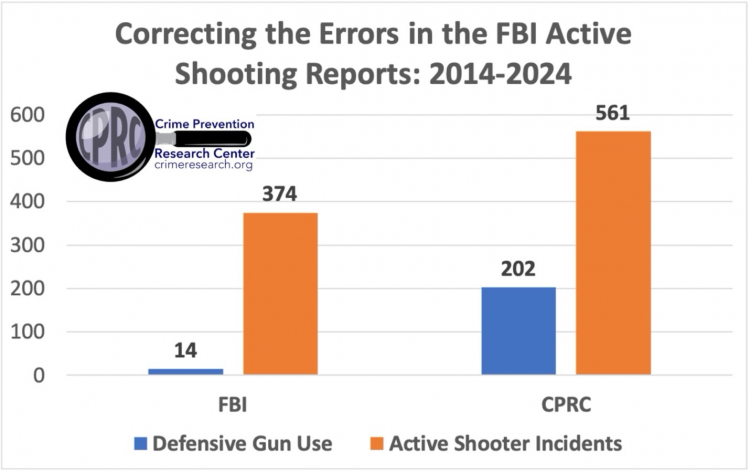
In 2022, the FBI reported that only 11 of the 252 active shooter incidents it identified for the period 2014-2021, or 4.4%, were stopped by an armed citizen. However, an analysis by my organization identified a total of 281 active shooter incidents during that same period and found that 41 of them – or 14.6% – were stopped by an armed citizen. 

Academic articles dating back to 2015 have flagged similar problems, and even the researchers who collected data for the FBI admitted that “our data are imperfect.”

The FBI report compiled for the Biden administration for 2023 and 2024 contains worse errors. It asserts that armed civilians stopped none of the 72 active shooting cases it identified. The CPRC, by contrast, identified 121 active shooter cases – 45 of which were ultimately halted by armed civilians. Those incidents included eight cases that likely would have resulted in mass public shootings with four or more people murdered. 

“There was a lady there. She heard the shots being fired, and one of them, I think it was her godchild, was involved,” a representative of the Berkeley County Sheriff’s Office in West Virginia told Metro News.  “[S]he fired some rounds back at them, which stopped this melee of firepower and they actually took off.”

In another case in 2023, CNN reported that a concealed handgun permit holder shot a gunman after he had murdered one person, wounded three others, and pointed his weapon at bystanders at the Cielo Vista Mall in El Paso, Texas. 

Various factors explain this stark discrepancy in the data. Police departments do not keep separate records of active shooter incidents, which is at the heart of the problem. Crime researchers, including my organization, have to rely on media reports, which can be inaccurate, to identify and classify the incidents. 

What’s more, the FBI does not compile its own list of cases but hires researchers at Texas State University who use Google searches to find news stories about these incidents. As a result, the potential for incomplete search results and difficult judgment calls by researchers means the FBI numbers are prone to error.

Between 2014 and 2024, FBI reports determined that armed citizens stopped 14 of 374 active shooter incidents its researchers identified – or 3.7% –  with zero defensive gun use cases occurring in the two most recent years. Using the FBI’s definitions, CPRC identified 561 active shooter incidents, with armed citizens stopping 202 of them – or 36%. In addition, CPRC found 31 other cases where civilians intervened before suspects fired their weapons – incidents CPRC excluded because they did not fit the FBI criteria, though they likely prevented shootings as well. 

Most significantly, during that decade, the FBI overlooked 42 incidents where civilians likely prevented mass public shootings.

M. Hunter Martaindale, a research assistant professor at Texas State University, was shown CPRC’s entire list of cases. He objected to just two of the incidents the CPRC identified that the FBI had missed – without commenting on any others. Even then, the two cases differed from the included ones only in that they lacked defensive gun uses. Texas State University declined to respond to repeated requests for comment.

All the cases missed by the FBI are available here, along with links to the underlying sources, so that people can double-check whether any of those cases don’t fit the FBI’s definition.

RCI
Correcting FBI Errors

The FBI compounds the problem by refusing to correct missing cases brought to its attention, including these high-profile ones:

  • In 2018, just months after the Parkland school shooting where 17 people were murdered, a gunman opened fire at a back-to-school event for children and their families at another Florida school. A concealed handgun permit holder quickly intervened and stopped the attack. More than 200 people, most of them children, were at the event. “This person stepped in and saved a lot of people’s lives,” said Titusville Police Sgt. William Amos. Unlike the earlier tragedy in Parkland, this incident ended without mass casualties – but national media outlets outside Florida ignored it.
  • A week after the Pulse Nightclub massacre in Orlando in 2016 where 49 people were murdered, a 32-year-old man began shooting inside another nightclub. Because South Carolina law allowed concealed handguns in bars, a permit holder was able to respond. Before the attacker could fire on a fourth victim, the permit holder shot him in the leg. Police later discovered the attacker carried more than 100 rounds. A South Carolina sheriff credited the man with preventing further bloodshed.

In 2024, when conservative freelance reporter John Stossel asked the FBI how complete its data was, the Bureau admitted: “[Our data is] not intended to explore all active shooting incidents but rather to provide a baseline understanding . . .” Yet the FBI never includes that qualification in its reports or press releases

“As an academic who relies upon the FBI for accurate reports on crime, I am disappointed by the many errors found in their crime data, particularly on their active shooting data,” said Gary Mauser, an emeritus professor at Simon Fraser University in Canada who has extensively studied gun control and defensive gun uses. 

The FBI’s active shooting reports never indicate whether the attacks occur in gun-free zones. “When places post gun-free zone signs, law-abiding citizens obey those rules and can’t stop attacks in those areas,” explains Professor Moody.

Surveys reveal that criminologists and economists rank the same four policies as the most effective for stopping mass public shootings: eliminating gun-free zones, relaxing federal regulations on company-imposed gun-free zones, allowing K-12 teachers to carry concealed handguns, and allowing military personnel to carry on bases.

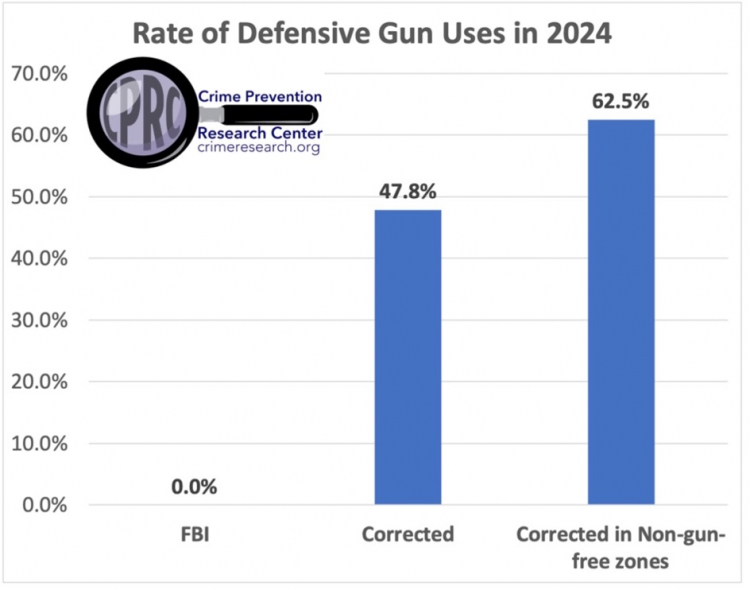
The corrected active shooting data between 2014 and 2024 undermines the argument for gun-free zones in particular. The data reveal that citizens stopped 178 out of 339 potential or actual mass shootings where it was possible to identify that guns were allowed in the area. So 52.5% of attacks were stopped by people legally carrying concealed handguns. In 2024, that rate had risen to 62.5%.

RCI
Defensive Gun Uses 2024

These corrected numbers show why it’s no accident that 92% of mass public shootings occur in gun-free zones, where civilians cannot legally carry firearms, and they highlight how the FBI’s reports leave out critical information.

The Annunciation Catholic School shooter in Minneapolis in August made this point explicit in his manifesto: “I recently heard a rumor that James Holmes, the Aurora theater shooter, may have chosen venues that were ‘gun-free zones.’ I would probably aim the same way. . . . Holmes wanted to make sure his victims would be unarmed. That’s why I and many others like schools so much. At least for me, I am focused on them. Adam Lanza is my reason.” (Lanza carried out the Sandy Hook Elementary School attack in Newtown, Conn.) This shooter even explained why he avoided attacking during morning drop-off or afternoon pick-up, when parents with concealed-carry permits might be present.

The 2023 Nashville Covenant School shooter made a similar calculation. She admitted she rejected another target because it had too much security. “There was another location that was mentioned, but because of a threat assessment by the suspect of too much security, they decided not to,” Nashville Police Chief John Drake explained. Covenant had no armed staff to fight back.

Pool The Buffalo News
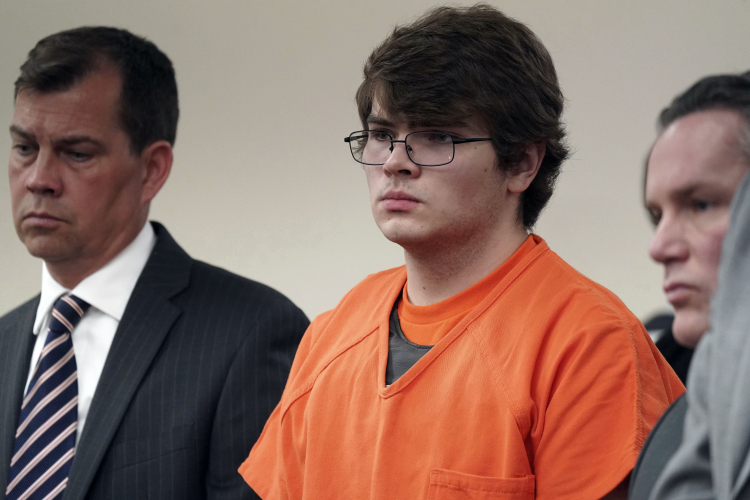
Buffalo Supermarket Shooter Payton Gendron said areas that prohibit citizens from carrying firearms are  "good for attack."

The Buffalo, N.Y., supermarket attacker in 2022 echoed the same logic in his manifesto: “Areas where CCW permits are outlawed or prohibited may be good areas of attack.” Many other killers have used almost identical words, with other cases going all the way back to Columbine, where the murderers expressed their opposition to potential victims being able to carry permitted concealed handguns.

These attackers may be deranged, but they are not stupid. They are almost all suicidal and plan to die, but they know that the more people they kill, the more media coverage they’ll get. That’s why they choose targets where no one can fight back.

The news media, federal lawmakers, and courts frequently rely on the FBI’s active shooting reports. News media articles rely on the FBI data to argue that guns are rarely used to stop these attacks. Headlines illustrate this framing: “Rare in U.S. for an active shooter to be stopped by bystander” (Associated Press); “Rampage in Indiana a rare instance of armed civilian ending mass shooting” (Washington Post); and “After Indiana mall shooting, one hero but no lasting solution to gun violence” (New York Times). 

Some states recently loosened or removed restrictions on gun-free zones and expanded the ability of teachers to carry firearms in schools. For example, Wyoming in 2025 abolished most of its gun-free zones in public buildings, state legislative sessions, and other governmental meetings, and public airports outside of those areas restricted by federal law. A number of states – such as Idaho, Florida, Kansas, Missouri, Oklahoma, South Dakota, Tennessee, Texas, and Wyoming – adopted statutes that explicitly exempt school employees from bans on firearms on K-12 grounds, subject to permitting, training, and approval by local authorities. UtahNew HampshireWyoming, and parts of Oregon allow any teacher with a concealed handgun permit to carry on school property.

After reviewing the missing data shown in this RCI report, Professor David Mustard, a distinguished professor at the University of Georgia who researches extensively on crime, was blunt in his conclusion: “The federal government must improve its records related to self-defensive uses of firearms – especially in active shootings. Because academics, media, and policymakers depend on their data, it is essential that the FBI collect and compile the data consistently and accurately.”

https://www.realclearinvestigations.com/articles/2025/10/02/unaccountable_the_fbis_strange_refusal_to_fix_key_crime_stat_1138566.html

FBI agents press Congress to end shutdown

 The United States Federal Bureau of Investigation's (FBI) Agents Association issued a statement urging Congress to end the government shutdown, warning that the funding lapse could weaken national security by limiting resources and delaying investigations.

The group said agents will remain on duty without pay but warned that funding gaps will reduce the agency's ability to carry out critical operations.

"If the shutdown continues, the Bureau will inevitably be forced to curtail travel, training, hiring, and other essential operations," the statement read. "These restrictions will slow investigations, delay forensic analysis, and weaken coordination with state, local, and international law enforcement partners."

https://breakingthenews.net/Article/FBI-agents-press-Congress-to-end-shutdown/64919779

Drone sightings disrupt Munich airport, halt flights and impact thousands

 Germany's Munich airport said early on Friday that drone sightings on Thursday evening had forced air traffic control to suspend operations, leading to the cancellation of 17 flights and disrupting travel for nearly 3,000 passengers.

Another 15 arriving flights were diverted to Stuttgart, Nuremberg, Vienna, and Frankfurt, the airport said in a statement, marking the latest drone disruption to European aviation after sightings temporarily shut airports in Denmark and Norway last week.

German air traffic control officials restricted flight operations at Munich airport from 10:18 p.m. (2018 GMT) on Thursday and later suspended them altogether due to several drone sightings, the airport added.

The city was already placed on edge this week when its popular Oktoberfest was closed temporarily due to a bomb threat and the discovery of explosives in a residential building in the north of the city.

Denmark has stopped short of saying who it believes is responsible for the incidents in its airspace last week, which disrupted air traffic at multiple airports, but Danish Prime Minister Mette Frederiksen has suggested it could be Russia.

European Union leaders backed plans on Wednesday to bolster the bloc's defenses against Russian drones.

Russian President Vladimir Putin joked on Thursday that he would not fly drones over Denmark anymore, but Moscow has denied responsibility for the incidents.

Local police have investigated the incident, but were unable to identify either the drones or their owners, according to Bild.

The report added that an hour later, the drones returned, this time over the airport grounds itself, confirmed Federal Police spokesperson Stefan Bayer.

Officials have not been able to determine who is behind the drone flights.

A police helicopter was also deployed to track down the drones, according German outlet Die Welt.

Similar incidents in Norway, Denmark

In September, similar incidents caused disruption at Scandinavian airports.

Drone sightings halted all take-offs and landings for nearly four hours at Copenhagen Airport on September 23.

Danish Prime Minister Mette Frederiksen linked the incident to a series of suspected Russian drone incursions and other disruptions across Europe

Norway's Oslo Airport also shut its airspace due to a drone sighting.

The following day, on September 24, Denmark's Aalborg Airport was closed due to drones in its airspace.

The event also affected Denmark's military forces, as Aalborg serves as a base of operations for the Danish Air Force. 

https://www.jpost.com/international/article-869307

Data Centers "Primary Reason" For High PJM Capacity Prices: Market Monitor

 By Ethan Howland of Utility Dive

Capacity prices — a cost that is ultimately paid for by electricity consumers — surged in PJM’s last two July capacity auctions.

An Amazon Web Services data center near single-family homes on July 17, 2024, in Stone Ridge, Virginia. Data center load resulted in $16.6 billion in capacity auction revenue in the PJM Interconnection’s last two capacity auctions, according to a report released on Oct. 1, 2025, by the grid operator’s market monitor

The 2024 auction results led to double-digit electric bill increases for some utility customers in PJM’s footprint, which covers parts of 13 Mid-Atlantic and Midwest states and the District of Columbia.

PJM holds capacity auctions to help ensure that it has adequate power supplies to meet future needs. In the last auction, PJM bought capacity for a one-year period that starts on June 1. The grid operator is preparing to hold its next auction in early December to buy capacity for a year beginning on June 1, 2027.

Monitoring Analytics contends it is “misleading” to say that PJM’s recent capacity market results simply reflect tightening supply and demand.

“The current conditions are not the result of organic load growth,” it stated. “The current conditions in the capacity market are almost entirely the result of large load additions from data centers, both actual historical and forecast.”

Also, the “extreme uncertainty” in data center load forecasts is unprecedented and “raises questions about the meaning of clearing a capacity auction based on those forecasts,” Monitoring Analytics said.

In June, the market monitor recommended requiring new data centers to supply their own generation instead of tapping into existing power supplies in PJM.

“The impact of the uncertain forecast of data center load on other customers would be limited or eliminated” by the requirement, Monitoring Analytics said in the report.

PJM is in the middle of a fast-track stakeholder process to develop new rules for adding large data centers to its system with a goal of filing a proposal before the end of the year at the Federal Energy Regulatory Commission.

As part of the process, PJM is proposing to bolster its load forecasting for data centers and other large loads, according to an Oct. 1 presentation from PJM staff. Under the proposal, state utility commissions could review and provide feedback on large load adjustments before they are included in PJM’s load forecast.

Utilities would also have to ask if any data center proposals in their service territory are duplicative proposals. Staff suggested requiring large load customers to post financial security for the capacity they plan to buy in an auction.

PJM has dropped a proposal for “non-capacity-backed load” that was widely opposed by its stakeholders, according to the presentation.

On the issue of a price cap and floor for PJM’s capacity auctions, the last auction would have been $3.2 billion, or 20%, higher except for a cost cap that grew out of an agreement between the grid operator and Pennsylvania Gov. Josh Shapiro, a Democrat, according to the market monitor’s report.

The impact of data center development on PJM’s auction results will increase sharply in the 2028/2029 base capacity auction scheduled for June, when the maximum and minimum price caps in the agreement expire, Monitoring Analytics said.

Separately, the Union of Concerned Scientists this week found that utility ratepayers in PJM will pay about $4.4 billion for data center-related transmission projects that were approved in 2024 with similar results expected this year.

https://www.zerohedge.com/economics/data-centers-primary-reason-high-pjm-capacity-prices-market-monitor

Top FDA Vaccine Official Says US Vaccine Schedule May Be Suboptimal

 by Zachary Stieber via The Epoch Times (emphasis ours),

The current vaccine schedule in the United States may not be optimal, the Food and Drug Administration’s top vaccine official said in a new interview.

Dr. Vinay Prasad, director of the Food and Drug Administration’s Center for Biologics Evaluation and Research, in an undated file photograph. FDA via The Epoch Times

I think the scientific establishment blindly defending the U.S. vaccine schedule is incorrect,” Dr. Vinay Prasad, director of the FDA’s Center for Biologics Evaluation and Research, told the Free Press in an interview published Sept. 29. “It is possible that our schedule is suboptimal.”

The FDA is part of the Department of Health and Human Services (HHS). Another HHS division, the Centers for Disease Control and Prevention, sets the immunization schedule, which contains more vaccines and doses than many other countries, such as Denmark.

I’ve seen some pundits claim that Denmark can get away with a different schedule because they’re a smaller country,” Prasad said. “That’s illogical. Denmark is connected to all of Europe. It would be like arguing that Boston could have a different vaccine schedule than the rest of the Eastern Seaboard if we made it its own nation.”

Susan Monarez, who headed the CDC until she was recently fired, told a congressional committee last month that HHS Secretary Robert F. Kennedy Jr. said during a private meeting that the vaccine schedule would be changing.

Monarez said she would only sign off on changes if she were presented with evidence backing them, and said she was not.

The childhood vaccine schedule has been vetted and validated through science and evidence,” Monarez said.

If children receive vaccines when recommended by the schedule, they receive multiple shots across multiple visits.

President Donald Trump in a Sept. 22 briefing said that parents should space out vaccines.

“I think the president has a deeper point about the evidence to support combination and concomitant administration. By background, combination vaccines combine two or more into a single vial or shot, while concomitant administration means administering two or more at the same visit. Historically, FDA has had stronger levels of evidence for combination than concomitant administration, but that is changing,” Prasad told the Free Press.

“We are planning new guidance to raise the bar for concomitant administration, and we have a paper now submitted in a medical journal.”

Measles, Hepatitis B Vaccines

Trump also proposed delaying the hepatitis B vaccine, which is currently on the immunization schedule at three doses in early childhood, or two doses for adolescents, and taking separate vaccines against measles, mumps, rubella, and chickenpox rather than combination vaccines.

Also recently, advisers to the CDC recommended the agency remove the measles, mumps, rubella, and chickenpox vaccine from the schedule for children younger than 4 years of age, emphasizing a different vaccine that targets measles, mumps, and rubella, due to an elevated risk of febrile seizures. Advisers also considered delaying the first dose of the hepatitis B vaccine regimen, but ultimately tabled the decision to explore whether to alter or remove the entire regimen. The CDC has not yet acted on the advice.

“I think the president is 100 percent correct that it is prudent to take the chickenpox shot separately,” Prasad said.

He said that Trump and the Advisory Committee on Immunization Practices (ACIP) were right to question whether hepatitis B shots should be administered to babies born to mothers who tested negative for hepatitis B, noting that some other countries do not give the vaccine to such children.

ACIP is also examining the cumulative impact of the vaccination schedule, advisers said in June.

Trump’s comments drew criticism from some, including the American Academy of Pediatrics.

Pediatricians know firsthand that children’s immune systems perform better after vaccination against serious, contagious diseases like polio, measles, whooping cough and hepatitis B. Spacing out or delaying vaccines means children will not have immunity against these diseases at times when they are most at risk,” the academy said in a statement.

Prasad said that Trump was offering personal advice and not trying to compel anyone to follow that advice. When asked whether Trump’s comments would drive vaccine hesitancy, Prasad said people are getting fewer vaccines due to the imposition of COVID-19 vaccine mandates during the pandemic.

“We will have more vaccine hesitancy for a generation. The president’s comments are not the driver of what we are seeing,” he said.

Prasad rejoined the FDA in August, several weeks after resigning. He had left the agency after some of his past comments were recirculated, including remarks about supporting Democrats.

“The FDA is steadfast in its commitment to rigorous, gold-standard science in the approval of vaccines, ensuring that every decision reflects the highest standards of safety and effectiveness. Science requires continual review and adaptation; when health recommendations become outdated or no longer align with the latest evidence, it is the responsibility of public health officials to make the necessary changes,” an HHS spokesperson told The Epoch Times in an email on Wednesday.

“Dr. Prasad’s comments underscore the open-mindedness that true gold-standard science demands, and that the health of our citizens depends upon. At this time, HHS and FDA cannot comment on potential future policy changes.”

https://www.zerohedge.com/political/top-fda-vaccine-official-says-us-vaccine-schedule-may-be-suboptimal