Search This Blog

Wednesday, October 8, 2025

Media Celebrates Fired NIH Official Jeanne Marrazzo With Fake “Whistleblower” Label

 by Paul Thacker

Oh boy, another one popped up over the weekend.

A slew of stories hit the internet last week alleging that HHS Secretary Robert F. Kennedy Jr. is ignoring The Science™ and fired ANOTHER federal scientist who IS following The Science™. Just a couple weeks ago, former CDC Director Susan Monarez made the exact same allegation: Kennedy Jr. fired her because she was following The Science™ while he was not.

Monarez was then embarrassed and humiliated during a Senate hearing.

Under close questioning, Senators discovered that Monarez’s allegations concerned policy disagreements she had with her boss Secretary Kennedy, not science disputes. And who hasn’t disagreed with their boss?

The hidden politics of Monarez’s hoary claims came to light when Senators began questioning Monarez to explain how and why she showed up to a hearing ostensibly about science, yet flanked by Democratic Party activist lawyers Mark Zaid and Abbe Lowell.


“Do you want to introduce your lawyers that you brought today?” one Senator asked. Monarez then ducked and dodged questions for over three minutes with a crazed smile plastered across her face. Goodbye credibility!

As with Monarez, the latest media kerfuffle involves Secretary Kennedy firing a federal official whose lawyer ran to legacy media outlets, planting nonsense complaints that Kennedy fired her because he doesn’t follow The Science™. In this case, the particulars involve former NIH official Jeanne Marrazzo, Fauci’s handpicked replacement, and notorious Democratic Party activist lawyer, Debra Katz.

As head of one of the NIH’s many institutes, Marrazzo worked at the discretion of the HHS Secretary and the NIH Director, who both had broad authority under the law to terminate her at any time.

But check out all the headlines that Katz drummed up for “whistleblower” Marrazzo.
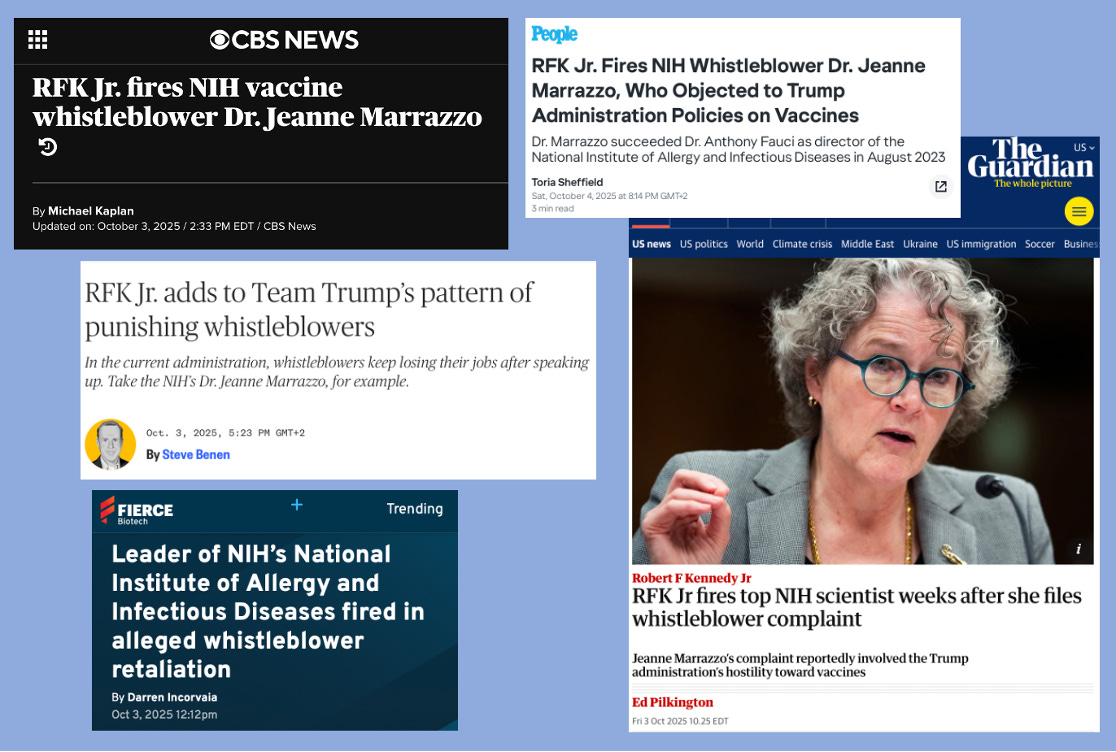
Here’s the New York Times fluff piece: “Debra S. Katz, a lawyer for Dr. Marrazzo, said in a statement this week that the firing was retaliatory.”

Katz enjoys portraying herself as a whistleblower attorney, but her legal status is often overshadowed by partisan DC credentials that include being a beloved Democratic Party donor and having a notorious reputation for launching lawsuits that boost Democratic Party special interests.

The Washington Post reported in 2018 that Katz was a member of the Trump “resistance” whose views “test the line between legal advocacy and political activism.”
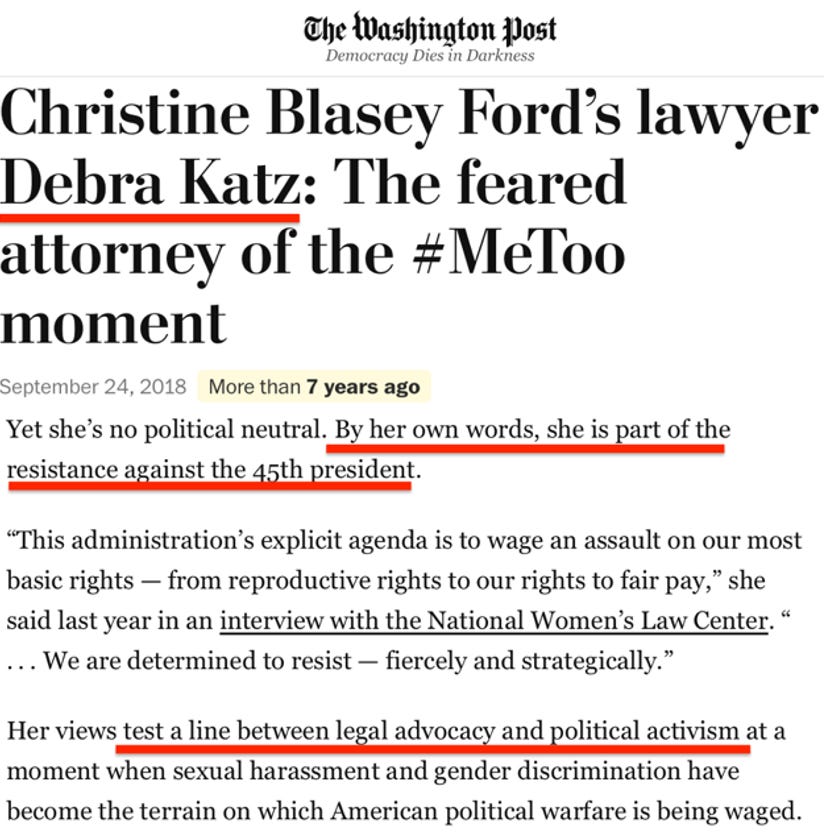
Katz has circulated in the tight-knit DC media and legal ecosystem for a couple decades, but she rocketed to national attention in 2018 when reporters began circulating rumors that an anonymous accuser said Trump’s Supreme Court candidate, Bret Kavanaugh, had sexually harassed her during high school. When the anonymous accuser was later revealed to be Christy Blasey Ford, the lawyer popping up beside her was none other than Debra Katz.

Political insiders were immediately suspicious.

During an ABC News panel discussion, Megyn Kelly noted that, during the Clinton years, Katz was “very defensive of Bill Clinton when he got accused by Paul Jones, and said that one allegation of Bill Clinton taking out his private parts in front of Paul Jones, wasn’t enough for sexual harassment.”

That’s right, Katz defended Bill Clinton when he yanked out his winky and wagged it at Paula Jones. Guess why? Surprise! Documents show Debra Katz is huge Hillary Clinton fan.

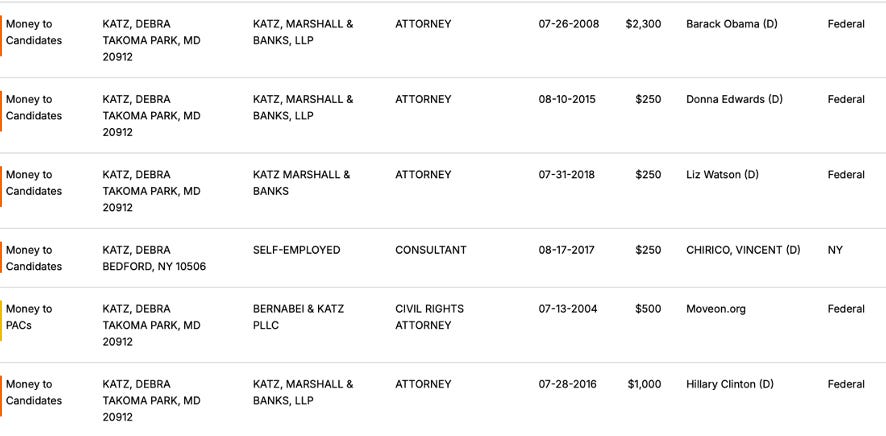
Records from OpenSecrets.org show Katz had given thousands of dollars in campaign donations to Hillary Clinton and other Democratic Party politicians. But one spicy document is even more revealing.
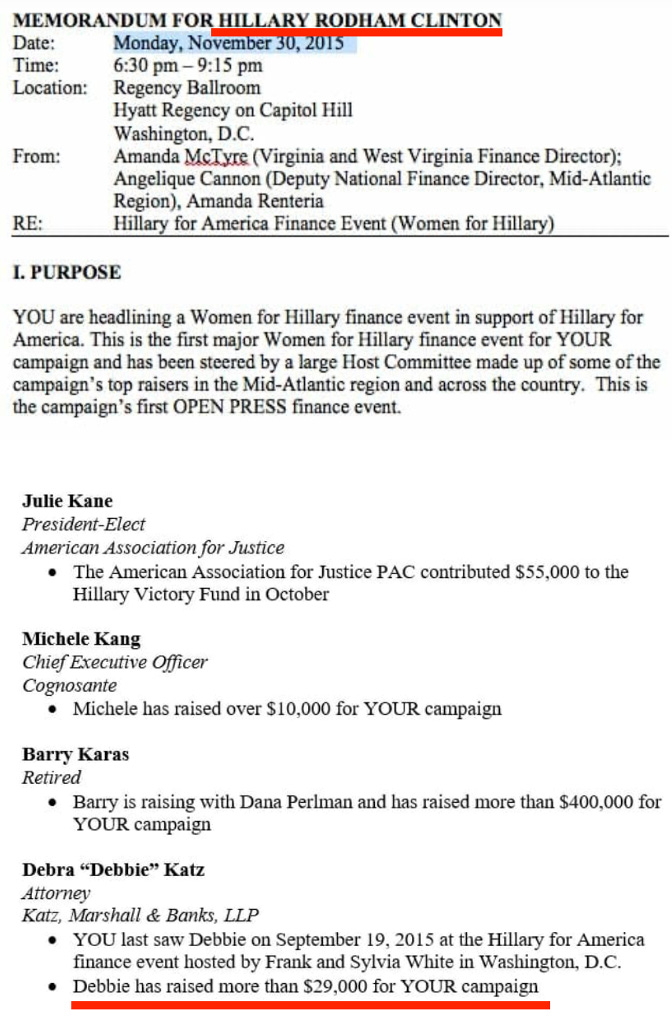
In the lead up to the 2016 election, hackers broke into Hillary Clinton’s campaign emails and began leaking them on social media. Included with the leaked files is a campaign fundraiser memo addressed to Hillary Clinton in 2015. The “Women for Hillary” memo reminds Clinton that she last saw Debra “Debbie” Katz at a Hillary for America finance event in DC.

“Debbie has raised more than $29,000 for YOUR campaign.”
With so much of Debra Katz’s financial ties to Democrats known throughout Washington, things got particularly tricky during the 2018 Senate hearing for the Brett Kavanaugh nomination. When Republicans began reading media reports about Brett Kavanaugh’s anonymous accuser, they reached out to Katz who was identified as the accuser’s attorney.

So that she would not have to face heated public attention, Republican Senators told Katz that they would do whatever Blasey Ford wanted to make her comfortable, to include flying female Senate staff to California for a private interview.

But Katz appears to have never informed Blasey Ford that she could speak to Committee staff in private. This became clear during the Senate hearing when Blasey Ford was asked if she knew she could have retained her privacy and spoke to staff behind closed doors.

Katz remained in the background, but her co-counsel jumped forward to try and shut down this line of questioning. But Blasey Ford then testified that she was not aware of the offer. Watch the exchange.

After the hearing, Committee Chairman Chuck Grassley released a statement noting the Committee had made multiple offers to Debra Katz to accommodate Blasey Ford, however she preferred. Katz never forwarded the offer to Blasey Ford, because she was apparently using Blasey Ford for her own agenda.

Clearly, Dr. Ford’s attorneys did not tell her that we could protect her privacy and speak to her in California. The ABA’s Model Rules of Professional Conduct require a lawyer to consult with his or her client about the means to be used to accomplish the client’s objectives—including informing the client of settlement offers. It is deeply unfortunate that Dr. Ford’s Democratic-activist lawyers appear to have used Dr. Ford in order to advance their own political agenda.

Katz’s political agenda became clear about a year later when a video circulated of her giving a talk at the University of Baltimore. Katz detailed that Christine Blasey Ford’s testimony was for the greater good as it helped to damage Kavanaugh’s reputation. “He will always have an asterisk next to his name …. That was part of what motivated Christine….”

Back to NIH’s Jeanne Marrazzo.

Marrazzo was placed on administrative leave back in April during a massive layoff at the NIH. Tony Fauci had picked Marrazzo to run the National Institute of Allergies and Infectious Diseases, one of the several dozen institutes within the NIH. While the President appoints the head of the NIH and the leader of the NCI (National Cancer Institute) the Secretary of HHS appoints the other institute directors, such as Marrazzo.

The law also states that the Secretary of HHS or the NIH Director may “terminate” institute directors, such as Marrazzo, at any time.

So why is Marrazzo running all over the place complaining she is a whistleblower? First, Marrazzo does not meet the legal criteria for being a whistleblower, because disagreeing with your boss doens’t make you a whistleblowwer. “She was constantly complaining in meetings about Memoli and the changes he was making,” an NIH source tells me. Last January, the White House chose Matthew Memoli to run the NIH until Jay Bhattacharya could get Senate confirmation. “If you keep disagreeing with your boss, what did she think was gonna happen?”

A close reading of Marrazzo’s “whistleblower” complaint filed by Debra Katz just a month back, reveals that the disagreements Marrazzo got into with her NIH bosses were not “science” disputes, but arguments over policy changes.

Here’s one example: when the new NIH leadership began to change priorities in early 2025, Marrazzo complained this violated “scientific integrity.”

The rest of Marrazzo’s complaint runs along similar lines: she didn’t like the policy changes, because, in her mind, those changes didn’t follow The Science™ as she sees it.

An official inside HHS dismissed Marrazzo’s claims as nonsense. “It’s a ridiculous complaint. She was handpicked by Fauci and doesn’t like the new administration, so why would they keep her?”

Marrazzo’s complaint has been filed with the U.S. Office of Special Counsel (OSC) where it will likely be ignored, ending her legal appeal process. Marrazzo will nonetheless remain celebrated in legacy media as “whistleblower” who stood up for The Science™. So expect to see her popping up on occassion in legacy media outlets.

“This was an obvious political stunt,” an HHS official says.

https://disinformationchronicle.substack.com/p/media-celebrates-fired-nih-official

Conservatives United Against Extending Biden COVID Credits


Conservatives—both in and out of government—are united that the Biden COVID credits should expire after 2025. I joined three dozen leaders in the conservative movement in a letter to President Trump that criticizes Democrats’ unserious demands that led them to shut down the government and makes the case that the COVID credits need to end. The letter, led by Americans for Tax Reform (ATR), made several key points:

  • The Biden COVID credits were intended to be temporary. At the time they were passed, the American people were assured that the expanded subsidies were a necessary and temporary response to the global pandemic. The pandemic ended several years ago. 
  • Over the long term, the Biden COVID credits raise premiums. A Congressional Budget Office report confirmed that premiums for exchange plans are rising more quickly than anticipated. When the government subsidizes the cost of anything, sellers raise their prices. Although some Americans may be concerned about premiums rising in the short term, removing the incentive for insurers to keep increasing prices will save patients money in the long run.
  • The Biden COVID credits are further bankrupting our country. The cost of the original subsidies will total $1 trillion over the next decade. Extending Biden’s COVID credits would increase that cost by 45 percent.

The letter cites Paragon’s research on widespread Obamacare fraud, which has double the number of zero-claim enrollees as you would expect in a normal health insurance market. Last week, we released Obamacare Fraud by the Numbers, which details the significant problems caused by the Biden COVID credits.
 
ATR has a webpage featuring quotes from prominent conservatives—including Ben ShapiroSean HannityErick EricksonDana Loesch, and many members of Congress—who oppose extending Biden’s COVID credits.
 
Not a single Republican voted for the COVID credits. It was the Democrats who unilaterally scheduled the add-on subsidies to expire after 2025. In a Wall Street Journal letter to the editor, Texas Representative Chip Roy represented the perspective of conservatives in Congress, making the case that “this is no time to go wobbly” on Obamacare:

Democrats are choosing to shut down the government…because they want to give $450 billion to big health insurance companies and the K Street lobby. Though Republicans are rightly resisting demands to provide “free” healthcare to illegal aliens, the fight is over a more fundamental question: Should Congress extend enhanced subsidies for ObamaCare that were established temporarily during Covid?
 
It doesn’t take a seasoned pol or savvy operative to know the answer is no. The jig is up, the pandemic is over and my colleagues shouldn’t blink in any other direction. Republicans must prove that we are for healthcare freedom and against socialized medicine. If we cave on these expensive and outdated subsidies, achieving our goals will be nearly impossible.
 
Making such concessions would make us look weak, saying we’re for one thing and doing another. How will voters take us seriously in our aspirations to deregulate the market to enable competition or expand health-savings accounts to meet their full potential, among other things, if we give up this fight? Rolling over will become our modus operandi.

The COVID credits go directly to health insurers, and they are fiercely lobbying for them to continue, including taking to the pages of The Journal. My colleague Niklas Kleinworth and I rebutted insurers’ argument and made the case that Obamacare is not a healthy market in our own letter in The Journal:

The sweetened “credit” is the problem, not the solution, driving the high cost of healthcare. The zero-dollar premiums created by the Biden administration policy exacerbated structural problems in the Affordable Care Act.
 
For everyday Americans, the result is worse coverage and tens of billions in higher taxes annually. Many also have been enrolled in plans without their knowledge, leaving them surprised at tax time or without coverage that meets their needs. …
 
Meanwhile, insurers happily collected large checks from the government that covered the entire premium. Nearly half of 2025 enrollees took no action during open enrollment, as they were automatically renewed into their subsidized plan.
 
Unfortunately, Trump administration efforts to address the large-scale fraud have been held up by one Democratic-appointed judge. This makes it more important that the Covid credits expire, and with them, the fuel for the fraud.
 
ObamaCare’s underlying subsidies would persist without the sweetened deal. The government would still pick up more than 80% of the cost of the premium for the typical enrollee next year after Covid credits expire.
 
The real beneficiaries of extending the credits are insurers, who would rather receive payments from Washington than offer plans people must at least partially pay for. Hard-working families who get coverage through the workplace shouldn’t have to bail them out to prop up this already oversubsidized market.  

The ATR letter follows a letter from the National Taxpayers Union that also expressed strong opposition to extending the COVID credits.


Brian Blase, Ph.D., is the President of Paragon Health Institute. 

https://www.realclearhealth.com/articles/2025/10/08/conservatives_united_against_extending_biden_covid_credits_1139710.html

Anatomy Of A Food Addiction Study

 By Chuck Dinerstein, MD, MBA


A new study claims that “ultra-processed food addiction” affects one in eight older adults. But how solid is the science behind that headline? Beneath the striking numbers lies a web of assumptions about what counts as “addiction” and even what qualifies as “ultra-processed.” Do the study’s definitions, measures, and interpretations measure up? Do its bold claims hold up under scrutiny?
A recent study in Addiction reported that “ultra-processed food addiction” (UPFA) affects roughly one in eight adults over 50—and nearly one in five women aged 50–64. These are striking numbers, making the study’s abstract enticing. However, they are only as strong as the chain of assumptions that underlie them. Let’s break down the study in an organized, skeptical step-by-step way to see whether we agree with the researcher’s conclusions.
  • What question are the authors really asking?Are they trying to establish causation, describe a trend, or argue for a new diagnosis?
  • How are the relevant variables defined? Are the study’s definitions (here, ultra-processed foods and food addiction) widely accepted, or are they still contested?
  • Which instruments and measures were used, and are they fit for purpose?
  • How do the authors link results to broader narratives? Does the narrative clarify mechanisms, or import emotional, value-laden rhetoric that could shape our interpretation?

By examining definitions, metrics, and context, we can determine the weight that those headline numbers deserve.

The Researchers Set the Stage

As with most studies, it begins with an introduction providing context for the research and the researchers’ underlying reasoning. The study begins by noting a long-term shift in the American diet: over the past half-century, ultra-processed foods (UPFs)—industrial formulations high in refined carbohydrates, added fats, and engineered flavorings—have become the dominant source of calories. By the late 1970s and ’80s, tobacco companies had entered the food industry, using their marketing expertise to promote these products. Today’s adults in their 50s to 70s grew up during that transformation. The researchers suggest this cohort was especially vulnerable to addiction “owing to heightened reward sensitivity, impulsivity and emotional dysregulation.”

Invoking the “tobacco playbook” lends rhetorical weight to the argument, since nicotine addiction is well established. Yet critics might see this analogy as evidence of bias, with researchers beginning with a conviction about UPFs’ addictiveness. The key question, then, is whether the study tests that idea objectively or selectively supports it. With that framing in mind, the next step is to examine how the study measured “addiction.”

Measuring Addiction: Tools, Tests, and Assumptions

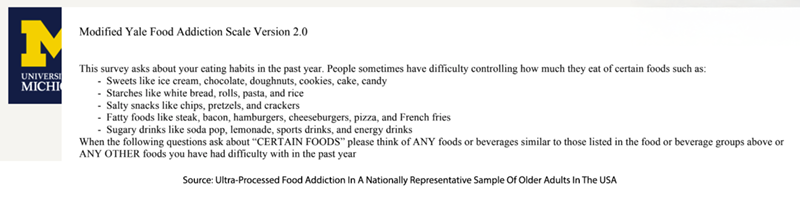
To assess whether early exposure to UPFs had lasting effects, the researchers analyzed survey data from 2,038 U.S. adults aged 50 to 80, who were representative across various demographic categories, including race, income, and education. They used the modified Yale Food Addiction Scale (mYFAS), which adapts diagnostic criteria for substance-use disorders, such as loss of control, craving, and tolerance to eating behaviors. 

One of the key points in debating the value of a scientific study is the tools used for measurement. Researchers applied the mYFAS to gauge “ultra-processed food addiction,” relating it to weight, self-rated health, and social isolation. For the skeptical, this is a treasure trove of concerns, beginning with the fact that there remains no consensus as to the definition of a UPF.

While the mYFAS is validated for measuring “food addiction,” it does not explicitly target ultra-processed foods. That distinction is crucial: participants were asked about foods like chocolate, salty snacks, and sugary drinks—items that may or may not meet formal UPF definitions.

However, the mYFAS’s most significant flaw is found in the wording of the foods participants are asked to opine upon. 


In effect, the study may have measured problematic eating patterns around familiar comfort foods rather than actual “ultra-processed” consumption. This nuance is not explicitly stated in the paper, although the supplementary materials reveal it. Understanding what was truly measured helps clarify how to interpret the results.

Reading Between the Results

The study suggests that addictive-style eating of ultra-processed foods (UPFs) is not rare: about one in eight adults aged 50–80 met criteria for UPFA, with rates rising to one in five among women aged 50–64. Women reported stronger cravings and greater difficulty cutting back than men. Yet these patterns rest on the assumption that the mYFAS captures UPFs specifically rather than any highly palatable foods.

A closer examination of the relationship of self-reported weight to UPFA was more revealing. The researchers found UPFA at every weight perception [1] except “about right” for women, a group that, for any number of reasons besides “addiction,” has disordered eating. Men demonstrated increased UPFA at both slightly underweight and overweight, perhaps reflecting less of a cultural bias towards male eating disorders. 

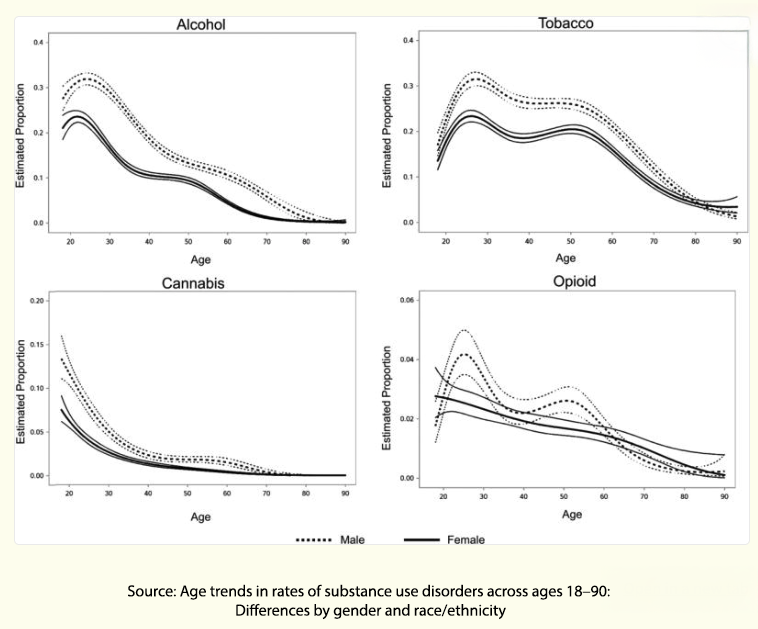
“In the current study, there also appear to be cohort effects in the prevalence of UPFA. Adults aged 50–64 years (15.7%) had almost double the prevalence of UPFA than adults aged 65–80 years (8.2%). Similarly, [alcohol and tobacco use disorders] rates have been found to be higher in those aged 50–64 years relative to those aged 65–80 years.” 

Within the confines of the study, which focused solely on those two age groups, the statement is entirely true, adding to the strength of their argument that the tobacco control efforts of Big Food in the 1970s and 1980s were critical. However, the age trajectory of alcohol and tobacco disorders peaks much earlier. Here is a graphic from a study of use disorders by age.


Because only two age groups were sampled, we cannot tell whether this reflects a genuine cohort effect or simply a snapshot.

Finally, there is a perennial chicken-egg problem as the study links addictive-style eating to mental health and social factors. The researchers found that one’s mental health goes hand-in-hand with UPFA. Participants who rated their mental health as “fair” or “poor” were three to four times more likely to show signs of UPFA, as were those who felt socially isolated. The researchers note that there are multiple pathways connecting isolation and UPFA:

“Older adults may consume UPFs to cope with negative effects associated with social isolation, which could then increase the risk of developing UPFA. … Individuals with UPFA report socially isolating themselves to avoid others from seeing how much they eat, which may weaken social networks over time.” 

From the researcher's perspective, it is a one-way street from UPFA to isolation. As an emotional eater myself, I get it. Yet causation could run both ways: emotional distress, limited food access, or the challenges of cooking alone may drive comfort eating without implying addiction.

The study’s timing adds another layer of uncertainty. Data collection took place during the pandemic, when social distancing and stress-related snacking were prevalent. These conditions likely amplified reports of cravings and loss of control, making it challenging to separate enduring patterns from temporary behavior.

Context, Confounders, and Causation

The study presents an arresting headline, and the data indicate that many respondents report experiencing symptoms such as cravings and a perceived loss of control over high-palatability foods. Yet several unspoken caveats temper the study’s conclusions.

  • Definition drift – The mYFAS tool measures self-reported problems with any highly palatable food; the leap to ultra-processed food addiction relies on an imprecise, still-debated UPF category.
  • Sampling scope – While nationally representative for age, sex, income, and education, the survey captures only two broad age bands (50-64 and 65-80), limiting insight into life-course patterns hinted at by substance-use epidemiology.
  • Contextual confounders – Data were gathered during the pandemic, when social isolation, stress-eating, and supply-chain disruptions may have all inflated scores.
  • Direction of association – The links between poorer mental health, loneliness, and high mYFAS scores could reflect comfort-eating in response to distress as readily as they reflect a distinct addictive disorder.

Where Evidence Ends and Interpretation Begins

The paper provides useful descriptive data on the perceived difficulty of regulating certain foods. Still, its framing of those difficulties as an “overlooked addiction” rests on contested definitions and associations that cannot untangle cause from consequence. Whether you accept the authors’ conclusion hinges on the beliefs and bias you bring to the study, a perception described by artists as the “beholder’s share.” It is up to each reader to decide how convincing the case really is.


[1] underweight, somewhat underweight, about right, somewhat overweight, and overweight.


Source: Ultra‐Processed Food Addiction In A Nationally Representative Sample Of Older Adults In The USA Addiction DOI: 10.1111/add.70186

https://www.acsh.org/news/2025/10/08/anatomy-food-addiction-study-49758

US FDA expands use of Regeneron's Libtayo as add-on treatment for skin cancer

 The U.S. Food and Drug Administration on Wednesday cleared Regeneron Pharmaceuticals’ immunotherapy, Libtayo, as an add-on treatment for skin cancer patients at high risk of their disease returning after surgery and radiation, the drugmaker said.

Libtayo is already approved in the U.S. for advanced skin cancer, basal cell carcinoma, advanced non-small cell lung cancer and cervical cancer.

Regeneron said its approved application did not include contract drugmaker Catalent's Indiana facility as a fill-finish site for the drug. The FDA in August had declined to approve Regeneron's blood cancer therapy, odronextamab, citing its inspection of the facility.

The Bloomington, Indiana site handles the final stages of drug preparation and packaging for Regeneron's Eylea HD and odronextamab. The contract drugmaker was acquired by Novo Nordisk last year.

Following an inspection at the facility in June and July, the FDA issued six observations detailing a range of manufacturing lapses, including the improper investigation of contaminants - one of which was identified as cat hair.

Regeneron said in August it is working with regulators to resolve manufacturing issues at the site, which has delayed other drug approvals including Scholar Rock's muscle weakness therapy.

Libtayo was cleared Wednesday as an adjuvant treatment for adult patients with cutaneous squamous cell carcinoma (CSCC) — the second-most common form of skin cancer.

The approval is based on a late-stage trial with 415 patients, in which Libtayo reduced the risk of cancer recurrence or death by 68% compared with placebo.

https://www.yahoo.com/news/articles/us-fda-expands-regenerons-libtayo-203121507.html

Rubio Suddenly Interrupts Trump Meeting: 'We Are Very Close To A Deal In The Middle East'

 Update(1707ET)In an unusual moment, during a White House round-table on Antifa, Secretary of State Marco Rubio interrupted things to inform President Trump of something quite urgent. Whether a deal is really imminent or not, it still made for good theater, at the very least. Trump soon after this moment left the meeting, announcing "I have to go now to try to solve Middle East problems."

Not long before that interruption, he had speculated that if the Egypt-hosted negotiations achieved a deal, he would likely travel to the Middle East. He even named Gaza as a potential destination, but then said it would most likely be Egypt.

"Peace for the Middle East, that’s a beautiful phrase, and we hope it’s going to come true, but it’s very close, and they’re doing very well," Trump told reporters.

Does this mean he's getting ready for a major announcement? There have been 'false starts' on Gaza peace before (many times, actually)... so will this be the one to stick?

* * *

Axios last week reported that President Trump recently told Prime Minister Benjamin Netanyahu to stop being so "f*cking negative" and "take the win" after Hamas voiced its initial agreement to free the 48 remaining hostages (both dead and alive) as part of the US 20-point peace plan for Gaza.

However, in more recent remarks Trump has denied ever saying this, or clashing with the Israeli leader on the pending agreement. "No, it’s not true. He's been very positive on the deal," Trump said of Netanyahu.

Israel's Strategic Affairs Minister Ron Dermer - who is the top negotiator for Israel (center), via Associated Press.

Asked specifically whether he has any red lines for Hamas in new round of negotiations that kicked off Monday in Egypt, Trump told reporters in the Oval Office that he does: "If certain things aren’t met, we’re not going to do it," he said.

Commenting on the potential for private vs. public friction further, Israeli media concludes the following:

Trump at times has avoided criticizing Netanyahu in public, even as reports have mounted about his private frustration with the Israeli premier, including during a tense phone call last week in which the Axios news site reported the US president responded angrily when Netanyahu said Hamas’s ambivalent response was "nothing to celebrate."

US envoy Steve Witkoff is in Egypt joining the talks Wednesday, as is Trump's son-in-law and adviser Jared Kushner, and Erdogan too has sent Turkish officials, which may amount to too many cooks in the kitchen. The Turkish delegation is led by spy chief Ibrahim Kalin. 

Top Hamas leader Taher al-Nunu has offered a generally positive assessment of where thing stand so far. "The mediators are making great efforts to remove any obstacles to the implementation of the ceasefire, and a spirit of optimism prevails among all parties," he said.

The two warring sides have exchanges lists of Israeli captives and Palestinian prisoners to be released in the major swap. But even if this is agreed to, the question of ending the war, and a future Gaza where Hamas is disarmed, remains a big open one.

In Tuesday comments in the Oval Office, Trump said "So the primary guarantee is, once this deal happens, if it does happen — look, they’re in negotiations right now."

"We are going to do everything possible. We have a lot of power, and we’re going to do everything possible to make sure everybody adheres to the deal," he added. However, it's notable that Trump stopped short of explicitly vowing that Israel would be barred from resuming military operations. For now, media reports say "progress" is being made in 

https://www.zerohedge.com/geopolitical/progress-reported-gaza-peace-talks-trump-denies-telling-israeli-pm-not-be-fcking

78% Of Americans Favor Deportation Of Criminal Illegal Immigrants; New Poll Finds

 by Debra Heine via American Greatness,

Nearly 80 percent of Americans favor the deportation of immigrants who are in the United States illegally and have committed crimes, and a clear majority favor deporting all immigrants who are here illegally, according to a new poll.

President Trump’s policy of deporting criminal illegal aliens is his second most popular policy according to the Harvard Caps/Harris poll, just under lowering prescription drug prices for Medicare recipients and low income patients.

The survey was conducted online within the United States on October 1-2, amid loud and often violent left-wing protests outside of ICE facilities in cities like Portland and Chicago.

The vast majority of respondents—78 percent—said they favored “deporting immigrants who are here illegally and have committed crimes.”

Even among Democrats, 69 percent said they favored the policy, while 77 percent of independents and  87 percent of Republicans do.

“Deporting all immigrants who are here illegally” garnered 56 percent support among all respondents.

The majority of Republicans and Independents favor the policy by 76 percent and 54 percent respectively, while only 36 percent of Democrats do.

“President Trump’s efforts to Make America Safe Again are very popular!” White House Press Secretary Karoline Leavitt commented on X, Tuesday, in response to the poll.

The surprising results come as Democrat politicians in blue cities and states continue to resist the president’s deportation efforts, with far-left Chicago Mayor Brandon Johnson on Monday signing an executive order designating “ICE-Free Zones,” and governors JB Pritsker  and Gavin Newsom ) suing the Trump administration to block National Guard deployments in Illinois and California.

https://www.zerohedge.com/political/78-americans-favor-deportation-criminal-illegal-immigrants-new-poll-finds