Search This Blog

Wednesday, October 8, 2025

"We Found A Network Of NGOs, Not Just Soros": Trump Briefed On Left-Wing Machine That Sows Chaos

 by Peter Schweizer & Seamus Bruner of The Drill Down,

The Government Accountability Institute's Director of Research, Seamus Bruner, has pulled the curtain back on a troubling pattern — how non-governmental funding networks are bankrolling protest and activist movements across the U.S.

According to GAI's findings, the chaos now gripping cities like Portland, Chicago, and Los Angeles — especially the recent waves of anti-ICE violence — isn't spontaneous. It's organized, coordinated, and funded.

Bruner's new research maps how progressive philanthropic networks intersect with activist groups that have escalated from demonstrations to riots. The report highlights how complex webs of charitable entities, donor-advised funds, and online platforms provide cover for financing activism that sometimes crosses into criminal behavior.

Organizations like Antifa, the Socialist Rifle Association (SRA), and the John Brown Gun Club operate decentralized chapters, making it difficult to track funding trails without subpoena power," Bruner said on X. "GAI has identified multiple online fundraising platforms where accountability gaps can obscure who contributes and how funds are used. The leftist funding platform, Open Collective, still allows for crowdfunding for these groups."

Bruner joined President Trump at the White House Antifa Roundtable to expose the funding web behind America's unrest: Antifa.

"I think we know that this is not just a story about violence and chaos … this is a money story," Bruner told President Trump. "And at the Government Accountability Institute … we follow the money, and we followed it to the top of what we call the protest industrial complex."

Bruner continued: "And we found a network of NGOs. It's not just the Soros network, the Open Society network, it's other funding networks, the Arabella funding network, the Tides funding network, Neville Roy Singam and his network, foreign cash." 

He added, "And it's also big, left-wing funders … they're pouring money into this entire ecosystem."

Watch the clip.

How the White House can counter rogue NGOs:


https://www.zerohedge.com/technology/we-found-network-ngo-not-just-soros-trump-briefed-left-wing-machine-sows-chaos 

Massive Mystery Fire Engulfs Defense-Linked Factory In Russia's East

 There are reports that a large fire has broken out in Novosibirsk at a factory that manufactures electronics and microchips for the Russian defense industry.

It's unclear whether a drone from Ukraine was behind the blaze, or whether it was a sabotage incident, or possibly an accident, which the cause of the fire being under investigation. The location is in southern Siberia.

Novosibirsk lies a huge distance from Ukraine, far east of Moscow, and northeast of Kazakhstan's border.

The warehouse which has clearly suffered total destruction is reportedly part of a defense-linked electronics and microchip manufacturing plant in the city.

Specifically the fire has impacted Zavod Pripoyev, a company specializing in metal and chip products, which serves a variety of domestic and international clients, among which is listed the Russian defense ministry.

RIA Novosti has since cited the Emergency Ministry as saying the fire has been contained and that no casualties were reported.

Just on Monday night, Ukrainian drones reached a record distance inside Russia, all the way to Western Siberia.

Though the attack didn't result in damage at an industrial site, based on local sources, the region is located roughly 1,240 miles (or 2,000 kilometers) from the Ukrainian border.

Could this be another Ukrainian intelligence-linked sabotage attack? Or possible long-range drone strike? The Ukrainians have of late been vowing more intense drone strikes, and deeper and deeper inside Russia.

https://www.zerohedge.com/geopolitical/massive-mystery-fire-engulfs-defense-linked-factory-russias-east

Hospitals Called Out for Unnecessary Back Surgeries on Seniors

 by Cheryl Clark

The Lown Institute called out dozens of hospitals for performing unnecessary surgeries on Medicare beneficiaries with low back pain, putting patients at risk of serious complications with no evidence of clinical benefit.

Its analysis focused on high-volume hospitals that performed at least 500 spinal fusion/laminectomy or vertebroplasty procedures over a 3-year period -- finding more than 200,000 unnecessary procedures amounting to about $1.9 billion in wasted Medicare spending during that time.

"We're not doing this just to draw attention to the fact that there is unnecessary surgery," Lown president Vikas Saini, MD, told MedPage Today. "We're doing it to track how much, so people who want to do something about it have a guideline."

As for the doctors who are performing these unnecessary procedures, Saini said there are "true believer" surgeons who insist that the procedure can benefit their patients despite a lack of evidence, "and there are those who are more skeptical. ... But let's be magnanimous and say that all of this comes from a place of wanting to help, and hope that it will help."

"But if we're really going to have a reliable, effective, and affordable healthcare system, we can't just base it all on hope and a prayer," he said. "It has to be based on evidence. Hope is easy to have, but in the end, it doesn't solve the problem."

The report also noted the high rate of complications from these procedures. Some 18% of spinal fusion procedures result in infection, blood clots, stroke, pneumonia, heart and lung problems, and in some cases, death.

The Lown Institute's list was taken from Medicare data. The hospitals with the highest rates of spinal fusion/laminectomy overuse are Mount Nittany Medical Center in Pennsylvania (57.2% of 505 procedures), Concord Hospital in New Hampshire (39.5% of 517 procedures), and Lutheran Hospital of Indiana (38.6% of 1,232 procedures).

The hospitals with the highest rates of vertebroplasty overuse included Kettering Health Miamisburg in Ohio (56.1% of 578 procedures), Shannon Medical Center in Texas (54.6% of 694 procedures), and St. Elizabeth Florence Hospital in Kentucky (50.1% of 668 procedures).

The report also applauded hospitals with the lowest rates of these procedures. Avala Hospital in Louisiana, Northwest Specialty Hospital in Idaho, and Baylor Surgical Hospital at Las Colinas in Texas all had spinal fusion/laminectomy overuse rates of 1.2% or lower. Metrohealth Medical Center in Ohio, Harborview Medical Center in Washington, and the Mayo Clinic Health System-La Crosse were among 11 hospitals with no vertebroplasty overuse.

The hospitals with high rates of overuse have not returned a request for comment from MedPage Today.

The report also highlighted enormous state variation in rates of overuse of these procedures. California, Florida, Texas, and Pennsylvania had the highest amount of overuse of spinal fusion procedures, with at least 5,000 unnecessary procedures in each state. Texas, Florida, and Ohio had the highest volume of vertebroplasty overuse with at least 6,000 unnecessary procedures in each of those states.

Spinal fusion/laminectomy procedures were considered overused when performed for low back pain, but excluded patients with radicular symptoms, trauma, herniated disc, discitis, spondylosis, myelopathy, radiculopathy, radicular pain, or scoliosis.

Spinal fusion-only procedures were not considered overused when performed for stenosis with neural claudication and spondylolisthesis. Laminectomy-only interventions were not considered overused when performed in patients with stenosis who had neural claudication.

Vertebroplasty procedures were considered overused when performed in patients with spinal fractures caused by osteoporosis, but the list excluded patients with bone cancer, myeloma, or hemangioma.

The Medicare data included fee-for-service patients' procedures from 2021 to 2023 and Medicare Advantage patients' procedures from 2020 to 2022. Procedures performed on Medicare beneficiaries under age 65 were not included.

Saini said the report concentrated just on those hospitals that performed at least 500 of these procedures. For the spinal fusion/laminectomy analysis, 466 hospitals were evaluated, and for vertebroplasty, 625 hospitals were included.

He said these procedures are extremely expensive, costing $14,500 for spinal fusion and $4,200 for vertebroplasty.

Asked what efforts he thinks will reduce the number of these unnecessary back pain procedures, Saini suggested federal oversight, such as the WISeR (Wasteful and Inappropriate Service Reduction) model, could have a larger role, perhaps with more targeted prior authorization requirements or guidelines. Yet he acknowledged that pathway is extremely controversial.

"There's no way we can replace clinical judgment of the physician in the exam room," Saini said. "We can't have the federal government practicing medicine."

But a lot of clinicians "just aren't with the program and some of them will argue with you until they're blue in the face that the data just doesn't refute the way they practice," he said, noting the saying, "It's hard to get somebody to understand something when their salary depends on them not understanding."

https://www.medpagetoday.com/surgery/orthopedics/117856

Study Renews Warning on Antidepressant, Painkiller Combo


  • Nursing home residents are commonly prescribed painkillers and antidepressants to manage comorbid pain and depressive disorders.
  • This study found that residents prescribed tramadol and a CYP2D6-inhibiting antidepressant had a higher seizure risk compared with those on the painkiller plus a CYP2D6-neutral antidepressant.
  • Clinicians should prescribe CYP2D6-neutral antidepressants when co-use is necessary, the researchers suggested.

Combining the commonly used painkiller tramadol with certain antidepressants may increase seizure risk for elderly patients, a cohort study suggested.

From a sample of over 70,000 nursing home residents, those who initiated a CYP2D6-inhibiting antidepressant on existing tramadol use had a 9% higher seizure risk than than those taking tramadol with CYP2D6-neutral antidepressants (adjusted incidence rate ratio [aIRR] 1.09, 95% CI 1.02-1.18), Yu-Jung Jenny Wei, PhD, of the Ohio State University in Columbus, and colleagues reported in Neurology.

Also, seizure risk was 6% higher among those who added tramadol onto an existing CYP2D6-inhibiting antidepressant (aIRR 1.06, 95% CI 1.03-1.10, P<0.001).

Compared with an estimated incidence of 1.64 per 100 patient-years among general nursing home residents, incidence seizure-related medical encounters were 16.10 and 20.17 per 100 patient-years among existing tramadol/new antidepressant users and existing antidepressant/new tramadol users, respectively, increasing to 18.91 and 22.02 per 100 patient-years when focusing on tramadol plus only CYP2D6-inhibiting antidepressants.

"Clinicians, patients, and their caregivers should be mindful of the potential seizure risk when older adults concurrently use tramadol with antidepressants, particularly CYP2D6-inhibiting antidepressants," Wei told MedPage Today.

Moderate to strong CYP2D6-inhibiting antidepressants include bupropion, fluoxetine, paroxetine, sertraline, and duloxetine.

"When co-use of tramadol and antidepressants is clinically needed, selection of CYP2D6-neutral antidepressants, rather than CYP2D6-inhibiting antidepressants, may reduce the risk of seizures," the researchers advised. "Clinical attention is particularly needed for patients who are female, have moderate to severe cognitive impairment, and have a history of cardiovascular disease, all of which were observed in this study to have heightened risk of seizures associated with co-use of tramadol and CYP2D6-inhibiting antidepressants."

The FDA issued a safety warning in 2016 regarding the risk for adverse events with concomitant use of antidepressants and opioids such as tramadol. Despite this warning, the researchers said older adults in nursing homes are commonly prescribed both tramadol and antidepressants to manage comorbid pain and depressive disorders.

Used for decades, tramadol is a commonly prescribed opioid agonist. Its label warns that seizures can occur within the recommended dose range and that concomitant use with certain other drug can raise this risk. The researchers pointed out that seizures can occur with tramadol at various doses, both higher and lower than standard doses.

This was the first study to use a national Medicare nursing home sample to look at seizure safety among tramadol-antidepressant users, said Wei, but she said that the findings didn't come as much of a surprise.

Wei noted that preclinical studies "have shown that co-use of tramadol with CYP2D6-inhibiting antidepressants reduces tramadol metabolism and increases its blood concentrations, which may enhance the risk of tramadol-induced toxicity, including seizures." Data have also suggested a higher frequency of adverse events from co-use of tramadol and CYP2D6-inhibiting antidepressants among those 65 and older, since hepatic function and renal clearance decrease with aging.

For the present retrospective study, Wei's group analyzed data on 70,156 nursing home residents taking tramadol and antidepressants from January 2011 to December 2021. The cohort was restricted to residents with a diagnosis of chronic pain for tramadol and disease conditions where antidepressants are FDA approved or commonly used off-label during the 6-month baseline period.

The study cohort was split between 58,994 individuals taking antidepressants with new tramadol use (mean age 85.3 years, 79.8% women) and 11,162 peers taking tramadol with new antidepressant use (mean age 86.2 years, 81.3% women).

CYP2D6-inhibiting antidepressants comprised 14% to 16.1% of all antidepressant use.

Wei's group corroborated the findings by performing a negative control exposure analysis that found concomitant use of hydrocodone with CYP2D6-inhibiting compared with CYP2D6-neutral antidepressants was not tied with seizure risk.

One limitation of the study was that it did not examine if the tramadol dose played a role in seizure risk, as there was little variation in the dosages prescribed -- ranging from 150 mg to 300 mg per day. Wei also emphasized that the findings are specific to the average nursing home population.

"While we accounted for many potential confounders -- a total of 41 variables -- derived from Medicare claims and nursing home minimum data set, our results remain subject to unknown or unmeasured confounders, like patients' response to medications and their side effects," Wei noted.

Disclosures

The study was supported by a grant from the National Institute on Aging.

Wei and co-authors reported no disclosures.


'Microsoft taps Harvard for Copilot health queries as OpenAI reliance eases, WSJ reports'

 Microsoft is partnering with Harvard Medical School to enhance its Copilot AI assistant with health content, as part of a broader effort to reduce its dependence on ChatGPT-maker OpenAI, the Wall Street Journal reported on Wednesday.

Copilot, following an update scheduled for release as soon as this month, is set to use Harvard Health Publishing information to respond to healthcare queries, the report said, citing people familiar with the matter.

Microsoft will pay Harvard a licensing fee, the report added.

In an interview with the Journal, Dominic King, vice president of health at Microsoft AI, said that the company’s aim is for Copilot to serve answers that are more in line with the information users might get from a medical practitioner than what is currently available.

Harvard did not immediately respond to a Reuters request for comment, while Microsoft declined to comment on the report. 

Copilot so far has been primarily using OpenAI’s models across its suite of applications, such as Word and Outlook, and — in an effort to reduce its reliance on the startup — Microsoft has started using Anthropic’s Claude and is curretly developing its own AI models.

https://www.investing.com/news/stock-market-news/microsoft-to-partner-with-harvard-in-healthcare-push-to-cut-openai-reliance-wsj-reports-4278520

"Did We Raid Biden's Home?" - Eric Trump Unloads On Chris Cuomo In On-Air Clash

 Chris Cuomo has an uncomfortable moment on-air as he sets Eric Trump OFF into a rage over his comments about Trump going after his political opponents.

As VigilantFox posted on X, this did not sit well with Eric, who blew up on Cuomo for nearly 3 minutes straight.

CUOMO: “Do you think that it is fair to say it looks like the administration is going after its political opponents now and doing exactly what you say you oppose?”

TRUMP: “What, Comey?… It certainly seemed like he lied to me. I’m also wondering what an FBI director is doing taking memos from the FBI and leaking them to The New York Times.”

That’s when Trump got personal, accusing Cuomo of playing coy even though his own family had also faced political lawfare.

Cuomo pushed back, insisting he wasn’t being coy… before accusing the Trump administration of going “right after Biden.”

Eric Trump then rattled off a series of examples to prove that his father is the victim, not the aggressor, in what can only be described as a mic-drop moment:

“Did we raid Biden’s home?”

“Did we try and bankrupt Biden?”

“Did we weaponize every AG and DA against Biden?”

“Did we do that against Hunter Biden, who had a laptop from hell, pictures of cocaine, illicit drug use, prostitution?”

“Did we make up a dirty dossier about Biden?”

“Did they try and destroy Biden’s marriage?”

“Did we make up stories that Biden had secret servers in the basement of his home communicating with the Kremlin in Russia?”

“Did we strip Biden off the ballot of multiple states?”

“Did we take Biden off of Twitter and Instagram and Facebook and try and silence his voice so he couldn’t communicate?”

“Did we put Biden in a courtroom every single day, 91 felony counts that have all been overturned for my father now for nonsense, to try and keep him off of a campaign trail and to try and destroy his life. "

"DID WE DO ANY OF THAT?”

Watch the full tirade below:

h/t @VigilantFox

https://www.zerohedge.com/political/did-we-raid-bidens-home-eric-trump-unloads-chris-cuomo-air-clash

Chinese-Mexican Syndicate's Supply Chain Exposed, Vancouver Emerges As Global Meth Hub

 by The Bureau's Sam Cooper,

 The case of Fatima Qurban-Ali, a 30-year-old Canadian sentenced recently in New Zealand for attempting to import nearly 10 kilograms of crystal methamphetamine on a flight from Vancouver — coerced at gunpoint by a transnational drug syndicate, the court heard — has illuminated a troubling global pattern.

Across a series of recent prosecutions, New Zealand Customs records and sentencing reports show that Canada — particularly Vancouver's port and airport — has become a major node in the production and shipment of synthetic narcotics by networks supplied through China-based syndicates and Mexican cartels.

Qurban-Ali, an immigrant from Afghanistan whose brother worked as a translator for U.S. and New Zealand forces, arrived in Auckland from Vancouver on December 8, 2024, carrying a red duffel bag filled with packages wrapped in festive paper. Inside, Customs officers found 9.9 kilograms of methamphetamine with an 80 percent purity — a haul valued at roughly NZ$2.9 million.

At her sentencing in Manukau District Court, the judge accepted that Qurban-Ali had acted under threat of violence. Evidence showed she had been lured under false pretences — told she would provide "bottle service" for wealthy clients at a private event similar to ones she'd worked in Vancouver — only to be threatened at gunpoint when she tried to back out.

Her lawyer said Qurban-Ali, an honours graduate who had worked with Indigenous communities in Canada, was "extremely susceptible and vulnerable" to manipulation. Her brother, an interpreter for the U.S. military who once assisted New Zealand forces in Afghanistan, has been missing since 2021.

The judge agreed her case was consistent with coercive recruitment — "how international syndicates tend to obtain their couriers and custodians" — and imposed a three-year, two-month sentence. But as New Zealand's Stuff reported, her story was part of a larger trend. Just thirty minutes earlier, another Canadian, David Blanchard, was convicted for smuggling a similar quantity of methamphetamine — his crime driven by addiction and the promise of quick money.

Also in August 2025, Customs records show, authorities intercepted a 124-kilogram shipment of methamphetamine concealed in machinery parts shipped by air freight from Canada and allegedly linked to the Auckland-based Killer Beez gang. The drugs' street value exceeded NZ$37 million.

Police said the operation — dubbed Vault — followed a series of "dry runs" in June consisting of machine-part shipments from Canada designed to test border vulnerabilities.

In September 2025, a 23-year-old Canadian woman received six years' imprisonment after Customs officers found 15 kilograms of methamphetamine in her luggage on a flight from Vancouver.

And from The Bureau's earlier reporting, three men were convicted last week in the largest methamphetamine seizure ever recorded at New Zealand's border — 713.8 kilograms of the drug disguised as maple-syrup bottles, shipped from Vancouver's port in January 2023. That single load carried an estimated social-harm value of NZ$800 million.

Together, these prosecutions reveal a striking pattern: repeated meth consignments originating in Canada, exploiting both air-cargo and passenger routes to penetrate New Zealand's lucrative market.

Former U.S. DEA Operations Chief Derek Maltz, who led international cartel investigations under Project Sentry, told The Bureau the trend emerging in New Zealand and Australia mirrors what he has tracked globally. Chinese and Mexican criminal networks — with Chinese actors supplying chemical precursors and laundering proceeds from fentanyl, methamphetamine, and cocaine, and Mexican cartels managing large-scale production and distribution — have been shifting parts of their operations beyond Mexico, into countries including Canada.

"They're getting inundated in Australia with cocaine. Same with New Zealand. And now, of course, they're getting hit with fentanyl shipments. And I believe — I don't have proof of this — that a lot of it's coming from these Canadian production operations," Maltz said.

His assessment aligns with mounting evidence from both hemispheres: Canada has become a strategic transshipment and production hub for synthetic narcotics sourced from China's chemical and Triad-linked supply base, feeding the lucrative Pacific drug markets.

The deeper roots of the network now targeting New Zealand — which investigators believe include elite Chinese Triad leadership operating from mainland China, Hong Kong, and Canada — stretch back several years. In 2023, Hong Kong national Chi Pang Li was sentenced to ten years and four months in prison after a New Zealand Customs investigation uncovered a parcel-post smuggling operation that moved 20.9 kilograms of methamphetamine from Canada into New Zealand.

Investigators found nine packages of methamphetamine hidden inside tubs of protein powder, each parcel weighing more than two kilograms. All were traced to Canadian postal origins, revealing an organized trafficking route already linking Canadian exporters to Chinese supply sources.

The methods Li's network used in New Zealand — employing fictitious names and short-term Auckland rental addresses to receive deliveries — mirror techniques seen in Canada, where chemical-precursor shipments from China are processed in a sprawling network of drug labs across British Columbia, according to The Bureau's investigations.

A Canadian police intelligence source said Chinese networks are exploiting Canada's Non-Resident Import system, which allows foreign nationals to receive opaque shipments from China under minimal scrutiny.

Customs Manager Cam Moore said Li first entered New Zealand legally from Hong Kong in 2018 as part of a tour group but disappeared the day before departure.

"Li remained in New Zealand unlawfully and, as Customs' investigations uncovered, he embarked on a smuggling enterprise that involved bringing significant quantities of drugs into New Zealand, which imposed both social and economic harm on our country," Moore said.

Li's methods — using Canadian postal channels, false identities, and short-term rental addresses in New Zealand — foreshadowed the much larger air-freight and maritime consignments that followed. His case shows that by 2020, Chinese non-resident import-export networks operating through Canada were already coordinating narcotics flows into Oceania, embedding operatives on both the export and import sides. They exploited the lighter scrutiny applied to Canadian shipments compared with direct exports from China, turning Canada into a preferred staging ground for the global synthetic-drug trade.

A Canadian intelligence source told The Bureau that shipping facilities in Richmond — a predominantly Chinese-immigrant municipality within metropolitan Vancouver that hosts both port and airport infrastructure — have become key staging points where Asian organized-crime networks package synthetic narcotics and marijuana for shipment across the Asia-Pacific and into the United States, often concealing drugs within legally traded goods such as furniture and industrial materials.

Seafood production and shipping facilities have also been used by Triad networks in Richmond and Toronto to export methamphetamine from Canada, the source said.

The Vancouver-area Chinese networks have deep ties to Beijing's foreign-interference and intelligence arm, the United Front Work Department, according to Canadian intelligence and a report by former U.S. intelligence official David Luna.

Across North America, sources confirmed to The Bureau, transnational crime networks are using commercial-trucking fleets to move narcotics across the northern border, exploiting the sheer volume of legitimate trade between Canada and the United States.
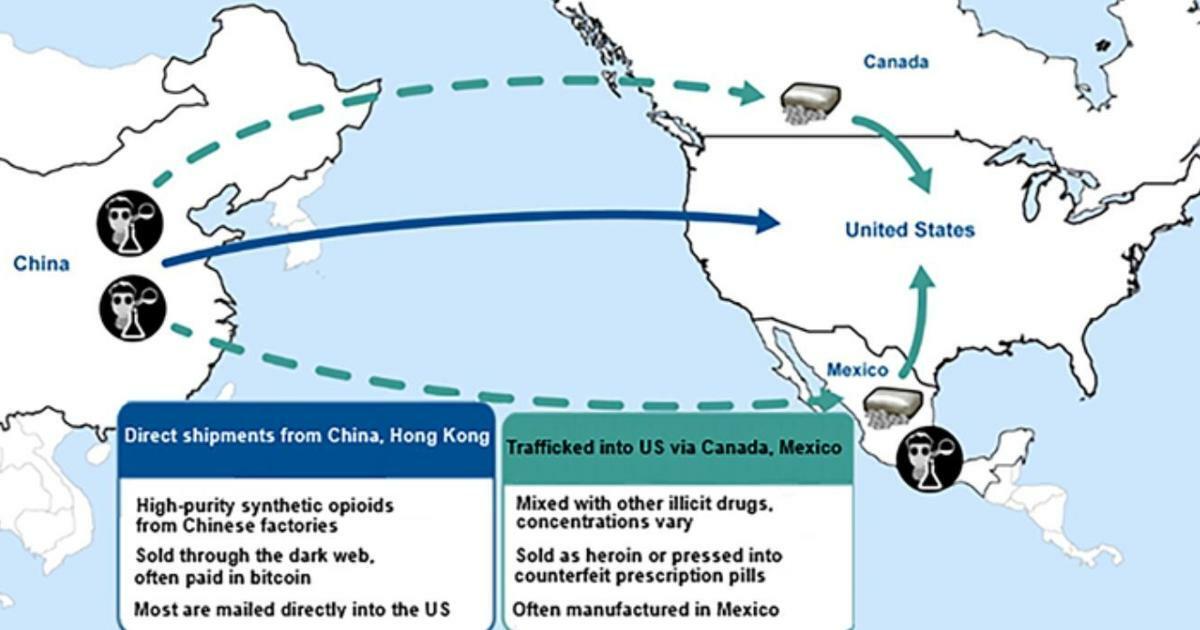
The issue has now reached Canada's political arena. With President Donald Trump's administration placing renewed pressure on Ottawa over cross-border fentanyl trafficking, Parliament is debating legislation to strengthen export controls — including greater powers to inspect postal shipments and tighten border-inspection regimes.

Some North American media outlets have criticized Washington's stance as unfairly portraying Canada as a source country for fentanyl. Yet within law-enforcement circles, the concern is real: transnational synthetic-narcotics syndicates originating in China — and operating through Latin American cartel networks — have exploited Canada's porous ports and liberal trade systems for years.

What began with mail-order protein powder, visa fraud, and exploitation of Canada's Non-Resident Import system — as New Zealand's case against Hong Kong national Chi Pang Li demonstrated — has evolved into multi-tonne, containerized narcotics traffic: evidence that Canada's Pacific gateways have become critical arteries in the global synthetic-drug economy, connecting China's chemical suppliers, cartel logistics networks, and Oceania's growing demand.

https://www.zerohedge.com/geopolitical/chinese-mexican-cartels-global-meth-supply-chain-exposed-vancouver-emerges-major-hub