Search This Blog

Thursday, October 9, 2025

NHS could pay more for medicines under new plan

 The UK government is considering ways to raise the price of medicines used by the NHS in an attempt to prevent further haemorrhaging of pharma industry investments in the country and avoid tariffs by the Trump administration.

That's the assertion in a report from Politico, citing "industry figures" who have indicated the main element of the plan will be raising the threshold for cost-effectiveness used by reimbursement authority NICE from its current ceiling of £30,000 per quality-adjusted life year (QALY).

That could go some way towards solving a current impasse between the pharma industry and the government on the system of rebates levied on sales of medicines to the NHS above a certain threshold, which is currently at record levels.

The QALY threshold used by NICE in its appraisals of new medicines has remained the same for more than 20 years, and has been an irritant for many years for the pharma industry, which contends that 'stagnation' in the measure is one of reasons why the real value of what the UK is willing to pay for new medicines has declined by 47% since 1995.

If the upper end of NICE's threshold had risen with inflation since 1999, it would now be around £56,794, according to the Association of the British Pharmaceutical Industry, which said that most countries do not specify a threshold for making decisions about funding new medicines and – among those that do – the UK is among the lowest.

The ABPI is pushing for the threshold to be raised to between £40,000 and £50,000 straight away and then linked thereafter to inflation, which would in time allow the share of the NHS budget spent on medicines to rise from its current level of around 9%, which lags behind other economies in western Europe. NICE already uses a higher £50,000 QALY threshold for severe diseases.

Issues over NHS drug pricing and rebates have resulted in some companies – including AstraZeneca, MSD, and Eli Lilly – abandoning UK investment programmes in protest as they ramp up spending in the US.

According to the Politico report, the UK government is preparing to brief the pharma industry on the details of its proposal later this week, and the measure is part of an effort to sidestep the 100% tariff on pharma imports to the US announced by the Trump administration last month.

Last week, Varun Chandra, the business advisor to UK Prime Minister Keir Starmer, held talks with US officials and pharma companies to try to reach an agreement on tariffs on medicines, which were left out of the recent UK-US trade agreement.

Drugmakers have come under pressure from Trump's Most Favoured Nation (MFN) policy, which is seeking to tie US medicine prices to those of similar economies elsewhere in the world, and some have already said that they will charge the same for certain new medicines in the UK as in the US, or simply decide not to supply the market if that is not possible.

Pfizer has sidestepped the tariff by agreeing to reduce the price of some of its medicines in the US and pledging a major investment in R&D and manufacturing capacity there, and other drugmakers are expected to follow suit.

Opponents of the idea of raising the QALY threshold argue that spending more on medicines diverts funding away from other NHS services that provide a greater return on healthcare investment and could lead to an overall reduction in public health.

"The industry position suggests that, unless new drug prices increase, life sciences in the UK will take a hit. But the factors that attract investment to life sciences are things like taxation, grants, and a skilled workforce. There is no reason why the prices the NHS pays for new products should influence this investment," commented Prof Mark Sculpher of the University of York.

"The geopolitical position is, however, complex and may force a trade-off between the health of the population and UK trade," he added. "If so, the government should be transparent about how any changes will be funded and the likely impact on the health of patients."

On the other hand, elevating the threshold could increase access for NHS patients to innovative treatments that were previously excluded on grounds of excessive cost relative to their clinical benefit, according to Prof Azeem Majeed of Imperial College London, although he acknowledged that would also put increased pressure on the NHS budget.

"It is not a straightforward issue and the Department of Health and Social Care, the Department for Business and Trade, and the Treasury may all have differing views about the relative costs and benefits of the change," he said. "Ultimately, the decision will depend on the government's political and economic priorities and its assessment of the relative importance of the competing costs and benefits."

https://pharmaphorum.com/news/nhs-could-pay-more-medicines-under-new-plan

Amazon to launch drug vending machines at One Medical sites

 Amazon's latest bid to disrupt the healthcare market in the US will see the introduction later this year of electronic kiosks at One Medical sites that will be able to dispense common medications.

The vending machines will start to roll out in Los Angeles in December and carry a range of drugs like antibiotics, asthma inhalers, and high blood pressure therapies, with hundreds of products that will be tailored to the prescribing patterns of each specific office location. A wider rollout of the network will take place in 2026.

According to Amazon, they will help patients get medications immediately after appointments and reduce the risk that they won't actually get their medicine. After getting a prescription, patients can choose to have it sent to Amazon Pharmacy for in-office kiosk pickup, with medications "typically ready in minutes."

It's the latest stage in a push by the e-commerce giant into health that gathered momentum in 2022 when it acquired One Medical, which provides virtual and in-person primary care services using a subscription fee model.

In recent years, it has also started operating an online pharmacy business – now integrated even more closely with One Medical – as well as a low-cost subscription service for generic medicines, and health monitoring programmes. The encroachment into health has thrown down the gauntlet to more established players in telehealth like Teladoc, Amwell, and MDLIVE.

In its launch announcement, Amazon cited figures showing that nearly a third of prescriptions are never filled in the US, while half of medicines for chronic conditions are not taken as prescribed, saying that kiosks can help to overcome those problems.

The scheme will also help to address the issue of 'pharmacy deserts' in the US, which the company said are seen in a quarter of all neighbourhoods and act as an impediment to better health outcomes and preventable health care costs.

"We know that when patients have to make an extra trip to the pharmacy after seeing their doctor, many prescriptions never get filled," said Hannah McClellan, vice president of operations at Amazon Pharmacy.

"By bringing the pharmacy directly to the point of care, we're removing a critical barrier and helping patients start their treatment when it matters most – right away."

In September, Amazon said that its online pharmacy business has helped customers save more than $100 million on prescription medications by automatically applying manufacturer-sponsored coupons directly to eligible orders.

https://pharmaphorum.com/news/amazon-launch-drug-vending-machines-one-medical-sites

Desperate Dem Sen. Claims Trump Staged Portland Antifa Riots To Justify Crackdown

 by Steve Watson via Modernity.news,

A Democratic Senator openly claimed Tuesday that the Trump Administration faked violent clashes between Antifa thugs and ICE officers in order to justify a federal surge.

Senator Jeff Merkley says that Trump “staged a fake riot” in order to invoke the Insurrection Act.

Merkley claims that peaceful protesters were marched three blocks and then confronted with “a line across the road, accompanied by “professional videographers.”

The Senator alleges that pepper balls, flashbangs sounding like gunfire, and tear gas were used, creating the appearance of a riot.

The Senator alleges that pepper balls, flashbangs sounding like gunfire, and tear gas were used, creating the appearance of a riot.

To be clear, he is suggesting that the Antifa leftists themselves are ACTORS.

“Of course when you put teargas everybody moves,” Merkley said, adding “It looks as if there is some kind of riot going on.”

He charged that the exchange was “Totally fake,” asserting that “This was first time I know at least in my lifetime that federal government has faked A RIOT in order to try and justify if you will the insurrection act being invoked.”

Yeah, because Portland is really a peaceful utopia where leftist agitators never cause any trouble.

It’s unclear exactly which exchange Merkley is referring to, but rioting and attacks on the ICE facility in Portland has been going on almost every night for months.

Merkley’s demented remarks come in the wake of Illinois Governor JB Pritzker suggesting that Trump is deploying the National Guard to cities as part of a grand scheme to end elections in the U.S.

*  *  *

https://www.zerohedge.com/political/desperate-dem-sen-claims-trump-staged-portland-antifa-riots-justify-crackdown

AI Is Now A Debt Bubble Too, Quietly Surpassing All Banks To Become The Largest Sector In The Market

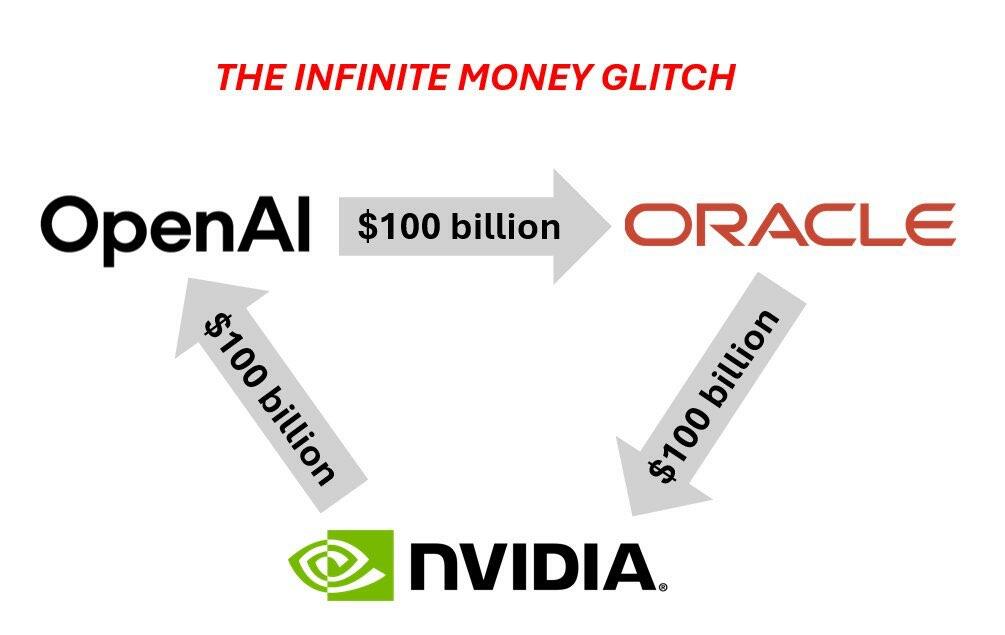
 Last week we published a lengthy article discussing in detail the current generation's (because every generation has one, just ask Global Crossing) "infinite money" circle jerk circular deals which have become the de jour staple of the AI bubble and which, simplified, look something like this...
... or, using a slightly more sophisticated variation from Bloomberg, like this...
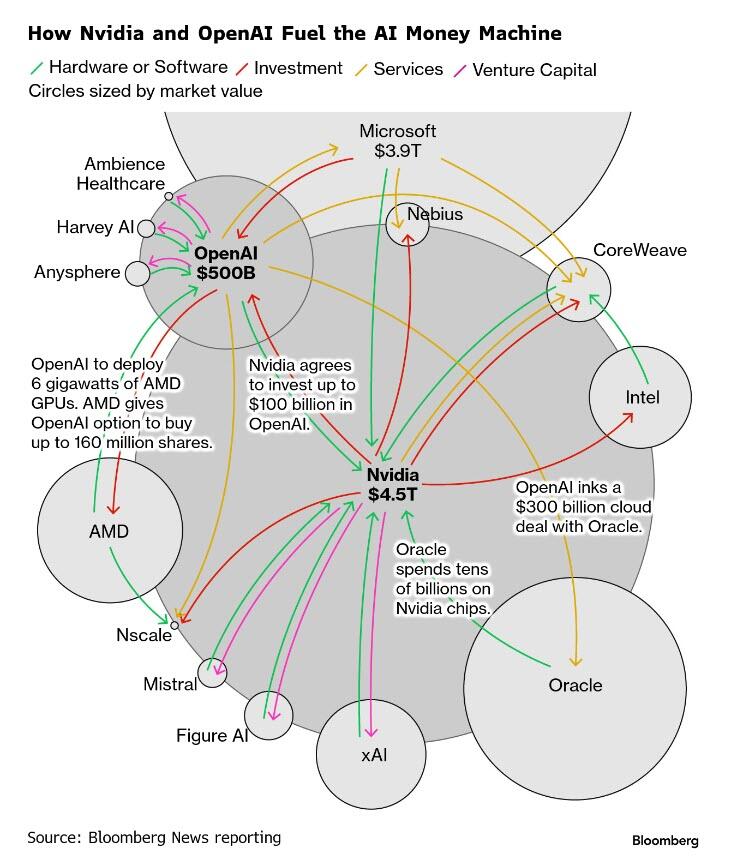
... which JPM's Michael Cembalest described laconically as follows...

Oracle’s stock jumped by 25% after being promised $60 billion a year from OpenAI, an amount of money OpenAI doesn’t earn yet, to provide cloud computing facilities that Oracle hasn’t built yet, and which will require 4.5 GW of power (the equivalent of 2.25 Hoover Dams or four nuclear plants), as well as increased borrowing by Oracle whose debt to equity ratio is already 500% compared to 50% for Amazon, 30% for Microsoft and even less at Meta and Google. 

There is no way for Oracle to pay for this with cash flow. They must raise equity or debt to fund their ambitions. Until now, the AI infrastructure boom has been almost entirely self-funded by the cash flows of a select few hyperscalers. Oracle has broken the pattern. It is willing to leverage up to hundreds of billions to seize a share. The stable oligopoly is cracking…The implications are profound. Amazon, Microsoft and Google can no longer treat AI infrastructure as a discretionary investment. They must defend their turf. What had been a disciplined, cash-flow-funded race may now turn into a debt-fueled arms race. 

... and which has conjured out of thin air massive amounts of investment capital which as Jensen Huang was kind enough to admit to CNBC earlier today, actually does not even exist...

... but will at some point in the future, either in the form of future cash from operations, equity raises (don't tell current investors) or debt. Well, really just debt. 

Lots and lots of debt, because with negligible enterprise penetration and the biggest use case so far being a $19.99 monthly subscription for lazy college students who are outsourcing their essay writing to some chatbot, someone has to pay for the $500 billion in annual capex.
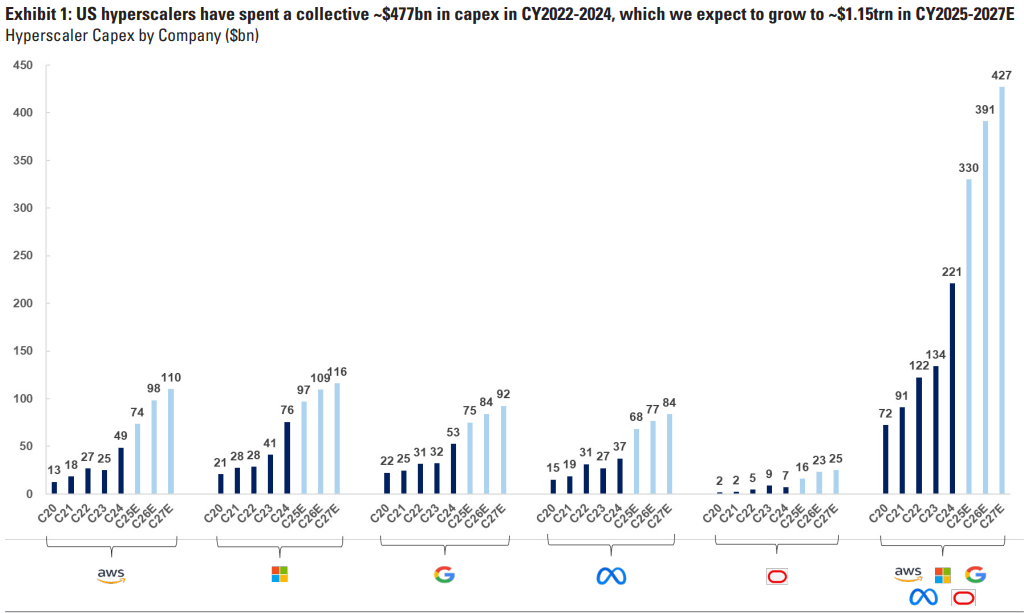
That someone, we discussed in detail, will be a new generation of creditors. Some will be private creditors as we explained back in July in "The Shocking Math: Paying For AI Capex Will Require Over $1 Trillion In New Debt By 2028," in which we quoted some stunning numbers from Morgan Stanley:

We forecast roughly $2.9 trillion of global data center spend through 2028, comprising $1.6 trillion on hardware (chips/servers) and $1.3 trillion on building data center infrastructure, including real estate, build costs, and maintenance.

This translates into investment needs of over $900 billion in 2028. For context, the total capex spending by all companies in the S&P 500 index combined was about $950 billion in 2024.

Such large potential spending has significant macro consequences as well. Our economists expect that investment spending related to data center  construction and power generation will add up to 40bp to US real GDP growth between 2025-26.

That's the good news... which many will say is already largely priced in. The bad news, again, is who pays for all of this. And Morgan Stanley admitted as much:

By any measure, the capital requirements to support this level of investment are staggering, and mobilizing efficient and scalable capital  becomes increasingly critical. We did a deep dive into this topic, exploring alternative avenues of capital to finance this expenditure, in a collaborative report published a few days ago. The key takeaway from the report is that credit markets – secured, unsecured, and securitized in both public and private markets – will play a growing role in financing data centers.

To be clear, capex related to AI and data centers has been in motion for the last few years. Spending from the hyperscalers alone has gone from ~$125 billion two years ago to ~$200 billion in 2024 and the consensus expectation is that it exceeds $300 billion in 2025.

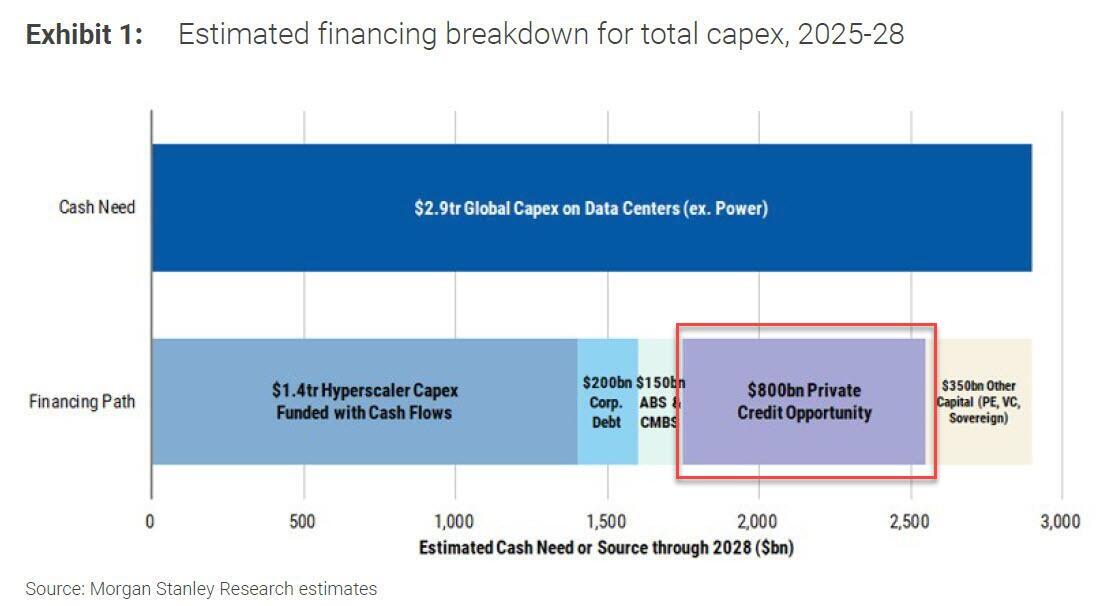
Internal operating cash flows from the hyperscalers have been the source of this spending. However, our equity analysts expect the investment needs for data centers to rise sharply over the next few years. While cash flows from hyperscalers will remain a key source of capital to  finance data center-related spending, these alone will no longer be adequate, after accounting for cash build and shareholder  capital returns. Leveraging our equity analysts’ projections, we estimate that $1.4 trillion of hyperscaler capex may be self-funded with cash flows, leaving a sizable $1.5 trillion financing gap.

We think that credit markets, broadly defined to encompass both public and private markets of different flavors, will gain traction as more efficient providers of capital to bridge this gap. There is a favorable alignment of significant and growing dry powder across credit markets with attractive real yields on offer with appeal to a sticky end-investor base (e.g., insurance, sovereign wealth funds, pension funds, endowments and high net worth retail) looking for scalable, high-quality asset exposures that can provide diversification benefits. We think that this alignment of needs of capital and investment will pave the way for bridging the $1.5 trillion financing gap.

We size the different financing channels as follows: unsecured corporate debt issuance from issuers in the technology sector (~$200 billion); securitized markets in the form of data center ABS and CMBS (~$150 billion), private credit markets in the form of asset-based financing (~$800 billion), and other capital sources across sovereign, private equity, venture capital, and bank lending (~$350 billion). Of these, we think that private capital – in particular credit – will play a key role in meeting a majority of the remaining financing gap as it sits optimally at the intersection of significant expansion in AUM in a higher rate environment and the complex, global, and customized financing needs that are associated with AI build-out. 

As MS concludes, "the point we want to drive home is that credit markets will play a major role in enabling AI-driven technology diffusion" and of all the available sources of credit, the chart below shows just how big the debt hole is that private credit will have to plug.
Two months later, a study by Bain came to virtually the same conclusion: 

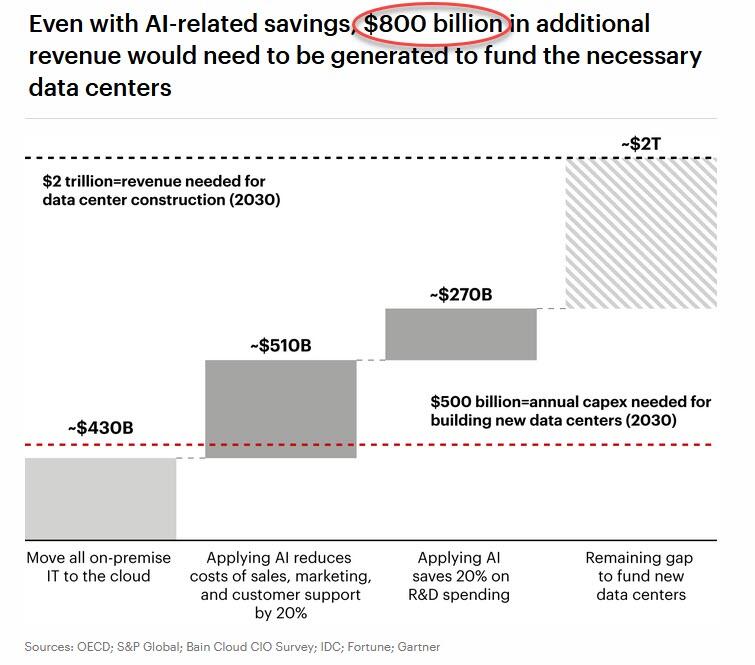
Bain’s research suggests that building the data centers with the computing power needed to meet that anticipated demand would require about $500 billion of capital investment each yeara staggering sum that far exceeds any anticipated or imagined government subsidies. This suggests that the private sector would need to generate enough new revenue to fund the power upgrade. How much is that? Bain’s analysis of sustainable ratios of capex to revenue for cloud service providers suggests that $500 billion of annual capex corresponds to $2 trillion in annual revenue.

What could fund this $2 trillion every year? If companies shifted all of their on-premise IT budgets to cloud and also reinvested the savings anticipated from applying AI in sales, marketing, customer support, and R&D (estimated at about 20% of those budgets) into capital spending on new data centers, the amount would still fall $800 billion short of the revenue needed to fund the full investment.

And visually:
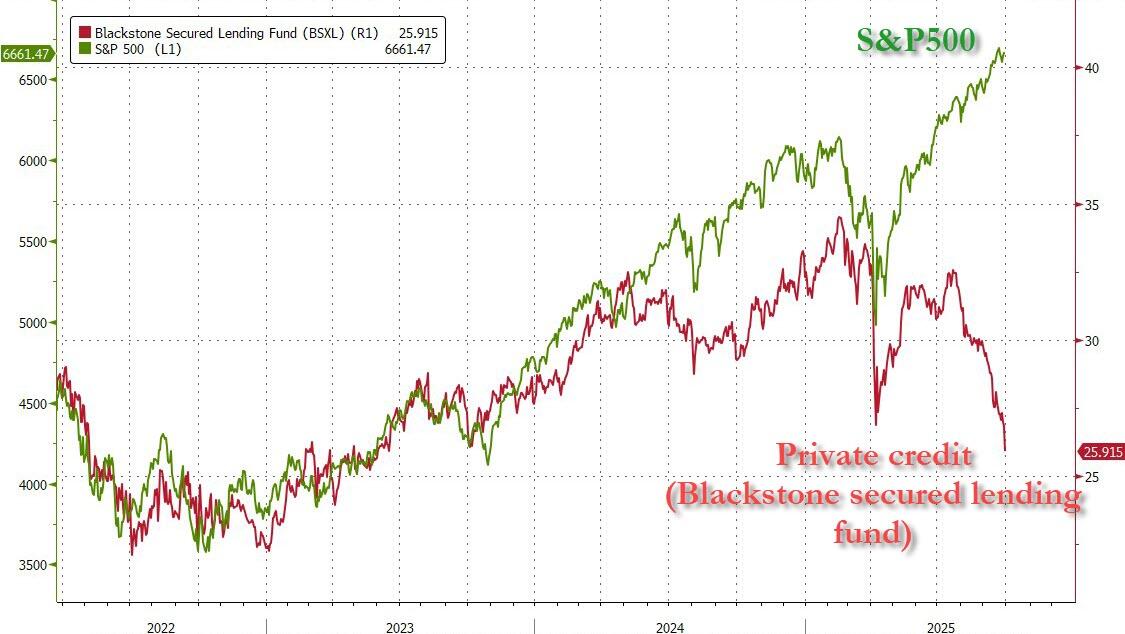
The problem, as we detailed last week, is that the private credit sector is starting to crack under the massive weight of its exposure to US consumers (where such notable implosions as the Tricolor and First Brands bankruptcies are just the beginning).
Luckily, there is also the public credit sector, and here we have a full-blown debt bubble brewing as well. And yes, it's all tech related too. 

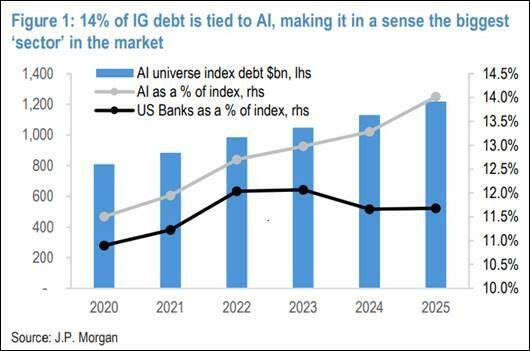
According to JPMorgan's Eric Beinstein and Nate Rosenbaum (full note available here), AI-related companies now make up 14% of the Investment Grade Index with $1.2T in debt. Shockingly, this is now the largest sector within the IG index, exceeding Banks.
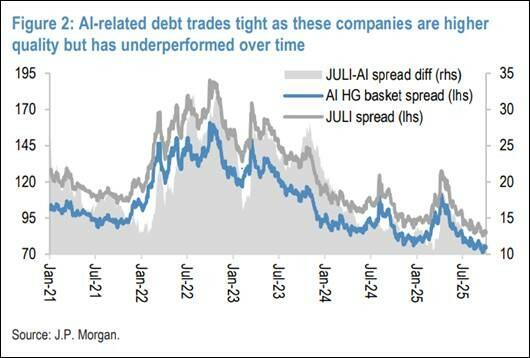
Further, the sector trades ~74bps which is 10bps tighter than the broader JULI index (these companies can be tracked on BBG via JPM's Delta-One basket JPAMAIDE).
This is how Beinstein summarized the problem:

The torrid ascent of AI stocks has caused some angst for credit investors worried that any potential downside there could have credit implications. We think that from a fundamental perspective, these fears are not justified as these companies are either cash rich/not highly levered (Tech and Cap Goods) or highly regulated (Utilities). That said, an equity selloff in AI-related names would likely impact credit too, and, given these companies trade tight to the rest of the market, a short basket of single name CDS may be an effective tail-hedge for cross-asset investors.

In conjunction with JPM HG Credit Tech, Utilities and Cap Goods analysts, we have identified what we believe to be the current cohort of IG companies most closely tied to the AI revolution. The amount of debt tied to these companies has grown rapidly to $1.2tr currently. As such, AI companies as we define them now make up 14.0% of the IG index, which if thought of as a ‘sector’ is now larger than the largest HG sector (US Banks).

JPMorgan's conclusion: "The market cap of the JPAMAIDE equity basket has grown to 39% of the market cap of the S&P500 so a repricing could be significant for broader markets"

At the single security level, AAPL, DUK, and ORCL are the largest bond issuers but are cash rich/net debt low types of companies. Of these, the last one is the most concerning because as JPM's Cembalest wrote in "The Data Center Blob", Oracle has a debt to equity ratio of 500% compared to 50% for Amazon, 30% for Microsoft and even less at Meta and Google. In other words, once the AI credit bubble bursts, Oracle will be the first to go.
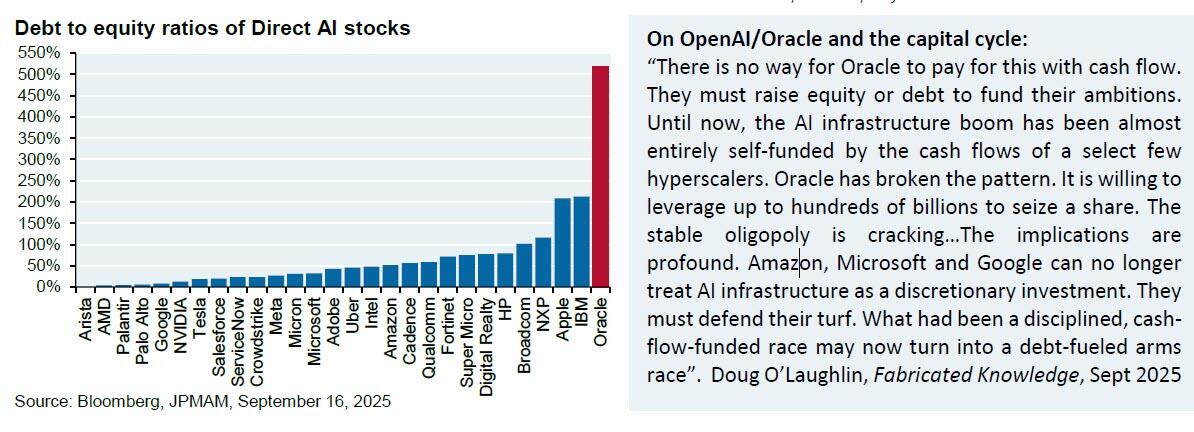
There is a bigger problem: if and when the AI paradigm shifts, whether due to the market suddenly demanding tangible returns on AI investment and not just circle jerk funny money, or because China comes up with a 1000x cheaper AI chip than Nvidia, or reverse engineers a better LLM than anything the Sam Altman "non-profit" can push out, equity investors in the AI sector will suffer massive losses, but at least these will be large contained to the stock market. However, it is the AI credit, which is being used to pay for that $500 billion in annual capex and serves as the scaffolding of the broader economy, and which is "guaranteed" with future cash flows that will never come, that will be the true time bomb that wrecks the economy once the AI bubble bursts. 

Or maybe not. 

In its gloomy report (mentioned above), which calculated the massive funding shortfall facing the AI bubble and which virtually assures it will burst over time, the consultancy laid out a case in which the economics of AI might actually work:

Technological breakthroughs change the landscape. History is replete with unexpected leaps of progress in computational power. Sixty years of Moore’s law progress in semiconductors has given us handheld devices that far outperform the most powerful computers of the 1970s. Many speculate that quantum computing, for example, could displace the favored semiconductors trajectory of today, reducing the compute and power demands of tomorrow’s systems. Bain’s research suggests we are at least 10 to 15 years away from quantum computers stable enough to replace generative AI training and inference workloads. Other technological breakthroughs could include specially designed training and inference application-specific integrated circuits (ASICs), which could be more efficient than general purpose graphics processing units (GPUs), or new forms of memory or advanced packaging to improve power efficiency.

In other words, there is hope the AI bubble won't burst and drag global markets and the economy with it, and that the AI sector will one day become self-sustaining. All we need, is a miracle.

https://www.zerohedge.com/markets/ai-now-debt-bubble-quietly-surpassing-all-banks-become-largest-sector-market

Novo Nordisk buys MASH specialist Akero for up to $5.2bn

 Novo Nordisk has agreed to buy Akero Therapeutics in a deal rising to a potential $5.2bn, as the Danish drugmaker looks to solidify its recent entry into the liver disease market amid restructuring efforts.

Novo will pay Akero shareholders $54 per share in cash, which represents a premium of around 16% to Akero stock’s last close of $46.49 on 8 October.

The semaglutide manufacturer will also pay an additional $6 per share upon US approval of Akero’s lead product candidate, efruxifermin (EFX), for treatment of compensated cirrhosis due to metabolic dysfunction-associated steatohepatitis (MASH) by mid-2031.

The deal represents the first major financial outlay by Novo’s CEO, Mike Doustdar, who joined the company in August 2025. Doustdar is tasked with turning around the company’s fortunes after falling behind Eli Lilly in the weight loss and type 2 diabetes treatment market. The new CEO already cut 9,000 jobs last month.

The liver disease market could represent a strong growth avenue for the company in the future. Novo’s Wegovy (semaglutide) became the first glucagon-like peptide 1 receptor agonist (GLP-1RA) to gain US approval for MASH treatment in August 2025.

According to GlobalData estimates, the MASH market is anticipated to reach sales of $25.7bn in 2032 across the seven major markets (7MM: US, France, Germany, Italy, Spain, the UK, and Japan).

GlobalData is the parent company of Clinical Trials Arena.

The decision to acquire Akero Therapeutics, therefore, makes strategic sense when combined with Novo’s recent MASH win and obesity treatment expertise. More than 40% of MASH patients also have type 2 diabetes, and over 80% of MASH patients are overweight or living with obesity, representing the closely linked nature of the diseases, according to Novo Nordisk.

“If approved, we believe it could become a cornerstone therapy, alone or together with Wegovy (semaglutide), to tackle one of the fastest-growing metabolic diseases of our time,” said Doustdar in a statement.

Adding flavour in a conference call on 9 October, Doustdar commented that: “We have been looking at a number of assets for a long period of time… [this deal] reflects the fact that we are continuously on the lookout for best in class and possibly first in class assets that fit within our strategy.”

The CEO stated the drug could become a “building block” for strengthening the company’s top line.

EFX is currently being evaluated as a once-weekly subcutaneous injection in the SYNCHRONY programme, which consists of three Phase III clinical trials in patients with pre-cirrhotic (F2-F3) MASH or compensated cirrhosis (F4) due to MASH. The triplet of randomised trials (NCT06215716, NCT06528314, NCT06161571) has enrolled 3,500 patients in total.

EFX has already demonstrated positive results in two Phase IIb trials. Akero’s drug significantly improved liver fibrosis and reversed compensated cirrhosis due to MASH. Over 96 weeks, the HARMONY (F2-F3) trial (NCT04767529) and SYMMETRY (F4) trial (NCT05039450) demonstrated 49% and 29% reduction in fibrosis without worsening of MASH respectively, compared to 19% and 11% in the respective placebo groups.

Akero’s EFX is a fibroblast growth factor 21 (FGF21) analogue that works by reducing liver fat, inflammation, and fibrosis. While EFX is the only treatment to have shown significant fibrosis regression in F4 patients in a Phase II trial at this stage, it is far from the only FGF21 to be on the market this year.

“Novo Nordisk’s acquisition of Akero is the third and largest major acquisition of an FGF21 analog by a big pharma company in the MASH therapy space over the last few months,” said Jay Patel, senior analyst at GlobalData.

Roche acquired pegozafermin-developer 89bio for $3.5bn in Sep 2025, while GSK agreed to buy efimosfermin from Boston Pharma for $2bn in May 2025. Novo’s deal is the most expensive, suggesting the treatment’s potential in MASH F4 is a strong revenue driver.

“[The deals this year] signal strong industry confidence in the potential of FGF21 analogs in MASH, suggesting this drug class could be the future of MASH treatment,” Patel added.

Novo Nordisk’s decision follows the discontinuation of its own FGF21 analog, zalfermin, which was being developed in combination with Wegovy and the amylin analog cagrilintide for MASH F2-3 and ALD.

https://finance.yahoo.com/news/novo-nordisk-buys-mash-specialist-140825067.html

Next CDC AdCom meeting on vaccines delayed

 The Centers for Disease Control and Prevention’s (CDC) Advisory Committee on Immunization Practices (ACIP) has postponed its upcoming meeting, originally scheduled for October 22-23. Officials have not announced a new date for the gathering. This development coincides with the release of new research from the Department of Veterans Affairs (VA), which highlights the continued effectiveness of COVID-19 vaccines in preventing severe outcomes such as hospitalizations and deaths.

The VA study underscores the protective benefits of COVID-19 vaccinations, particularly in reducing serious health risks associated with the virus. The findings arrive at a time when public health officials continue to monitor vaccine efficacy amid evolving variants and shifting pandemic dynamics. No further details regarding the reasons behind ACIP’s postponement or its potential rescheduling have been provided at this time.

https://www.geneonline.com/cdc-advisory-committee-meeting-postponed-as-va-study-confirms-covid-19-vaccines-prevent-severe-outcomes/

Citi makes strategic investment in stablecoin startup BVNK

 Citigroup's (NYSE:C) venture arm, Citi Ventures, has made a strategic investment in the stablecoin infrastructure startup BVNK.

Financial terms of the transaction were not disclosed.

https://www.msn.com/en-us/money/companies/citi-makes-strategic-investment-in-stablecoin-startup-bvnk/ar-AA1O94Pw