Search This Blog

Thursday, November 6, 2025

Problems with ACA Subsidies Compounded by COVID Credits


Unfair to Americans with Employer-Based Insurance, Punish Work, and Incentivize Employers to Drop Coverage

Key Takeaways

  • The ACA subsidies create major financial inequities for low- and middle-income Americans, penalizing those who receive health insurance through their employers.
  • The ACA subsidies shift the tax code from rewarding work and employer coverage to subsidizing early retirement and non-work while discouraging upward mobility.
  • The ACA subsidies create large incentives for employers—particularly those with a high concentration of low- and middle-income employees—to stop offering coverage:
    • Coverage offerings have already dropped by nearly one-third at small firms.
    • State and local governments have dropped retiree health plans by moving retirees into the exchanges.
    • If the COVID credits are made permanent, more employers will drop coverage for employees, and more state and local governments will offload retiree health care expenses onto federal taxpayers.
  • The COVID credits exacerbate all the underlying problems with the original subsidies.

Background on ACA and Employer Coverage

Most Americans who are not enrolled in Medicare or Medicaid receive health insurance through their employers or those of their spouses or parents. These workers pay for that coverage. Although commonly called the employer’s share of the premium, that amount simply represents wages the employee forgoes. Because premiums are excluded from income and payroll taxes, employees face a lower tax burden than if the same compensation were paid in wages. This is an untaxed earned benefit.

By contrast, the vast majority of people who receive coverage on the exchanges established under the Affordable Care Act (ACA) bear little, if any, of the cost. In effect, the ACA exchanges function as welfare—an unearned benefit provided by federal taxpayers.

The ACA created premium subsidies that limit the amount of income households must pay for health insurance on the ACA exchanges. The subsidies are structured to be much more favorable for Americans nearing retirement than for younger Americans. In 2021 and 2022, without any Republican support, Democrats expanded those subsidies—the so-called Biden COVID credits—and lifted the cap that had originally limited ACA subsidies to households earning less than four times the federal poverty level (FPL). Congressional Democrats set the COVID credits to expire at the end of 2025. As a result of that subsidy expansion, in 2024, federal taxpayers covered 83 percent of the revenue insurers collected for exchange plans and 87 percent in states using the federal exchange1 Moreover, roughly half of all enrollees were enrolled in fully subsidized plans that did not require enrollees to pay any portion of the premium.

As a result, two workers creating equal value for an employer receive dramatically different after-tax compensation depending on whether their employer offers coverage. If one worker receives employer coverage and earns a low or middle income, he is worse off, because part of his compensation must go toward that coverage. If he does not receive employer coverage, he generally qualifies for large premium subsidies—particularly after the Biden pandemic-era subsidy expansion—and will in most cases be much better off economically. Thus, the worker without employer coverage ends up with higher wages and greater federal health insurance benefits.

The authors of the ACA needed to build on employer-based health benefits—a characteristic of the American workplace since around World War II—for political and policy reasons. In an attempt to expand coverage with the lowest possible budgetary cost, the ACA included an employer mandate and barred people with offers of “affordable” employer plans from premium subsidy eligibility. Under the mandate, employers with 50 or more workers have to offer “affordable” coverage to at least 95 percent of their full-time employees (those who work for at least 30 hours a week) or suffer significant fines.2 The ACA defines <em>affordable</em> as no more than 9.5 percent of an employee’s household income.3

Of note, the Biden administration expanded eligibility for subsidies in the so-called “family glitch” fix by—with questionable legal authority—redefining affordability based on the cost of family coverage, not single coverage. By doing this, employers have less incentive to offer “affordable” dependent coverage, which means that more dependents will lose employer coverage and be shifted to the exchanges unless the Trump administration returns to the policy that prevailed in the Obama administration and first Trump administration.

The employer mandate penalty was necessary because the ACA’s subsidy design discriminates against low- and middle-income workers offered employer-provided health benefits. Without government coercion to continue offering health benefits under threat of severe penalty, many employers would have stopped offering coverage, leading their workers to enroll in exchange plans at significant additional cost to taxpayers.

Despite the ACA’s employer mandate, some anticipated a reduction in employer-based insurance offerings because of the exchanges and corresponding subsidies. The Congressional Budget Office (CBO) forecast that about 3 million fewer people would have employer-based plans in 2019, five years after the ACA exchanges launched—a reduction of about 2 percent.4 But some surveys of employers forecast a different result. A McKinsey and Company survey in 2011 attracted the most attention, finding that 30 percent of employers would “definitely” or “probably” stop offering health coverage under the new law.5 Among employers with a high awareness of the reform, the proportion choosing to drop coverage increased to 50 percent.

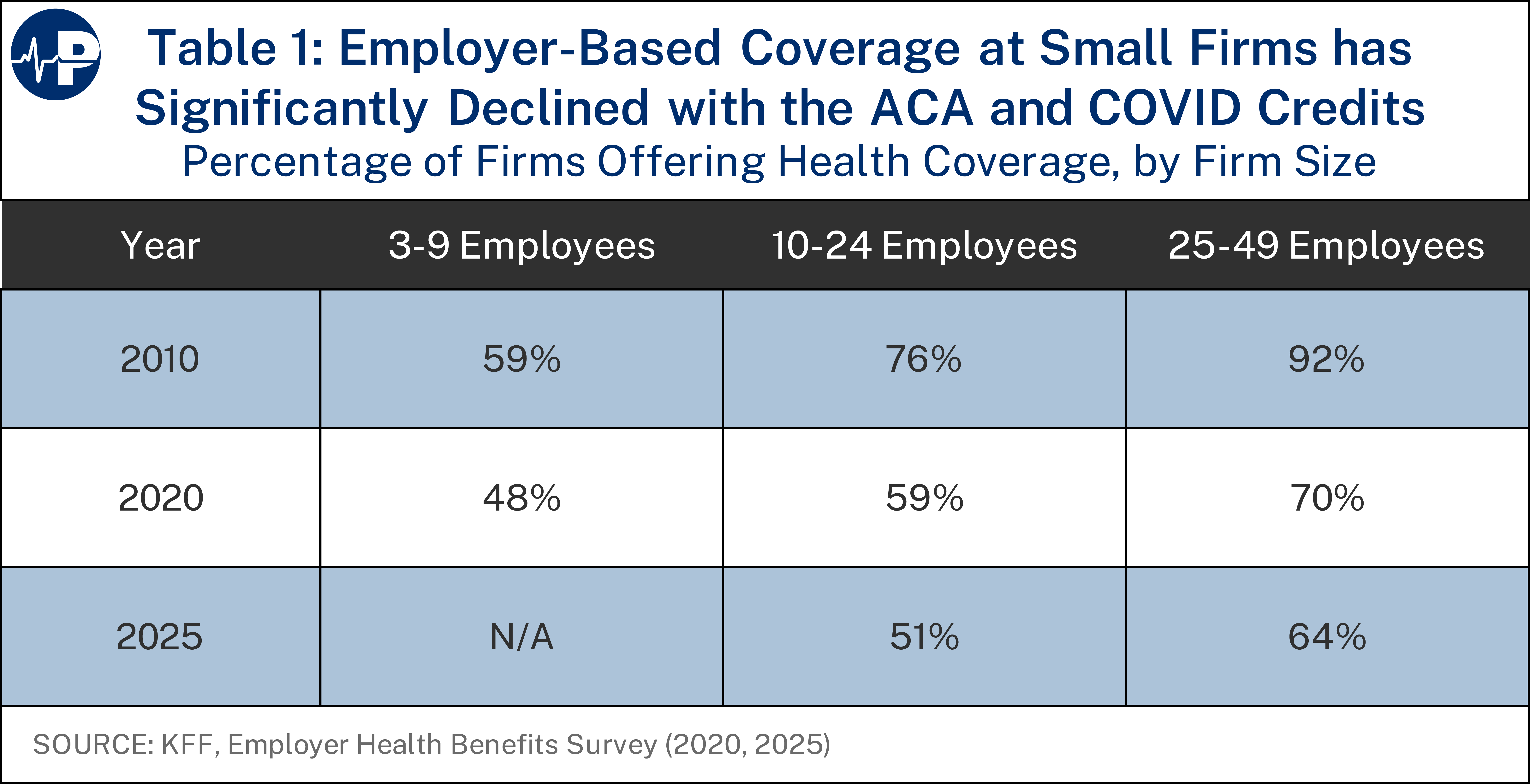
Although a large drop in employer-based coverage has not occurred, coverage has declined significantly at small firms. Exchange coverage was widely viewed as unattractive for employees, and few large employers altered their offerings because of the law. Because small businesses are exempt from the employer mandate, some dropped coverage after the ACA passed. As shown in Table 1, in 2010, 76 percent of firms with 10-24 employees and 92 percent of firms with 25-49 employees offered health insurance.6 By 2020 (the last year before the COVID credits), those numbers had dropped to 59 percent and 70 percent.7 By 2025, those numbers had fallen further—to 51 percent and 64 percent, respectively.8 There was also attrition in offerings at firms with three to nine employees from 59 percent to 48 percent from 2010 to 2020 (although this percentage was not reported for 2025). Small businesses are also more likely to drop coverage because administrative costs per employee for managing health benefits are higher at small firms than large ones.9
1AW Tab1 Employer Based Coverage At Small Firms A0wUU000004cWmAYAU 01

Although there has been a significant drop in small businesses offering coverage, the overall attrition of employer-sponsored insurance has been much less than expected, as almost all large employers (those with at least 50 full-time employees) have continued to offer coverage. For this reason, revenue collected from the employer mandate has been only about 1 percent of what CBO originally expected.10

This policy brief will discuss three key problems from the excessive subsidization of the ACA exchanges:

  1. Large discrimination against people with employer-provided coverage
  2. Large effective taxes on work, particularly for the most productive employees
  3. Large incentives for employers to drop coverage

Discriminating Against People with Employer-Provided Health Coverage

The results are perverse: people who keep working and receive coverage through their employer lose out, while those who don’t—such as early retirees—receive the biggest subsidies. Consider the case highlighted by U.S. Senator Amy Klobuchar: a couple in their 50s, recently retired from public employment, earning nearly $140,000 per year in combined pension income.11 Under the COVID credits, they received a $15,000 premium subsidy in 2025—even though they are in the top income decile.12 Before 2021, this couple would have received no premium tax credit (PTC) at all. The expanded subsidies transformed the ACA into a program that subsidizes not only low-income workers but also wealthy early retirees who can now leave the labor force—and the connection to employer-sponsored health coverage—years before becoming eligible for Medicare. In 2023, only about 6.7 percent of enrollees with employer-coverage were 60-64 compared to about 13.0 percent of enrollees in the exchanges of that age.13

This example vividly captures how the ACA’s subsidy design discriminates against working families. While full-time employees must pay their share of employer-based coverage out of earnings, high-income retirees with guaranteed pensions can receive tens of thousands of dollars in federal health insurance subsidies. The inequity has widened since the pandemic-era expansion, and if Congress makes the COVID credits permanent, similar couples across the country would gain another incentive to retire early, while younger workers with employer-based coverage would continue to shoulder the costs through higher taxes and lower wages.

The status quo is extremely unfair to workers who receive employer-based health benefits, especially those who earn lower wages. While less severe at higher incomes, the discrimination persists well into six-figure salaries, especially under the COVID credits.14 The figures below demonstrate the underlying unfairness to workers with employer-based coverage created by the ACA’s subsidy regime and how the unfairness would significantly increase if Congress maintains the COVID credits instead of allowing them to sunset at the end of this year (and three years after the end of the pandemic emergency for which they were instituted).

For this paper, we make a simplifying assumption that $1 of employer-based coverage is equivalent to $1 of ACA coverage. However, there is strong evidence that ACA coverage is of lower quality than employer-based insurance. A 2023 survey found 20 percent of ACA enrollees reported a doctor or hospital they needed was not covered by their plan, whereas only 13 percent of enrollees in employer-based health plans faced this problem. This rose to 34 percent of ACA enrollees in only fair or poor health, versus only 16 percent of enrollees in work-based plans. Further, twice as many ACA enrollees skip or delay care because they cannot find a doctor who accepts their plan than those with employer-based benefits do.15

Beyond the numbers, this difference in quality makes the perverse financial incentives to drop employer-based coverage for ACA plans even more distressing. Taxpayers are subsidizing working people and their families to move from higher quality to lower quality coverage. These disparities are not abstract. They translate into thousands of dollars in after-tax compensation differences for two workers doing the same job.

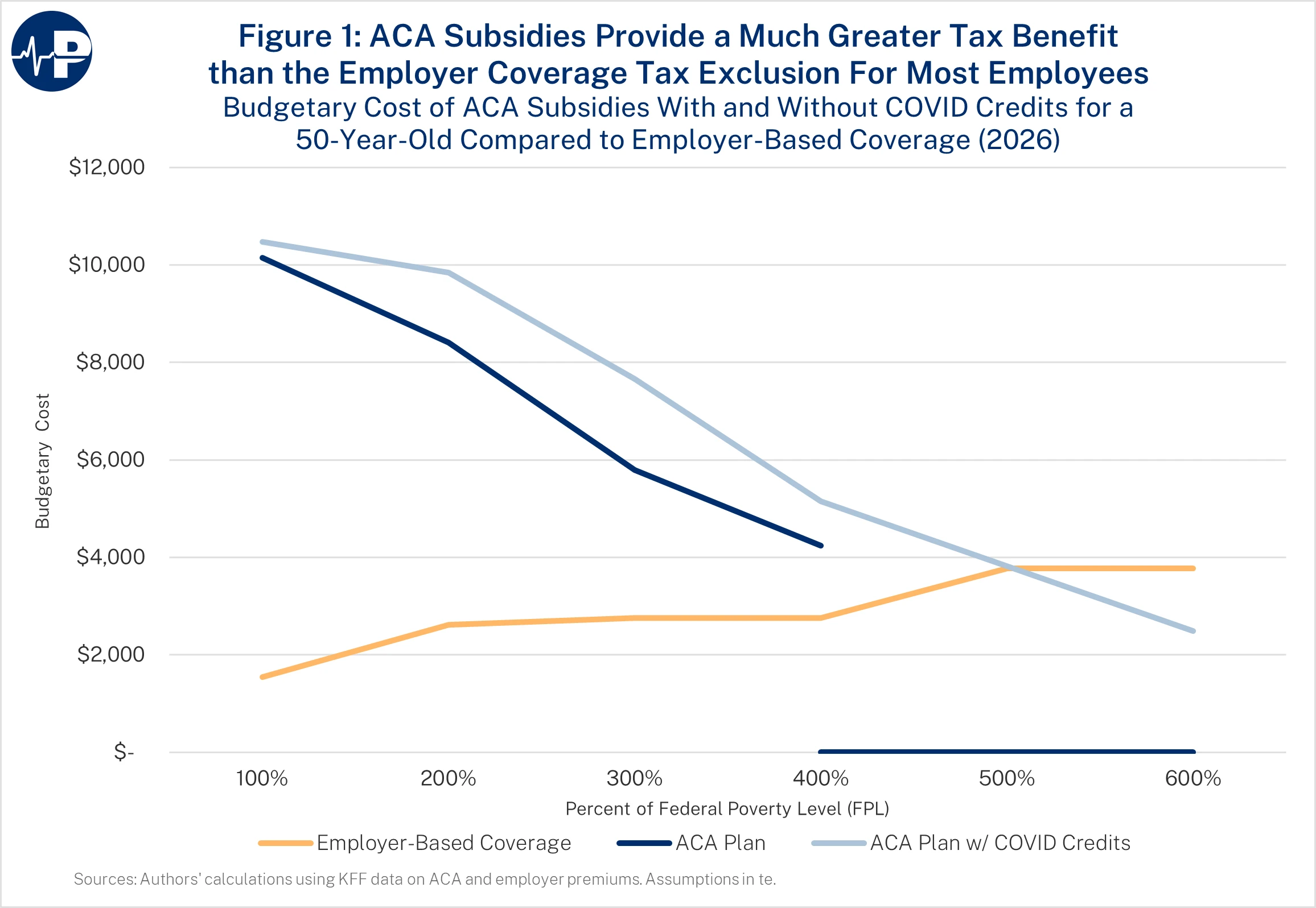
Figure 1 shows the size of the government health insurance benefit for a 50-year-old with single coverage at different income levels in 2026 for three scenarios: (1) employer-based coverage (orange line), (2) the original ACA subsidies (navy blue line) and (3) the original subsidies plus the COVID credits (light blue line). The government benefit in scenario 1 is from the exclusion of premiums from income and payroll taxes. The benefit in scenarios 2 and 3 is from the government subsidy for an exchange plan. The figure shows that lower- and lower-middle-income enrollees obtain much greater benefit if they do not receive coverage at work and instead enroll in exchange coverage. In other words, workers face a large penalty if they receive health insurance through their employers rather than through the exchanges.
11MH Fig1 ACA Subsidies Provide A Much Greater A0wUU000004cWmAYAU

Consider a worker earning $46,950 (300 percent FPL). With exchange coverage, he would receive a $5,797 PTC under current law—or $7,656 with the COVID credits. If a worker with the same job and salary has employer-based coverage, his tax benefit from the premium exclusion is $2,760. The difference—$3,037 under current law and $4,896 with the COVID credits—is effectively a penalty on the worker with employer-based insurance. Moreover, it is also a penalty on work. The worker with employer coverage earns his health benefit but is not taxed on that portion of his compensation. The person with employer-based health insurance does not earn the tax credit.

For a 50-year-old, the disadvantage of receiving employer-based coverage persists up to an income of 400 percent FPL under the original PTCs (because those above 400 percent FPL are ineligible for the original subsidies) and up to 500 percent under the Biden COVID credits (because the subsidy phaseout extends further up the income scale). This might explain why so few people at higher incomes who are working are enrolled in exchanges: They do not suffer the discrimination that lower-earning workers do and benefit from having jobs that offer health insurance. In 2025, fewer than 7 percent of exchange enrollees reported incomes above 400 percent FPL.16

Figure 2 demonstrates the differential benefit between the PTCs and employer coverage for a younger worker. The effects are not as pronounced, because younger workers qualify for lower PTCs as the plan premium is lower. Nevertheless, the effects can still be significant, because a 21-year-old is likely earning a much lower wage than her middle-aged colleague. If she earns $31,300 (200 percent FPL), her original PTC would be $3,798 and her PTC with the COVID credit would be $5,238, whereas the tax preference for an employer-based plan would be only $2,620. The difference between the PTC and her tax benefit for an employer-based plan, $1,178, is the increased tax burden she suffers if she chooses a job with health benefits. That burden would increase over two and a half times to $2,618 if Congress extends the COVID credits.

11.1MH Fig2 ACA Subsidies Provide A Much Greater A0wUU000004cWmAYAU

Figure 3 illustrates the effect for a young family with 35-year-old parents and two children, ages 7 and 10 years. If the family’s income is $64,300 (200 percent FPL), they will receive a PTC under the original ACA subsidies of $19,059. The tax break for an employer-based health plan for the family would be only $5,904. The difference is a $13,155 net government benefit for not receiving coverage at work. However, if Congress extends the Biden COVID credits, the family’s credit would be $22,017, and the net government penalty for receiving coverage at work would increase to $16,113.

11MH Fig3 ACA Subsidies Provide A Much Greater A0wUU000004cWmAYAU

Beyond discriminating among workers, the ACA subsidy structure also distorts how people make decisions about work and income.

ACA Subsidies Punish Work

By tying the government benefit to the absence of an employer-based health insurance plan, the government discourages people from working for employers who offer health coverage, which is most employers and virtually all large employers. This design distorts labor market decisions, encouraging people to opt for jobs or work arrangements that do not provide coverage simply to qualify for larger subsidies. Unlike employer-based benefits, which employers use to attract workers and have greater tax benefits when income increases, the ACA tax credits punish enrollees who increase their income, because earning higher income cuts their subsidies. By contrast, there is no disincentive to a worker with employer coverage who seeks to increase his pay by becoming more productive or working more. Because premiums are excluded from taxable income, the value of employer-provided health benefits rises as workers move into higher tax brackets. While there are drawbacks with employer coverage and the tax exclusion for premium payments,17 it does not punish workers who want to increase their earnings.

These inequities extend beyond fairness—they alter how people choose when and how much to work. The ACA subsidies present a disincentive for work and income growth as each additional dollar of income modestly reduces the subsidy amount. On average, the subsidy phaseout creates an implicit marginal tax rate of about 15 percent—so for every $100 in extra earnings, an enrollee loses roughly $15 in PTCs.18 As CBO projected in 2015, the ACA’s subsidy phasedowns would reduce the full-time workforce by roughly 2 million workers by 2025—underscoring how work-disincentive effects from the law have long been expected.19

Figure 4 illustrates this effect for a single 64-year-old—generally the oldest possible exchange enrollee. Under the ACA, he receives no PTC if his income exceeds 400 percent FPL ($62,600). However, if his income is up to that threshold, he would receive a PTC of $11,357—$8,597 more than his tax benefit if he received employer-based coverage. With the COVID credits, he would receive a total subsidy of $12,271, increasing the benefit of ACA coverage over employer coverage to $9,511. However, because the COVID credits extend beyond 400 percent FPL, the discrimination in favor of people who do not receive coverage at work persists even at very high income levels. We cut the figure at 600 percent FPL ($93,900), but the gap persists well into six-figure incomes.

11MH Fig4 ACA Subsidies Provide A Much Greater A0wUU000004cWmAYAU

For households like the early retirement couple cited above, the expanded subsidies also lower the effective cost of leaving the labor force. By guaranteeing heavily subsidized coverage to households with high pension income, the Biden COVID credits give affluent older Americans yet another incentive to retire early. The policy thus reduces workforce participation among the very people whose experience and productivity drive the economy while forcing taxpayers to finance their coverage.

Crowd-out of Employer Plans, and Rising Taxpayer Costs

The same subsidy design that discourages work also pressures small employers to drop coverage. When far larger government benefits are available for exchange plans than the tax exclusion for employer-based insurance, the financial calculus for firms—especially those with lower-wage employees—tilts toward not offering company health plans. Firms can increase worker well-being by raising wages and having workers qualify for premium subsidies on the exchanges. As more workers shift from employer coverage to subsidized exchanges, taxpayer costs rise sharply.

The worst discrimination caused by the ACA and the COVID credits is on Americans who receive employer plans and have modest incomes. Because of the fines on employers who fail to offer “affordable” health benefits, people who work at firms with at least 50 full-time employees are effectively unable to avoid this punitive tax treatment. Extending the COVID credits would reduce employer-based coverage by roughly 4 million people according to CBO, and it would impose a substantial deadweight loss on economic activity.20

However, employer plans are facing extreme cost pressure now, including the demand from employees to broadly cover GLP-1s. If the expanded COVID credits are made permanent, most employees would qualify for subsidies. Most small employers, particularly those with low- or middle-income workers, would have enormous incentives not to offer insurance. And some large employers, again those with low- or middle-income workers, would also have incentives to drop coverage. To the extent this happens, the growing cost of the ACA on federal taxpayers will escalate.

In addition to crowding out employer plans, <em>The Wall Street Journal’s </em>Allysia Finley recently highlighted that the ACA and its subsidies led many Democratic-dominated cities, such as Chicago and Detroit, to offload public sector retiree health care costs.21 These cities moved those retirees into the ACA exchanges, eliminating unfunded retiree health care liability. Finley correctly argues that the COVID credits make this dumping of public sector retirees’ health care obligations into the exchanges even more likely as few governments have set aside money to pay their retirees’ future health care costs. The COVID credits would make wealthy early retirees eligible for large taxpayer-financed subsidies for their health care, adding to the incentive for state and local governments to move those retirees into the exchanges. Finley also highlights the risk that this would make the ACA risk pool older and sicker, pushing up premiums and exacerbating structural problems in the program.

Conclusion

The ACA, compounded by the ill-conceived COVID credits, has produced a tax and subsidy structure that punishes workers with employer-based coverage. The underlying ACA subsidies, compounded by the COVID credits, penalize employment, reward early retirement, and leave taxpayers footing a rapidly expanding bill. Allowing the temporary COVID credits to expire is a critical step toward restoring fairness, strengthening work incentives, and improving fiscal discipline.


Brian Blase, Ph.D., is the President of Paragon Health Institute. Brian was Special Assistant to the President for Economic Policy at the White House’s National Economic Council (NEC) from 2017-2019, where he coordinated the development and execution of numerous health policies and advised the President, NEC director, and senior officials. After leaving the White House, Brian founded Blase Policy Strategies and serves as its CEO.


John R. Graham is a Visiting Fellow who contributes nearly three decades of health policy expertise to research across all of Paragon’s initiatives. He worked on Capitol Hill from 2021 to 2024 as a Professional Staff Member on the Senate Special Committee on Aging and the House Committee on Ways & Means. From 2018 to 2021, he served as the U.S. Department of Health & Human Services (HHS) Regional Director for Region 10 (Washington State, Oregon, Idaho, and Alaska), where he managed relationships with state governments and the private sector. In 2017-2018, John was the HHS Acting Assistant Secretary for Planning & Evaluation.


https://paragoninstitute.org/private-health/problems-with-aca-subsidies-compounded-by-covid-credits-unfair-to-americans-with-employer-based-insurance-punish-work-and-incentivize-employers-to-drop-coverage/

PBMs Support the Administration’s Drug Pricing Momentum

 The Trump Administration’s efforts to lower prescription drug prices has resulted in progress on a new approach to getting brand name drug manufacturers to announce price reductions in connection with direct-to-consumer avenues for Americans to access some of their products. Selling to direct-to-consumer has been characterized by some as a way to work around consumers’ pharmacy benefits – the reality is that America’s pharmacy benefit managers (PBMs) stand ready to support the Administration’s work to foster more options for patients and consumers by bringing to the table our expertise and ability to lower drug costs and support patient safety. There is enormous upside to making sure that direct-to-consumer options are pulled through to consumers’ insurance coverage to ensure they are not only getting the lowest cost for their medication, but that their safety and clinical needs are being taken care of.

Our industry commends the President and his Administration for their ongoing work to deliver a better deal for American patients, and for rightly recognizing that big drug companies set the price, can lower the price at any time — and that the price is the problem when it comes to Americans being able to afford their prescription drugs. PBMs support lower list prices for all drugs and welcome more options and greater competition across the entirety of the prescription drug marketplace.

PBMs deliver savings for consumers and patients who have prescription drug benefits by negotiating on behalf of health plan sponsors against big drug companies and maintaining accessible and affordable pharmacy networks, saving patients and payers on average $1,154 annually. This work results in low out-of-pocket costs for most insured patients for most drugs. PBMs also provide specialized clinical expertise to patients that supports adherence to treatment, prevents medication errors and negative drug-drug interactions, and promotes better health outcomes.

In fact, PBMs are helping patients avert a projected one billion medication errors over the next 10 years, improving drug therapy and patient adherence in patients with diabetes, and supporting convenient home delivery of medications and access to uniquely sophisticated specialty pharmacies for the most complex medicines and conditions.

So, it should come as no surprise that PBMs already work with direct-to-consumer sales models in the market today to provide this specialized support through the unique role our industry plays in the supply chain as the only participant with broad visibility into patients’ affordability and safety needs. Mail-order pharmacies operated by PBMs today provide a convenient, reliable, and affordable option for patients, including those in rural areas, to safely access prescription drugs.

Drug manufacturers set the list price of the medications they market. Their ability to announce that they will provide medications direct-to-consumers at a different price than they offer in other settings, as well as past actions to lower the price of insulin and other products under immense public pressure, clearly show that they can simply lower the prices, at any time.  

PBMs support efforts to lower prescription drug costs and PBMs have always supported greater competition in the health care system. Whether through traditional pharmacies, direct-to-consumer programs, or other avenues, we are committed to reducing drug costs in any way possible, while upholding patient safety and health outcomes.

We will also continue to support policymakers’ calls for lower drug prices for the American people. PBMs have repeatedly called on Big Pharma to lower list prices, and supported the work from the White House, and from Republicans and Democrats in Congress, to advance bipartisan reforms that would eliminate unnecessary red tape and foster greater competition from generics and biosimilars. The industry applauded the Administration’s recent announcement to remove the unnecessary step of providing studies for biosimilar interchangeability and make biosimilars more accessible for patients. These actions, along with cracking down on Big Pharma’s outrageous spending on misleading advertising for blockbuster brand-name products that increases costs for taxpayers and patients, will deliver real affordability.

More competition among drug companies and new models for patients to access medications are welcome — and we will work with the Administration and Congress to make prescription drugs affordable, safe, and accessible for every American. 

JC Scott is the president and CEO of the Pharmaceutical Care Management Association (PCMA).

https://www.realclearhealth.com/articles/2025/11/06/pbms_support_the_administrations_drug_pricing_momentum_1145789.html

Novo Nordisk CagriSema cuts blood pressure, heart disease risk, shows anti-inflammatory effect


Novo Nordisk (NVO) presented post hoc REDEFINE 1 analyses at ObesityWeek (Nov 6, 2025) showing investigational CagriSema (2.4 mg/2.4 mg) reduced systolic blood pressure by 10.9 mmHg versus 8.8 mmHg for semaglutide 2.4 mg and 2.1 mmHg for placebo over 68 weeks.

CagriSema allowed ~40% of participants on antihypertensives to reduce or stop medication and lowered hsCRP by 68.9% (versus 55.4% semaglutide, 16.0% placebo). Safety was consistent with the GLP-1 RA class; gastrointestinal adverse events were more frequent with CagriSema.

US FDA awards six more fast-track vouchers to speed drug reviews

 The U.S. Food and Drug Administration said on Thursday it has awarded six more companies, including Eli Lilly and Novo Nordisk, special vouchers that will speed up the review of their medicines, bringing the total number of recipients to 15.

The vouchers went to treatments for cancer, obesity, tuberculosis and sickle cell disease.

The recipients include Novo's weight-loss drug Wegovy, Lilly's experimental obesity pill orforglipron, and Vertex Pharmaceuticals' gene therapy Casgevy for sickle cell disease.

Also selected were: GSK's dostarlimab for rectal cancer, Takeda Pharmaceutical's bedaquiline for drug-resistant tuberculosis in young children, and BeiGene's zongertinib for a type of lung cancer.

The vouchers are part of a pilot program called the Commissioner's National Priority Voucher that was launched in June. Companies that receive them can get a decision on their drug applications within one to two months instead of waiting the typical 10 to 12 months.

"National priority vouchers are granted to a select group of products where the company has agreed to increase affordability, domesticate manufacturing as a national security issue, or address an unmet public health need," FDA Commissioner Marty Makary said in a statement.

https://www.newsbreak.com/reuters-555486/4335277234260-us-fda-awards-six-more-fast-track-vouchers-to-speed-drug-reviews

What Blood Cancer Patients Prioritize When Considering Hospice Care


  • Most hospice programs do not offer access to blood transfusions.
  • In a survey of blood cancer patients, access to palliative blood transfusions was of greatest importance when considering enrollment in hospice care.
  • Both transfusion-dependent and transfusion-independent patients placed high value on access to transfusions.

Access to services not traditionally associated with hospice, particularly palliative blood transfusions, is a key consideration for patients with advanced blood cancers when they are deciding whether to enroll in end-of-life care, according to a survey study.

Among 200 eligible patients with a life expectancy of 6 months or less, access to palliative blood transfusions was of greatest importance when considering enrollment in hospice care, reported Oreofe O. Odejide, MD, MPH, of Dana-Farber Cancer Institute in Boston, and colleagues in JAMA Network Open.

Based on survey responses and using a best-worst scaling strategy, the authors assigned a mean standardized importance score (SIS) to routine and nonroutine hospice services (with the sum total equal to 100) and found that access to blood transfusions (mean SIS 20.53), telemedicine (18.45), transportation to and from medical appointments (13.09), and visiting nurses (12.15) were considered to be the most important services.

The three least important services according to survey respondents were access to peer support (mean SIS 5.06), social workers (4.35), and chaplains (1.80).

The survey also showed that when respondents were grouped by transfusion requirements, both the transfusion-dependent and transfusion-independent groups placed the highest value on access to transfusions.

"Given that the majority of hospices in the U.S. do not provide transfusion access, patients with blood cancers are faced with the impossible choice of preserving access to palliative transfusions versus accessing quality home-based hospice care," wrote Odejide and colleagues. "Our findings underscore the need to develop and test novel hospice delivery models that combine palliative transfusions with routine hospice services to effectively alleviate discomfort and optimize the [quality of life] of patients with blood cancers near the [end of life]."

In a commentary accompanying the study, Pamela Egan, MD, of Tufts University School of Medicine in Boston, and Dana Guyer, MD, of the Warren Alpert Medical School of Brown University in Providence, Rhode Island, noted that the healthcare system has arbitrarily labeled transfusion as a life-prolonging strategy, rather than a supportive one, even though transfusion "may be the most beneficial symptom management strategy for patients with leukemia."

Thus, they observed that while the benefits of hospice care for patients with advanced hematologic malignancies nearing end of life are clear, that recommendation becomes complicated when those patients are told they'll have to stop transfusions.

"We find it painful and difficult to explain this to our patients," Egan and Guyer wrote. "It is time to heed the call from the American Society of Hematology and palliative care and hospice agencies nationwide to revise the Medicare hospice benefit such that patients with blood cancers can receive hospice care as soon as their cancer-directed treatments are no longer valuable without sacrificing the quality-of-life-sustaining transfusions."

In explaining the rationale behind the study, Odejide and colleagues said that while the evidence suggests transfusion access plays a key role in end-of-life care, "little is known about the importance that patients with blood cancers place on access to transfusions in their decision-making regarding hospice."

Patients eligible for the survey had to be 18 or older and have two or more outpatient visits to the cancer center and a physician-estimated prognosis of 6 months or less.

Participants were presented with a series of 10 questions with different combinations of hospice services in groups of four, and were asked to select the service they considered the most and least important when deciding whether to sign up for such a program.

The 200 participants had a median age of 70, 66.5% were men, and 88% were white.

The most common diagnosis was leukemia (36.5%), followed by lymphoma (31%). Among patients with leukemia, 93.2% had acute myeloid leukemia, and 6.8% had acute lymphoblastic leukemia. In patients with lymphoma, 67.7% had an aggressive non-Hodgkin lymphoma, 25.8% had an indolent non-Hodgkin lymphoma, and 6.5% had Hodgkin lymphoma.

The median time from blood cancer diagnosis to survey completion was 23.8 months, and 30% reported receiving more than one blood transfusion in the 30 days prior to survey completion.

Disclosures

This study was supported by a grant from the National Cancer Institute to Odejide.

Odejide also reported receiving grants from the Dana-Farber Cancer Institute.

Egan and Guyer reported no conflicts of interest.

'Some Patients Can Maintain Health Gains After Reducing GLP-1 Dose Frequency'

 Patients with plateaued weight loss or who reached their weight-related goals on a GLP-1 receptor agonist were able to maintain their improvements in weight, body composition, and metabolic improvements after they reduced the frequency of their dose, according to a recent case series.

Among 30 patients who reduced their dose frequency to anywhere between every 10 days to every 5-6 weeks, 26 of them remained at the weight they had reached before doing so, and some even lost another couple of pounds, Mitch Biermann, MD, PhD, from the Scripps Clinic Department of Internal Medicine and the Scripps Whittier Diabetes Institute in San Diego, reported at the ObesityWeek annual meeting.

Patients also saw no subsequent worsening in blood glucose, lipids, blood pressure, or other metabolic measures, and some continued to improve.

"My main conclusion is that, at least among patients that experience normalized metabolic syndrome parameters doing every week on these medications, if they are that type of successful patient, they're likely to remain successful even if you reduce the frequency," Biermann said. "The dose doesn't have to be the maximum, and the frequency doesn't even have to be every other week."

Patients are usually the ones to start the conversation about deescalation, Biermann said, sometimes before they even start the medication. When patients learn they may benefit from a GLP-1 agonist, "the first question I get, is not, 'what are my risks of medullary thyroid cancer? What's my risk of an [acute kidney injury]?' It's 'how long do I have to be on this thing?'" he said. "People are pre-contemplating the change, and right now, we don't really have a good answer for those patients."

Two previous trials have shown that abrupt discontinuation often leads to weight regain, so reducing the frequency of the dose is a way to mitigate that risk while reaping the benefits of reduced medication costs or addressing a loss of payer coverage when patients have reached a weight they are comfortable with, he said.

Biermann said he approaches these decisions by assessing three things:

  • Does the patient want to deescalate?
  • Has the patient normalized their weight or otherwise reached a plateau?
  • Have most or all of the comorbidities associated with obesity improved or resolved?

"I actually recommend it more often when just two of these three things are true," Biermann said, especially if there may be remaining comorbidities that are potentially due to another cause.

For the study, Biermann asked 34 patients who had approached him about reducing their dose frequency if they would like to start getting their dose every other week; all but four agreed. Participants were an average 59 years old with an average body mass index (BMI) of 30. The average tirzepatide (Zepbound) dose was 7.5 mg, and the average semaglutide (Wegovy) dose was 1.7 mg.

Four patients returned to weekly dosing after starting to regain weight. Of the remaining 16 men and 10 women, five took the medication every 10 to 14 days, 16 took the medication every 2 weeks, and five had more than 2 weeks between each dose.

Researchers measured the patients' collective body fat percentage, body fat mass, skeletal muscle mass, and truncal body fat mass at three time points: before they started the medication, at their weight plateau when they switched to less frequent dosing, and then at the 38-week follow-up during reduced-dosing maintenance. The 26 patients experienced no significant change in those metrics after reducing their dose frequency.

Patients' HbA1c, triglycerides, mean arterial pressure, systolic blood pressure, and diastolic blood pressure also did not significantly change after 38 weeks on the reduced-frequency dosing, and there was a significant improvement in HDL during the maintenance phase.

About 20% of patients had at least three comorbidities before starting a GLP-1 receptor agonist, which dropped to only about 5% at their plateau and none after reduced-frequency dosing; just over 20% had two comorbidities before taking a GLP-1 drug, which fell to a little over 10% after taking the reduced dose. All patients achieved healthy triglyceride levels during the maintenance phase, and more patients had healthy blood glucose and blood pressure ranges during the maintenance phase than at their plateau.

Sarah Barenbaum, MD, an assistant professor of clinical medicine at Weill Cornell Medical College and an assistant attending physician at NewYork-Presbyterian Hospital in New York City, was pleased to see the research.

"I think we need more studies like this to help guide clinicians," Barenbaum told MedPage Today. "Clinical trials are so different from how we practice clinically," and when patients do reach an ideal weight, the clinician and patient need to decide whether to remain on the medication, reduce the dosage, or reduce the frequency of doses. "We don't do this universally," she said. "It's another off-label technique that we have that really helps patients."

But it's important to get data seeing what happens with those off-label practices, Barenbaum suggested.

"An important takeaway for clinical practice is just that there's so many different ways to do this, and every patient is unique, and this really needs to be individualized," Barenbaum said. "For some people, this is the right decision. For some people, it may not work. I think [Biermann] did a good job of pointing that out that this doesn't always work for everybody, but for the right person, it can really help."

In his presentation, Biermann highlighted a couple of individual patients' specific progress. One 56-year-old woman had been taking a 5-mg dose of tirzepatide every 10 days for 115 weeks and went from a BMI of 29 before the medication to 25 at her plateau, and then to a BMI of 26 during the maintenance phase.

Biermann acknowledged several limitations to the data beyond it being a retrospective case series: the power was lower for comparing changes in comorbidities and body composition than for weight, four patients needed to return to weekly dosing because of weight regain, and no patients had class III obesity when they started taking a GLP-1 agonist. Also, the patients selected for deescalation were specifically those who had already been successful at losing substantial weight and improving metabolic parameters.

"I definitely counsel patients that this will not work for absolutely everybody, but for the vast majority of people, it seems to," Biermann said.

Disclosures

Biermann reported research support from Eli Lilly and Novo Nordisk but did not note any external funding for this study. Barenbaum had no disclosures.

SEC Is Probing Egan-Jones Over Its Private Credit Rating Practices

 For once the SEC, perhaps having finally learned its lesson from the Global Financial Crisis, or simply because it read one too many critical pieces in the press in recent weeks, is not waiting until the credit bubble bursts to warn the raters not to engage in rating shopping. 

Bloomberg, which was the first to highlight Egan-Jones' role in rating thousands of credit ratings in the multi-trillion private credit market, reports that the Securities and Exchange Commission has been scrutinizing Egan-Jones Ratings, delving into the business practices of a leader in the fast-growing market for private-credit ratings.

Egan-Jones Ratings Co. has for years operated from a four-bedroom colonial in Haverford.​Photographer: Sarah Silbiger, Bloomberg

According to the report, SEC enforcement attorneys are "looking into whether the firm and some of its senior executives have exerted improper commercial influence on its ratings procedures, said the people, who asked not to be identified discussing the ongoing probe."

Officials in the agency’s complex financial instruments unit are involved in the investigation, the people said. The probe began during the Biden administration and has continued this year.  The regulator hasn’t accused Egan-Jones or its officials of wrongdoing as part of this probe, and it wasn’t clear how advanced the review was.

An Egan-Jones representative said the firm takes compliance “very seriously and remains in good standing with our regulator.” He added that the business “remains dedicated to serving our clients and the global capital markets.”

The SEC declined to comment, citing the ongoing US government shutdown. “During the shutdown, the SEC’s public affairs office is not able to respond to many inquiries from the press,” the agency said in a statement.

Egan-Jones is a Nationally Recognized Statistical Rating Organization, an accreditation which allows its grades to be used by US insurers to calculate their regulatory capital charges. A higher rating means an insurer has to set aside less against an asset. 

Egan Jones built a dominant position early in the rapidly expanding private credit market as bigger ratings agencies focused on serving the larger public sectors. Roughly a a third of the $6 trillion of cash and invested assets held by US life insurers was allocated to various types of private credit investments, Moody’s Ratings estimates based on a survey of insurers it rates.

According to Bloomberg, Egan-Jones bills itself as the most prolific grader in that market and last year rated more than 3,000 private credit investments, all with about 20 analysts, prompting questions not only about rating shopping but quality control. The role that such ratings play in the industry’s boom has been in the spotlight this year, as more insurers seek to gain exposure to the private credit markets.

In a report published last month, the Bank for International Settlements said that private credit grades used by insurance companies tend to be concentrated among smaller ratings firms, raising the risk of “inflated assessments of creditworthiness.” 

Separately, Bank of England Governor Andrew Bailey recently told lawmakers he’d had conversations with industry figures who assured him that “everything was fine in their world, apart from the role of the rating agencies.” UBS Group AG Chairman Colm Kelleher said on Tuesday he’s beginning to “see huge rating agency arbitrage in the insurance business.”

Egan-Jones had attracted scrutiny from large players in the industry over its upbeat ratings of various private credit loans, Bloomberg reported in June. 

https://www.zerohedge.com/markets/sec-probing-egan-jones-over-its-private-credit-rating-practices