The White House has informed other federal agencies that it will not permitNvidiato sell its latest scaled-down AI chips to China, The Information reported on Thursday, citing three people familiar with the matter.
Nvidia has provided samples of the chip to several of its Chinese customers, according to the report.
The chip, known as the B30A, can be utilized to train large language models when efficiently arranged in large clusters, a capability many Chinese companies require, the report added.
Nvidia is working on modifying the B30A's design in hopes that the U.S. administration will reconsider its stance, the report said, citing two company employees.
An Nvidia spokesperson told Reuters that the company has "zero share in China's highly competitive market for datacenter compute, and do not include it in our guidance."
White House did not immediately respond to Reuters' request for a comment.
We know that socialist mayorZohran Mamdani wants to give everything away for free, essentially doubling the NYC budget and raising taxes on successful earners and businesses to allegedly pay for his big government socialism. We know he will destroy New York housing by freezing rents. We know he hates cops. And on top of all that, he’s a heavy duty antisemite who also hates the state of Israel.
So, it’s a pretty grim picture if you happen to live in the city, like I do. However, there’s a big difference between his crazy campaign promises and what he can actually achieve when he governs the city.
The toughest nut to crack is public safety and policing. Mamdani loves social workers, not cops. Big problem. But he also wants Jessica Tisch to stay on as police commissioner. Under her direction, crime in New York has fallen significantly. The two of them are going to talk soon. It is possible that in return for staying on as the head of the NYPD, Miss Tisch will teach Mamdani why social workers are not cops, and why the Civilian Complaint Review Board must not make NYPD decisions. Otherwise, Mamdani will just load it up with all of his lefty socialist pals and they’ll ride roughshod over the police. So, we’ll see how this turns out.
Now, other Mamdani promises will be almost impossible to keep, luckily. He wants free buses, but that’s the domain of the MTA (Metropolitan Transportation Authority) and they’ve already said no because they can’t possibly afford it. Because they’re already in deep deficit.
Then there’s Mamdani’s rent freeze, which would destroy half of the city’s housing stock. But such decisions are made by the Rent Guidelines Board, not the mayor. And current mayor, Eric Adams, wants to put several of his people on that board in order to stop Mamdani’s rent freeze for many years.
And finally, Mamdani’s other spending plans include free childcare, Soviet-style supermarkets, and Lord knows what else he wants to give away. He wants to raise taxes to finance it. But that’s a decision made in Albany by the State Legislature and Governor Hochul.
The Legislature is far left. But Hochul, one of the worst governors in the country, has said she does not want to raise taxes. After all, 14.8% city and state taxes, which would become 16.8%, is a whole lot higher than 0% in Miami or Dallas or Nashville. Those are among the favorite watering holes for New Yorkers fleeing Mamdani.
Now, enter Elise Stefanik - a brilliant, energetic, and well-financed Republican House Leadership Member - who is running for governor. And though it’s early, she is already polling even with Hochul.
And if Hochul even hints that she will raise taxes again to finance Mamdani’s big government socialism, you can bet that Miss Stefanik will relentlessly pound Hochul into the ground, at the mere hint of another big tax hike. And without taxes, Mamdani can’t do near as much spending damage.
So for all New York City folks who are depressed about Mamdani and getting ready to migrate out of the city, hold your horses. There’s two great women who can save New York: Jessica Tisch and Elise Stefanik.
Yesterday, NVIDIA CEO Jensen Huang dropped a bombshell. He told the Financial Times, “China is going to win the AI race.”
Via FT.com:
Nvidia chief executive Jensen Huang has warned that China will beat the US in the artificial intelligence race, thanks to lower energy costs and looser regulations.
In the starkest comments yet from the head of the world’s most valuable company, Huang told the FT: “China is going to win the AI race.”
It’s disturbing to hear the founder and CEO of the world’s largest company say this so definitively. But to be clear, Huang is working an angle.
Jensen wants to be able to sell his chips to China again, as he believes that keeping their AI developers “locked in” to the NVIDIA ecosystem is essential to maintaining America’s AI leadership. He frequently points out that fully 50% of the world’s AI engineers live in China.
But President Trump recently shot down the idea of selling NVIDIA’s top AI hardware to China, stating, “The most advanced [chips], we will not let anybody have them other than the United States.”
Already, it may be a moot point. Because China is moving to eliminate the need for NVIDIA chips within a few years. So even the crippled versions that we allowed NVIDIA to sell them may soon disappear. Jensen does NOT want this outcome.
Of course, there are still cutting-edge U.S. chips being smuggled into China, but increasingly the country’s tech firms are relying on domestic AI hardware to power their own models.
And the Chinese government is subsidizing the country’s leading tech firms to use local gear. They’re giving discounted electricity rates to data centers which use domestic chips.
By restricting the country from getting our best hardware, we’ve given China a powerful incentive to build their own alternatives. It could end up being one of the biggest backfires in history.
Back to the Power Problem
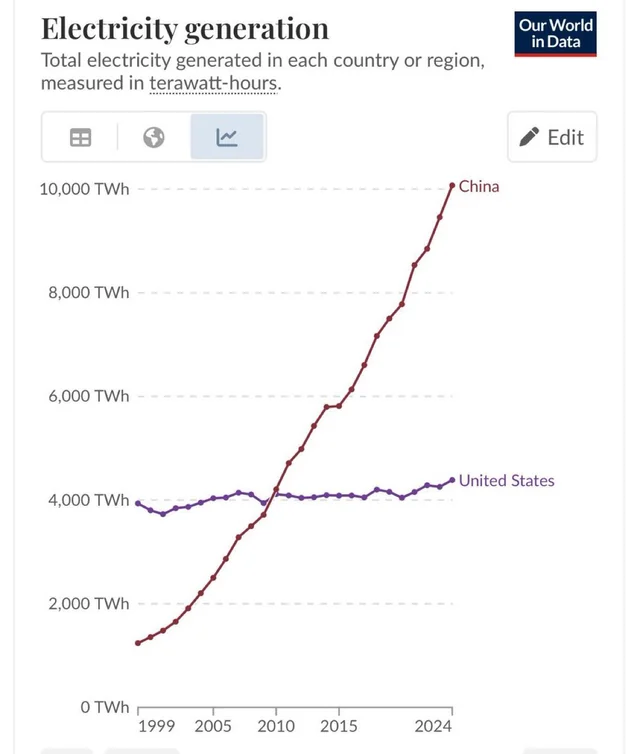
One of the primary problems NVIDIA’s Huang cited is China’s electricity advantage. The country is undergoing a massive power generation buildout, with 30 nuclear plants under construction, countless solar and wind projects, and of course, plenty of coal and gas too.
In terms of cost, it’s about $.08 per kilowatt-hour in China vs $.18 here in the States.
This is a problem. To maintain our AI lead, America needs a massive new buildout of power infrastructure. Not to mention that we’ll need a lot more energy to re-shore manufacturing.
It’s gotten to the point where power is the primary bottleneck in building data centers and manufacturing plants.
Unfortunately, our options are limited. New coal plants seem unlikely. Nuclear takes 10+ years. Gas turbines are in high demand, so there’s a 3-5 year wait. Solar and wind have a role to play, but not a huge one. Our aging grid doesn’t handle the sporadic output from “green” energy sources well.
We need a massive government-backed plan to build more power plants and modernize the grid. Permitting, financing, and construction all need to be streamlined. A new Manhattan Project for electricity.
Personally, I think natural gas is our best option. But we need to incentivize more turbine manufacturing capacity, immediately.
Natural gas is clean, cheap, and plentiful. But environmentalists have lumped it in with coal and oil as a dirty fossil fuel, setting us back decades.
Will China Win?
Despite NVIDIA CEO Jensen Huang’s definitive statement that, “China will win”, the outcome is far from certain.
What worries me is how so many people underestimate China. It’s easy to dismiss them as a typical communist nation, but that’s a gross oversimplification. This is no Soviet model.
China today is less regulated and more “free market” than some U.S. states. And the Chinese people are not communist by nature. They are entrepreneurially-minded and money-driven. As Chinese reformer Deng Xiaoping famously said, “to get rich is glorious”.
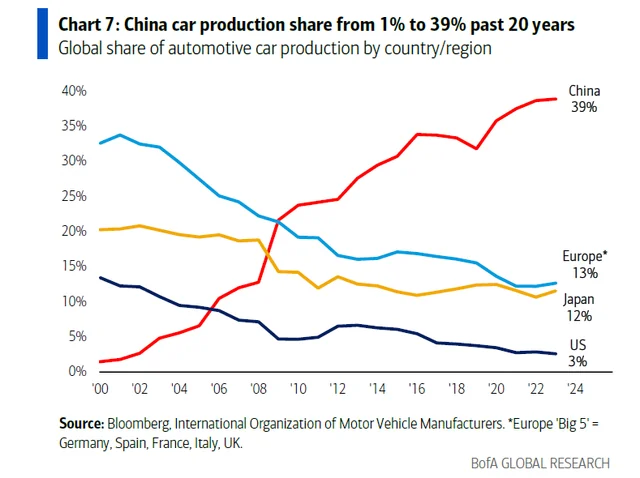
Sure, the government is officially communist, but it’s more like state capitalism these days. Competition in almost every industry is fierce. For example, 20 years ago China’s government incentivized local governments to start car production.
All over the country, governments gave out cheap land, loans, and made permitting a breeze. Today China has the largest auto industry in the world. You can buy a decent electric car for $6,000.
China set out to make itself an auto-manufacturing powerhouse two decades ago. Now they’re running the same playbook with AI hardware and software.
China has their problems. Too much debt. Ghost cities. Overcapacity. But to underestimate them is a mistake. We must face up to the fact that they are becoming a peer competitor.
Competition and necessity drive innovation. The modern computer industry was born because we needed to crack Germany’s encryption codes during WW2.
So having a fierce competition with China isn’t a bad thing. We should embrace it.
But to beat them, we’ll need to take full advantage of America’s greatest asset: our innovative and entrepreneurial spirit.
And that means the government needs to become an ally of business, rather than a roadblock.
President Trump has made good progress on this front, cutting red tape and streamlining processes. But we need to do much more.
If we don’t get our act together, China is on track to win the AI race. And possibly much more.
CHULA VISTA, Calif.—The scene that unfolded along Interstate 5 looked like a carefully choreographed action-film sequence. But it was a real life-or-death situation.
Flames and smoke billowed into the night sky from a vehicle that had crashed off the roadway. Upon arrival, police discovered that the car’s driver was trapped inside, screaming in agony.
“C’mon, give me your hand!” an officer yelled, as he and three others worked frantically to extricate the man through a rear window they had broken.
Panting and grunting, the officers struggled. Then, seconds after they pulled the man to safety along the highway’s berm, the car exploded. A ball of fire engulfed it—just as a fire truck arrived.
The Hollywood-worthy timing, captured on video, is breathtaking.
“That guy probably would have perished,” Chula Vista Police Capt. John English said, if not for the officers’ heroism—and the aid of a camera-equipped, airborne drone.
By relaying real-time information to officers as they head to emergencies such as this one, drones help police plan their actions.
English reviewed video of the fiery rescue with The Epoch Times, explaining how a drone helped officers save the man’s life.
As the car burned, the drone’s aerial view allowed police to quickly identify the best route to the scene. Without that perspective, officers easily could have chosen a more distant highway entrance. “That would have taken extra time to get there—and they didn’t have it,” English said.
Also, because the drone’s thermal imaging showed no person near the burning car, officers suspected someone might still be inside the wreckage. That fear increased their sense of urgency, helping to avert tragedy.
Although the man and three of the four rescuing officers were hurt, all recovered. That incident, on Oct. 13, 2023, stands out as a dramatic example of how drones are bolstering police work across the nation.
Officers have used terms such as “game-changer,” “transformational,” and “revolutionary” to describe the impact of drones on their jobs.
Others are raising alarms over this technology’s capability to be intrusive.
In Eureka, a city of about 25,000 people in northern California, opponents recently stopped local police from even looking into a drone program.
The city’s police had relied on outside agencies for drone assistance in several situations, such as locating armed suspects near school campuses, and negotiating with a suicidal person who threatened to leap from the city water tower. Lacking a local drone fleet “can limit timely access to this critical resource,” officials said, explaining the reason for the proposed study.
After citizens pressured city leaders to back away from the idea, the city announced that the proposed drone study was cut from city council’s Oct. 21 agenda.
An opposition group, which declared victory on its website, said it expects the city to resurrect the proposal. If that happens, “We vow to keep fighting surveillance overreach … [to] preserve our integrity, safety, and privacy in our rapidly changing world.”
Advocates say that police already are following standard procedures that safeguard people’s privacy while greatly enhancing public safety. They consider drones a crucial asset at a time when many police agencies are understaffed and underfunded.
From Rescues to Arrests
In the seven years since Chula Vista pioneered using drones as first responders, increasing numbers of police and fire agencies have adopted the technology.
Some, including Chula Vista, still use advanced, affordable drones from DJI—a source of security concerns because the company is based in China, which has a history of stealing American technology and data.
Chula Vista says its devices have always operated with U.S.-based software “to bypass the drone manufacturer’s systems.” Data from the drones is encrypted and stored on U.S.-based servers “that meet federal requirements for confidential law enforcement databases,” the police department’s website states.
Skydio, a U.S. company, supplies drones to 800 public safety agencies, including New York City, where police are using the aircraft to quell the dangerous trend of riding on top of subways—known as “subway surfing.”
In Cincinnati, which sits along the Ohio River, police used a drone to track a felony suspect who jumped into the water and tried to swim away.
In Redmond, Washington, officers used a drone to reveal the hidden location of a missing elderly man with dementia. He was found safe, sitting in a wooded area.
Police in all three cities run drone first response programs. Drones go airborne to relay and record live video images from scenes where people reported disturbances or circumstances that appear to imperil lives, safety, or property.
Across America, officers credit drones with improving police safety and efficiency. Drones also help police rescue people, de-escalate contentious situations, and arrest suspects.
“We hear more and more reports from our customers about people actually surrendering to drones,” Skydio CEO Adam Bry said at a 2024 conference in California.
His audience had just watched a staged, live demonstration of a remote police officer using a drone to track a fleeing suspect. Using the drone’s loudspeaker, the officer ordered him to put his hands up and walk toward on-scene police. Such an outcome “is not far-fetched at all,” Bry said.
Chula Vista Laid Groundwork
Jon Beal, CEO of the Law Enforcement Drone Association, said he expects the drone first responder trend to grow rapidly, largely because of “trailblazers” such as Chula Vista.
That department’s leaders “stuck their necks out” to figure out drone methods that are now being replicated across the nation, he said, noting that departments fine tune policies to meet each community’s needs.
Over the years, the Federal Aviation Administration (FAA) has been removing approval obstacles.
And President Donald Trump’s June executive order supporting expansion of drone use in the United States further aims to streamline the administration’s processes for drones.
It builds on a directive he issued during his first presidency, ordering agencies to update regulations for “unmanned aircraft systems”—the technical term for drones and their related equipment—while ensuring safe operations. He aims to spur drone use in sectors ranging from agriculture to commerce and emergency management.
The technology’s role in law enforcement has become increasingly important, Beal said. “We believe we’re getting to that place where … it’s almost negligent” if departments fail to use every tool available—including drones, he said.
That’s particularly true in “search-for-persons operations” and high-risk incidents, Beal said. Those might include police serving search warrants targeting dangerous people or responding to shootings-in-progress, unruly crowds, or standoffs with barricaded suspects.
In such circumstances, the high-tech devices give officers two new advantages: “an eye in the sky and time on their side,” Beal said.
About 2,500 police agencies own at least one drone, and 400 police departments run some type of drone program, Beal estimated.
Those numbers are low, considering America is home to about 18,000 federal, state, and local law enforcement agencies.
But “we’ve got law enforcement agencies buying drones on a daily basis,” Beal said.
Agencies that lack their own drones often borrow them from neighboring departments.
And, as agencies’ drone use expands, people on both sides of the political aisle are raising concerns, Beal acknowledged.
In Eureka, California, an Oct. 17 social media post from a group calling itself “The Humboldt Area Center for Harm Reduction” called drones “militarized police technology” and “fascist.”
“Research is only the first step,” the post said, alleging police would move toward “a military drone surveillance program.”
Beal said it’s impractical—and irresponsible—for agencies to deploy drones for general surveillance. It makes no sense for officials to say, “Hey, we’re gonna go out and fly a drone for 10 hours today and hopefully find something,” he said.
Misusing the technology, he said, could ignite backlash against drone programs across America.
Beal’s 2,000-member nonprofit helps train drone operators and sets standards to ensure that the technology is being used “the right way,” he said. His group assists public safety agencies not only across America but also in Canada, Europe, South America, and Australia.
To learn more about police drones, The Epoch Times visited Chula Vista as well as Cincinnati’s new program, which began this summer.
Although the two departments are located 2,200 miles apart and serve starkly dissimilar communities, both follow some of the same key principles. Their drone pilots must be federally certified, and policies prohibit general patrolling or random surveillance with drones.
Unique factors affect police drone operations in each city.
Chula Vista, which means “pretty view” in Spanish, enjoys Southern California weather that is reliably clear and sunny—ideal drone-flying conditions.
And it is a low-rise city, with buildings mostly 20 stories or lower—simplifying drones’ flight paths.
The police headquarters building is only about four stories high, but its rooftop enables a miles-wide view. It’s one of the locations from which police launch drones.
Under federal rules, a person must be present at the site; that’s typically a contractor who performs maintenance on the drones and coordinates flights with a drone operator inside the building. The indoor employees operate controls and monitor computer displays of maps and of drone-collected images.
In contrast, Cincinnati faces more obstacles for its drone flights.
Midwest weather tends to be more fickle, and skyscrapers form the Queen City’s distinctive skyline—posing challenges for drones. Tall buildings can disrupt GPS signals that guide the aircraft. The structures also may create a “canyon wind effect” that can destabilize drones.
Numerous federal flight restrictions affect Cincinnati airspace, too. While Chula Vista lacks a professional sports team, Cincinnati is home to three: Reds baseball, Bengals football, and FC Cincinnati soccer. Those teams’ schedules and the presence or movement of Vice President JD Vance, whose permanent residence is in Cincinnati, all can cause the FAA to impose restrictions.
The United States Congressional Budget Office (CBO) was targeted in a hacking attack by a suspected foreign actor, the Washington Post reported on Friday, citing four people familiar with the matter.
According to the report, CBO officials have recently uncovered the breach and are concerned that the hackers may have gained access to communications between lawmakers' offices and nonpartisan researchers, as well as internal emails and office chat records. The officials reportedly informed lawmakers that they believe the intrusion was identified at an early stage.
The alleged hacker attack follows reports of a similar incident targeting the Washington Post earlier today, with the ransomware organization Cl0p claiming credit for the attack.
Tesla Inc. CEO Elon Musk told shareholders that Tesla's new AI chip design will use about one-third the power of Nvidia's Blackwell processor while offering similar performance at less than 10% of the cost.
Musk said efficient and affordable chips are critical for building robots and stressed the design is tailored for Tesla's software stack and not intended for general use. He noted the company may also eventually need its own chip factory because existing partners lack the capacity to meet its ambitions and noted the company could explore working with Intel in the future.
Musk said production of Tesla's new hardware is planned at TSMC in Taiwan, Samsung in South Korea and TSMC in Texas and Arizona.
United States President Donald Trump confirmed that Kazakhstan will join the Abraham Accords, marking the first nation to enter the framework during his second term.
Trump said he spoke with Israeli Prime Minister Benjamin Netanyahu and Kazakh President Kassym-Jomart Tokayev before announcing the news. He added that a formal signing ceremony will be scheduled "soon." Trump also said more countries are preparing to join. "This is a major step forward in building bridges across the World. Today, more Nations are lining up to embrace Peace and Prosperity through my Abraham Accords," he wrote on Truth Social.
Kazakhstan maintains diplomatic relations with Israel, but joining the accords places the country within the US-led initiative.