Search This Blog

Saturday, December 6, 2025

Time to Pump the Brakes on Artificial Intelligence Finance?

 Artificial Intelligence dealmaking has surged in 2025 and looks to keep right on going in 2026 on the way to the stupidity where all booms eventually end up.

Deals among the major players have reached around $1 trillion. Nearly every week, tech giants like Oracle, Meta, Amazon, Microsoft, Google and Nvidia announce multi-billion dollar circular investment deals with AI, large language models, or “chatbot” creators such as OpenAI, Anthropic, and xAI, along with data center providers like Coreweave and several smaller firms. These are circular investments where the tech giants pour billions into AI chatbot companies, which rely on massive data centers and purchase or lease millions of graphic processing units (GPUs), the chips used for AI computing. 

Amazingly, the deals closed in 2025 may be just the tip of the iceberg. A recent study by McKinsey & Co. concluded that data centers will require $6.7 trillion worldwide to keep pace with demand for computing power.

What could go wrong?

Concerns for hyperscaler stock investors

Hyperscalers provide large cloud-based computing services, the largest being Microsoft, Oracle, Meta, Amazon and Google. Institutional investors, including pension funds and insurance company portfolios, own large amounts of hyperscaler stocks. The tremendous and historic capital expenditures (“CapEx”) by hyperscalers could significantly weaken the financial position of companies that make up 26.1% of the S&P 500 as of November 26th. The spend now and expect revenues to catch up in 3 to 5 years plan is a perilous and perhaps fanciful proposition. Revenue is dependent on the success of the leading chatbot developers, the biggest being OpenAI. Fortune Magazine recently reported that investment bank HSBC doesn’t expect OpenAI to deliver profits that soon

HSBC Global Investment Research projects that OpenAI still won’t be profitable by 2030, even though its consumer base will grow by that point to comprise some 44% of the world’s adult population (up from 10% in 2025). Beyond that, it will need at least another $207 billion of compute to keep up with its growth plans. This stark assessment reflects soaring infrastructure costs, heightened competition, and an AI market that is surging in demand and cash-intensive to a degree beyond any technology trend in history.

Additionally, the AI ecosystem of hyperscalers, chatbot creators and AI chip makers is incredibly integrated.
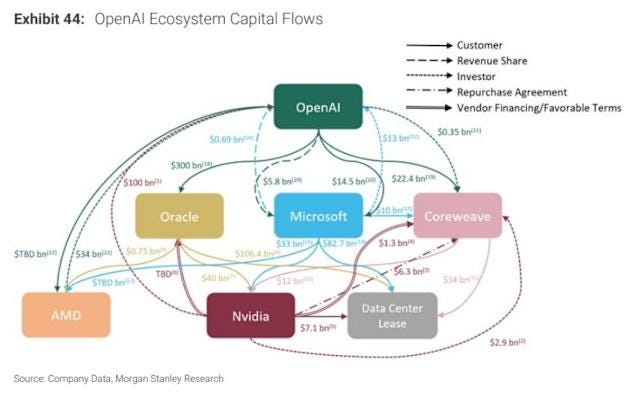
Morgan Stanley says the colossal AI spending spree could pay for itself by  2028

This inter-connectivity could lead to a systemic meltdown as the problem of one major player could become a problem for all the players. Normally, I might say let the buyer beware, but considering the concentration of risk in companies that make up more than a quarter of the S&P 500’s market capitalization, anyone who owns stocks and mutual funds —including retirement accounts and insurance company portfolios — could lose substantially.

  1. Private credit, including insurance and pension assets, will fund a good portion of these risky investments

Hyperscalers and other AI players will have to borrow billions each to fund all the necessary AI infrastructure. A recent article from the F.T. noted that hyperscalers are burning through cash, with Oracle leading the way down.

Of the five hyperscalers — which include Amazon, Google, Microsoft and Meta — Oracle is the only one with negative free cash flow. Its debt-to-equity ratio has surged to 500 per cent, far higher than Amazon’s 50 per cent and Microsoft’s 30 per cent, according to JPMorgan. While all five companies have seen their cash-to-assets ratios decline significantly in recent years amid a boom in spending, Oracle’s is by far the lowest, JPMorgan found.

In the old days of a few years ago, these hyperscalers — which Bloomberg reports have a combined $324 billion in outstanding corporate bond debt — would do a combination of investing their cash and borrowing in the corporate bond market. That’s no longer a complete option for this amount of funding, not even close. To achieve the level of spending the hyperscalers need, if they tried to raise all the funds in the public bond market, they would probably all be downgraded to junk by the ratings agencies, not to mention increasing interest rates for all of us (like mortgage rates).

To the delight of Wall Street, much of the needed funding will come from “Off Balance Sheet” sources, a lot of which come from private credit. As we have already reported, private equity firms have been snapping up life insurance companies and annuity providers, and funneling these companies’ assets into their private credit deals.

A good example is the recent Meta “Beignet” deal. Meta is constructing a massive data center in Louisiana in a deal that the Wall Street Journal labeled a“Frankenstein financing.” The $30 billion deal, structured by Morgan Stanley and the private investment firm Blue Owl, combines private equity and semi-public bonds, all of which will be done off Meta’s balance sheet. The owner of the data center will be the Special Purpose Vehicle, Beignet.

In the deal, Blue Owl invests $3 billion for an 80% equity stake, while Meta ends up with 20% of the equity for funds it has already invested in the project. Once the data center is built, Meta will be the sole tenant. The remaining $27 billion of funding will come in the form of debt, which will be investment-grade-rated notes. Investment manager giant PIMCO will own $18 billion of the notes, while private credit firms will most likely purchase the rest. Principal and interest for the notes will come from Meta’s lease payments to Beignet. The notes mature in 2049. Interestingly, Meta has the right to walk away every four years. If Meta exercises this option, Blue Owl will sell the data center and if there is a loss, Meta is obligated to make up the difference.

As noted earlier, all else equal, Meta will be burning through its substantial $44.5 billion cash pile as it ramps up its AI capital expenditures (“CapEx”). With current expenditures on AI far exceeding revenues, what does that mean for Meta’s future financial condition?

Future value of data centers

It’s a boom time for data centers as demand exceeds supply. Valuations of data centers and expected lease payments are probably at their most favorable point right now. Generally, boom times bring overbuilding and a glut of whatever is being built. What if in five years or ten years, lease agreements and data center valuations drop sharply? What if data centers go unused or dark? As McKinsey and Co. asked in its article, “Will demand for data centers rise amid a continued surge in AI usage, or will it fall as technological advances make AI less compute-heavy?”

Beignet is in the middle of nowhere, Louisiana. Many of the data centers being constructed are also in the middle of nowhere. If they go dark on AI computing what else could they be used for? At least when other commercial real estate sectors go bad, like shopping malls, there is some recovery value, as at least something else can be built there. Data centers in the middle of nowhere are useless without AI.

In addition, there’s a growing pushback against data centers near populated areas with their demand for power and water, as well as noise concerns. Microsoft recently issued a warning to investors about community opposition, which could put more data centers further out into the boondocks, leaving them almost worthless should they go dark.

Another deal that was recently completed is Elon Musk’s xAI circular deal with Nvidia. xAI is constructing a massive Tennessee data center, Colossus. A special purpose vehicle will purchase GPUs from Nvidia and then xAI will lease-to-own approximately 300,000 GPUs for five years. The total size of the deal will be approximately $20 billion — $7.5 billion of equity and $12.5 billion of notes. Nvidia will contribute $2 billion in equity, while private credit giant Apollo is arranging the debt financing. The lease payments will go toward partially paying down the notes. The big question here is, what are these chips going to be worth five years from now?

In five years, there may be better chips, there may be too many chips, there may be cheaper chips, or maybe a combination of all three. There could be a big shortfall between what note holders are owed and the residual value of the chips.

Asset-Backed Securities

ABS is a source of funding for AI infrastructure. Wall Street has already begun packaging data center and GPU leases into ABS, creating approximately $11 billion in 2025.

Similar to ABS on commercial real estate (CMBS), lease payments on data centers are being packaged up, divided into tranches and rated. Since the leases are long-dated, they will fit perfectly into insurance and pension fund needs. Expect insurance and pension funds to buy such ABS, probably in the highest credit rating tranches.

Similar to Collateralized Loan Obligations, as we reported this past July, insurance companies and pension funds owned or managed by private equity will invest heavily, more than those not owned by private equity. The worry I have here is that we are dealing with a very new product (data centers and GPU leases) with very little historical data and a lot of uncertainty. How will rating agencies such as S&P and Moody’s arrive at their ratings?

These investments, either in the form of private credit investment or ABS investment, could be fine for those who voluntarily take the risk. If an investor wants to invest in a private credit deal that specializes in AI infrastructure, they should have at it. This is what private credit should be all about. However, if it is your pension or your annuity or your insurance policy, you don’t get a vote on whether or not you want to take this risk. You likely won’t even know you have this risk until something bad happens, that is.

Eric Salzman has been a financial market professional for 38 years, serving as a trader, risk manager, salesperson and regulator.

https://www.racket.news/p/time-to-pump-the-brakes-on-artificial

Saving Is a Must

 by Ben Stein

Now, for a few humble thoughts on the first day of the last month of 2025.

First, if I ever have another life to live, please, dear God, remind me that the huge rivers of money I had coming in for the last 30 years or so can and will end.

This means I MUST save more. Mr. Buffett put it well: no matter how much you are saving, save more. Save it in gold. Save it in real estate. Save it in BRK. But save it you must. I got used to seeing immense checks pouring in month after month. I thought that gusher would slow down — but certainly not end.

It has ended, though. And it was incredibly lucky that, for reasons of maniacal egomania and just plain chance, I did have some savings. Not enough, and I have some scary, terrifying moments: the worst moments of my life.

I did manage to look at the bright side. I realized that my goddess wife was my overwhelmingly most important asset. As long as I had her by my side, I was still alive. But please, dear pals and readers, learn from my mistakes.

No amount of vainglory in show-off spending is worth even a tiny fraction of the pain of the fear of homelessness. My parents were always a bit frugal except when it came to my sister’s and my education.

They were smart. I have been stupid. As my smart sister says, “Hollywood encourages foolish behavior. Brooklyn does not.”

Next: Your spouse is everything. If you treat her right and she treats you right, your life will work out fairly well. Not perfectly, but incomparably better than otherwise.

Three, keep your friends through all kinds of weather. It’s not just important to have loyal friends for all of your life. It is essential. Old age is a lonely time for too many of us. Our spouse and our friends are all that stands between despair and death.

Fourth, do not trust the government to take care of you. The horrific “war on drugs” has kept way too many of us from the basic meds we need to stay sane. The “war on drugs” is trench warfare against man’s ability to develop meds that keep us from suicidal pain. It is a disgrace.

I will write more later.

https://spectator.org/saving-is-a-must/

The fight to keep politics out of medicine

 Dr. Stanley Goldfarb’s Doing Great Harm? isn’t another anti-woke broadside. It’s something rarer: a first-hand dispatch from a man who spent half a century inside the medical establishment, watched it lose its bearings, and decided to do something about it.

The story begins with his own cancellation at the University of Pennsylvania’s medical school and the online medical encyclopedia UpToDate, banished for the crime of asking whether lowering standards in the name of diversity might, in fact, harm patients. The fallout was predictable — what followed was not. Rather than retreat quietly, Goldfarb founded Do No Harm, a national network of physicians, nurses, and patients determined to push back against what he calls the “ideological capture” of medicine.

His argument throughout Doing Great Harm? is clear and compelling. The central ethic of medicine, “do no harm,” has been replaced by a political one: “do social justice.” Admissions committees now rank “lived experience” above academic preparation. Professors tell students that objectivity is a form of bias. The American Medical Association urges doctors to factor “equity” into treatment decisions, even if that means distributing care unequally. What was once a science of the individual has become an experiment in social engineering.

Goldfarb doesn’t rant about this — he lays it out like a clinician reading a lab result. Every hour a medical student spends on ideological indoctrination is an hour not spent mastering anatomy, pharmacology, or diagnostics. When political conformity replaces scientific rigor, the casualties aren’t theoretical — they’re patients. And yet, what makes the book persuasive even to skeptics is that Goldfarb never sounds like a partisan. He acknowledges that racism and inequity exist in healthcare. He simply insists that replacing one set of prejudices with another isn’t progress, it’s malpractice. His voice is weary, not angry, and it carries the moral authority of a doctor who’s seen what happens when truth becomes negotiable.

The book’s second half expands into Do No Harm’s campaign against pediatric gender medicine, and here Goldfarb’s clarity hardens into moral urgency. He describes how children presenting with anxiety, depression, autism, or trauma are being ushered toward irreversible interventions under the banner of “affirmation.” His group has helped draft and pass laws in 25 states banning puberty blockers, cross-sex hormones, and surgeries for minors, and built long-tail liability provisions so that detransitioners decades from now can sue the institutions and doctors who harmed them. Whatever one’s politics, it’s difficult to read these sections without feeling that something has gone badly wrong.

But Goldfarb draws a bright line at adulthood, arguing that once a person turns 18, the state should step aside. It’s the book’s only real inconsistency, and a significant one. He insists that informed consent requires stable judgment and full understanding of risk. Yet the very mental health challenges he so meticulously documents in adolescents, depression, self-harm, anxiety, autistic traits, and personality disorders, don’t magically disappear on a birthday. The ability to give meaningful consent to life-altering interventions depends not on age alone, but on stability, comprehension, and the absence of coercion, conditions often missing even in adults seeking transition.

Goldfarb’s deeper warning is not just about DEI or gender policy — it’s about what happens when medicine forgets its humility. The authority of the medical profession was built on the assumption that truth exists outside ideology and that a doctor’s first duty is to seek it on behalf of the patient in front of them. When schools prize “representation” over readiness, someone qualified is displaced by someone less prepared. When administrators pursue “equitable outcomes,” they quietly abandon equal treatment. When doctors are retrained to see patients as avatars of identity, medicine stops being personal and becomes political theater.

Doing Great Harm? is the work of a man who decided that complaining wasn’t enough. It’s more persuasive because it’s written without self-pity and without bombast. By the time you reach the end, even the most skeptical reader will concede that Goldfarb is fighting for something deeper than a culture war. He’s fighting for the soul of medicine, and he’s doing it the way doctors used to: with evidence, ethics, and the courage to tell uncomfortable truths.

You don’t have to share Goldfarb’s outlook to recognize that something is breaking. The profession that once asked only “What’s wrong, and how do we fix it?” now asks, “Whose fault is it, and what does justice require?” The first question heals. The second divides.

Bethany Mandel (@bethanyshondark) is a homeschooling mother of six and a writer. She is the bestselling co-author of Stolen Youth: How Radicals Are Erasing Innocence and Indoctrinating a Generation.

https://www.msn.com/en-us/health/wellness/the-fight-to-keep-politics-out-of-medicine/ar-AA1RLP7D

How Minnesota Became the Land of 10,000 Frauds

by Matthew Continetti

 Federal prosecutors have charged dozens of people, many from Minnesota's Somali community, for defrauding the state's welfare programs. Does the outrage suggest that the GOP can win the debate over reforming America's systems for public assistance?

The numbers out of Minnesota are staggering: Three separate plots to bilk welfare programs. Fifty-nine federal convictions. More than $1 billion stolen from taxpayers. Of 86 people charged so far, all but eight are of Somali descent.

The scandal has seized headlines and put Gov. Tim Walz, seeking a third term, on the defensive. It’s huge, brazen and entangled with the seamy politics of migration and assimilation. President Trump has weighed in with characteristic subtlety: “We don’t want them in our country,” he said of Somali-born Rep. Ilhan Omar and “her friends” during Tuesday’s cabinet meeting. “Let them go back to where they came from and fix it.”

The massive fraud shows there is plenty to fix in America. What’s unfolding in Minnesota is sensational but not unusual. Ripping off the taxpayer has become a national pastime. The needy deserve support, but when entitlements become ends in themselves, they invite criminality and dependence.

The nobler the cause, the nastier the graft. Since 2020, when Washington turned on the spigots to counter effects of the pandemic, government-benefits fraud cases have increased 242%. According to the Government Accountability Office, from 2020 to 2023 the amount of fraud in unemployment-insurance programs was between $100 billion and $135 billion. In June, the Justice Department announced charges against 324 defendants in schemes involving $14.6 billion in healthcare fraud. Last month a Miami grand jury indicted Rep. Sheila Cherfilus-McCormick and others on charges of stealing $5 million in Federal Emergency Management Agency relief and laundering the money into her campaign. The Democratic congresswoman pleaded not guilty.

Minnesota fits the pattern. In 2022 federal investigators noticed unusual activity in a program to serve meals to children during the pandemic. Empire Cuisine & Market, a small halal grocery in Shakopee, Minn., claimed to be feeding thousands of children daily. Abdimajid Mohamed Nur pocketed close to $1 million by submitting lists of fake names and food sites to the Federal Child Nutrition Program. He spent the money on a Dodge Ram, jewelry and a honeymoon in the Maldives. In 2024 Mr. Nur was sentenced to 120 months in prison.


https://www.wsj.com/opinion/how-minnesota-became-the-land-of-10-000-frauds-6602e137