The Pentagon is doubling its fleet of US Air Force A-10 attack aircraft in the Middle East, the New York Times reported on Wednesday, citing two Pentagon officials.
The report said the Air Force is sending 18 A-10s to join roughly a dozen already in the region, which US commanders have used to strike Iranian boats and Iran-backed militias in Iraq.
Former President Hassan Rouhani called for reforms in policymaking and said Iran should prepare for an honorable end to the war, while continuing resistance.
“Alongside heroic resistance, we must be prepared to bring the war to an honorable end in the interest of the country and the people,” he said.
Addressing the Supreme National Security Council, he said it should urgently place different scenarios for continuing or ending the war into the legal decision-making process.
“Preserving the country and the system requires immediate fundamental reforms in policymaking; the people have made their position clear to the authorities,” he said.
Rouhani also said it was necessary to coordinate national resources to prevent attacks on the Persian Gulf islands and maintain control of the Strait of Hormuz.
US President Donald Trump’s objectives in the campaign against the Iranian regime remain “clear and unchanging” while driving decisive progress, the White House said on Wednesday.
Trump will address the nation on Wednesday night on Operation Epic Fury, “a decisive campaign of American strength that is systematically dismantling the Iranian regime’s ability to threaten the United States and the free world," according to the White House.
In a statement, the White House said the operation aimed to destroy Iran’s ballistic missile arsenal and production capacity, weaken its naval forces, cut support for allied groups, and prevent it from acquiring a nuclear weapon.
It said the campaign was being carried out with “unmatched power and precision” under Trump’s leadership.
The United Arab Emirates and Saudi Arabia say their air defence systems have intercepted Iranian missiles and drones.
The UAE defence ministry said its air defences are “currently responding to incoming missile and drone threats from Iran,” adding that the sounds heard in the sky were the result of interceptions by defence systems.
Saudi Arabia’s defence ministry said its air defence systems intercepted and destroyed a ballistic missile headed toward the kingdom’s Eastern Province.
Mohsen Rezaei, a military adviser to Iran's Supreme Leader Mojtaba Khamenei, said Iran would not stop the war until it secures what he described as its rights and deters its enemies.
“Until we make the enemy regret and obtain our definite rights, we will not let it go,” the former Revolutionary Guards commander said.
He added that the end of the war depended on the supreme leader and the Iranian people and warned the United States against assuming it could act and then leave the region without consequences.
Rezaei also questioned the idea of negotiations or a ceasefire, saying: “What does it mean to talk about negotiations and a ceasefire in these conditions?”
A leaked internal directive from the IRGC’s missile command appears to show that the use of civilian locations to conceal, support and in some cases facilitate missile launch operations is not ad hoc, but structured, documented and built into operational planning.
The 33-page document shared with Iran International by the hacktivist group Edalat-e Ali (Ali’s Justice) has been marked “very confidential” and is titled Instruction for Identification, Maintenance, and Use of Positions.
The document is attributed to the Specialized Documents Center of the Intelligence and Operations Deputy of the IRGC's missile command.
A framework for missile operations
What emerges from the directive is a bureaucratic framework for missile deployment that goes well beyond hardened silos or underground “missile cities.”
The text lays out categories of launch positions, inspection procedures, coding systems, site records, chains of responsibility and rules for maintaining access to a wide network of locations that can be used before, during and after missile fire.
Its significance lies not only in the variety of launch positions it defines, but in the explicit inclusion of non-military environments in that system.
In its introduction, the document says missile positions are an inseparable part of missile warfare tactics and argues that the enemy’s growing ability to detect, track and destroy missile systems requires special rules for identifying, selecting, using and maintaining such positions.
It adds that the use of “deception,” “cover” and “normalization” alongside other methods would make the force more successful in using those positions.
That language is important. It suggests the document is not merely about protecting fixed military assets. It is about making missile units harder to distinguish from their surroundings and harder to detect in the first place.
Civilian locations as missile cover
The implication of the directive is that it describes a system for embedding missile activity within ordinary civilian geography.
Rather than relying only on conventional military facilities, the document sets out a model in which missile units can move across a wider landscape of pre-identified sites selected for concealment, access and operational utility.
The result is a structure that appears designed to preserve launch capability while reducing visibility and complicating detection.
The clearest indication comes in the section on what the document describes as artificial dispersion or cover positions. These include service, industrial and sports centers, as well as sheds and warehouses – places that are civilian in function or appearance, but can be repurposed to hide missile units.
The conditions listed for such sites include being enclosed, not overlooked by surrounding buildings, and either lacking CCTV cameras or allowing them to be switched off.
Taken together, those requirements point to a deliberate screening process for civilian sites that can be used as missile cover. The concern is not only protection from attack, but invisibility within the civilian landscape.
The broader structure of the document reinforces that conclusion. It contains sections on site identities, naming and coding, inspections of routes and positions, record maintenance and responsibilities across intelligence, operations, engineering, communications, safety, health and counterintelligence.
This is the language of a standing system, not an improvised wartime workaround.
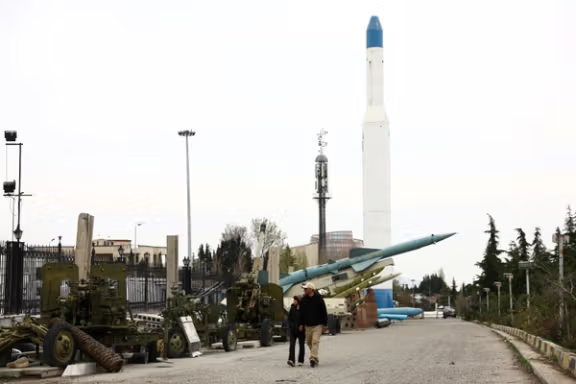
An Iranian couple walks near Iranian missiles in a park in Tehran, March 26, 2026.
A system for concealment
Farzin Nadimi, a senior defense and security analyst at the Washington Institute who reviewed the document for Iran International’s The Lead with Niusha Saremi, said the text points to a database-driven effort to identify areas around missile bases that can be used for different kinds of positions.
He said the IRGC missile force appears to have mapped not only launch positions, but also dispersal, deception and technical positions – the latter being places suitable for storing launchers and support vehicles and, when needed, preparing missiles for firing.
“These technical positions,” Nadimi said, “can include large, covered spaces such as industrial sheds or sports halls, where missile launchers and support vehicles can be brought inside, and where missiles can be mounted onto launchers, warheads attached and, in the case of liquid-fueled systems, fueling operations carried out.”
That point is critical. If civilian-looking or civilian-owned structures are being used not only to shelter launchers, but also to prepare them for launch, then the document describes more than concealment. It describes the embedding of missile operations inside civilian infrastructure.
A network built for dispersal
Nadimi also said the directive places repeated emphasis on speed – getting launch vehicles into these buildings quickly before launch and returning them to cover quickly afterward.
In his reading, the database tied to these positions includes technical features of each site, access routes and nearby facilities, including the nearest medical center, police station and military post.
It also, he added, records whether use of the property can be coordinated in advance with the owner, including contact details, or whether occupation could occur without prior coordination in urgent cases.
If so, that would suggest the system extends down to the level of property access and local civilian surroundings, turning seemingly ordinary sites into preplanned nodes in a missile network.
The document’s own emphasis on route inspection, site profiles, records and coded classification supports the picture of a missile force operating through a dispersed support architecture rather than through fixed bases alone.
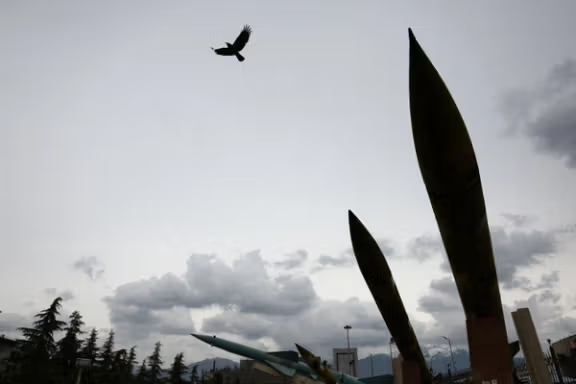
Iranian missiles displayed in a park (March 26, 2026)
Why this puts civilians at risk
Nadimi warned that the use of civilian environments is especially troubling because many IRGC launchers are themselves designed to blend into civilian traffic.
“Many of these launchers essentially resemble civilian vehicles or trailers,” he said.
He added that larger launchers for Khorramshahr missiles can be covered with a white casing that makes them look like an ordinary white civilian trailer, while the towing vehicle is also typically white.
Smaller launchers, he said, are often painted not in conventional camouflage but in ways that make them less conspicuous in civilian surroundings.
That observation fits closely with the document’s emphasis on cover, concealment and post-launch disappearance. The combination of disguised launch vehicles and preidentified civilian sites suggests an operational doctrine built around blending missile units into non-military space.
According to Nadimi, this has direct consequences under the laws of war.
“The use of civilian environments, structures and buildings for this purpose is unlawful under the laws of war,” he said. “It removes the protection those buildings would otherwise have and turns them into legitimate military targets.”
The danger, he added, is that civilians living or working in such places may have no idea a missile launcher is being hidden in their vicinity until they themselves are exposed to attack.
An organized doctrine, not an exception
The leaked directive therefore appears to document something broader than the existence of underground missile facilities or dispersed launch sites.
It points to an organized method for extending missile operations into the civilian sphere – using industrial buildings, service facilities, sports complexes, warehouses and other non-military spaces as part of a launch architecture designed to survive surveillance, evade detection and preserve firing capability under wartime pressure.
In that sense, the document is not just about positions where missiles are launched from. It is about how a military force can fold launch operations into everyday civilian geography – and in doing so, transfer the risks of missile warfare onto places and people that outwardly have nothing to do with it.
ising tensions between the Pezeshkian administration and Iran’s military leadership have pushed the president into a “complete political deadlock,” with the Revolutionary Guard effectively assuming control over key state functions, informed sources told Iran International.
The IRGC has blocked presidential appointments and decisions while erecting a security perimeter around the core of power, effectively sidelining the government from executive control.
Efforts by Masoud to appoint a new intelligence minister last Thursday collapsed under direct pressure from IRGC chief-commander Ahmad Vahidi, sources with knowledge of the situation told Iran International.
All proposed candidates, including Hossein Dehghan, were rejected. Vahidi is said to have insisted that, given wartime conditions, all critical and sensitive leadership positions must be selected and managed directly by the IRGC until further notice.
Under Iran’s political system, presidents have traditionally nominated intelligence ministers only after securing the approval of the Supreme Leader, who holds ultimate authority over key security portfolios.
However, with the condition and whereabouts of Supreme Leader Mojtaba Khamenei unclear in recent weeks, the IRGC is now effectively blocking the president from advancing its preferred candidate, further consolidating its grip over the state’s security apparatus.
Security cordon around Khamenei Jr.
Pezeshkian has repeatedly sought an urgent meeting with Mojtaba Khamenei in recent days, but all requests have gone unanswered, with no contact established.
Informed sources say a “military council” composed of senior IRGC officers now exercises full control over the core decision-making structure, enforcing a security cordon around Mojtaba Khamenei and preventing government reports on the country’s situation from reaching him.
Speculation has also emerged regarding whether Mojtaba Khamenei’s health condition may be contributing to the current power dynamics.
Efforts to remove Hejazi
At the same time, an unprecedented internal crisis is reportedly unfolding within Mojtaba Khamenei’s inner circle. Some close associates are said to be pushing to remove Ali Asghar Hejazi, a powerful security figure in the Supreme Leader’s office.
The tensions are rooted in Hejazi’s explicit opposition to Mojtaba Khamenei’s potential succession. He had previously warned members of the Assembly of Experts that Mojtaba lacks the necessary qualifications for leadership and argued that hereditary succession is incompatible with the principles outlined by Supreme Leader Ali Khamenei, according to informed sources.
Hejazi reportedly cautioned that elevating Mojtaba would effectively hand full control of the country to the IRGC and permanently sideline civilian institutions.
In the first week of the ongoing war, Israeli media reported that Hejazi had been targeted in an airstrike in Tehran. However, later reports indicated that he survived the attack.