Search This Blog

Saturday, May 9, 2026

Iranians risk arrest at Iraq border to escape Tehran's total internet blackout


Desperate to communicate with the outside world, Iranians are increasingly travelling to the border with Iraq, where Iraqi SIM cards and impromptu hotspots became a hot commodity, they told Euronews.

Iranians living near the border with Iraq's Kurdistan region are crossing into neighbouring territory or gathering at the frontier just to get online, as the Tehran regime's months-long internet blackout has cut tens of millions of people off from the outside world.

The Islamic Republic officials have justified the restrictions by citing "security considerations" and the need to counter "cyber warfare".

Citizens say the blackout has cut them off from independent news sources, made it impossible to reach family members abroad, and in many cases destroyed their livelihoods.

Authorities have also outright criminalised many of the tools Iranians have turned to in order to get online, including VPNs and Starlink satellite internet.

"After the war began, the internet in Iran was completely shut down and practically no communication existed between inside and outside the country," a resident of the border city of Baneh told Euronews, speaking anonymously for security reasons.

Iran and Iraq share a 1,600-kilometre-long border, from the tripoint with Turkey to the Arvand river and the Persian Gulf to the south. Baneh, a city of some 100,000 residents, is just 30 kilometres from the nearest crossing.

"In Baneh, where much of the economy depends on trade, many merchants and shopkeepers needed internet access to continue their work, and for this reason they turned to SIM cards from neighbouring countries," they explained.

Some residents of towns near the Kurdistan region already held Iraqi SIM cards or travelled into Iraq to obtain them. In areas with stronger cross-border reception, people called relatives abroad or tried to keep their businesses running.

An improvised internet access point eventually appeared several kilometres outside Baneh, near the frontier.

"Many people would go to an area about 3 to 4 kilometres outside the city of Baneh, near the Iraqi border, where reception was better and it was possible to connect to the internet," the Baneh resident explained.

"Gradually, the number of people going there increased, and a group built a small shack on the spot and started offering internet access by the hour in exchange for money, by sharing their mobile internet with others via Wi-Fi," they said.

More than 50 arrests

Islamic Republic authorities eventually raided the site. "They raided the area, arrested more than 50 people and confiscated their mobile phones," the Baneh resident said.

"The agents went through all the data stored on the mobile phones of those arrested and then warned that anyone who approached the border or carried an Iraqi SIM card would face a harsh response."

"Those detained were put under pressure to explain why they had sought to access the internet.
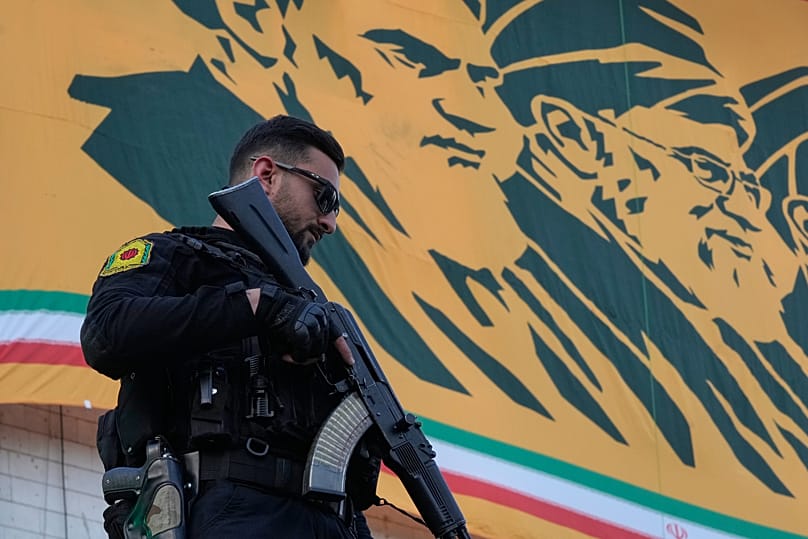
FILE: A police officer stands guard in front of a banner with portraits of late Ayatollahs Khomeini and Khamenei in a state-organised rally, Tehran, 29 April 2026
FILE: A police officer stands guard in front of a banner with portraits of late Ayatollahs Khomeini and Khamenei in a state-organised rally, Tehran, 29 April 2026 AP Photo

Many had only called relatives abroad, while others were traders and businesspeople who needed the internet to do their work," he added. Most were released after signing written pledges. Around 10 people remain in custody, according to eyewitnesses Euronews spoke to.

The crackdown made people more cautious at the border crossings as well.

"At the moment, because of security sensitivities, people avoid some border crossings, and many of those travelling between Iran and the Kurdistan region wipe their mobile phones and laptops to avoid arrest or being accused of collaborating with Israel and the US," another witness told Euronews.

Internet for the few

Over the past months, only a small number of Iranians have managed to access the global internet through costly or officially prohibited means.

A limited category of business licence holders can register for what authorities call "pro internet," but a 50-gigabyte package costs around 2.8 million tomans — around €15 at current free-market exchange rates — and is charged separately from registration fees.

For many workers whose monthly salary does not reach 20 million tomans (€110), the cost is out of reach.

A select few also have access through special SIM cards or privileged journalistic access. Some who have such access refuse to use it, either because it is unavailable to most Iranians or because they are concerned that their online activity is being monitored.
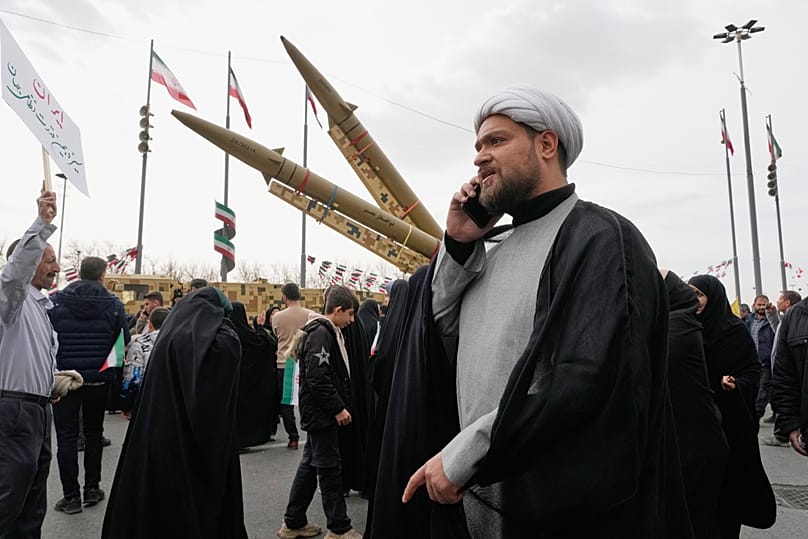
FILE: A cleric talks on his phone as he walks in front of missiles during an annual rally marking the Islamic Revolution at the Azadi square in Tehran, 11 February 2026
FILE: A cleric talks on his phone as he walks in front of missiles during an annual rally marking the Islamic Revolution at the Azadi square in Tehran, 11 February 2026 AP Photo

VPN prices, which spiked sharply at the start of the blackout, have since fallen as supply has increased. A limited number of Starlink devices, most of them smuggled, are also circulating — but their use carries the risk of prosecution and has already cost one person their life.

In the latest incident, a 40-year-old businessman from Tehran died in detention after security forces arrested him when he went to follow up on the case of his brother, who had been held on charges related to the use of Starlink equipment.

A resident of Sardasht told Euronews that access conditions in the border areas were now "somewhat better" and that most people without any of these options were using Iran's domestic "national internet" and waiting for the restrictions to end.

The head of the Iran Chamber of Commerce's economy commission Afshin Kalahi told domestic media that the shutdown was causing direct daily losses of $30 million to $40 million (€25.5m to €34m) for Iran's economy.

Iran's ministry of communications separately cited daily business losses of 600 billion toman (€30.3m) for businesses.

The ministry also said that around 10 million people — mainly from the middle and lower classes — depend on stable digital communications for their work.

https://www.euronews.com/2026/05/08/exclusive-iranians-risk-arrest-at-iraq-border-to-escape-tehrans-total-internet-blackout

Friday, May 8, 2026

US FDA to ease crackdown on some under-review unauthorized vapes


The U.S. Food and Drug Administration (FDA) said on Friday it would not prioritize enforcement against certain unauthorized e-cigarettes and ‌nicotine pouch products if the companies have marketing applications under review.

The ‌new guideline applies to products with premarket applications that have been accepted for review or supplemental ​filings that have been pending for more than 180 days, the agency said.

Non-tobacco-flavored vape makers, who face heightened scrutiny due to youth usage concerns, must also provide sufficient scientific data to assess whether the products are "appropriate for the protection of ‌the public health".


The change means ⁠that manufacturers with products that meet the agency's conditions are unlikely to face enforcement action even if they sell their ⁠products without the legally-required license.


It marks a boost for companies like Philip Morris International, which have held off on launching new products while waiting for an agency ​decision, sometimes ​at the expense of market share.

Tobacco companies ​have been lobbying President Donald ‌Trump and other key officials in the administration for changes including a faster, clearer FDA authorization process.

Earlier this week, the agency approved the marketing of certain fruit-flavored e-cigarettes in a first authorization of non-tobacco-flavored vaping products.


The FDA also said on Friday that applications that include detailed data on product composition, health risks ‌and device specifications are more likely to ​meet regulatory standards.

"By not prioritizing these tobacco products ​for enforcement, FDA will be ​able to better allocate its enforcement resources. FDA lacks the ‌resources to pursue enforcement against every ​product that has not ​received authorization," it said.

The FDA may still take action against products that have certain "presumptively underage-appealing elements such as depicting a cartoon-like fictional character, ​disguising its nature as ‌a vaping product, or resembling a children's toy, phone, or gaming platform."

https://www.yahoo.com/news/articles/us-fda-ease-crackdown-under-210817959.html

Iran lawmaker blames European tankers for oil slick near Kharg Island


An Iranian lawmaker rejected claims that Tehran had dumped oil into the sea near Kharg Island after satellite images showed large oil slicks around the key export hub.

Jafar Pourkabgani, a member of parliament representing Bushehr province, said the slicks were caused by “oil residue and ballast water waste from European tankers” discharged into the sea.

“This claim is false and part of the enemy’s psychological operation,” he wrote on X, referring to allegations that Iran had released oil because storage tanks were full.

Satellite images published on Friday appeared to show large oil slicks around Kharg Island, with some reports estimating the affected area at around 40 square kilometers.

Experts cited by Fox News said the slick could be linked to operational strain in Iran’s oil export system, though the exact cause has not been independently confirmed.

https://www.iranintl.com/en/liveblog/202605087268

DOE's NNSA Removes Enriched Uranium From Venezuela And Japan

 The Department of Energy's National Nuclear Security Administration (NNSA) has coordinated with Japan and Venezuela to remove enriched uranium from both countries. 

The NNSA coordinated with Japanese government and nuclear agencies to transfer 1.7 metric tons of high-assay low-enriched uranium (HALEU) from Japan to the US. The material comes from excess supplies at the recently shut-down test reactor in Japan. 

Japan has not completely ceased research into new reactor technology, and instead will focus on the Joyo research reactor. There is a long-standing coordination between the US and Japan to offload excess quantities of enriched uranium due to proliferation concerns.

Typical commercial reactors run on low-enriched uranium (LEU) which is typically enriched to 3-5%. The percentage of enrichment indicates how much of the fuel is actually usable for fission; the amount of U-235 isotopes present in the uranium mix. 

Some of the advanced reactors and currently operating research reactors across the world use HALEU, enriched up to 20%. Enrichment levels beyond that are considered weapons grade and only used for military reactors and nuclear weapons development. 

The HALEU that was imported from Japan will be repurposed and utilized in advanced reactors being developed under the DOE's Reactor Pilot Program and other research efforts.

For context, the amount of enriched uranium brought over from Japan is likely enough to fuel only one microreactor for one full operating cycle. Centrus Energy also currently produces 900kg/year of HALEU at their Piketon facility, with a massive expansion effort currently underway. 

Immediately following the Japan announcement, the NNSA declared all the highly enriched uranium (HEU) was successfully removed from Venezuela. The material was left over from a research reactor program in Venezuela that shut down in 1991. 

The HEU has been transported to the Savannah River Site for processing and reuse, potentially to also be included in future DOE programs 

https://www.zerohedge.com/energy/does-nnsa-removes-enriched-uranium-venezuela-and-japan

The Rise Of AI Writing And The Decline Of Human Voice

 Artificial intelligence has become a powerful writing assistant, helping people draft emails, essays, marketing copy, and social media posts in seconds. But as these tools grow more popular, researchers are raising concerns about an unintended consequence: AI may be changing not just what we write, but how we communicate altogether, according to Axios.

New research suggests that widespread use of large language models is making language more uniform. A study conducted by University of Southern California found that after the release of ChatGPT, diversity in writing styles declined across several forms of communication, including scientific publications, local journalism, and social media posts. Researchers observed fewer differences in vocabulary choices and sentence patterns, pointing to a growing preference for polished, formulaic language.

Axios writes that the influence appears to extend beyond writing. Researchers at the Max Planck Institute for Human Development analyzed more than 740,000 hours of spoken and written material and found that certain words commonly associated with ChatGPT responses are appearing more frequently in everyday communication. Words like “delve,” “meticulous,” “boast,” and “comprehend” have become increasingly common, suggesting AI-generated language may be shaping human speech habits as well.

Morteza Dehghani, who led the USC research, believes this shift is happening because people are becoming familiar with a specific type of polished communication. “People get used to this idealized, very predictable form of language, and even people who are not using it, in order to have that sense of powerful, influential writing, they start writing more like LLMs,” he told Axios.

Not everyone sees that as progress. Alex Mahadevan of the Poynter Institute for Media Studies argues that AI-generated content often feels empty despite being technically sound. He described it as noticeably “soulless” and “mediocre,” adding, “There’s no art in it.”

For Emily M. Bender, the concern is personal as well as cultural. The University of Washington linguist said she avoids AI-generated writing whenever possible, explaining, “I do my very best not to read any synthetic text.” However, she admitted that identifying it is becoming increasingly difficult: “oftentimes people will send me something and I won’t know.”

That challenge may only grow as AI adoption accelerates. According to a 2025 survey from the Brookings Institution, nearly one-third of small businesses now use AI tools for customer service and outreach, while 16% of individuals report using large language models for communication and social media content.

Bender warns that the pursuit of flawless AI-style writing could create what she calls the “‘LinkedIn average,’” where communication becomes polished but generic. Mahadevan echoed that frustration, saying he misses “good bad writing,” the kind of imperfect but memorable work that reflects real human personality. He admitted that AI’s growing presence has even made him second-guess his own style: “I have been second-guessing myself, thinking, ‘well, sh*t, is someone going to think this was written with AI?’”

At the heart of the debate is a larger question about what writing actually does for people. Bender argues that writing is more than producing clean sentences—it helps people process ideas and sharpen their thinking. “There is value in the struggle of writing, because we learn to express ourselves, and we learn to do the thinking that happens as we’re writing,” she said.

As AI tools become a permanent part of modern communication, experts say the challenge will be maintaining individuality in a world increasingly shaped by machine-generated language. “Each time we choose not to do that, we are losing out, both individually and societally,” Bender says.

https://www.zerohedge.com/markets/rise-ai-writing-and-decline-human-voice

J&J seeks to rewrite the script on depression treatment

 A survey by Johnson & Johnson has revealed patients with major depressive disorder (MDD) are pessimistic about the chances of being free of their symptoms – and it has launched an awareness campaign to challenge that assumption.

The global Generation Fine campaign, developed in partnership with Mental Health America and clinical experts, is designed to "challenge what it means to feel 'fine' in depression care and empower patients to take the first step in moving beyond 'good enough' by talking with their healthcare provider."

The survey – conducted in 859 MDD patients currently managing their MDD with oral antidepressants and 800 healthcare providers who treat patients with MDD in the US, Brazil, Canada, China, Germany, Italy, and Spain – found that nearly four out of five patients felt antidepressants were unlikely to address all of their symptoms or help them reach remission.

Around three-quarters of them also said that residual symptoms still plague their lives, with 90% saying this affects their work and more than half reporting that they sometimes isolate themselves from others as a result.

Among patients who had not discussed the problem of lingering symptoms with their doctor, 40% reported they did not have the energy to even raise the subject, while a third said there was little point because they felt nothing could be done about it.

"Depression doesn't look the same for everyone, but it is often treated with the same one-size-fits-all approach," said Jessica Jackson, head of alliance development at Mental Health America.

"This disconnect can leave people feeling unseen or misunderstood, while stigma and societal pressures make it even harder to seek help," she added. "We need to change the conversation and create opportunities where all people feel empowered to say, 'I'm not okay'."

Generation Fine has been launched to highlight the day-to-day challenges of people living with MDD – an estimated 332 million people worldwide – and support conversations about their care and the possibility of remission.

The campaign is being fronted by mental health advocates, including retired National Football League (NFL) player Kyle Long, who played for the Chicago Bears and is now a TV pundit for the game.

"I've battled depression at different stages of my life, including during my career in the NFL, and for a long time I felt like I had to 'tough it out' and handle it by myself," said Long. "When I stopped trying to fight it alone and started being honest with myself and my support system, including my doctor, everything changed. Speaking up about what you're feeling isn't weakness - it's the strongest play you can make."

J&J has developed two therapies aimed at the estimated two-thirds of MDD patients who continue to experience symptoms despite treatment with conventional antidepressants, Caplyta (lumateperone) and Spravato (esketamine), which are both approved as add-ons to standard therapy.

The drugmaker also has another candidate in the pipeline with orexin-2 receptor antagonist seltorexant, which has shown efficacy in a phase 3 trial for insomnia associated with depression, a symptom that currently has no FDA-approved treatments and affects around 60% of patients. 

https://pharmaphorum.com/news/jj-seeks-rewrite-script-depression-treatment

Capricor sues partner Nippon Shinyaku in DMD therapy spat

 Capricor Therapeutics has fallen out with its commercial partner for Duchenne muscular dystrophy (DMD) cell therapy deramiocel, Nippon Shinyaku, and is taking its complaint to the courts.

The San Diego biotech has filed a lawsuit against the Japanese drugmaker and its US subsidiary, NS Pharma, claiming that the terms of their distribution contract for deramiocel are flawed and could hinder DMD patients from getting access to the therapy if it gets approved by the FDA.

According to Capricor, the distribution agreement with NS Pharma contains a "fundamental pricing flaw" that its partner has refused to address, and it has accused the company of failing to "adequately prepare" for the commercial launch.

Deramiocel was turned down by the FDA last year as a treatment for cardiomyopathy associated with DMD, but has since been refiled as a treatment for skeletal and cardiac manifestations of the muscle-wasting disease, and the US regulator is due to deliver a verdict on that second attempt by 22nd August after a priority review.

The lawsuit is seeking to set aside the agreement altogether, arguing that NS Pharma's actions mean that the deramiocel launch will be "delayed and disrupted" due to a previous pricing structure, described as a "mutual mistake," that it claims "renders commercialisation nonviable."

While Capricor has tried to modify the agreement with a new pricing structure, correcting what it describes as a disconnect between the proposed pricing and the Medicare reimbursement framework that would affect both federal and private reimbursement. However, it contends that NS Pharma has refused to cooperate and effectively has tried to "seize control" of the deramiocel.

"I have spent nearly two decades building Capricor with one goal in mind: making deramiocel available to treat these boys," said Dr Linda Marbán, Capricor's chief executive. 

"I know what every additional month of delay costs them, because I know what is happening inside their muscles when they cannot be treated," she added. "There is no version of this case in which I am willing to watch NS Pharma's inaction take that away from them."

The lawsuit is asking for the distribution agreement to be rescinded and an injunction imposed to prevent NS Pharma from "interfering with Capricor's efforts to distribute deramiocel […] in the US."

Deramiocel consists of donor cardiosphere-derived cells (CDCs), given by intravenous infusion once every three months, that are thought to modulate the immune system and regenerate skeletal and cardiac muscle cells.

Capricor entered into the distribution agreement with Nippon Shinyaku and NS Pharma in 2022, receiving an upfront payment of $30 million and the promise of up to $705 million in milestone payments.

Under the terms of the deal, Capricor would sell supplies of the therapy to NS Pharma for distribution and receive a share of product revenue.

https://pharmaphorum.com/news/capricor-sues-partner-nippon-shinyaku-dmd-therapy-spat