The United States and South Korea signed a Memorandum of Understanding to expand cooperation in shipbuilding, the US Department of Commerce's International Trade Administration (ITA) announced in a statement.
The agreement establishes the Korea-US Shipbuilding Partnership Initiative, which is said to promote collaboration in "workforce training, industrial modernization and maritime investment," the agency said.
Oversight will be provided by US Secretary of Commerce Howard Lutnick and Republic of Korea Minister of Trade, Industry and Resources Jung-kwan Kim, with a new partnership center expected to open later this year in Washington DC.
The paperback of “How NOT to Invest” drops this week; to celebrate, this whole week I am running various stories and excerpts about the book.
This short, Beatles-related excerpt from the book was one of my favorite chapters to write… Enjoy!
Is there any greater gap between “Expert Opinion” and subsequent history than The Beatles?
AllMusic sums up the Fab Four as “The most popular and influential rock act of all time, a band that blazed several new trails for popular music.”1 That’s obvious today, but it was not the consensus early in their career.
Many amusing details were recounted by Bob Seawright is his “Better Letter.” Nobody skewers humanity’s cognitive failings with more amusing flair than Seawright. He giddily recounted the early reviews of the Beatles when they first came to America. At the time, they had five singles in Britain’s Top 20, three of which hit #1 – all in 1963. Their debut album, “Please Please Me,” held the top spot on Britain’s charts for 30 weeks, displaced only by the band’s next album, “With the Beatles.“
Despite the sensation they were causing in Great Britain, The Beatles’ record label (EMI) could not persuade its American counterpart (Capitol) to release any of the band’s singles in the States. Dave Dexter was the man in charge of international A&R for Capitol, and ostensibly an industry expert on the public’s musical tastes. He repeatedly rejected The Beatles’ singles, calling them “generally amateurish and unappealing.” One after another, Dexter vetoed those singles tearing up the charts in the UK, starting with “Please Please Me” and “She Loves You.”
Ed Sullivan had also turned down the Fab Four (twice) for his television show. He was by coincidence at London (now Heathrow) Airport when he witnessed “Beatlemania” firsthand. The band was returning home from a tour in Sweden, greeted by a raucous, screaming mob of teenage girls. That convinced Sullivan to book the lads.2
The Ed Sullivan Show was a huge platform for breaking new acts, and Capitol decided to release “I Want to Hold Your Hand” a few weeks before The Beatles’ appearance. This was not some insightful exec reversing Dexter’s misguided rejections or a change of musical heart but rather, simply good corporate opportunism. How could you not capitalize on the demand one of the country’s most popular TV shows might create?
And how did the Sullivan Show go? 3
The Beatles played five songs on two broadcast segments, ending with “I Want to Hold Your Hand.” Ray Bloch, Ed Sullivan’s musical director, was unimpressed: “The only thing different is the hair, as far as I can see. I give them a year.” 4
He was not alone in panning the appearance. Seawright collected a string of headlines and reviews that have not aged particularly well:
The New York Herald Tribune: “BEATLES BOMB ON TV.”
The Boston Globe: “Don’t let the Beatles bother you. If you don’t think about them they will go away and in a few more years they will probably be bald.”
The New York Times: “The Beatles’ vocal quality can be described as hoarsely incoherent, with the minimal enunciation necessary to communicate the schematic texts.”
The Los Angeles Times: “Not even their mothers would claim that they sing well.”
The New York Herald Tribune: “75 percent publicity, 20 percent haircut and 5 percent lilting lament.”
It wasn’t just that the reviews missed the mark. What is noteworthy is all of biases evident in those critiques. This is also evident in the prior section on Media (later on, we explore what causes this).
Consider Newsweek:
“Visually they are a nightmare, tight, dandified Edwardian-Beatnik suits and great pudding bowls of hair. Musically they are a near disaster, guitars and drums slamming out a merciless beat that does away with secondary rhythms, harmony and melody.”(emphasis added)
Whether you like their songs or not, The Beatles’ harmonies and melodies are simply not debatable. The musicality and beauty of their songs is simply beyond reproach.
And this was The Washington Post revealing their inside-the-beltway angle:
“They are, apparently, part of some kind of malicious, bi-lateral entertainment trade agreement. The British have to sit through dozens of dreadful American television programs. In return, we get The Beatles. As usual, we got gypped. Nothing we have exported in recent years quite justifies imported hillbillies who look like sheep dogs and sound like alley cats in agony.”
What was the 1960s equivalent of “Okay, Boomer”…? 5
You probably know what happened next: “I Want to Hold Your Hand” went to number one in the U.S., quickly selling a million copies.5 American tastes were not so different than Britain’s after all, and Beatlemania became a cultural phenomenon here too.6
***
Ironically, these music “experts” missed the biggest cultural shift in generations, and it was happening right before their eyes and ears. How did they blow it? In his book “Hit Makers,” 7 Derek Thompson explains Raymond Loewy’s concept of MAYA: New products that are “most advanced yet acceptable.”8
Loewy “believed that consumers are torn between two opposing forces: neophilia, a curiosity about new things; and neophobia, a fear of anything too new. As a result, they gravitate to products that are bold, but instantly comprehensible.” Any innovation too far ahead of the curve gets rejected by much of the public.
But with music, I suspect that MAYA line varies with age. The receptiveness to new music is different for a critic in their 40s or 50s than for teenagers. One group is still in its formative age, embracing new things (while rejecting most of what their parents liked); the others’ formative years were decades earlier. Once your musical taste hardens, you may be less receptive to the latest sounds.
This might explain the bad reviews from Beatles’ critics throughout their career. Many of their albums, including some of the best music ever recorded, were initially panned. Musicologist and Historian Ted Gioiaobserved that critics “literally were handed the greatest recordings of their era to review, and blew them off. Every classic song on these albums was not only attacked, but actually mocked.” 9
MAYA helps explain why.
Gioia notes that The Beatles were “punished for how quickly they were pushing rock music ahead . . . the critics misunderstood the lads from Liverpool for the worst possible reason – namely, that they were constantly learning, growing more ambitious, and willing to take risks.”
Or as UK rocker Elvis Costello said, “Every [Beatles] record was a shock.” 10
The Ed Sullivan appearance was merely a single episode in an explosive career. Throughout the 1960s, bad reviews of Beatles’ albums such as Sgt. Peppers, The White Album, and Abbey Road would come back to haunt the critics who penned them…
Iran may be releasing oil into sea amid export strain - Fox
Observers cited in a Fox News report said on Friday a large oil slick detected near Iran’s Kharg Island may be linked to operational strain in the country’s oil export system, with satellite images showing a spread of oil in the Persian Gulf.
Others said ageing infrastructure and the use of older vessels for storage or transport could also be contributing factors. The exact cause of the slick has not been independently confirmed.
REGIME RUPTURE: Experts say Iran may be dumping oil as US blockade puts Tehran regime under growing pressure. Report by @EfratLachterhttps://t.co/Z4fmewHezi
Russian President Vladimir Putin stated on Friday that Ukraine's attack on Russia's Rostov region is "another act of terrorism," claiming that the strike on the Rostov Regional Air Traffic Management Center could have impacted the safety of civilian aircraft.
"Early this morning, the Kiev regime committed another act, clearly of a terrorist nature. Specifically, it struck the Rostov Regional Air Traffic Management Center. This could certainly have impacted the safety of civilian aircraft. Fortunately, no tragic events occurred thanks to the highly professional work of our air traffic controllers," Putin said during a security council meeting.
The Russian president's comments come amid the ongoing ceasefire with Ukraine, while Ukrainian Foreign Minister Andrii Sybiha stated that Moscow has already violated the ceasefire that Ukrainian President Volodymyr Zelensky said started on May 6.
Nvidia (NVDA) and Micron (MU) have become two of the defining stocks of the AI boom. But a come-from-behind trade in old-school storage has outrun both, with Western Digital (WDC) and Seagate Technology (STX) leading the charge.
Since ChatGPT launched in November 2022, Western Digital and Seagate have outperformed Nvidia and Micron, according to Yahoo Finance data. Western Digital and Seagate Technologies have outperformed Nvidia and Micron since ChatGPT launch
The timing is key. The storage rally really took off in April 2025. Around the same time, Micron and the broader memory trade started to emerge as a central AI theme after the post-”Liberation Day” lows.
That’s not because storage and memory suddenly became sexier than GPUs. It’s because AI has turned the less glamorous parts of the hardware stack into scarcity trades.
The market is moving past the first AI winners and chasing companies tied to the physical demands of the infrastructure build-out: memory, storage, networking, foundry capacity, optical gear, and legacy chips.
The heat map tells the same story, with some of the biggest moves coming from names that were not the face of the AI trade even one year ago. AI trade heat map — since ChatGPT launched November 30, 2022 · Yahoo Finance
The catch-up trade is showing up across the chip complex. Intel (INTC) is up roughly 200% since the March 30 low and just hit its fourth straight intraday record high following a report that Apple (AAPL) and Intel reached a preliminary chipmaking agreement.
Micron, meanwhile, is up roughly 130% since the March 30 low and has added roughly $470 billion in market value over that stretch. AMD (AMD) and SanDisk (SNDK) have also posted triple-digit rallies, while Lumentum (LITE) is riding a 13-month win streak.
Nvidia still dominates by size. The stock has added more than $1 trillion in market value since the March 30 low alone.
But the performance race has moved beyond the initial AI winners. The market is now paying up for the companies that can help relieve the bottlenecks created by the boom.
The World Health Organization just went on record to claim that ivermectin is “not an effective treatment for hantavirus,” fully dismissing the large body of research suggesting the opposite is likely true.
This rapid dismissal of a safe, cheap, widely available drug follows a now-familiar pattern. When health authorities immediately reject repurposed medicines with plausible mechanisms and real-world data against RNA viruses in favor of experimental “vaccines”, it often means that the opposite the true. We see this out with the dilemma of a rodent infested ship with hantavirus in the Atlantic Ocean where the WHO has 147 passengers locked down without access to early treatment kits.
Let’s look at the evidence for ivermectin and chloroquine/hydroxychloroquine against hantavirus:
Ivermectin’s Strong Track Record Against RNA Viruses
Since the early 2010s, researchers have documented ivermectin’s broad-spectrum antiviral activity against a wide range of RNA viruses, including dengue, Zika, West Nile, yellow fever, chikungunya, influenza, HIV, and SARS-CoV-2. These antiviral effects are summarized across dozens of studies in a 2020 systematic review by Heidary et al.
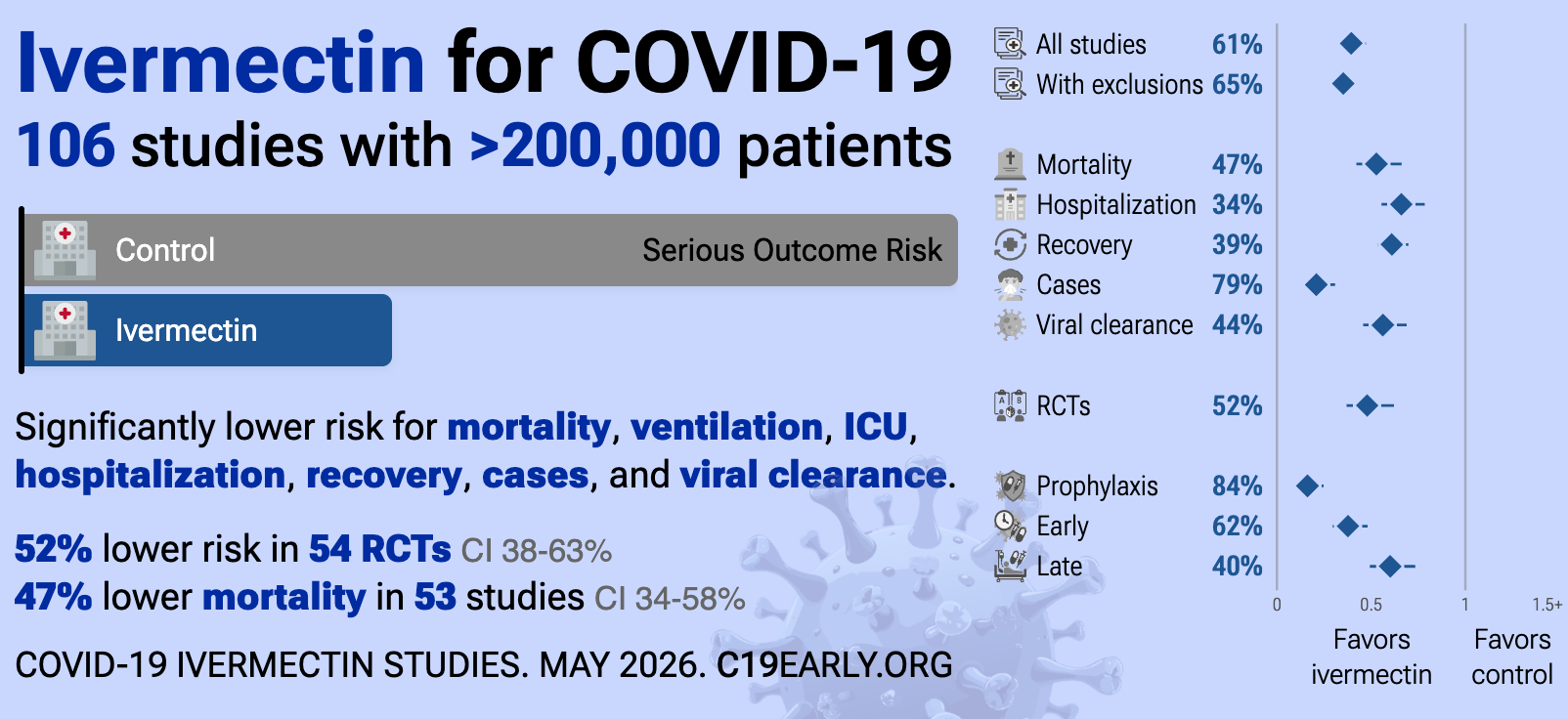
The most compelling real-world evidence comes from its performance against COVID-19. The comprehensive real-time meta-analysis at https://c19early.org/i now includes 106 studies involving hundreds of thousands of patients. These studies consistently show strong benefits — particularly when used early or as prevention — with major reductions in mortality, hospitalization, and severe disease.
Crucially, hantaviruses are also RNA viruses — specifically negative-sense single-stranded RNA viruses. While they differ in structure and replication details from viruses like SARS-CoV-2, they still rely on host cell machinery and intracellular transport pathways that ivermectin is known to disrupt.
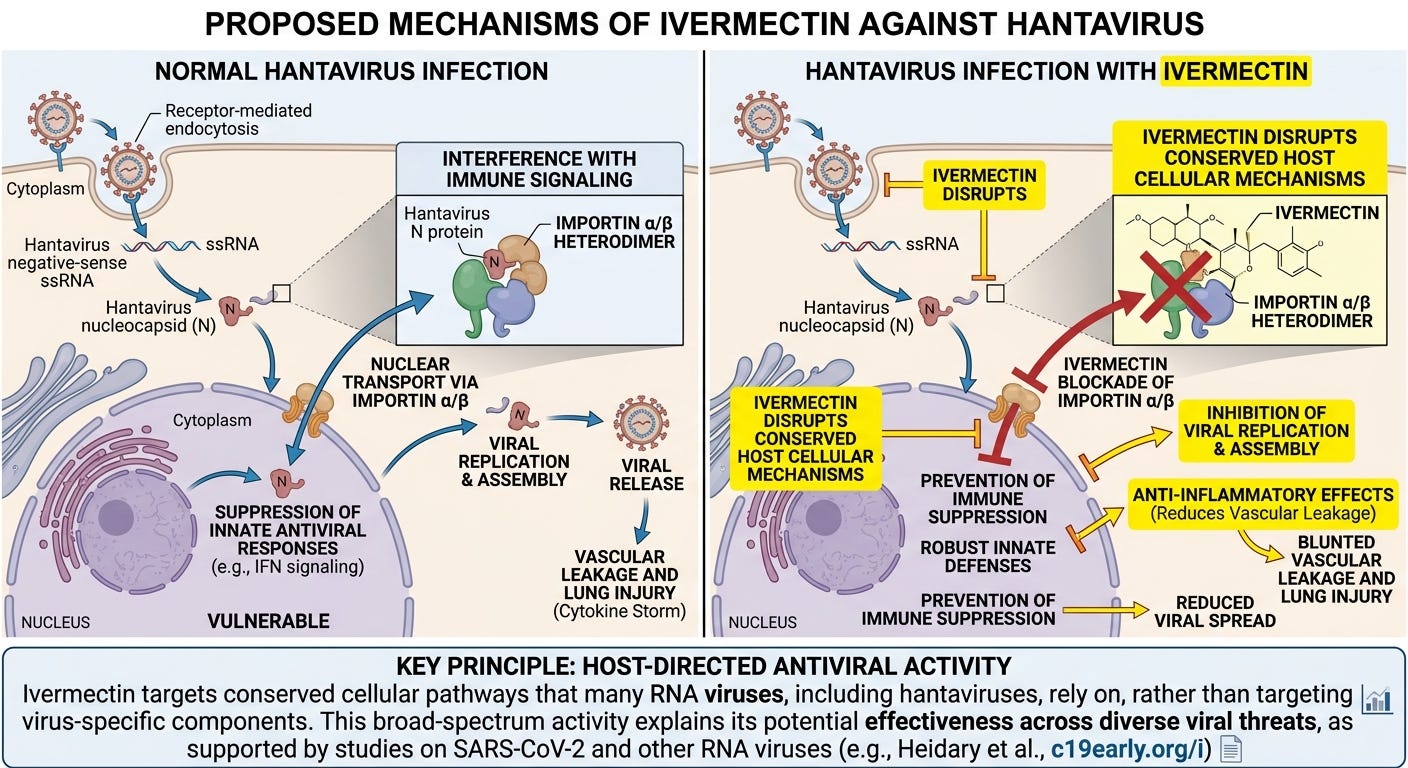
Mechanistically, ivermectin inhibits importin α/β nuclear transport, a pathway many RNA viruses exploit to shuttle viral proteins into the host cell nucleus to suppress antiviral responses. Hantavirus nucleocapsid (N) protein has been shown to interact with these same host pathways to interfere with immune signaling. By blocking this transport system, ivermectin may prevent the virus from disabling the host’s innate defenses.
In addition, ivermectin interferes with viral replication and assembly processes inside the cell, and exerts anti-inflammatory effects that could blunt the vascular leakage and lung injury characteristic of severe hantavirus disease.
This is the key point: ivermectin does not need to be “hantavirus-specific” to be effective. Its antiviral activity is largely host-directed — targeting conserved cellular mechanisms that many RNA viruses, including hantaviruses, depend on.
Given this combination — a shared RNA-virus biology, overlapping reliance on host pathways, and a well-documented antiviral mechanism — ivermectin likely exerts at least some degree of anti-hantavirus activity and warrants serious investigation, not dismissal.
Compelling Evidence for Hydroxychloroquine
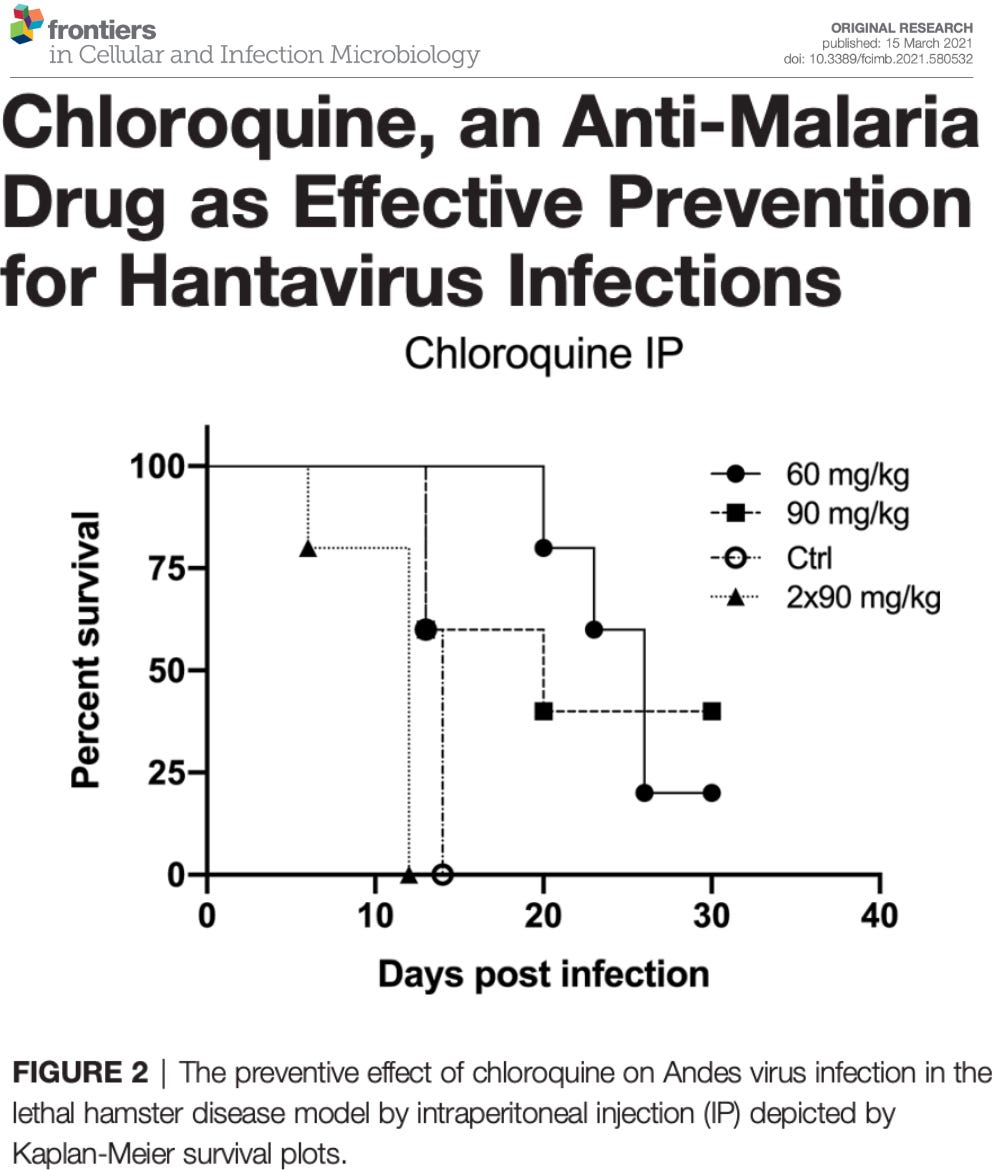
A 2021 peer-reviewed study in Frontiers in Cellular and Infection Microbiology directly evaluated chloroquine against multiple hantaviruses, including the Andes virus — the most clinically relevant strain and the one implicated in the recent cruise ship outbreak .
The key finding comes from the Andes virus model:
In the gold-standard Syrian hamster model of hantavirus pulmonary syndrome (which closely mimics severe human disease), chloroquine produced a striking survival benefit. When administered continuously before infection:
60% of treated animals survived to 26 days
100% of untreated controls died within ~14 days
Even when treatment was started after infection, survival improved and time to death was significantly delayed — demonstrating both prophylactic and therapeutic potential.
Supporting this, chloroquine also showed strong antiviral activity in vitro across multiple hantavirus species, inhibiting replication at concentrations far below toxic levels, with a favorable selectivity index.
Hydroxychloroquine, the safer and more commonly used human derivative, shares the same core mechanisms. It raises endosomal pH to block viral entry and uncoating, acts as a zinc ionophore that facilitates intracellular zinc accumulation (which can inhibit viral RNA polymerase activity), and exerts immunomodulatory effects that may reduce the vascular leakage and inflammation central to severe hantavirus disease.
Taken together, the data show a clear, consistent pattern: chloroquine-class drugs can directly inhibit hantavirus replication and meaningfully improve survival in a lethal Andes virus model — with hydroxychloroquine representing the more practical candidate for human use.
Conclusion
Both drugs likely attack key steps in the hantavirus life cycle and the body’s harmful over-reaction to infection:
Hydroxychloroquine (and chloroquine):
Raises the pH inside cell endosomes, blocking hantavirus entry and uncoating. Hantaviruses depend on acidic conditions in these compartments to release their genetic material.
Acts as a zinc ionophore, facilitating the entry of zinc ions into cells. Once inside the cell, zinc potently inhibits the RNA-dependent RNA polymerase enzyme that hantaviruses require for replicating their genetic material (a mechanism well-documented against other RNA viruses).
Helps modulate the immune system to reduce dangerous inflammation and vascular leakage that drive severe disease.
Ivermectin:
Inhibits importin α/β nuclear transport proteins, disrupting the virus’s ability to hijack host cell machinery and suppress antiviral defenses.
Interferes with viral replication and assembly.
Reduces excessive inflammation that contributes to lung damage.
These mechanisms are complementary: hydroxychloroquine primarily blocks early viral entry, while ivermectin targets later intracellular replication and inflammation. For those interested in having these compounds on-hand in case of emergency, you can obtain some from TWC.
Specific, well-designed clinical trials for both hydroxychloroquine and ivermectin against hantavirus are needed. However, the science here is far stronger than the official “nothing to see here” narrative suggests.
Adding zinc, vitamin D, and vitamin C could compose a synergistic protocol:
Vitamin D is a critical immune modulator that strengthens the body’s innate antiviral defenses, helps regulate inflammatory responses, and has been associated with better outcomes in severe respiratory viral infections.
Vitamin C, a potent antioxidant, supports immune cell function, reduces oxidative stress, protects blood vessels from damage, and helps counteract the cytokine storm and vascular leakage that are hallmarks of hantavirus pulmonary syndrome.
While the hantavirus outbreak is expected to remain quite small and limited, we can’t put anything past the pandemic profiteering cartel who’s high-containment biolabs remain fully operational.

 Western Digital and Seagate Technologies have outperformed Nvidia and Micron since ChatGPT launch
 AI trade heat map — since ChatGPT launched November 30, 2022 · Yahoo Finance