Twenty-nine-year-old Suhas, a businessman, thought he had defeated coronavirus when he came out of a non-invasive ventilator and went home after two weeks. But soon he started experiencing pain and swelling on the face. A quick CT scan confirmed the doctor's fears - he had contracted mucormycosis, a potentially fatal fungal infection. He recently underwent a surgery at Global Hospital in Parel, where doctors had to remove his upper jaw to arrest the spread of the fungus to the brain.
Triggered by coronavirus, mucormycosis, which has a mortality rate of over 50% and can lead to blindness, is sweeping through parts of the state. City hospitals that are treating dozens of such cases from northern Maharashtra and Vidarbha said its spread is assuming epidemic proportions, so much so that regions have started facing a shortage of anti-fungal medicines. Global Hospital, which has started a dedicated clinic for mucormycosis after witnessing a surge in cases during the first wave, has 18 patients admitted at present.
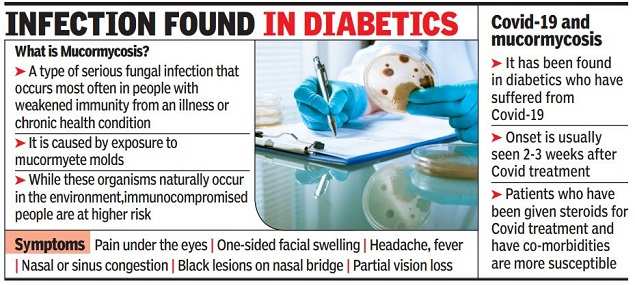
Parel's KEM Hospital has 25 patients undergoing treatment for mucormycosis. Dr Hetal Marfatia, head of ENT, said almost all patients are from far-off districts and have come at an advanced stage. The infection typically starts growing from the nose, upper jaw and travels to the brain. "Once it reaches the brain, it's almost a death sentence," she said, adding that from treating a handful cases annually, the hospital is now seeing three-four referrals daily.
ENT surgeon Dr Sanjeev Zambane said he has been seeing a minimum of two mucormycosis cases in a day. The bigger challenge now is treatment, since anti-fungal medicines are not just in short supply but also very expensive.
In pre-Covid times, the 'black fungus' mucormycosis used to be rare and seen mainly in immunocompromised people. However, after the pandemic, three factors have led to an exponential rise- Covid itself, diabetes and abuse of steroids that lower immunity.
In pre-Covid times, the 'black fungus' mucormycosis used to be rare and seen mainly in immunocompromised people. However, after the pandemic, three factors have led to an exponential rise- Covid itself, diabetes and abuse of steroids that lower immunity.

No comments:
Post a Comment
Note: Only a member of this blog may post a comment.