KEY FINDINGS

THE BOTTOM LINE:
ONCE THE MEDICAID HANDCUFFS ARE REMOVED, STATE OFFICIALS SHOULD BEGIN CONDUCTING REDETERMINATIONS AS SOON AS POSSIBLE.
Congress dramatically expanded welfare programs in response to the COVID-19 pandemic.1 In March 2020, Congress passed the Families First Coronavirus Response Act, which provided a temporary increase in funding to pay for a portion of states’ traditional Medicaid costs during the public health emergency.2
But this federal funding boost came with massive strings attached. In exchange for the funding, states had to give up significant control over their Medicaid programs.3-4 States cannot strengthen program eligibility standards or remove individuals from the program—including individuals who are ineligible or were never eligible for coverage.5 Enrollees may only be removed if they die, voluntarily opt out, or move to a different state.6
So long as states continue to accept the federal funding boost or until the public health emergency officially ends, states are handcuffed from removing ineligible enrollees from Medicaid.7 Unsurprisingly, the federal handcuffs have led to skyrocketing Medicaid enrollment, with millions of ineligible enrollees locked into the program during the pandemic.8

Medicaid handcuffs have led to record-high enrollment and are costing taxpayers billions
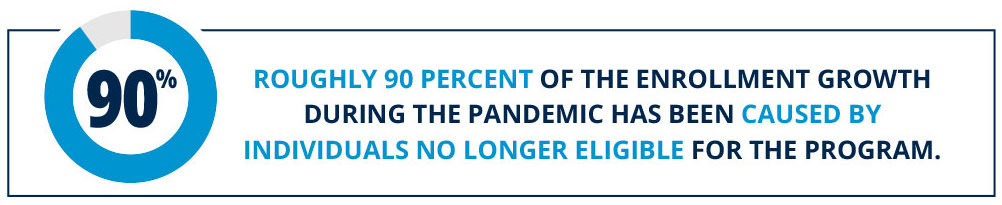
Locking enrollees into the program has caused Medicaid enrollment to soar to record heights.9 By June 2022, total program enrollment had ballooned to an estimated 95 million people, a record high.10 Worse yet, roughly 90 percent of the enrollment growth during the pandemic has been caused by individuals no longer eligible for the program.11 This means that an estimated 20 million enrollees were ineligible for the program nationwide by June 2022.12
Skyrocketing enrollment of ineligible individuals comes with a high price tag for taxpayers. Accepting the federal funding boost is not cost effective for most states, with the funding boost not covering the cost of keeping ineligible enrollees on the program.13 Covering ineligible enrollees is already costing billions of dollars, and soon state taxpayers will be footing an even greater share of the bill.14
State taxpayers will soon be paying an even greater share of the cost of covering ineligible enrollees
Federal taxpayers are temporarily financing the funding boost to states, and states are eligible for the funding until the public health emergency ends.15 But once the public health emergency is officially declared over, states will no longer receive that funding boost.16 At this point, states will be on the hook for an even greater share of the cost of covering ineligible individuals—until officials start removing them from the program.
The Biden administration has signaled that the public health emergency will continue into at least October 2022.17 By then, states will have an estimated 98 million Medicaid enrollees, including as many as 23 million people no longer eligible for the program.18 Those ineligible enrollees will cost taxpayers nearly $16 billion per month, with states picking up nearly $6 billion of those costs when the public health emergency ends.19

Ineligible enrollees come with a high cost to taxpayers and siphon resources away from the truly needy and other state priorities. Fortunately, once the Medicaid handcuffs are unlocked—either by a state’s decision to opt out or when the public health emergency ends—states may once again conduct redeterminations to remove ineligible enrollees.20 The longer states delay removing those ineligible enrollees, the more money state policymakers will need to find to cover their costs.
The Biden administration has encouraged states to take a year or longer after the public health emergency expires to complete these redeterminations—a decision that would add more than $50 billion in new costs for state taxpayers.21 At least 41 states have signaled they are planning to take up to a year to initiate and process redeterminations before eventually returning the program to normal operations.22
To preserve limited resources for the truly needy, state officials must conduct redeterminations and remove these ineligible enrollees as soon as possible.
THE BOTTOM LINE: Once the Medicaid handcuffs are removed, state officials should begin conducting redeterminations as soon as possible.
Once a state opts out of the funding or the public health emergency ends, ineligible enrollees will continue to be locked into Medicaid until states start conducting redeterminations. Conducting redeterminations would remove enrollees who are no longer eligible for the program, reduce taxpayer costs, and protect scarce resources for the truly needy. Once able, state officials shouldbegin conducting redeterminations immediately.
https://thefga.org/paper/states-should-conduct-redeterminations/

No comments:
Post a Comment
Note: Only a member of this blog may post a comment.