by Vinay Prasad
For years university researchers have complained that high indirects mean their institution takes a large portion of the money they earned, but now that Trump’s NIH is cutting indirects from 60 or even 90% to 15%, researchers are up in arms.
One argument they make is that each dollar given to the NIH has return on investment. It earns 2-3 dollars back. Let us set aside for a moment the low quality (and NIH funded) evidence used to make this claim— I don’t doubt that science has massive ROI because it generates technology. But this says nothing about waste. You could be earning 5 to 10 dollars instead of 2-3, if we trim the waste. Why not do that?
Here are 8 reforms the NIH must do
Indirects - Trump was right to go after indirects. This money is largely unaccountable to the American people. A famous researcher liked to say that “an NIH dollar is more valuable than any other dollar” precisely because the money can be used for any purpose. For people running computational labs, the indirects are insane. How can you justify 65% to sit at home on your computer? For some training grants, only a fraction of the money reaches the intended purpose. How can we allow this:
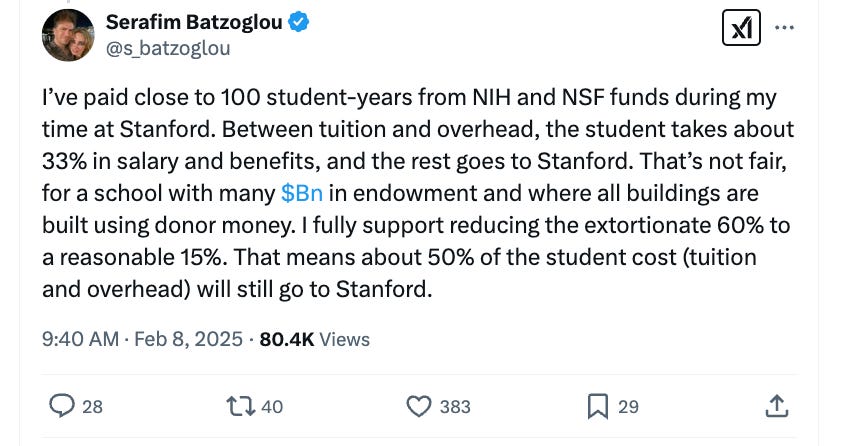
Some universities launder indirects. They take a portion of the indirect money and give it back to the researcher, who can use it as unrestricted funds. This is used for travel, including business class travel to Europe, and events with alcohol. It's hard to justify the use of taxpayer money in this fashion. It's again hard to justify taxing a plumber so that an upper middle class scientist can lie down on their flight to Geneva. This should be banned.
Stop funding bad science. I don’t know why many have a hard time admitting but most of science is neither true nor useful. Here is an NIH funded paper.
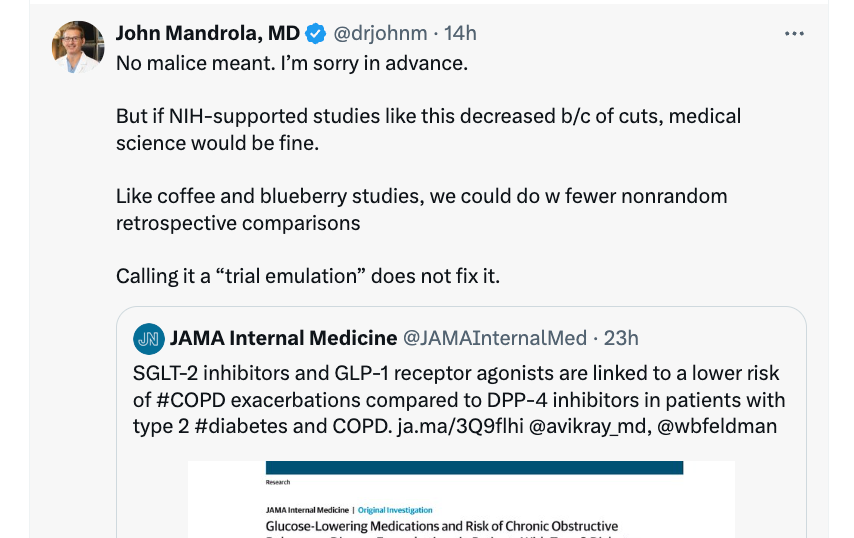
It uses observational data to claim DPP-4 drugs are worse for your diabetic COPD pt than GLP-1 wrt COPD exacerbations. But, as John tells us, it proves literally nothing. In fact, if you really wanted to know what order to initiate diabetic medications in a diabetic COPD pt, you should randomize them to GLP1RA then DPP-4 if poor control or vice versa, or perhaps 10 different treatment strategies, then measure the range of outcomes (COPD/ mortality/ etc). That study can be done with or without this retrospective study— i.e. this is not even hypothesis generating. The NIH funds so many studies like this. Waste.
Stop funding science the American people are sick of. This is an NCI funded study.

First, it is a county level analysis. It shows that counties that have more Blacks have fewer cancer centers and fewer trials. What is the purpose of this research? This has been known for decades. The article doesn’t tell us what we can do to fix it. Build more centers? Have target enrollment criteria for Blacks? But what about the bigger question: is it even a good thing to enroll on trials? Some prostate trials are really bad. I call PROFOUND, profoundly bad. Many use unethical control arms. I wouldn’t want my father to enroll on many of these trials. Why should we increase the number of Blacks who enroll on them? This research smells to me like the classic: NIH funds the buzzword ‘diversity’, whether the research is useful or not.
Don’t kill mice, dogs or monkeys without knowing if we are getting valuable information. Each year, millions of mice are killed at universities to cure cancer. The trouble is we have no idea if this is helpful. A common method to screen cancer drugs for their success and toxicity in human beings is to take genetically engineered mice, grow cancer under their skin, and then administer the drugs to see how effective they are. The trouble with this is that we have been able to successfully cure these mice for decades. But many times, the successful drugs don't work in people. The NIH has never studied whether or not these animal models are broadly predictive of human outcomes, and which ones are needed and which can be cut. How can we kill millions of mice to screen candidate compounds when we don't know if that screen actually helps us select better drugs to advance? Finally, there is an element of moral anguish as some of the people who have to crack the necks of these mice do not enjoy doing that, and only do so under the uncertain premise this is needed.
In medical school, my colleague had to put a tourniquet around the neck of dogs, to strangle them to cause a stroke, so he could give drugs that don’t work, and have no possibility of working, to try to fix them. He was so broken by the experience, he hated neurology/ neurosurgery, and worked in an animal shelter to pay penance. We owe it to animals and people to understand if this work is necessary (I suspect it is not only unethical, but scientifically useless to boot).
Randomize grant giving. It's astonishing to me how much researchers criticize the current system of study sections, without admitting that it is completely unproven. The NIH has a duty to know whether or not the cumbersome and complicated method by which money is allocated is superior to a lottery. Take $200 million, and randomize it to the current system or a lottery, and follow outcomes. I strongly suspect, given the limitations of the study section membership, given the idiosyncrasies of grant making, that a lottery would achieve similar results.
Audit the intramural branch. The intramural branch syphons off 4 billion dollars, and it is unclear if the productive justifies its existence. It needs independent audit and likely strict downsizing.
The NIH should explore whether or not to penalize universities that restrict the first amendment rights of faculty, or fail to uphold academic freedom. It is imperative for science to have a free exchange of ideas, but that was broadly abandoned in the pandemic. Stanford famously censured Scott Atlas for saying schools should be open and kids shouldn’t mask, and many faculty were discouraged from speaking. Right now some universities have sent gag orders to faculty to comment on indirects while they fight this in court. These actions are un-American, and the NIH should consider commitments to academic freedom/ freedom of speech as it funds institutions.
Penalize labs that do work that can’t replicate. The NIH should audit grants, and randomly pick basic science experiments. It should then commission other groups to replicate those studies. With time, each researcher can get a “replication” score card. If you run lab studies that fail to replicate much worse than your peers, you should lose funding. We should defund labs where people say, “Don’t worry, everything is looking great now, Dr. Tessier-Lavigne.”
The NIH generates return on investment, but that means waste has been tolerated for decades. The American people deserve to know that each dollar they spend has been MAXIMIZED and OPTIMIZED. This has never been attempted, despite decades and hundreds of billions in funding. Thankfully, the opportunity for reform has never been better, as the American people know that scientists cannot be blindly trusted.
https://www.drvinayprasad.com/p/the-nih-must-make-these-8-reforms

No comments:
Post a Comment
Note: Only a member of this blog may post a comment.