Search This Blog

Sunday, May 20, 2018

Smart luggage firms close because of airline battery rules

Two smart luggage firms have closed in May, with both blaming changes to airline policies regarding how lithium batteries can be taken on board planes.
Raden and Bluesmart said the changes, by several major airlines in December 2017, had made business impossible.
The new rules meant that luggage batteries had to be removable.
The smart suitcases feature weight sensors, a built-in phone charger and location awareness – but all require battery power.
“…our intent was to add ease and simplicity to your travel experience and this unforeseen policy change has made this impossible,” Raden said in a message on its website, spotted by The Verge.
Bluesmart’s products did not feature removable batteries at all.
The firm described its news as “bittersweet” in an announcement online, saying that it had sold its intellectual property to US suitcase brand Travelpro.

‘Veritable minefield’

Both firms said the luggage apps would continue to work for existing customers but refunds and replacements would not be possible.
Raden suitcases started at $295 (UK price £250) and are still stocked by some retailers.
At time of writing, Amazon UK has Bluesmart suitcases available with a starting price of £364 ($490).
Analyst Ben Wood, from CCS Insight, said the rules had created confusion at check-in, meaning people were unsure whether they would be able to travel with their bags.
“The integration of lithium-ion batteries and radio technologies such as Bluetooth and cellular connections was always going to make smart luggage a veritable minefield,” he told the BBC.
“Given the complex regulations around what you can and can’t take on to a plane it is little surprise it has become an issue.”

Stem cell sales pitch questioned by local Denver area doctors

Radio, television and newspaper advertisements are inundating the Denver area promising an end to pain through regenerative medicine.
Stem cell clinics, often operated inside the offices of chiropractors, are marketing their services as an alternative to surgery.
The clinics promise to inject stem cells from amniotic fluids donated by new mothers. The clinics say when those stem cells are injected into knees, hips and other pain-plagued areas, they can regenerate cartilage and resolve pain without a costly and risky surgery.
But those drawn in by marketing materials may not realize the stem cell injections are not approved by the FDA, are typically not covered by insurance and cost patients thousands of dollars out of pocket.
“What’s driving stem cells, a lot of it, is the patient desire for a miracle,” said Dr. Jared Foran, an orthopedic surgeon. “I see patients a lot where there’s not even a shred of evidence that a cell has grown in their knee.”
A group of local orthopedic surgeons and doctors told Contact7 Investigates the stem cell publicity blitz is bringing more and more patients into their operating rooms who have already spent thousands of dollars on injections that did not resolve their pain.
“We’re talking about huge amounts of money being paid for something where the enthusiasm is ahead of the science right now,” said Dr. Ian Weber, an orthopedic surgeon. “I think when I see patients who get misinformation, you’re selling them a dream. And these seminars are very good at it, these radio ads are very good at it, but you’ve got to know the facts.”
Weber estimated he sees one to two patients every week who have paid for injections that did not ultimately help them enough to avoid surgery.
One such patient is Eduardo Dominguez, who said he spent $6,000 on a hip injection that didn’t help him at all. He ended up getting hip replacement surgery performed by Weber.
Contact7 Investigates went undercover to watch how the clinics market their treatments to people looking for an end to their pain.
Seminars held in hotel conference rooms, restaurants
Contact7 Investigates attended two seminars put on by clinics affiliated with the Stem Cell Institute of America (SCIA). It describes itself not as a research facility but as a consulting company that provides its nationwide network of doctors with marketing materials that are frequently updated to comply with FDA guidelines.
Several websites linked to SCIA advertise about a dozen seminars held every week across the state where “space is severely limited.”
One local seminar attended by Contact7 Investigates was held in an event center in Littleton, another in a hotel conference room in Westminster.
Neither of the presenters said they were licensed medical professionals. They spoke to rooms of mostly older individuals, many who raised their hands when asked if they deal with daily pain.
In each seminar, the presenters detailed traditional medical treatments for pain – medications they said could be dangerous, surgery they said could kill you for simply living with the discomfort.
“Has a doctor ever told you, ‘You’ll just have to live with it? That it’s your age? That it’s the weather?’ I’ve had a lot of people tell me doctors have told them there’s absolutely nothing they could do,” one presenter told the audience. “Why do doctors tell you these things? It’s because they don’t know what else to do for you.”
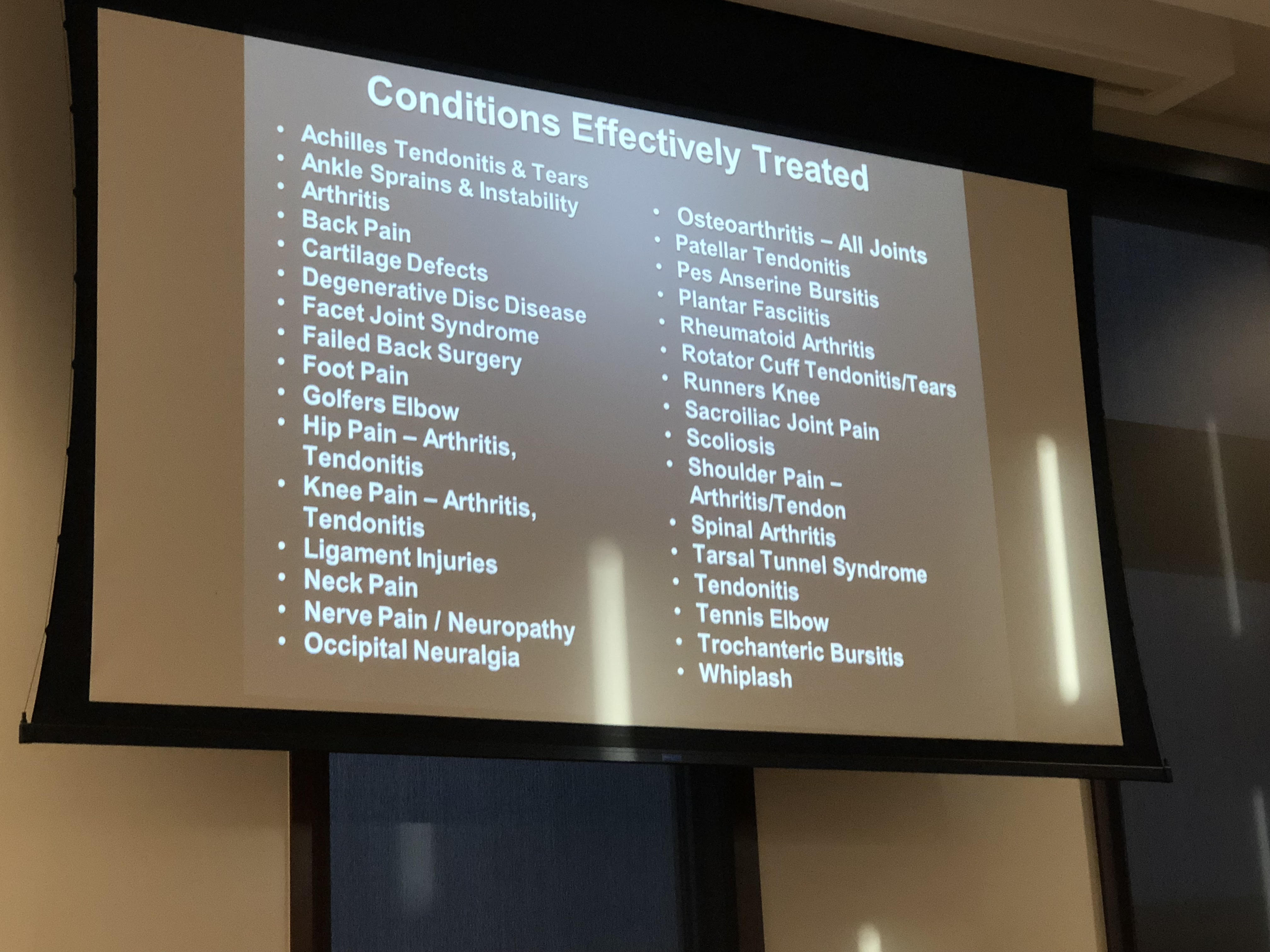
The pitch then switched to describe the regenerative properties of amniotic stem cells. In one presentation, audience members were encouraged to read a lengthy list of conditions the presenter said injections could effectively treat.
Presenters also discussed offering treatments for a host of other disorders. One presenter discussed successful treatments for patients suffering from COPD, asthma and multiple sclerosis. The other mentioned stem cell treatments for Alzheimer’s, diabetes, and erectile dysfunction. Each presenter also spoke of a 97-year-old patient who had success from a stem cell treatment in her hip.
Each presenter also said their clinic used injections of live stem cells.
“Umbilical cord stem cells are going to double every 24 hours. So, when you have one stem cell, 24 hours later, you have two. 24 hours later, you have four. Then eight, and so on and so forth. If you do the math with a calculator, in 30 days, one stem cell becomes a billion stem cells. So, their ability to self-replicate is much higher than the other kinds,” one presenter told the crowd.
The Stem Cell Institute of America told Denver7 there is debate about whether or not the amniotic injections being given by many clinics contain live stem cells, and said it was looking further into the science.
“Until we know definitively, we do not recommend that our clinic directors state that amniotic injectables contain live stem cells or that they don’t, but that amniotic has a particular quality of cells and growth factors which create healing activity,” SCIA said in a statement to Denver7 in October.
SCIA has not responded to a follow-up inquiry about whether or not its guidance to providers has changed.
When the presenters revealed the injections can cost anywhere from $6,000 to $10,000 each and are not covered by insurance, they explained the price by launching attacks on familiar targets: insurance companies and “Big Pharma.”
“Pharmaceutical companies are actually in the process right now of trying to patent stem cells. Do you know what happens if they go through with that? Each and every one of us will be owned by pharmaceutical companies because we all own stem cells, they’re all inside of our bodies, which means Big Pharma has the right to take your stem cells whenever they want to,” a presenter told the audience. “They want as much money as possible.  They want to be the only ones that are able to sell anything related to health care.”
The presenters then told the audience they had the opportunity to sign up for a free consultation at the clinic and offered discounts that would be available for signing up the same day of the event.
Presenters took questions from audience members after the seminars. When an undercover Contact7 producer asked one presenter if the results from injections are guaranteed, she responded:
“There’s not a guarantee, but they do such a thorough job of screening people prior to recommending it to them that that’s how we have a 96-percent success rate. We really don’t have anybody that it hasn’t worked for. … Really, there’s not anyone that’s unhappy with their results,” she said.
Orthopedic surgeon Ian Weber attended a seminar with Contact7 Investigates.
“These are very scary claims and I just can’t believe what I saw,” Dr. Weber said after leaving the presentation. “This is an absolute shakedown in which you’re taking advantage of people’s high hopes of something that may have potential in the future based on basic science research, but it hasn’t been clinically-proven in any of these situations and taking these people for $6,000 a pop.”
Seminar attendees encouraged to sign up for free consultations
After that seminar, a Contact7 Investigates producer signed up for a free consultation at West2North Medical Solutions at the chiropractic clinic’s office in downtown Denver.
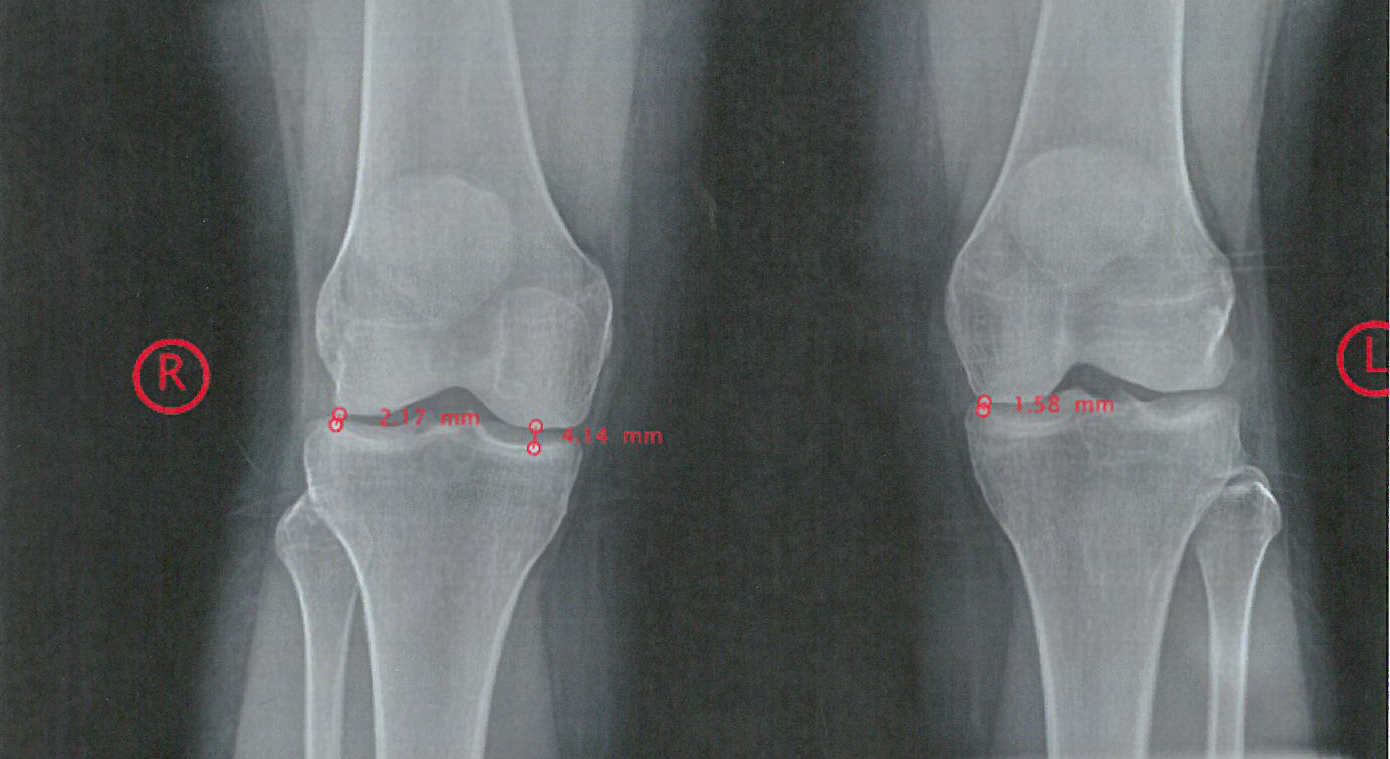
Upon arrival for the consultation, the Contact7 producer was led into an X-ray room to take images of her knees.
The producer, who is in her 30s, spoke with a patient educator and described having aching pain in one knee occasionally after running.
Within minutes, the patient educator showed the Contact7 crew the producer’s X-ray and said the images showed degeneration in both knees.
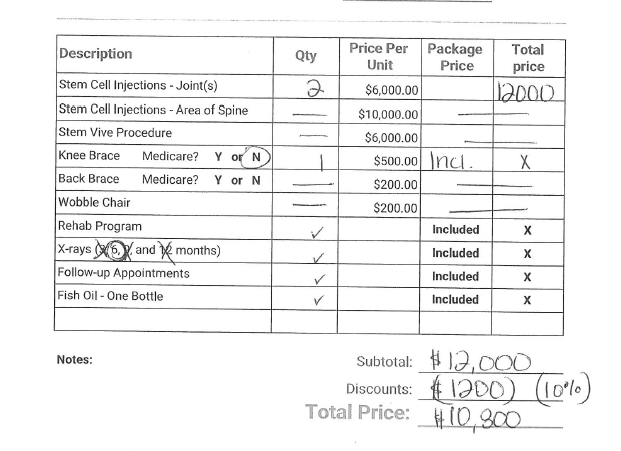
The patient educator recommended stem cell injections in both knees – at the total cost of $10,800 – reflecting a 10 percent discount for attending the promotional seminar.
A search of the state’s licensure database did not show the patient educator holds any professional licenses. She said the injections would be administered by a licensed nurse practitioner.
“My fear is we take care of the right knee, take care of the one that’s having the most problems, and then you start having the problem with the other one because we’re already degenerated,” the employee told the producer. “That’s what stem cells are good at doing, getting in there, rebuilding that cartilage so that we’re not having this pain, not having that overall stress.”
Orthopedic doctors told Denver7 there is no solid evidence yet that stem cell injections can repair such degeneration.
“There’s no evidence to say that any of this stuff regrows cartilage,” Dr. Efren Caballes said.
West2North’s website includes videos of patients saying the treatments helped their pain. The orthopedic doctors who brought their concerns to Denver7 said it’s possible the injections can offer some measure of pain relief so their practices also offer stem cell injections – but they don’t promise it could repair arthritic joints.
“[We] will be the first to tell a patient, ‘We’re not saying this is going to regrow your cartilage, there is some proof that helps decrease your pain and improve your function, but that’s about it,’” Dr. Foran said. “You get an injection and you end up feeling better. Now why are you feeling better? Are you feeling better because you’re growing cartilage? There’s almost no science behind that. Are you feeling better because it has some anti-inflammatory effect? Probably. Are you feeling better because it has a large placebo effect? Probably.”
West2North agrees to repay customers, stop injections in another state
West2North employees made no mention during the consultation or seminar of enforcement actions handed down by the North Dakota attorney general just days earlier.
The attorney general’s filing mentions “multiple sales presentations at hotel meeting room venues or other locations for the purposes of advertising and soliciting the sales of stem cell injections” and says the state believes claims made in those presentations are “untrue, misleading or unsubstantiated.”
The filing mentioned specific claims made in sales presentations the state believed were unsubstantiated including:
  • “You can possibly regenerate every area in your body”
  • “Regenerate cartilage”
  • “End your pain now”
West2North agreed to stop engaging in any stem cell injections in the state of North Dakota “unless the stem cells or stem cell products are compliant with any Food and Drug Administration requirements for use.”
West2North also agreed to issue refunds to four patients totaling close to $20,000.
West2North’s Denver-based chiropractor, Dr. Dean Jones, told Contact7 Investigates his clinic disagreed with the North Dakota attorney general’s findings.
“To prevent a very lengthy and expensive battle in court to defend our position and since we now have alternative stem cell therapy that is not subject to FDA regulation, we have agreed to refrain from using those products,” Jones wrote in an email.
Jones declined Denver7’s requests for an interview, instead forwarding a link to a documentary about stem cells that he said costs $300 for the public to view.


US surgeon general says he assisted in medical emergency on Delta flight

The United States surgeon general said on Wednesday that he assisted in a medical emergency on board a Delta flight.
“On my @Delta flight to Jackson, Mississippi (by way of Atlanta), and they asked if there was a Doctor on board to help with a medical emergency- why yes- yes there was. Patient doing well and like a good #USPHS officer, I was glad to be able to assist!,” Surgeon General Jerome M. Adams tweeted on Wednesday.
It was not immediately clear what situation Adams was referring to and what happened on the flight.
Delta said in a statement Adams intervened when a passenger became ill.
“Prior to takeoff, Delta flight 1827 from Fort Lauderdale to Atlanta returned to the gate following a customer illness. Medical assistance was provided by the U.S. Surgeon General who worked with our flight crew to aid the customer,” the company said in a statement. “Delta thanks the Surgeon General for volunteering his services in assisting this customer.”
close dialog
A request for comment to the Surgeon General’s office was not immediately returned.
Adams, who has served as surgeon general since September of last year, is an anesthesiologist, according to his official biography.
Delta’s official Twitter account also responded to the tweet, saying, “We certainly thank you for volunteering as well as for your service. Thank you so much for sharing this with us.”
Mississippi Gov. Phil Bryant also offered up praise, tweeting, “Nice job, Dr. Adams!” on Wednesday.

Will Shire’s top R&D talent bolt now that Takeda has struck a merger pact?

With the Takeda/Shire merger underway, the big question now is whether the older acquirer can combine the two R&D organizations without the kind of disruption that has marked past deals involving big players. I discussed that recently with Andy Plump, the R&D chief who will have to see to the details. And Takeda CEO Christophe Weber is clearly backing a swift resolution.

According to the news wire, Weber wants to quickly move to chop out programs that don’t make the cut on innovation.
“It’s really important that we don’t waste resource on assets that are moderately innovative,” Weber told Reuters. “When you combine two pipelines you can be more stringent.”
But he also noted that cutting doesn’t have to be a brutal procedure. Takeda has spun out 10 companies rather than just dump efforts. And Plump has been promising that same kind of delicate approach as he looks at some R&D areas — like ophthalmology — and locations that fall outside their sweet spot.
Maintaining that position, though, could be difficult, particularly in the Boston/Cambridge area, where competition for talent is high.

“They are cutting quite deep in R&D and it is not clear if the amount of money they are saving is going to be beneficial or harmful,” John Rountree, a partner at pharmaceutical strategy consulting firm Novasecta, told Reuters. “Merging R&D is never easy. There are going to be lay-offs and that creates uncertainty and disruption and sometimes the best talent just leaves.”
Even under the best of circumstances, this won’t be easy.
Takeda spent about $2.85 billion on research in the past year, while Shire racked up $1.7 billion in costs during 2017. Together, Plump will be handed a group with collective costs of a little more than $4.5 billion, with a goal to cut that by about $600 million. Based on their layoff plans outlined today, that will cost roughly 1,000 jobs.

CMS rejects Ohio’s ObamaCare individual mandate waiver

The CMS has rejected Ohio’s request to become the first state to waive the Affordable Care Act individual mandate that requires residents to have health insurance.
Ohio’s Legislature called for a 1332 innovation waiver last summer, before Congress zeroed out the financial penalty for not having coverage in its tax bill in December. But the waivers must follow provisions of the ACA that require the number of people covered remains the same and that their benefits remain comprehensive. The CMS said Ohio did not meet those requirements. State officials also never provided a reason why they should be exempt from the individual mandate.
“For this reason and those described above, the departments determined that the application is not complete,” the CMS said.
Ohio Department of Insurance Director Jillian Froment said in a March 30 letter to HHS Secretary Alex Azar that the reason why the state was requesting the waiver was that “the (tax) legislation zeroed out the penalty that is associated with the individual mandate…but…did not eliminate the mandate itself.”
Ohio officials now are determining potential next steps, according to Chris Brock, a spokesman for the state’s department of insurance.
In its application to HHS, Ohio actuaries predicted individual market enrollment will fall from 307,000 people this year to 248,000 enrollees in 2022, and average monthly premiums will increase from $493 to $600 in the same time frame.
State officials and Jennifer Tolbert, director of state health reform at the Kaiser Family Foundation, said that would happen as a result of the elimination of the tax penalty.

NIH stops enrollment in $100M alcohol study, probing industry ties to research

National Institutes of Health Director Francis Collins told lawmakers on Thursday that his agency suspended enrollment for a study on alcohol consumption found to have beverage industry ties.
Collins assured members of a Senate subcommittee, which was examining the NIH’s budget for next year, that the agency is carefully examining whether or not the study is still worth pursuing.
The study in question was a $100 million project aimed at examining the potential benefits of moderate alcohol consumption on cardiovascular health.
“For NIH, our reputation is so critical and if we are putting ourselves in a circumstance where that could be called into question, I felt we had to look at that very seriously and look at another strategy,” Collins said.

The study, which was being overseen by the National Institute on Alcohol Abuse and Alcoholism, was called into question in March by an investigation reported in the New York Times. They later reported NIH officials were investigating whether those health officials violated policy by reaching out to alcohol companies for funding.
Collins said the agency is also investigating research at other NIH institutes to ensure the “compromised” project is not part of a bigger problem.
“I’m very concerned that this might be the tip of a larger iceberg,” Collins told lawmakers. “We will look closely to see if there are other examples of this sort because that would be very much against the principles we stand for, which is separation of funding sources from outside with decisions about science. And also, of course, the peer review process needs to be absolutely above reproach.”
He promised to follow up with the committee on what he finds.

NIH carefully navigating opioid partnership with drug industry

With the backdrop of the concern over the alcohol study, Collins said his agency is moving forward—albeit carefully—in a partnership with pharmaceutical companies.
In response to lawmaker questions about plans for industry players to help pay for and participate in efforts to address concerns tied to the opioid crisis, Collins said the NIH has been in conversations with 33 companies and that he expects to release more partnership details within the next couple of weeks.

Areas where NIH and the industry could partner include the sharing of data and assets, as well as repurposing compounds which might have been tried for something else or abandoned.
However, he said, serious concerns were raised about the funding.
“The controversies that arose were—given the circumstances around the opioid crisis and the fact that there are now lawsuits filed against no less than five of these companies claiming they may have played some role in the opioid crisis in the first place by marketing such drugs as oxycontin—whether it is a good idea or potentially carries a reputational risk for NIH to receive funds from the companies.”
NIH decided to pursue the partnerships but will not accept funds from pharma, he said.

5 interesting plot twists in the Cigna-Express Scripts deal

Months before Cigna began negotiating with Express Scripts, the insurer was in talks with another large publicly traded healthcare company.
But the discussion of a strategic partnership that began in September never progressed into serious negotiations, and the insurer ultimately determined there was more value in acquiring the pharmacy benefit manager, according to a financial filing by the companies this week. The filings didn’t indicate which company Cigna was in discussions with.
A month later, Cigna and Express Scripts executives met to discuss a possible “white label” commercial arrangement, which eventually transformed into acquisition talks. Five months later, the two companies inked a $67 billion deal.

The filing includes several interesting factors that impacted the deal:
  • Despite shopping around after its deal with Anthem fell through in May 2017, Cigna received no acquisition offers or interest from any third parties, prompting it to look for an acquisition.
  • The terms of the deal fluctuated between the beginning of January, when Cigna made its first offer, and the final deal in March. Cigna’s initially offering was $87-$89 per share. Express Scripts balked at that offer and countered weeks later at $102 a share. The two companies eventually settled on a $97.50 per share price.
  • Amazon made a brief appearance in the discussions when the Express Scripts board of directors acknowledged the potential entry of “significant new participants” in the healthcare industry during a December meeting. Another topic of discussion: The CVS-Aetna deal announced earlier that month.
  • Anthem’s decision to terminate its contract with Express Scripts in April of last year factored into the company’s decision to sell. Express Scripts CEO Tim Wentworth also highlighted “recent consolidation trends” as well as the “regulatory and political climate” and “continued competitive pressure” as reasons the board should seriously consider Cigna’s offer.
  • The regulatory termination fee tied to the deal reach as high as $3.25 billion, part of the counteroffer proposed by Express Scripts in February. The two companies eventually agreed Cigna would pay a $2.1 billion breakup fee if the Department of Justice doesn’t approve the deal.
Express Scripts and Cigna expect the deal to close by the end of the year.