Search This Blog

Tuesday, May 22, 2018

Most Preclinical Alzheimer’s Doesn’t Progress to Dementia

May 22, 2018
Most people with preclinical Alzheimer’s disease will not develop Alzheimer’s dementia during their lifetimes, according to a mathematical analysis based on several large cohort longitudinal studies.
Based on a multistate model for the Alzheimer’s disease process, the risks of Alzheimer’s dementia varied by age and sex, as well as by preclinical biomarker results and clinical symptoms, reported Ron Brookmeyer, PhD, and Nada Abdalla, both of the University of California Los Angeles, in Alzheimer’s & Dementia.
“This is the first paper to calculate the lifetime risks of Alzheimer’s disease taking early preclinical signs from biomarker test results into account,” Brookmeyer told MedPage Today.
There were some surprising results, he noted. For instance, a 70-year old male with only amyloid has a lifetime risk of only 20%. “It’s more likely that he won’t get Alzheimer’s disease dementia than he will, even though he has amyloid in his brain,” Brookmeyer stated.
But if that same 70-year-old male also has neurodegeneration, his risk climbs to 31%. Brookmeyer noted that “if has mild cognitive impairment, plus neurodegeneration and amyloid, his lifetime risk rises to 86%. That’s quite a range.”
This “methodologically sound study” provides “hope to most with preclinical Alzheimer’s that they might live dementia-free even when very old,” observed Constantine Lyketsos, MD, MHS, of Johns Hopkins School of Medicine in Baltimore, who was not involved in the study.
“What’s encouraging here is that people with preclinical Alzheimer’s are not destined to develop dementia,” Lyketsos told MedPage Today.
Brookmeyer and Abdalla used two large published epidemiological cohort studies that had measured biomarkers for amyloidosis and neurodegeneration: the Mayo Clinic Study of Aging, which analyzed 1,541 participants, and a study based on 13 cohorts in Europe and the U.S., which evaluated 353 people with mild cognitive impairment (MCI) as well as amyloidosis and neurodegeneration, plus another 222 individuals with MCI and neurodegeneration.
Using the transition rates from the published studies and U.S. death rates data based on age and sex, the researchers created a model to determine the likelihood of lifetime progression along the continuum of the disease.
“The preclinical period of Alzheimer’s dementia is very long and variable,” Brookmeyer said. “In elderly populations, many will likely die of other causes before the disease actually expresses itself clinically.”
Sex plays a role, too, he added. “Females generally will have higher risk because of their longer life expectancy. A 90-year-old female who has just amyloid, nothing else, has a lifetime risk of only 8% of developing Alzheimer’s dementia.”
While these calculations may reassure some patients who test positive on amyloid, the risks may change considerably as the disease progresses. “Once patients have MCI, our calculations show the rates go up quite a lot,” Brookmeyer noted. “But based only on preclinical conditions, these calculations may help guide clinicians in interpreting what biomarker results might mean for a patient. Is the risk low? Is it moderate? That’s its utility.”
The results also may have implications for research and clinical trials. “One of the things we also calculated were 10-year-risks to help show who might be a priority for entering clinical trials, and what kinds of people are most likely to progress to dementia,” Brookmeyer said.
There’s more work to be done, including factoring in APOE4 to see how that might interact with preclinical states, he said. While the analysis included some of the largest cohort longitudinal studies that have been published, the populations assessed were not ethnically diverse.
Brookmeyer and Abdalla’s model differs from the new Alzheimer’s definition for researchrecently proposed by the National Institute on Aging (NIA) and the Alzheimer’s Association (AA), said Maria Carrillo, PhD, chief science officer for AA.
Under the proposed NIA-AA definition, a person who does not have amyloid plaques does not have Alzheimer’s pathology. In Brookmeyer and Abdalla’s model, two states of Alzheimer’s disease progression do not include amyloid.
Brookmeyer disclosed support from the NIH and relevant relationships with Takeda. Abdalla disclosed no relevant relationships with industry.

Rockwell Medical CEO terminated

Rockwell Medical announced that its Board of Directors has formed a Special Transition Committee to provide board-level oversight over the Company’s strategic direction and day-to-day operations, effective immediately. The Board of Directors also announced that the Company’s President and Chief Executive Officer, Robert Chioini, has been terminated from his positions, effective immediately. In connection with today’s announcement, Chioini has resigned as a member of the Board and will not stand for reelection at the 2018 Annual Meeting of Shareholders. The Special Transition Committee, which will remain in place until a new CEO is appointed, will comprise independent directors Ben Wolin, who is also Chairman of the Board, Lisa Colleran and John Cooper. The Board has initiated a formal search process and retained a leading executive search firm to identify a permanent CEO

Up-and-coming Pfizer, AbbVie drugs set to threaten Amgen, Celgene: Bernstein

With Pfizer’s Xeljanz snapping up new indications and AbbVie’s upadacitinib on the way, makers of anti-inflammatory drugs will soon feel the heat from JAK inhibitors if they haven’t already. But some will feel it more than others, Bernstein analysts say.
Makers of drugs for rheumatoid arthritis are the ones who really need to watch out, Bernstein’s Ronny Gal wrote to clients on Tuesday. JAK inhibitors have posted “strong” efficacy data in the disease versus other drug classes, and JAKs’ side effects—which can include infections and elevated cholesterol—are “more acceptable” in that setting.
Overall, he sees JAKs going on to snatch a 24% chunk of the market, which is bad news for products such as Amgen’s Enbrel. That drug’s decline “will accelerate as physicians increasingly use JAKi as the second drug after (AbbVie’s) Humira, instead of trying a second aTNF (Enbrel).”
In inflammatory bowel disease, though, they’ll make less of a mark; Gal predicts they’ll wind up with a 12% market share. The reason? So far, efficacy data has only been “decent” in ulcerative colitis and “moderate” in Crohn’s, he wrote. And on top of that, multiple other classes will hit the market at the same time JAKs do.

That doesn’t mean JAKs won’t cause problems for Celgene, which is developing candidate ozanimod in both ulcerative colitis and Crohn’s. By the time ozanimod could potentially reach the market, Xeljanz should have an 18-month lead in ulcerative colitis, as well as leverage with payers, Gal figured.
The way he saw it, though, Celgene can relax when it comes to JAK competition for its psoriasis drug, Otezla. “JAKs will likely not be used in Otezla’s core market of psoriasis and do not look particularly promising” in psoriatic arthritis, he wrote. Regeneron and Sanofi, which market atopic dermatitis treatment Dupixent, face “limited risk,” too.

In addition to out-of-class rivals, makers of JAK drugs have one another to worry about. Most payers will have at most one member of the class co-preferred, according to Gal, and doctors will switch to other classes after trying a single JAK in patients.
“Prices will likely be flat and competition for preferred will likely pit Xeljanz (PFE’s incumbent) and upadacitinib (ABBV) against each other,” he wrote, noting that AbbVie’s stellar formulary positioning with Humira could help it gain an edge.

Dr. Reddy’s fourth-quarter profit falls 19 percent on U.S. headwinds

Indian generic drugmaker Dr. Reddy’s Laboratories Ltd posted a 19 percent drop in quarterly net profit on Tuesday, missing analysts’ estimates, pulled down by headwinds in the U.S. market.
The company’s net profit, for the quarter ended March 31, came in at 2.72 billion rupees ($39.98 million), compared with 3.38 billion rupees a year earlier, the company said.
Nineteen analysts on average expected a net profit of 3.59 billion rupees, according to Thomson Reuters data.
Revenue from the generics business in North America, its biggest market, dropped 6 percent to 14.49 billion rupees due to price erosions and increased competition.
Export-driven Indian drugmakers’ ability to negotiate on prices has been hit by consolidation among drug distributors in the United States.
Revenue from its generics business in Europe plunged 17 percent largely due to supply disruptions.

Pharma will back generics-easing bill if Senate funds another project: Grassley

After pharma suffered an unexpected loss in this year’s budget deal, the industry sees an opportunity to get some relief. It might trade concessions on a bill favoring generics makers in return for a policy tweak elsewhere, Sen. Charles Grassley, R-Iowa, said Monday.
Speaking with reporters, the Senate Judiciary Committee chairman said he’s been in talks about a deal in which the drug industry would pull its opposition to the Creates Act, which would crack down when branded drugmakers use FDA regulations to keep drug samples out of generics makers’ hands, according to The Hill.
That capitulation would come in exchange for a separate policy tweak favoring the industry, according to the lawmaker—potentially relief on the “donut hole” change that put the industry on the hook for bigger Medicare discounts.
The donut hole gap hits after Medicare patients reach $3,750 in drug spending for the year and lasts until their total spending reaches about $8,400, or $5,000 in out-of-pocket costs for patients. To help bridge that gap, drug companies previously had to offer a 50% discount on drugs; lawmakers have increased the amount to 70% starting in 2019.
Industry resisted the change, but ended up suffering a rare loss in Washington. PhRMA President Stephen Ubl said at the time that the change “provides a massive bailout for insurance companies and undermines their incentive to reduce Part D costs” instead of working to lower patient out-of-pocket costs.
On the other side of a potential deal, the Creates Act aims to stifle regulatory abuses that stave off generics competition. Generics drugmakers have said branded drug companies use the FDA’s Risk Evaluation and Mitigation Strategies regulations to limit their ability to get drug samples and test generic equivalency. If they can’t test for equivalency, they’re not able to bring cheaper generics to market.
Cracking down on such abuses has had some bipartisan support for years, but it hasn’t gotten anywhere in Congress
Meanwhile, the Trump Administration is pushing back against REMS abuses independent of Congress. Last week, the FDA published a list of drugmakers that have received complaints on the issue, including Celgene, Johnson & Johnson, Gilead Sciences, Novartis and Pfizer. Industry lobby group PhRMA responded that the list “lacks proper context and conflates a number of divergent scenarios.”
While Grassley’s remarks don’t directly link the “donut hole” budget change to the Creates concessions, it’s been a priority for the industry because of its potential to cost leading drugmakers billions of dollars. The boost in “donut hole” responsibility could mean a “multibillion-dollar impact on some large companies,” healthcare consultancy Avalere Health concluded after the change.
Grassley’s remarks come shortly after House of Representatives speaker Paul Ryan said House committees are working on a compromise to pass Creates Act legislation, The Hill reported last week.

Insmed Phase 3 lung med study meets primary endpoint

Insmed announced that detailed data from its ongoing Phase 3 CONVERT study of ALIS in adult patients with treatment refractory NTM lung disease caused by MAC were presented at the American Thoracic Society, or ATS 2018 International Conference. Results from 336 randomized patients in the Phase 3 CONVERT study cumulatively demonstrated that ALIS, combined with GBT, improved culture conversion rates. The global CONVERT study met its primary endpoint of culture conversion by month six with statistical significance. In the study, the addition of ALIS to GBT eliminated evidence of NTM lung disease caused by MAC in sputum by month six in 29% of patients, compared to 9% of patients on GBT alone. Additionally, results from an exploratory analysis using the 6MWT, a quality of life measure, demonstrated that converters from both groups saw a mean increase in distance walked at month six of 16.8 meters as compared to baseline

CVS-Aetna, Cigna-Express Scripts mergers would spur massive Part D consolidation

Planned mergers between major health companies could lead to a serious anticompetitive landscape, a new analysis finds.
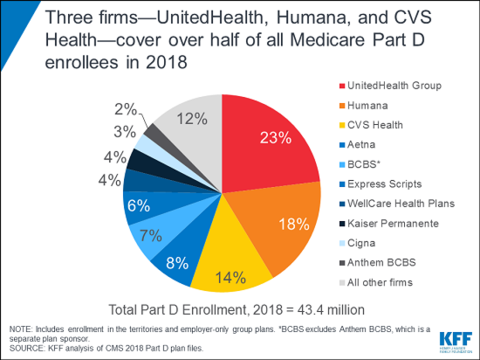
The proposed mergers of Cigna-Express Scripts and CVS Health-Aetna would further consolidate the Medicare Part D marketplace, research by the Kaiser Family Foundation found. The merged entities, plus Humana and UnitedHealth, would cover 71% of all Part D beneficiaries.
That type of dominance in the Part D market is comparable to Verizon and AT&T’s command of the wireless carrier industry. Those two companies occupy about 69% of the market, according to Statista.

Currently, three companies—UnitedHealth, Humana and CVS—already account for more than half of the program’s 43 million beneficiaries.
Kaiser Family Foundation
Critics of the mergers, including the American Medical Association, have said the deals, particularly CVS-Aetna, pose anticompetitive concerns, “unique to vertical mergers,” as new competitors would have to enter the market in both insurance and PBM to compete with the combined CVS-Aetna.
We continue “to strongly encourage state and federal officials to rigorously review the proposed mergers between pharmacy benefit managers and health insurers given the potential negative impact on pharmaceutical benefit management services, local health insurance markets, as well as local retail pharmacy markets, which in turn can harm consumers in these markets,” David O. Barbe, president of AMA, told FierceHealthcare in an email. “Close scrutiny is needed to determine if the ramifications of these massive mergers will threaten the benefits of competition, including increased access and choice, lower prices and higher quality care for patients.”
The companies, however, have argued that the deals will allow for more integrated care and will increase competition in the PBM sector, and lower drug costs for patients.
The Trump administration is pushing for more competition in the Part D market as part of a drug pricing blueprint, seemingly putting the mergers at odds with the White House’s vision.

The Department of Justice is currently reviewing the $69 billion deal between CVS and Aetna and has given few clues on whether the transaction will be approved. With its business-friendly approach, one might expect the White House to be more open to such a deal than the Obama administration, which blocked the Anthem-Cigna and Aetna-Humana deals.
However, the Trump administration’s decision to block the AT&T-Time Warner deal could indicate the proposed healthcare mergers might ultimately be too big, and too anticompetitive, to approve.