Search This Blog

Saturday, August 11, 2018

Substandard, falsified meds prevail in developing countries


A new study from the University of North Carolina at Chapel Hill found that substandard and falsified medicines, including medicines to treat malaria, are a serious problem in much of the world. In low- and middle-income countries, more than 13 percent of the essential medicines that satisfy the priority health care needs of the population fall in this category. When looking specifically at African countries, the portion of substandard and falsified medicines rises to almost 19 percent.
Researchers analyzed 96 previous studies of falsified and substandard medicines and each of the studies tested more than 50 medications. The team found that antimalarials and antibiotics were the medicines most commonly sold in substandard or falsified conditions. In low- and middle-income countries, 19 percent of antimalarials and 12 percent of antibiotics are substandard or falsified.
“The prevalence of substandard and falsified medicines is a substantial public health problem because these medicines can be ineffective or harmful and can prolong illnesses, cause poisoning or lead to dangerous drug interactions,” said Ozawa. “Our study shows that a concerted global effort is needed to improve supply chain management for medicines and to identify solutions to this understudied issue.”
The researchers searched five databases for studies related to substandard and falsified medicines. They reviewed 256 studies and included 96 studies in their analysis.
“We need more global collaboration to implement laws on drug quality, increase quality control capacity, and improve surveillance and data sharing,” said
The team’s analysis found limited information on the economic impact of poor quality medicines, with the estimates of market size ranging widely from $10 billion to $200 billion. Substandard and falsified medicines can burden health systems by diverting resources to ineffective or harmful therapies and cause additional treatment costs and reduced worker productivity due to treatable illnesses, but these effects have not been measured.

Weedkiller glyphosate ‘doesn’t cause cancer’ – Bayer


Pharmaceutical group Bayer has dismissed claims that an ingredient used in weed killers is carcinogenic.
The German company, which owns agriculture giant Monsanto, says herbicides containing glyphosate are safe.
On Friday, Monsanto was ordered to pay $289m (£226m) damages to a man who claimed the products caused his cancer.
A Californian jury said Monsanto should have warned users about the dangers of its Roundup and RangerPro weedkillers.
Bayer completed its $66bn takeover of Monsanto in June.
A Bayer spokesperson told the BBC the two companies operate independently. In a statement the company said: “Bayer is confident, based on the strength of the science, the conclusions of regulators around the world and decades of experience, that glyphosate is safe for use and does not cause cancer when used according to the label.”
The landmark lawsuit was the first to go to trial alleging a glyphosate link to cancer.
The claimant, groundsman Dewayne Johnson, was diagnosed with non-Hodgkin’s lymphoma in 2014. His lawyers said he regularly used a form of RangerPro while working at a school in Benicia, California.
He is among more than 5,000 similar plaintiffs across the US.
Glyphosate is the world’s most common weedkiller. The California ruling could lead to hundreds of other claims against Monsanto.
The company said it intends to appeal against the verdict.
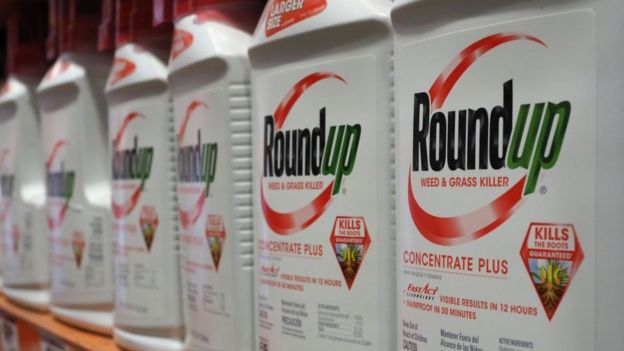
Bottles of Monsanto's Roundup are seen for sale June 19, 2018 at a retail store in Glendale, CaliforniaImage copyrightGETTY IMAGES

What is glyphosate and is it dangerous?

Glyphosate was introduced by Monsanto in 1974, but its patent expired in 2000, and now the chemical is sold by various manufacturers. In the US, more than 750 products contain it.
In 2015, the International Agency for Research on Cancer, the World Health Organisation’s cancer agency, concluded that glyphosate was “probably carcinogenic to humans”.
However, the US Environmental Protection Agency (EPA) insists it is safe when used carefully.
The European Food Safety Authority (EFSA) also says glyphosate is unlikely to cause cancer in humans.
Last November 2017 EU countries voted to renew the licence of glyphosatedespite campaigns against it.
BBC North American correspondent James Cook reported that in California – where a judge recently ruled that coffee must carry a cancer warning – the agriculture industry sued to prevent such a label for glyphosate, even though the state lists it as a chemical known to cause cancer.

What happened in the groundsman case?

Jurors found on Friday that Monsanto had acted with “malice” and that its weed killers contributed “substantially” to Mr Johnson’s terminal illness.
Following an eight-week trial, the jury ordered the company to pay $250m in punitive damages together with other costs that brought the total figure to almost $290m.
Mr Johnson’s lawyer, Brent Wisner, said the jury’s verdict showed that the evidence against the product was “overwhelming”.
“When you are right, it is really easy to win,” he said.

How did Monsanto react?

“The jury got it wrong,” vice-president Scott Partridge said outside the courthouse in San Francisco.
In a written statement, the company said it was “sympathetic to Mr Johnson and his family” but it would “continue to vigorously defend this product, which has a 40-year history of safe use”.
“Today’s decision does not change the fact that more than 800 scientific studies and reviews – and conclusions by the US Environmental Protection Agency, the US National Institutes of Health and regulatory authorities around the world – support the fact that glyphosate does not cause cancer, and did not cause Mr Johnson’s cancer,” it added.

Demi Lovato’s ‘road to recovery’ through rehab will be costly


Following her drug overdose, singer Demi Lovato said she is on the “road to recovery” — and she’s not alone. Most Americans entering rehab will face wildly different costs, depending on their insurance provider and state.
In a statement on her Instagram FB, -1.55%   account, Lovato said she wanted to be transparent about her addiction and thank her family, friends and fans (as well as the hospital staff) for their support. “What I’ve learned is that this illness is not something that disappears or fades with time,” she wrote. “It is something I must continue to overcome and have not done yet.”
Lovato said she now needs time to heal and focus on sobriety and her “road to recovery.” She added, “I look forward to the day where I can say I came out on the other side. I will keep fighting.” (Lovato did not disclose what drug she had taken that led to her overdose.)
Lovato is one of millions of Americans who suffer from addiction to drugs and alcohol. Nearly half of Americans say they’ve had a family member or friend with a current or past drug addiction, according to a 2017 survey by the Pew Research Center.
More than 115 Americans die from opioid overdose every day, according to the National Institute on Drug Abuse, and opioid overdoses have increased 30% between July 2016 and September 2017 in 52 areas in 45 states. Opioids include prescription medication, heroin and synthetic drugs such as fentanyl.

A patient’s out-of-pocket expenses vary drastically by insurance provider — whether it is a private company or Medicare or Medicaid — their plans and what their c and deductibles are, the patient’s state, and the treatment necessary, said Michael Cartwright, chief executive officer of American Addiction Centers, a rehabilitation company based in Brentwood, Tenn.
“Some rates haven’t changed in 20 years,” he said. “It is a highly underfunded field.”
Cathryn Donaldson, director of communications and public affairs at America’s Health Insurance Plans, a member organization of about 1,300 insurance companies, told MarketWatch, “Health insurance providers are committed to providing access to evidence-based substance use disorder therapies, rehabilitation, and innovative, holistic treatment plans to help patients get and stay sober.”
Medicare, the federal program for people 65 and older and people with disabilities, can cover inpatient treatment at hospitals and some drug centers, or screening for substance abuse and counseling, but might be limited.
Medicare Part A, which is hospital insurance, states an individual can receive no more than 190 days of treatment at a psychiatric center for the life of the patient. Medicare Part B may cover screening and intervention, but require copays. Part D covers medications, though patients should double check those they were prescribed are covered by their insurance plan.
There are a few ways to treat addiction, and they each come with varying price tags, according to the Addiction Center, an online resource about drug addiction and treatment from the Beach House Center for Recovery in Juno Beach, Fla. It breaks down some of the costs:
• Outpatient detox can cost between $1,000 and $1,500 in total.
• Inpatient rehab could cost between $6,000 and $20,000 for a 30-day program, or up to $60,000 for a 60-day or 90-day programs.
• Outpatient rehab allows patients to live outside of the facility, and its price depends on how frequently they visit. They cost at least $5,000 for a three-month program.
• Medications cost thousands of dollars every year. Heroin users may need a year-long methadone treatment, which could cost about $4,700 per year.
States also fund their own drug rehabilitation centers. These centers cater to low-income residents or people living in poverty or without health insurance, which could be free to eligible participants. They are in high demand and, in some cases, patients may be released before their treatment is complete, according to New Beginnings, an online resource for drug addiction and treatment.

Immediate intervention can be critical in helping someone survive an initial overdose. Naloxone is a drug that helps reverses the effects of an opioid overdose as it’s happening, allowing the person to restore his or her breathing and, in most cases, wait for a paramedic or doctor to arrive. A kit costs between $20 and $40, according to GoodRX, a website that tracks drug prices.
It is administered via a nasal mist or injection, and is now available over the counter. The U.S. Surgeon General said earlier this year more people should be carrying naloxone.
The economic impact of opioid drug abuse was $504 billion in 2015, the most recent year for which data is available, according to the Council of Economic Advisers. That includes health-care expenses, criminal justice costs and lost productivity. President Donald Trump has called the crisis a “public health emergency.”

Brazil slams Venezuela as measles spreads across border


Brazil complained on Thursday that Venezuela was doing nothing to stop the spread of an outbreak of measles in Brazil and other neighboring countries that has been sparked by an exodus of Venezuelans fleeing economic collapse.
Since February, four people – three of them Venezuelan – have died of measles in the remote Brazilian border state of Roraima where health authorities have confirmed 281 cases of the disease, mostly among children.
Brazil’s Health Minister Gilberto Occhi said Venezuela had ignored Brazilian offers of assistance and vaccines and had not replied to requests for information to assess the extent of the epidemic.
“We need to know what Venezuela’s policy is and what it has done to vaccinate its population, and so do other countries,” Occhi said in a conference call with foreign media.
The Venezuelan Information Ministry did not immediately reply to a request for comment.
Occhi said Brazil was considering vaccinating all Venezuelans entering the country – some 2,000 people a day, with around half of those in transit or on a short-term visit. Currently only those that ask to stay as refugees or residents are vaccinated.
Brazil, along with Colombia and other neighbors, has been discussing the need for Venezuela to provide up-to-date information with the Pan American Health Organization (PAHO), an official said.
“All we have is preliminary data from 2017. They are not updating the information and we can’t see the magnitude of the problem,” said Carla Domingues, head of Brazil’s immunization program.
PAHO said last month that nearly 2,500 confirmed cases of measles had been reported in the Americas in 2018, with over 1,600 of those occurring in Venezuela and nearly 700 in Brazil.
Since Venezuelans fleeing economic and political turmoil started entering Roraima at the only land crossing three years ago, Brazil has vaccinated 45,000 arrivals.
A decree by Roraima state government ordering the compulsory blanket vaccination of Venezuelans was struck down by the Supreme Court this week.
Measles vaccination in Brazil fell to around 70 percent coverage in 2017, a ministry official said.

India’s Hetero pulls heart drug from U.S. amid cancer risk probes


A unit of India’s Hetero Drugs is recalling some batches of the blood pressure and heart medicine valsartan in the United States, a notice on the U.S. regulator’s website said, amid a wider probe into cancer risks associated with the drug.
At least a dozen companies around the world have pulled specific batches of valsartan from the market since early July, when regulators said valsartan made by the Chinese supplier Zhejiang Huahai Pharmaceuticals had been found to contain a probable human carcinogen, N-nitrosodimethylamine (NDMA).
The notice from the U.S. Food and Drug Administration (FDA) said Hetero was found to be using a similar manufacturing process to China’s Zhejiang Huahai for valsartan. (bit.ly/2MjohkN)
“Test results from Hetero Labs show the amount of NDMA found in its valsartan active pharmaceutical ingredient (API) exceeds acceptable levels; although it is generally lower than the amount discovered in the API manufactured by Zhejiang,” the FDA said.
The company, among India’s top 15 drugmakers and one of the world’s largest suppliers of HIV/AIDS drugs, sells valsartan in the United States through its unit Camber Pharmaceuticals, which is recalling the drug as a “precautionary measure,” the FDA notice said.
It added that Camber had not received any reports of adverse events related to the drug. (bit.ly/2Bc5u6T)
Calls to New Jersey-based Camber went unanswered on Saturday, outside of regular working hours.

INDIA IMPORTS

Valsartan was originally developed by the Swiss firm Novartis and sold under the name Diovan, but it is now off patent and is used in several generic medicines made by companies around the world.
Hetero’s website says the company has more than 30 manufacturing plants around the world.
India has temporarily suspended imports of medicines from China that contain valsartan, K. Bangarurajan, a joint drugs controller at India’s main drug authority, the Central Drugs Standard Control Organization, told Reuters on Saturday.
Imports from elsewhere continue, he said.
“Not all imports have been blocked,” he said, adding that the action was taken after FDA posted a notice about cancer links to valsartan last month.
European regulators said on Friday that a second Chinese contract manufacturer, Zhejiang Tianyu, had produced valsartan with the cancer-causing chemical. (reut.rs/2ns12qB)
NDMA is classified as a probable human carcinogen. Based on results from laboratory tests, it may cause cancer with long-term use.
China and India supply more than two-thirds of all active drug ingredients used in medicines, industry experts estimate.

Cannabis Companies Are Moving To Canada, Its Friendlier Legal Climate


Investors should expect a rise in cannabis IPOs in Canada — rather than the U.S. — due to the country’s legalization of recreational use, according to AxisWire’s 2018 Cannabis Trend Report.

What Happened

Canada possesses more short-term advantages for going public, as cannabis business owners benefit from operating in a market that carries little legal risk.
“Sure, nine states have legalized recreational cannabis, but it’s still federally illegal. U.S. cannabis companies continuously have to look over their shoulders, hoping that the federal government isn’t about to kick down their door and make their business close its doors for good,” the report said.
Canadian company Sunniva, Inc. (CNSX: SNN) plans to obtain licensing in both Canada and California, making it one of the first cannabis companies operating in both regions. Both California and Canada are among the largest cannabis markets in the world.

What’s Next

Aside from legality of the sale and use of cannabis, U.S. companies must comply with listing requirements set by the New York Stock Exchange and NASDAQ.
In order to be listed on the NYSE, a company is required to have publicly held securities totaling at least $100 million, while companies looking to be listed on NASDAQ need a pretax income of $11 million over three years. Canadian exchanges require a pretax income of $300,000 in the prior year, the report said.
The report also suggests that a majority of key players within the U.S. industry are biopharmaceutical companies rather than cannabis companies. The numerous companies solely marketing cannabis are largely moving operations to Canada in an effort to avoid barriers and risks to the business.
“In the short term, expect an exodus of cannabis companies either going public or completely moving their operations to Canada and expect them to stay there until the United States finally decides to tackle federal cannabis reform,” AxisWire said.

Friday, August 10, 2018

Alnylam in Value-Based Agreements with Insurers, Patient Support for New Med


− Structure of Value-Based Arrangements Agreed in Principle with Harvard Pilgrim Health Care and Other Major Health Insurers –
− Alnylam Assist™ Program Designed to Facilitate Access to ONPATTRO and Provide Dedicated Patient Support –
Alnylam Pharmaceuticals, Inc. (Nasdaq: ALNY), the leading RNAi therapeutics company, today announced it has agreed on the structure and key terms of value-based agreements (VBA) with leading health insurers for ONPATTRO™ (patisiran) lipid complex injection, a first-of-its-kind RNA interference (RNAi) therapeutic for the treatment of the polyneuropathy of hereditary transthyretin-mediated (hATTR) amyloidosis in adults. ONPATTRO, approved today by the U.S. Food and Drug Administration (FDA), is the first FDA-approved treatment available in the United States for this indication. ONPATTRO was shown to improve polyneuropathy, with reversal of neuropathy impairment in a majority of patients, as measured by change from baseline in the modified Neuropathy Impairment Score +7 (mNIS+7) primary endpoint in the APOLLO pivotal study. In the largest controlled study of hATTR amyloidosis patients with polyneuropathy, ONPATTRO was also shown to improve quality of life, as measured by the Norfolk Quality of Life-Diabetic Neuropathy (QoL-DN) patient-reported assessment, reduce autonomic symptoms, and improve activities of daily living.
“While preparing for approval and launch, we knew that our more than 15-year effort to advance RNAi therapeutics would only be successful if ONPATTRO gets to the patients who need it,” said Barry Greene, President of Alnylam. “Our pursuit of value-based agreements with insurance providers and our Alnylam Assist™ program demonstrate how we intend to operate as a commercial company, consistent with our Patient Access Philosophy. We believe these initiatives are the right things to do for patients and will deliver value to the healthcare system.”
Alnylam is actively discussing VBAs with leading commercial insurers, and has reached agreement in principle on the structure of value-based agreements with Harvard Pilgrim Health Care and other major health insurers, with many ongoing discussions. Based on MMIT, a leading medical policy reporting agency, these engaged payers cover approximately 76 percent of commercial medical lives in the U.S. The goal of these agreements is to ensure that Alnylam is paid based on the ability of ONPATTRO to deliver outcomes in the real world setting comparable to those demonstrated in clinical trials. Partnering with payers on these agreements is intended to provide more certainty to them for their investment, and help accelerate coverage decisions for patients. The agreements are structured to link ONPATTRO’s performance in real-world use to financial terms.
“Alnylam’s proactive approach to working closely with Harvard Pilgrim far ahead of the drug approval date to develop a value-based agreement highlights its commitment to patients, patient access, and delivering meaningful outcomes to the healthcare system,” said Michael Sherman, M.D., M.B.A., Chief Medical Officer of Harvard Pilgrim Health Care. “By virtue of linking level of reimbursement to meaningful patient outcomes, this agreement will help us meet the needs of hATTR amyloidosis patients by supporting our efforts to balance access and affordability.”
The VBAs build upon Alnylam’s Patient Access Philosophy announced last year, which focuses the Company’s commercial objectives on being proactive about patient access while delivering value to patients, physicians, and insurers. This Philosophy commits Alnylam to act with urgency for patients, pursue value-based agreements and to not increase the annualized price of its medicines above the consumer price index (CPI-U) unless valuable new innovation has been achieved.
“Express Scripts is enthusiastic about this approval as it represents a new therapeutic technology that should improve the lives of patients. We applaud Alnylam for taking a responsible approach to pricing and patient access in the rare disease space, an increasingly complicated challenge,” said Steve Miller, M.D., Chief Medical Officer, Express Scripts. “We want to work together toward a common goal of ensuring broad, affordable access to important medicines for rare conditions.”
Other insurers have also recognized Alnylam’s approach to delivering good value through reimbursement design:
“Alnylam’s approach is to start with a clinical package that provides real benefit to patients and then ensure value is delivered in the real world over time. It’s about reducing uncertainty and knowing that you’re paying for the outcomes you expect,” said Jim Clement, Executive Director, Value Based Care and Supply Chain Management, Aetna Pharmacy Management. “I congratulate Alnylam for establishing the Company as a proactive, innovative and influential leader in the industry, and am looking forward to being a part of this Alnylam initiative.”
Alnylam Assist
Today, Alnylam also launched Alnylam Assist, a comprehensive support services program to help patients. Alnylam Assist will offer a wide range of personalized services that include access to in-house Case Managers who will assist with verification of insurance benefits and financial support for eligible patients, and field-based Patient Education Liaisons who will offer patients education on hATTR amyloidosis.
Physicians and patients can learn more about Alnylam’s comprehensive patient services by visiting AlnylamAssist.com or calling 1-833-256-2748.