PTC Therapeutics announced preliminary data from the first international drug registry for Duchenne patients receiving Translarna, underscoring the long-term clinical benefit of Translarna when used in routine clinical practice in delaying irreversible muscle loss in children with Duchenne caused by a nonsense mutation, when compared with published natural history. The data show that children and adolescents receiving Translarna in the real-world setting are continuing to walk years longer than untreated children, and are staying more physically able. A time-to-event analysis for loss of ambulation has shown that patients on Translarna had a median age of loss of ambulation of 16.5 years of age – up to 5 years later than seen with natural disease progression in untreated children. The data were presented as a late breaker at the 23rd International Annual Congress of the World Muscle Society in Argentina. Patients who received Translarna in routine clinical practice also experienced a slower decline in their physical function compared with the placebo arm of Phase 3 Study 020, as measured by a series of timed function tests. Safety outcomes for patients in the STRIDE Registry were consistent with the known safety profile of Translarna. The analysis was based on data captured from 216 patients, the majority of whom had not been previously enrolled in an ataluren clinical trial, across 11 European countries and Israel. Patients had a mean age of 9.8 years at first assessment and had been diagnosed with Duchenne caused by a nonsense mutation at approximately five years of age. Almost 90% had previously or were still receiving corticosteroids.
Sunday, October 7, 2018

Loxo Oncology announces LOXO-292 durability update in RET-Mutant MTC
Loxo Oncology announced updated interim clinical data for LOXO-292 from the global Phase 1/2 LIBRETTO-001 trial in patients with RET-mutant medullary thyroid cancer and RET fusion-positive thyroid cancer who were initially included in the LOXO-292 presentation at the 2018 ASCO Annual Meeting. In these 38 patients, approximately 3.5 months of additional patient follow-up were available, as were first follow-up scans for the nine patients most recently enrolled. Sixteen of 17 responding RET-mutant MTC patients remained on therapy, with median follow-up of 8.4 months. Seven of seven responding RET fusion-positive thyroid cancer patients remained on therapy, with median follow-up of 8.5 months. Inclusion of new restaging data for the most recently enrolled patients resulted in a 59% overall response rate in the presented subset of RET-mutant MTC patients, and a 78% confirmed overall response rate in the presented subset of RET fusion-positive thyroid cancer patients. These data were presented at the 88th Annual Meeting of the American Thyroid Association. The data presented were based on a July 19, 2018 data cut-off date and included the 29 patients with RET-mutant MTC and the nine patients with RET fusion-positive thyroid cancer who were initially included in the LOXO-292 presentation at the 2018 ASCO Annual Meeting. Patients were heavily pretreated, having received a median of three prior systemic treatment regimens. Of the patients with RET-mutant MTC, 79% had previously received cabozantinib or vandetanib and 45% had received prior treatment with both agents. Of the patients with RET fusion-positive thyroid cancer, 78% had previously received radioactive iodine and 78% had previously received sorafenib or lenvatinib. Anti-tumor activity was observed regardless of RET mutation, RET fusion partner, and prior multikinase inhibitor treatment. One patient, with RET fusion-positive thyroid cancer, had RECIST target lesions in the central nervous system and exhibited an intracranial partial response by RECIST 1.1, pending confirmation. Of the 82 patients in the safety analysis, most treatment-emergent adverse events were Grade 1 in severity and judged by the investigator as not related to LOXO-292.
Loxo Oncology’s 292 remains on top after RET data updates, says Piper Jaffray
Piper Jaffray analyst Tyler Van Buren reiterates an Overweight rating and $200 price target for Loxo Oncology (LOXO) after the company provided an update of the thyroid patients in the Phase I/II study of LOXO-292. The analyst highlights that in the largest patient population the response rate increased from 45% to 59% with three additional patients responding between 9 and 12 months. Blueprint Medicines’ (BPMC) competing BLU-667 reported a 49% ORR in a similar patient population and recall that adverse events of hypertension are still a concern, he notes. Van Buren believes that the 667’s safety profile could continue to look worse as it continues to administer the drug to patients at higher doses and that treatment discontinuations could increase. Overall, the analyst believes Loxo’s 292 appears to be the superior RET inhibitor in development, both in terms of efficacy and safety and could easily become a $1B+ drug.
Poor Hospital Compliance With Patient Record Requests
US hospitals continue to place cost and processing obstacles in the way of patients requesting their personal medical records, according to a study published online October 5 in JAMA Network Open.
The study highlights the need for tougher enforcement of state and federal policies on the accessibility of protected health information to ensure a smooth, timely, and affordable process for patients, write Carolyn T. Lye, BA, a medical student at Yale School of Medicine, New Haven, Connecticut, and colleagues.
In its survey of 83 top hospitals across 29 states, the study reports that many facilities do not comply with the Privacy Rule of the Health Insurance Portability and Accountability Act (HIPAA) of 1996. This federal law guarantees that patients have access to their protected health information within 30 days in their preferred format and at a reasonable charge.
The investigators evaluated adherence to HIPPA guidelines through prescripted telephone interviews conducted with one person at each of the hospitals’ medical records departments from August 1 to December 7, 2017. The elite hospitals were ranked as the top 20 for each of the 16 adult specialties in the 2016-2017 US News & World Report’s Best Hospitals National Ranking.
The survey found contradictory information about records entitlement, varying release times, and higher-than-recommended fees.
“There were overwhelming inconsistencies in information relayed to patients regarding the personal health information they are allowed to request, as well as the formats and costs of release, both within institutions and across institutions,” Lye said in a JAMA news release. “We also found considerable noncompliance with state and federal regulations and recommendations with respect to the costs and processing times associated with providing access to medical records.”
In 2017, a report from the US Department Health and Human Services’ Office of the National Coordinator for Health Information Technology revealed barriers to patients’ obtaining their medical records.
Although all 83 facilities in the study communicated by telephone that they could release a patient’s entire medical record, only 53% explicitly stated this on their paper authorization forms, and only 11% stated on forms that they could release physicians’ orders.
Discrepancies about available formats emerged in telephone statements vs statements on forms, pointing to noncompliance with federal regulations that require release in a patient’s preferred format. There was a phone-vs-form discordance of 83% vs 48% on the option of picking up the records in person and of 24% vs 17% for transmission by fax. For other release options, the phone-form discrepancies were 47% vs 33% for email, 66% vs 42% for CDs, and 25% vs 40% for online patient portals. There was no discrepancy for release by regular mail (100% both).
As for fees, 43% of hospitals provided no fee schedule on the authorization form or on the webpage for downloading the form. Whereas some hospitals charged no processing fees, 48 (59%) charged costs higher than the Office for Civil Rights recommendation of a flat fee of $6.50 for electronically maintained records — in one case charging $541.50 for a 200-page record.
In the telephone interviews, 82 hospitals disclosed costs for a paper release, and one was unable to comment because costs were calculated by an external party. Of the 29 hospitals that disclosed fees on authorization forms, nine (31%) charged the same fees as those disclosed by telephone, 10 (34%) charged less, three (10%) charged more, and seven (24%) charged nothing.
On the issue of timing, 71 hospitals provided mean times of release for paper records in telephone interviews, with the time ranging from same day to 60 days. Of the hospitals that responded with processing times, seven centers were not compliant with government requirements.
Ten institutions gave a maximum time of release, whereas two could not specify either a mean or maximum. Of those supplying processing time information, 17 (21%) reported mean times of fewer than 7 days, 21 (25%) of 7 to 10 days, 26 (31%) of 11 to 20 days, four (5%) in 21 to 30 days, and three (4%) of more than 30 days. Almost 15% were “unable to say.” Release times were generally shorter for electronic records than for paper records.
“As legislation, including the recent 21st Century Cures Act and government-wide initiatives such as MyHealthEData continue to stipulate improvements in patient access to medical records, attention to the most obvious barriers should be paramount,” the authors write.
“We are also in an era in which patients are participants in their own health care. Inhibiting access for patients to their own medical records with complicated, lengthy, and costly request processes prevents patients from obtaining information that they may need to better understand their medical conditions and communicate with their physicians,” Lye added in the news release.
The authors’ relevant financial relationships are listed in the original article.
JAMA Network Open. Published online October 5, 2018. Full text
Teen Youngest Person in History of IDWeek to Present
Thirteen-year old Devyn Stek, from Pottstown, Pennsylvania, made history here at IDWeek 2018 as the youngest person ever to present at the conference.
Her work, which was originally her seventh-grade science project at St. Teresa of Calcutta Education Center in Schwenksville, Pennsylvania, is anenvironmental surveillance study of Toxocara (roundworm) contamination levels in selected parks in Montgomery County. The abstract will be published in the Journal of Infectious Disease after the conference.
The idea for the project came when Stek and her family got their three cats — all strays — dewormed.
“The veterinarian first introduced me to roundworm and all types of parasitic worms. That’s when I got into microbiology,” she explained. “I did some research and found out that you can isolate Toxocara from soil. I just kept going further with it.”
“I didn’t know what to expect because the testing had never been done in Pennsylvania,” she added.
About 13.9% of people in the United States have antibodies to Toxocara. “This suggests that tens of millions of Americans may have been exposed to the Toxocara parasite,” according to the Centers for Disease Control and Prevention website. And often, people don’t know they have been exposed.
Stek collected six soil samples at each of six different parks in the county. She looked at the parasitic worms that grow in the intestines of dogs and cats and studied the prevalence of eggs under a microscope. Overall, 35 of the 36 samples tested positive for Toxocara eggs, although the level of contamination varied widely by park and sample. The most contaminated spots were around dog parks and places pets found food or relieved themselves.
Stek has shared her results with some of the parks and hopes that the findings will result in better messaging about the value of frequent hand-washing, she told Medscape Medical News.
She also hopes to educate people about toxocariasis — which can cause eye, lung, heart, and neurologic damage in humans — and the necessity of getting pets dewormed.
Science Teacher “Thrilled”
Devyn is the kind of student science teachers hope for every year, said Dave Dusza, Stek’s science teacher at St. Teresa.
“I am so very proud of what Devyn has done,” he told Medscape Medical News. “When Devyn came to me about her topic, I was thrilled that she was going to do something on this scale. After the school science fair, she advanced to the Montgomery County science fair. She won a prize there and was invited to speak at Merck on her findings.”
Stek’s father, Jon, is a medical writer for Merck vaccines, and his father was a Navy doctor who did work with parasitic worms. Both men have presented at IDWeek in the past, which is how Stek set her sights on this conference.
She found out she was accepted when her mom got the invitation confirmation in June and told her, “You’re going to San Francisco.” Much dancing and shouting followed, her dad said.
No other presenter at IDWeek has ever come close in age, said Andrew Pavia, MD, IDWeek cochair for the Infectious Diseases Society of America (IDSA).
Youngest by a Longshot
“We’ve definitely had projects submitted with college students on the author list, but I’m not sure we’ve had someone who hadn’t started medical school present here before,” Pavia told Medscape Medical News.
He said that when the work was first reviewed by experts looking at the public health abstracts, they were impressed because of the content and public interest and gave it a high score.
“Then they noticed there were no physicians on it,” he said. A member of the review group realized Stek’s grade level and called her home to verify that she was indeed the person who had done the research.
Her father confirmed that Devyn had conceived and designed the project, conducted the research, and did all the analysis working with a statistician. He said his contribution was providing the microscope at home so she didn’t have to do outside lab work and providing poster templates.
When the chairs of the meeting received the abstract, said Pavia, and “we were very excited by the newsworthiness of the subject and, more than anything, about how this brought a young person into the field, doing really good science.”
IDSA and the conference’s partner societies have actively been trying to reach out to younger researchers, he added.
“To be honest, we thought we just had to reach medical students and, perhaps, people finishing up their college careers. We’ve got to rethink that now,” he told Medscape Medical News. “This raises a whole new opportunity to reach even younger students and we need to figure out what to do with that.”
There is broad concern that some of the best young technical minds get swept into areas other than medicine, he explained.
“We’ve got to get people excited about the contributions they can make and the opportunities and the fun of the science, and change the perception that it’s all about starting a company and making your first billion,” he said.
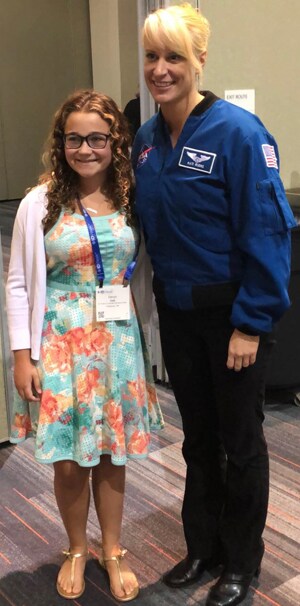
Devyn Stek meets NASA astronaut Kate Rubins, PhD, shortly after Rubins delivered the keynote address at IDWeek 2018.
Stek is already excited about the future of her work and her future in general. She said she plans to keep testing the 36 samples to see if the prevalence of Toxocara is affected by the seasons. This will be next year’s science project and, she hopes, the subject of her presentation at IDWeek 2019. Stek plans to submit the completed paper on her current work to a journal for publication.
When she’s not studying, she splits her time between Girl Scouts, swimming, soccer, dance, church activities, and being president of her school’s student council.
As for career plans, “anything in science would be great,” said Stek. But first she has to choose her high school; she has four options.
She also said she knows what she won’t be doing: studying Guinea worm disease. In her sampling of IDWeek sessions, she saw just enough to know that not all work with worms suits her.
“They’re really gross,” she said.
Devyn and Jon Stek, Dusza, and Pavia have disclosed no relevant financial relationships.
IDWeek 2018: Poster 438. Presented October 4, 2018.
Drug trade war: Chinese fentanyl is fueling the US opioid crisis
The U.S.-China trade relationship has dominated headlines in recent months, but it’s the illicit drug trade that some lawmakers and experts believe should be moved to the top of the list of issues between the two countries.
Last year, more than 49,000 Americans died from opioid-related overdoses. The majority of those deaths, 60 percent, involved fentanyl, a synthetic opioid up to 50 times more potent than heroin. Between 2014 and 2016, the number of fentanyl-related deaths skyrocketed by almost 600 percent.
China leads the world in the production and supply of fentanyl and the chemical precursors used to manufacture the drug. Roughly 68 percent of all global fentanyl movements originate in China, according to the Defense Intelligence Agency.

Data provided by the Defense Intelligence Agency. Chart produced by Sen. Dianne Feinstein’s office for a Senate Drug Caucus hearing, Tues. Oct. 2, 2018.
The United States is currently pouring billions of dollars into combating the opioid epidemic. Law enforcement agents have been given emergency authorities to try to control the flow of fentanyl and target opioid “kingpins.” Border and customs officials have seized record amounts of fentanyl and other synthetic opioids this year but the drug crisis continues to get worse.
At a Tuesday hearing of the Senate Caucus on International Narcotics Control, lawmakers, drug control officials and experts argued for addressing the source of the problem, namely, China’s outsized role in fueling the U.S. opioid epidemic.
TRACKING THE FLOW OF FENTANYL
“China is the number one problem when it comes to illegal fentanyl coming into the United States,” said Sen. Chuck Grassley, R-Iowa.
China is one of the world’s largest producers of the precursor chemicals used to manufacture fentanyl and other synthetic opioids. It also leads the world in making the chemicals used to process heroin, cocaine and methamphetamines. That production is largely unregulated by Chinese authorities, making it easy for local actors to divert supplies to overseas buyers.
U.S.-based traffickers and consumers can go online and easily order fentanyl off the dark web at up to 90 percent purity and have it shipped overseas through the U.S. Postal Service or other international mail carriers. Congress passed legislation last month — the Synthetics Trafficking and Overdose Prevention Act, or STOP Act — to prevent the exploiting of the Postal Service by drug traffickers. That included provisions for sophisticated equipment to detect opioids.

WPEC CBS12 News@CBS12
‘We are getting inundated’: Report tracks fentanyl shipments through US Postal Service http://bit.ly/2Fi3cAe

“A single individual with a computer, P.O. Box, and a pill press can order fentanyl directly from China to his or her home,” Grassley said, describing the rise of a mom and pop shop model of drug trafficking. “For the cost of a few thousand dollars of raw product, the sole proprietor can turn that raw fentanyl into thousands of pills worth literally millions of dollars on the street.”
The Drug Enforcement Agency has estimated a kilogram of fentanyl priced at roughly $5,000 can yield $1.5 million in profits when pressed into counterfeit pills, cut into heroin or sold on the street.
The profit potential has attracted Mexican drug cartels who represent “the most significant criminal threat to the United States,” according to DEA Global Enforcement deputy chief of operations, Paul Knierim.
“Now Chinese and Mexican nationals are increasingly operating in concert, resulting in an alignment responsible for the proliferation of heroin, fentanyl and related synthetics coming across the South West border,” Knierim asserted.
IMPROVING INTERNATIONAL COOPERATION
In recent years, the United States has reached out to China, Mexico and other partners to improve cooperation and stem the flow of drugs into the United States. At the United Nations last week, President Donald Trump acknowledged the international dimensions of the U.S. opioid epidemic and secured a commitment by 130 nations to crack down on the global drug trade.
In 2017, as part of President Trump’s first high-level meeting with Chinese President Xi Jinping, the two agreed to a framework to improve bilateral counternarcotics cooperation. Since that time, U.S. and Chinese law enforcement have worked together to take down chemical laboratories and criminal networks. In 2019, the DEA plans to open a new office in Guangzhou, China the origin of a substantial amount of fentanyl consumed in the United States.
The United States has also worked with China to help issue and implement regulatory controls on 175 psychoactive substances, including 25 fentanyl analogs and two fentanyl chemical precursors.
The State and Justice Departments are now pushing their Chinese counterparts to schedule fentanyl and fentanyl analogs as an entire class of drug with no accepted medical use. Scheduling fentanyl as a class would help law enforcement in both countries target illicit laboratories and drug trafficking networks involved in the trade.


ACT Missouri@ACTMOPreventionThe NIH posted new infographics highlighting recent trends in Fentanyl and Other Synthetic Opioids Drug Overdose Deaths. https://goo.gl/2RREUg

“Identifying a technical path forward on China class scheduling is our number one drug control ask of the Chinese government,” said Kirsten Madison, Assistant Secretary of State for International Narcotics and Law Enforcement Affairs.
The United States took a similar step in February when the Justice Department invoked emergency authorities and scheduled the entire category of fentanyl and fentanyl-related drugs, making it illegal to manufacture, sell or possess. That order was unprecedented and will remain in effect until 2020.
PRESSURING CHINA TO CUT SUPPLY
Despite progress in some areas, the continued rise in overdose deaths and the steady flow of illicit drugs into the United States is proof that the current efforts are not working, said Sen. Dianne Feinstein, D-Calif. “I really believe we need to hold China responsible for some of this. I really believe that we need to see that China change course,” she argued.
Citing DIA figures, she noted that between 2016 and 2015, there were 1,072 shipments of fentanyl seized by U.S. officials before they entered the country. In China, there were only four occasions where fentanyl was interdicted before it was shipped out.
China has publicly downplayed its role in the deadly opioid epidemic, instead blaming American demand. In August, the Chinese government responded to a tweet from President Trump who said, “It is outrageous that Poisonous Synthetic Heroin Fentanyl comes pouring into the U.S. Postal System from China.”
Donald J. TrumpIt is outrageous that Poisonous Synthetic Heroin Fentanyl comes pouring into the U.S. Postal System from China. We can, and must, END THIS NOW! The Senate should pass the STOP ACT – and firmly STOP this poison from killing our children and destroying our country. No more delay!

Yu Haibin of the Chinese Ministry of Public Security’s Narcotics Control Bureau said Trump’s comments were “completely unacceptable.” He argued, “The United States has no proof that most fentanyl in the country comes from China,” he said. “It’s highly irresponsible to draw such a conclusion based on some individual cases.”
In a recent interview with ABC’s “20/20,” Yu Haibin again denied China’s role as chief exporter. “I want to stress that as far as I know, it’s impossible for fentanyl that’s produced legally here to be exported to the U.S.,” he claimed. “So it must be done by criminals using underground processing plants and the internet.”
On Tuesday, Derek Scissors, an expert in U.S.-China relations at the American Enterprise Institute, emphasized that the Chinese government “undoubtedly has the capacity to curb large-scale export of illegal drugs to the U.S. It has intentionally or unintentionally decided these actions are not worth their costs.”
He told the committee there is “no reason for the Chinese not to be good cooperative partners” in stopping the export of fentanyl. “But they will only make these changes if it’s a priority for them.”
Improving China’s level of cooperation will be another test of America’s willingness to pressure President Xi Jinping, Scissors continued. “For us to get them to take action that they have not been willing to take for the safety of their own citizens, it is going to require a coercive threat,” he said.
Specifically, the Trump administration could sanction specific Chinese provinces or cities that are not cooperating with international drug control efforts. The State Department could decertify those regions, cutting off foreign aid and assistance.
Scissors also suggested charging Chinese government officials for criminal negligence. The government would not extradite Chinese nationals to face the U.S. justice system, but it would send a message, he noted.
It is not clear how much pressure the United States will be willing to put on China to address the drug issue. Between the trade war and President Trump’s latest threat to impose tariffs on essentially all Chinese imports, the bilateral relationship is fraught.
“I think we have the capacity to affect that judgment on the part of the Chinese,” Sen. Sheldon Whitehouse, D-R.I., said, noting it will be a challenge. “I think obviously in the trade war we’re at right now, it’s a little hard to highlight that because there are so many points of conflict that have emerged.”
Lawmakers are currently pushing forward a number of additional drug control bills including the bipartisan Stop the Importation and Trafficking of Synthetic Analogues Act, or SITSA.
The Justice Department and Department of Homeland Security support the legislation which would give law enforcement agencies the authority to quickly classify and schedule dangerous opioids and fentanyl analogs. Critics of the bill have argued it will expand the war on drugs by criminalizing a new class of drugs, synthetic opioids. Sponsors of the bill have noted the legislation only targets the manufacturers and traffickers of illicit opioids. Those in simple possession of the drugs are exempted.
Major Advance Reported in Understanding Antibiotic Resistance
Scientists at the University of Montana (UM) and the University of Washington have discovered how pathogenic bacteria resist antibiotic treatment and recently published their findings in an article titled (“Entropically-driven aggregation of bacteria by host polymers promotes antibiotic tolerance in Pseudomonas aeruginosa”) in the Proceedings of the Natural Academy of Sciences.
“Bacteria causing chronic infections are generally observed living in cell aggregates suspended in polymer-rich host secretions, and bacterial phenotypes induced by aggregated growth may be key factors in chronic infection pathogenesis. Bacterial aggregation is commonly thought of as a consequence of biofilm formation; however, the mechanisms producing aggregation in vivo remain unclear. Here we show that polymers that are abundant at chronic infection sites cause bacteria to aggregate by the depletion aggregation mechanism, which does not require biofilm formation functions. Depletion aggregation is mediated by entropic forces between uncharged or like-charged polymers and particles (e.g., bacteria),” write the investigators.
“Our experiments also indicate that depletion aggregation of bacteria induces marked antibiotic tolerance that was dependent on the SOS response, a stress response activated by genotoxic stress. These findings raise the possibility that targeting conditions that promote depletion aggregation or mechanisms of depletion-mediated tolerance could lead to new therapeutic approaches to combat chronic bacterial infections.”
“Antibiotic resistance is a major problem,” says Patrick Secor, Ph.D., assistant professor in UM’s division of biological sciences and lead researcher on the paper. “However, it is often the case that if you take bacteria that survive antibiotic treatment from someone’s infected lungs and treat those same bacteria with antibiotics in the lab, the bacteria die. We wanted to understand why.”
We found that bacteria living in high concentrations of polymers get a little stressed out,” adds Lia Michaels, a researcher at UM and co-author of the paper. “Basically, the polymer-rich environment activates stress responses in the bacteria, causing them to tolerate higher levels of antibiotics.”
“I like to compare it to the stress our bodies undergo when we exercise,” notes Dr. Secor. “Exercising today allows you to run a little further or lift a little more weight later on. This is analogous to the stress responses turned on in bacteria living in airway mucus—exposure to stress today allows the bacteria to survive the stress of antibiotic exposure later on.”
The researchers found that stress responses induced by mucus polymers pressing on the bacteria were a result of mild DNA damage in the bacterial cells.
“One thing that this DNA damage did was slow bacterial growth,” says Laura Jennings, Ph.D., UM research assistant professor and co-author of the paper. “Because most antibiotics work best on rapidly dividing cells, these slow-growing bacteria were more difficult to kill with antibiotics.”
The researchers speculate that the mechanisms by which polymers turn on bacterial stress responses could be targeted therapeutically to treat long-term bacterial infections.
“Our hope is that we could come up with new ways to treat bacterial infections or increase the efficacy of antibiotic treatment,” according to Dr. Secor.
Subscribe to:
Posts (Atom)