Search This Blog

Sunday, October 20, 2019

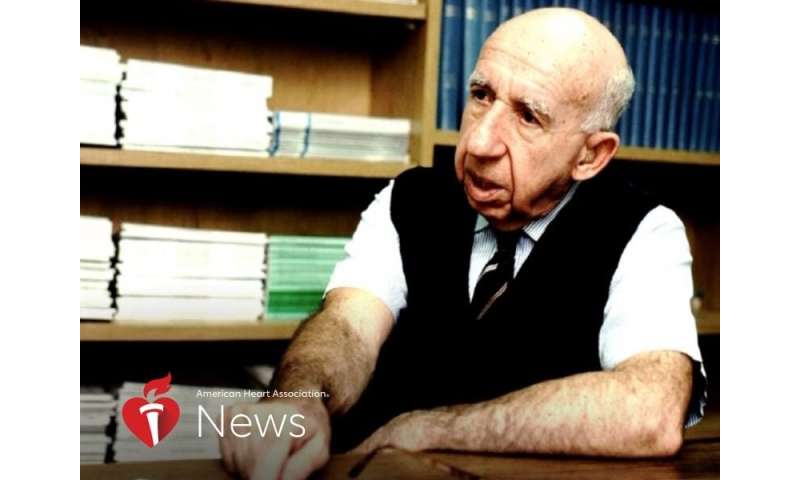
At 99, this pioneering heart doctor still leading the way


AHA news: retired? hardly – at 99, this pioneering heart doctor still leading the way
At 99 years old, most people are not engaging in complex research funded by the National Institutes of Health (NIH). Dr. Jeremiah Stamler is no ordinary person.
The author and co-author of hundreds of peer-reviewed studies and books, Stamler’s cutting-edge research into the cardiovascular health impact of lifestyle factors like diet, smoking, diabetes, cholesterol and has been cited more than 25,000 times, and it has shaped public policy for decades.
“It’s very gratifying when I go into a supermarket and see a section of especially heart-healthy foods or a section of canned goods in which the usual salt content has been reduced or eliminated,” Stamler said. “The public is benefiting from the research.”
Born Oct. 27, 1919, Stamler today is considered the father of preventive cardiology. He joined Northwestern University’s department of medicine in 1958 as an assistant professor. In 1972, he became the first chair of the community health and preventive medicine department, a position he held for nearly two decades, ultimately becoming professor emeritus.
Over the years, he has served on numerous committees and lectured on cardiovascular disease prevention and treatment across the globe. He has mentored many young scientists, offering helpful tips about their research and career advice.
“What’s special about Jerry is that he truly loves what he’s doing,” said Dr. Donald Lloyd-Jones, chair of the department of preventive medicine at the Northwestern University Feinberg School of Medicine in Chicago. “There is always a glint in his eye, and every sentence ends with a little smile. He’s one of my heroes.”
There was a great deal of pushback about Stamler’s findings in the beginning, Lloyd-Jones said, particularly the landmark 1997 Intersalt study, which revealed the important link between salt intake and high blood pressure. That did not deter the scientist.
“These diseases were producing a lot of misery in the population,” Stamler said, noting that rates of smoking, diabetes and other increased in the years after World War II, resulting in an epidemic of heart disease. “To avoid these diseases, the optimal approach is preventive medicine.”
Stamler was just as determined in his showdown with the House on Un-American Activities Committee in the 1960s. Called to testify and identify friends who had attended communist party meetings, Stamler refused, ultimately suing the committee. The case went all the way to the U.S. Supreme Court, which decided in his favor.
“You can imagine the stresses and strains of going through this, being charged with contempt of Congress for several years, facing imprisonment and fines,” Lloyd-Jones said. “He put his career on the line to make sure the right thing was done. It’s quite remarkable, but it’s really just a measure of his character.”
According to Lloyd-Jones, Stamler’s work also has had a major impact on health outcomes worldwide, leading to far more screening and treatment. “As a result of Jerry’s work, there are many, many people who are now walking around who didn’t have a heart attack and die,” he said.
Not yet ready for retirement, Stamler is currently leading a team of about 20 people studying the link between high blood pressure and the metabolome, involving thousands of small molecules in the blood and urine. The study is funded by the NIH.
“You can imagine the extensive data analysis that needs to happen,” Lloyd-Jones said. “It is truly remarkable that somebody at age 99 has an R01 grant, the premier investigator-initiated grant. It’s highly competitive.”
Stamler also remains active as a mentor, spending hours in his Chicago condo reviewing manuscripts and advising young scientists on their careers. They will have a chance to honor him on Oct. 25, when Northwestern University hosts a scientific symposium followed by a dinner and personal tributes for Stamler’s 100th birthday.
“I’m sure it’ll be a great evening, and I’ll see a whole lot of people that I haven’t seen in a while, and that will be very pleasant,” Stamler said, noting that he hopes the event raises money for future research.
What keeps Stamler going at an age when the vast majority of people have long since retired?
Physically, Stamler attributes his good health to the Mediterranean diet he has maintained for many years. Perhaps more importantly: “There’s always something on your plate that requires further, innovative work,” he said. “It’s a fascinating process, and it’s fun.”
https://medicalxpress.com/news/2019-10-heart-doctor.html

First evidence seen that fat accumulates in airways of overweight, obese people

Researchers have shown for the first time that fatty tissue accumulates in the airway walls, particularly in people who are overweight or obese.
Scientists already know that people who are overweight or obese are more likely to suffer with wheezing and asthma, but the reasons for this have not been completely explained.
The new study, published in the European Respiratory Journal [1], suggests that this fatty tissue alters the structure of people’s airways and this could be one reason behind the increased risk of asthma.
The study’s author is Mr John Elliot, a senior research officer at Sir Charles Gairdner Hospital in Perth, Western Australia. He said: “Our research team studies the structure of the airways within our lungs and how these are altered in people with respiratory disease.
“Looking at samples of lung, we spotted fatty tissue that had built up in the airway walls. We wanted to see if this accumulation was correlated with body weight.”
The researchers examined post-mortem samples of lung that had been donated for research and stored in the Airway Tissue Biobank. They studied samples from 52 people, including 15 who had no reported asthma, 21 who had asthma but died of other causes and 16 who died of asthma.
Using dyes to help visualise the structures of 1373 airways under a microscope, they identified and quantified any fatty tissue present. They compared this data with each person’s body mass index (BMI).
For the first time, the study showed that fatty tissue accumulates in the walls of the airways. The analysis revealed that the amount of fat present increases in line with increasing BMI. The research also suggests that this increase in fat alters the normal structure of the airways and leads to inflammation in the lungs.
Co-author, Dr Peter Noble, an associate professor at the University of Western Australia in Perth said: “Being overweight or obese has already been linked to having asthma or having worse asthma symptoms. Researchers have suggested that the link might be explained by the direct pressure of excess weight on the lungs or by a general increase in inflammation created by excess weight.
“This study suggests that another mechanism is also at play. We’ve found that excess fat accumulates in the airway walls where it takes up space and seems to increase inflammation within the lungs. We think this is causing a thickening of the airways that limits the flow of air in and out of the lungs, and that could at least partly explain an increase in asthma symptoms.”
The team are looking for new ways to study and measure fatty tissue in the lungs. They want to confirm the relationship with respiratory disease and to find out whether the effect can be reversed by weight loss therapy.
Professor Thierry Troosters is President of the European Respiratory Society and was not involved in the study. He said: “This is an important finding on the relationship between body weight and respiratory disease because it shows how being overweight or obese might be making symptoms worse for people with asthma. This goes beyond the simple observation that patients with obesity need to breathe more with activity and exercise hence adding to their ventilatory burden. The observation points at true airway changes that are associated with obesity.
“We need to investigate this finding in more detail and particularly whether this phenomenon can be reversed with weight loss. In the meantime, we should support asthma patients to help them achieve or maintain a healthy weight.”
https://www.eurekalert.org/pub_releases/2019-10/elf-spf101619.php

Prelim med marijuana research shows promise in cutting opioid use, abuse

Medical marijuana shows early promise to lessen opioid use and potential abuse, suggests a systematic review of published studies being presented at the ANESTHESIOLOGY® 2019 annual meeting. However, much more rigorous scientific research must be done to determine if there truly are pain relief benefits to medical marijuana that can ease chronic pain and outweigh potential risks.
The analysis focused on seven studies, five of which concluded medical marijuana may be associated with benefits such as: decreased opioid overdose rates, decreased opioid use, improved quality of life and improved pain control.
“Overall the results suggest medical marijuana may provide some benefit in mitigating opioid misuse, but the studies were not randomized controlled trials comparing marijuana to a placebo, which is what we need to determine a true benefit,” said Mario Moric, MS, lead author of the study and a biostatistician at Rush University Medical Center, Chicago. “There are other issues to consider as well, including side effects and the fact that these products often aren’t regulated.”
“Long-term effects of medical marijuana are not known and haven’t been studied yet. Early clinical evidence suggests that marijuana might have detrimental effects on the brain,” said Asokumar Buvanendran, M.D., co-author of the study, chair of the American Society of Anesthesiologists (ASA) Committee on Pain Medicine and vice chair of research at Rush University Medical Center.
The researchers determined the effect of the combined studies was .59, meaning the benefits of medical marijuana were found to be weak to moderate overall, but significant. Anything above 0 is positive and anything below 0 is negative, with 1 or higher demonstrating a strong effect for this type of research.
The various findings from the five studies that showed a positive benefit included a 29% reduction in opioid overdoses in states with medical marijuana and a 44% to 64% reduction in opioid use among chronic pain patients. The two other studies found no evidence of reduced opioid use overall. One of these studies found that pain actually increased for a small subset of patients using marijuana who had more illnesses and were sicker in general. The researchers note that because studies reporting positive findings are more likely to be published than those with negative ones, the results of this new systematic review may be skewed.
Currently, 33 states and Washington, D.C., have legalized medical marijuana, but all set their own regulations, which vary. Known side effects of marijuana can range from sleepiness to liver damage. Also, the lack of oversight and inconsistent regulation means ingredients can differ and may include pesticides and other impurities.
Short-term opioids can be useful for easing pain when managed safely and the risks are minimized, but longer use needs to be weighed for risk vs. benefit. More than 11 million Americans misuse opioids, more than 2 million have an opioid abuse disorder and an estimated 130 people die of an opioid overdose every day. *More than 20% of Americans suffer from chronic pain, according to the Centers for Disease Control and Prevention.
“While we await better research on marijuana, pain specialists such as physician anesthesiologists can offer many non-opioid medications and other alternatives to treat chronic pain such as injections, nerve blocks, physical therapy and spinal cord stimulation,” said Dr. Buvanendran.
The ASA supports more rigorous studies on marijuana and recently endorsed two bills that seek to expand research: H.R. 601, the Medical Cannabis Research Act of 2019 and S. 2032, the Cannabidiol and Marihuana Research Expansion Act.
https://www.eurekalert.org/pub_releases/2019-10/asoa-pmm101119.php

Biotech week ahead, Oct. 21: Earnings On Tap; Glaxo, Melinta, Eton Await FDA

Biotech stocks saw some strength last week. Positive clinical readouts, a couple of M&A deals and hopes of drug companies clinching a broader opioid settlement agreement worked in favor of the sector.
Reata Pharmaceuticals Inc RETA 6.77% was among the strong performers of the week following a positive Phase 2 readout for its drug to treat Friedreich ataxia.
Here are the key catalysts for the upcoming week.

Conferences

  • United European Gastroenterology Week – Oct. 19-23 in Barcelona, Spain
  • The Chest Annual Meeting – Oct. 19-23, in New Orleans, Louisiana
  • 21st World Congress on Advances in Gastroenterology and Hepatology – Oct. 21-22 in Melbourne, Australia
  • Annual Congress on Vaccine Immunology & HIV/AIDS – Oct. 21-22 in Copenhagen, Denmark
  • 12th International Conference on Allergy & Immunology – Oct. 21-22 in Rome, Italy
  • Targeted Protein Degradation Summit – Oct. 22-24, in Boston, Massachusetts
  • European Society of Gene and Cell Therapy 27th Annual Congress – Oct. 22-25 in Barcelona
  • European Heart Congress – Oct. 23-24 in Prague, Czech Republic
  • 11th International Conference on Predictive, Preventive and Personalized Medicine & Molecular Diagnostics – Oct. 23-24 in Amsterdam, Netherlands
  • 23rd European Nephrology Conference – Oct. 23-24 in Rome, Italy
  • 15th World Congress on Blood Cancer – Oct. 23-24 in Prague, Czech Republic
  • 32nd European Cardiology Conference – Oct. 24-26 in Zurich, Switzerland

PDUFA Dates

Sunday
The FDA is set to rule on Foamix Pharmaceuticals Ltd FOMX 2.54%‘s NDA for FMX101 in treating inflammatory lesions of non-nodular moderate-to-severe acne vulgaris in patients nine years of age and older.
Monday
The regulatory is also expected to issue its verdict on Eton Pharmaceuticals Inc ETON 0.66%‘s NDA for ET-202, a ready-to-use injectable formulation of phenylephrine.
Thursday
Melinta Therapeutics Inc NASDAQ: MLNT) and Ligand Pharmaceuticals Inc. LGND 2.08% await FDA decision on a label expansion for Baxdella in community-acquired bacterial pneumonia.
The FDA is scheduled to rule on GlaxoSmithKline plc GSK 0.09%‘s sNDA for Zejula in treating advanced ovarian, fallopian tube, or primary peritoneal cancer patients who have been treated with three or more prior chemotherapy regimens and whose cancer is associated with either BRCA mutation or homologous recombination deficiency.

Clinical Trial Readouts

Protagonist Therapeutics Inc PTGX 3.98% will present Phase 1 data for PTG-200 in Crohn’s disease on Tuesday.
Arvinas Inc ARVN 1.09% is scheduled to present at the Targeted Protein Degradation Summit initial Phase 1 data on ARV-110 for treating castration-resistant prostate cancer on Wednesday. The company will also present Phase 1 data for ARV-471 in ER+ positive/HER2-negative breast cancer at the summit.
Bellerophon Therapeutics Inc BLPH 0.43% is due to present Phase 2b additional cohort 1data at the CHEST meeting on Wednesday.
Axovant Gene Therapies Ltd AXGT 5.88% is scheduled to present Phase 1/2 data for AXO-Lenti-PD in Parkinson’s disease and AXO-AAV-GM2 in GM2 gangliosidosis. Both presentations are to be made at the ESGCT annual Congress on Wednesday.

Earnings

Wednesday, Oct. 23

  • Eli Lilly And Co LLY 0.17% (before the market open)
  • Alexion Pharmaceuticals, Inc. ALXN 1.58% (before the market open)
  • BioMarin Pharmaceutical Inc. BMRN 1.84% (after the close)
  • Edwards Lifesciences Corp EW 0.14% (after the close)

Thursday, Oct. 24

  • Baxter International Inc BAX 0.15% (before the market open)
  • Integra Lifesciences Holdings Corp IART 0.86% (before the market open)
  • West Pharmaceutical Services Inc. (NYSE: WST (before the market open)
  • Anika Therapeutics Inc ANIK 0.7% (after the close)
  • ResMed Inc. RMD 0.29% (after the close)
  • Illumina, Inc. ILMN 0.36% (after the close)
  • Gilead Sciences, Inc. GILD 0.49% (after the close)

IPOs

Phathom Pharmaceuticals, a company working on in-licensed assets for treating gastrointestinal disorders, proposes to offer 7.9 million shares in an IPO, estimated to be priced between $18 and $20. The company seeks to list its shares on the Nasdaq under the ticker symbol “PHAT.”
https://www.benzinga.com/general/biotech/19/10/14614270/the-week-ahead-in-biotech-earnings-trickle-in-while-glaxo-melinta-foamix-and-eton-await-fda-verdi

New York medical experts want to establish 16-year-old vaccine visit

Low vaccination rates in adolescents and teenagers have some New York medical groups calling for the creation of a 16-year-old immunization visit, according to local CBS affiliate Channel 3 News.
“It gives the opportunity for the pediatricians and the families to sit down and review the vaccine schedule and find if there are any holes,” Jay Berger, MD, CMO at ProHEALTH Care in Lake Success, N.Y., told Channel 3 News.
The proposed visit would offer patients the HPV booster, the meningitis B vaccine and the flu shot.
In 2017, only 69.2 percent of college students ages 18-24 received the meningitis vaccine, compared to 57.1 percent non-college students, according to the CDC.
A different CDC report found only 49 percent of adolescents in 2017 were up to date with HPV vaccines. For the 2017-18 flu season, less than half of 13- to 17-year-olds received the vaccine, the CDC says.
https://www.beckershospitalreview.com/quality/new-york-medical-experts-want-to-establish-16-year-old-vaccine-visit.html

Saturday, October 19, 2019

Even short-term vaping causes inflammation in non-smokers: Study

E-cigarette (e-cig) use is rising at concerning levels among both smokers and non-smokers, and new research data suggests that even short-term e-cig use can cause cellular inflammation in never-smoker adults.
Researchers at The Ohio State University Comprehensive Cancer Center—Arthur G. James Cancer Hospital and Richard J. Solove Research Institute (OSUCCC—James) report the first evidence of biological changes correlated with e-cig use in never-smokers in the journal Cancer Prevention Research on Oct. 16 (online ahead of print).
Using a procedure called bronchoscopy to test for and smoking-related effects, researchers report a measurable increase in inflammation after four weeks of e-cig use (without nicotine or flavors). Although the magnitude of change was small compared with a control group, the pilot data suggests that even short-term usage can result in inflammatory changes at a cellular level. Inflammation from smoking is an important driver of lung cancer and other respiratory disease development.
Peter Shields, MD, senior author of the study and deputy director of the OSUCCC—James, says any level of cellular inflammation correlated with e-cig use is concerning because the biological and health effects of e-cig constituents such as propylene glycol and vegetable glycerine—while “generally regarded as safe” by the U.S. Food and Drug Administration (FDA) when used in foods and cosmetics—are unknown when heated and inhaled with e-cigs. Researchers note that even in this small study, there were observable effects.
“The implication of this study is that longer term use, increased daily use and the addition of flavors and nicotine may promote additional inflammation,” says Shields. “The general perception among the public is that e-cigs are ‘safer’ than cigarettes. The reality is the industry is changing so fast ¬- and with minimal regulation—that usage is outpacing the rate of our scientific understanding. It’s becoming a public health crisis we should all take very seriously from a general pulmonary health, cancer risk and addiction perspective. E-cigs may be safer than smoking, but that is not the same as safe, and we need to know how unsafe they are.”
With the recent reports of lung disease and deaths associated with vaping, the effects of vaping nicotine and marijuana oils makes this research more critical.
For this pilot study, OSUCCC—James researchers recruited 30 healthy, non-smoking volunteers to directly assess the impact of tobacco and e-cig use on the lungs through bronchoscopy, an outpatient test in which a doctor inserts a thin tube through the nose or mouth to view the airways. A small sample of lung cells is collected from fluid in the lungs. Participants were randomized to a four-week intervention with e-cigs containing only 50% propylene glycol (PG) or 50% vegetable glycerine (VG) without nicotine or flavors. (PG and VG are used in e-cig devices.) Results from these tests were then compared to a separate control group of never-smokers. Researchers did not see levels of inflammation higher than the controls, but there was an increase in inflammation among the users who inhaled more of the e-cigs.
In August 2016, the FDA was granted regulatory authority over e-cig product design. Data about e-cig toxicity in humans is urgently needed to establish scientific evidence-based regulatory policies.
“Human clinical trials can provide valuable information regarding actual toxicant exposure and risk for disease. Through the randomized clinical trial of healthy never-smokers over a month, we found that an increase in urinary propylene glycol, a marker of inhalation-e-cig intake, was significantly correlated with increased inflammatory response in the lung,” says Min-Ae Song, first author of the manuscript and environmental health researcher at the Ohio State College of Public Health. “Future studies could be of longer duration, include an assessment of flavors, the effect by varying ratios of and vegetable glycerine, and examine randomization of smokers to e-cigs.”
https://medicalxpress.com/news/2019-10-short-term-vaping-inflammation-non-smokers.html

‘Unbelievable journey’ of CRISPR, now on Netflix

Unnatural Selection Season 1 Episode 1 - Option 2
A scene from “Unnatural Selection” featuring David Ishee, a biohacker who, among other things, is seeking to bring bioilluminescence to dogs. Netflix
Mankind’s ability to edit the fabric of human life has led to scientific upheaval, global debate, and at least one international incident. Now, it’s coming to Netflix.
Unnatural Selection,” a four-part docuseries debuting Friday, dissects the stories, science, and ethics behind genome editing, following academics, biohackers, and patients as they move through a brave new world made possible by technologies like CRISPR.
We recently spoke with co-directors Joe Egender and Leeor Kaufman about how the series came to be and how it frames the sprawling story of human genetic engineering. This transcript has been lightly edited for clarity.
So what is the show about and what can viewers expect if they watch it?
Kaufman: I think the show is about this new world in which we can alter DNA in any organism, including humans. We’ve entered this world gradually and over the past decades, but significantly with the discovery of CRISPR.
Egender: When we first jumped into this project, one thing we really wanted to do was not make a show about science, but make a show about the people either researching and doing the science, people benefiting from the science, people fighting against the science, and really tell the story of these incredible new technologies through the people, through their experiences, through their eyes, rather than a science show with a host or a narrator — which can be very effective, but also can create a little bit of a distance between the viewer and what is actually going on in this world.
We wanted the viewer to feel like they were and are a part of this world, because we all are now that we can edit the DNA of any living organism.
Kaufman: A lot of this technology is done in the labs, or within very initial applications. And the people who are experiencing this technology today are very few. They are the pioneers and they are already experiencing the dilemmas, the ethics, the financial struggles of dealing with tomorrow’s technology.
What first sparked your interest in genome editing?
Egender: I come from the fiction side, and I was actually in the thick of developing a sci-fi story and was reading a lot of older sci-fi books and was doing some research and trying to update some of the science. And — I won’t ever forget — I was sitting on the subway reading an article when I first read that CRISPR existed and that we actually can edit the essence of life. And around that time — you know, it’s one of those moments where you kind of stop in your tracks and wonder if this is real — around that time, Leeor and I had met and we were talking about collaborating. Leeor comes from the doc side. And when I was telling him about CRISPR, he thought initially I was talking about the sci-fi project that I was working on. When he understood that, no, this is real science and it’s happening now, he said, “I think this might be a documentary rather than a science fiction film.”
Kaufman: The moment that I understood that actually this is real and there are real people that are already dealing with this technology in their lives, in their labs, and in their homes, their work, thinking about how the world would be tomorrow, I said immediately, “OK, let’s just start calling these people and understanding what it looks like and what kind of dilemmas that they’re facing.” And I think that the moment that we started calling people, we were amazed by how much these people are thinking about the future and how many things that most people are not aware of. They’re already thinking about what the world of tomorrow is going to look like and the risks and the benefits and so forth. It started this unbelievable journey that we’re still in today. 
It seems like you got pretty sweeping access to the major scientific figures who are driving the genome editing story, but also regular folks who may benefit or just may have strong opinions about this and how it affects their lives. Was it difficult to convince anyone to open up their labs or their homes to you and your cameras?
Kaufman: Obviously people are … sometimes wary in the first conversation. And, I mean, I understand it. But I think that people also want to tell this story, because all of our characters think that everybody should be involved in this discussion.
A lot of the conversations in science nowadays are not about can we do this, but should we do this. How far should we push genome editing? What are the philosophical battlegrounds that people are arguing over?
Kaufman: This is why it was so important for us to feature all aspects — or a lot of the aspects — in the show. The technology touches many different things in our world, from the environment to gene therapies to fertility. So there are a lot of very specific ethical dilemmas that arise from different sub-applications of such technology.
The environmental question is a big one. I mean we have the ability to maybe eradicate a horrible disease like malaria in Africa that science has yet to find a solution for. And here comes a technology that theoretically has the promise to do so. And people agreed that theoretically it has the promise to do so, but it comes with the risk of eradicating an entire species in a big area. And it can spread through countries. So there is immediately this unbelievable hope and benefit that can come out of applying this technology, but also a great risk or at least a great unknown. And everybody agrees that it’s a great unknown.
Another question [involves] fertility. We have the ability to alter genes and embryos. Obviously, people suffer from horrible diseases. We can fix genes. We can make people suffer less, or not at all. We can allow people who couldn’t be pregnant before to have children. This is a great promise for a lot of people who are suffering. On the other hand, there’s a really big philosophical debate about how far we go in designing our next generation. There are also financial implications. Not everybody has access to new technologies.
Egender: What we wanted to do, especially by making it a series and opening it up to four episodes, is to really get into these discussions, because there are a lot of things going on in the world of genetics. There is gene editing, there are gene therapies, there are gene drives. It covers fertility environment, designer babies, self-experimentation. In the end, people still might be afraid of some of these technologies. People might be excited about some of these technologies. But what we hope is that they have a better understanding so their fear or their excitement comes from a place of understanding and not a place of fear of the unknown.
“Unnatural Selection” takes a really wide view of how this science is done, whether that’s at a lab at the Salk Institute in San Diego or in a garage in Oakland. Even though we perceive those worlds as being very far apart, in practice, it’s kind of just people using pipettes in different clothes, perhaps. When you were filming it, did you find that these maybe seemingly opposing worlds had more in common than not?
Kaufman: Sometimes, yes. Many times when we were in some of the more rogue labs and the garages, I was seeing more and more that some of the equipment was very similar. And what people are doing in practice is very similar. Obviously, there are things that are different. There are machines that are expensive and only available to big corporations and big institutions. You know, I don’t think we know enough. I think we learned a lot. But we don’t know enough exactly about how everything is made.
I was intrigued by the storyline in the show that involved the Mississippi dog breeder who was attempting to use CRISPR-Cas9 to alter the genomes of his dogs so that they would glow in the dark. Now, honestly, when I first saw this, it kind of got me mad because it seemed to put the dog’s health at risk possibly, and kind of also underscored maybe the way genome editing could be used for exploitative or superfluous reasons. Is that why he was included in the show?
Kaufman: First and foremost, David [Ishee] is included in the show because I think he has a lot of very important ideas and things to say, and he also represents the fact that we are now entering a world where there is an ability of people — in their homes, in their garages — to do DIY genetic engineering.
A lot of these ideas are at first scary and perhaps even disgusting to some people. And yet … a lot of what we do is breaking nature, moving away from nature. And I think the characters in the show, including David, are people who are facing that and are willing to face that every day and are thinking about it.
How do we want to see a world that is more designed? Perhaps we can’t go back anymore to a world that is not designed. … The future of a wild nature — that we like to romanticize — perhaps is not sustainable anymore. Perhaps we need to design it. Perhaps we want to design it for our own needs. And if we are going that way, what does that mean?
The broader story of genome editing is one that has been continuously evolving. Just this summer, there was news about a Russian scientist who might be considering another CRISPR baby experiment. So how do you approach making a documentary that you want to stand on its own as a film while news seems to keep breaking in genome editing?
Egender: When we first started the project and we were dipping our toes into it, if you’d have said to us during the process of filming there would be a CRISPR baby born, there would be a bio-hacker injecting himself with CRISPR, there would be a cure for genetic blindness … we wouldn’t we wouldn’t have believed you because, you know, in many ways, science moves very slow. Right? But then sometimes science moves very fast.
And we are in a moment right now where CRISPR was only discovered six, seven years ago and things are moving very fast. On the one hand, we did have to be ready for anything. On the other hand, we had such great relationships with our characters that when things did happen, we would see them happening through the eyes of our characters. So what was their response to the CRISPR baby being born? What is their response to these drug prices being $1 million, $2 million for one shot? How does that affect their work? And so the audience gets to experience these fast-moving events with our characters. So it makes for quite a journey. And it let us relax a little bit to say, “OK, we’re in this world now. We are with the people, with the pioneers. So when things come up, we’ll be there and we’ll experience that with them.”
After working on this project, we want to know, would either of you undergo genome editing to augment or enhance a part of your body? Now, please keep your answer clean. This is not exactly a family-oriented podcast, but we do have limits.
Kaufman: With a lot of these technologies there, it’s easy to say, “Oh, I would never do that,” or, “I wouldn’t want anybody to do something like that,” until you faced a dire need. Now, I know you’re asking about cosmetics and stuff like that, but I think it’s hard sometimes to define a line between what is purely medical and what is purely cosmetic or enhancement. It’s not black and white.
I think things have to be judged by a specific case and a specific need and a reason.
Egender: There’s a moment in episode one with Carlos Belmonte at the Salk Institute, and he’s talking about this issue and about enhancement. And he gets into inequality and what Leeor mentioned before, some of these technologies will be very expensive. So is it fair if only the rich are allowed to enhance themselves and the poor are not able to? And what will that do to further class divisions?
But if everyone can have access to these technologies, as Carlos said, what’s wrong with everyone having the vision of an eagle?
Kaufman: We like to think of ourselves as pure and natural. But the reality is, we all want to be birds and we go on planes. Our basic DNA is not enabling. We can’t fly. We can’t swim long, long distances. And yet build these devices to enable us. And now we’re entering this world where not only can we build a device to enable us, we can change and alter our own DNA. And of course, it’s scary. And, of course, it immediately brings these unbelievable philosophical questions. But I think it’s too easy to discard it all as something that is just a crazy idea.
The ‘unbelievable journey’ of CRISPR, now on Netflix