Search This Blog

Thursday, February 6, 2020

AbbVie Q4 2019 Earnings Preview

AbbVie (NYSE:ABBV) is scheduled to announce Q4 earnings results on Friday, February 7th, before market open.
The consensus EPS Estimate is $2.19 (+15.3% Y/Y) and the consensus Revenue Estimate is $8.68B (+4.5% Y/Y).
Over the last 2 years, ABBV has beaten EPS estimates 88% of the time and has beaten revenue estimates 88% of the time.
Over the last 3 months, EPS estimates have seen 6 upward revisions and 2 downward. Revenue estimates have seen 5 upward revisions and 3 downward.
https://seekingalpha.com/news/3539307-abbvie-q4-2019-earnings-preview

Bristol-Myers Squibb and Merck going opposite ways with PD-1 inhibitors

Q4 results for Merck (MRK -0.3%) and Bristol-Myers Squibb (BMY +2.3%) present stark contrasts between their rival PD-1 inhibitors with the former clearly demonstrating superior execution in sales and expanding approved uses.
Merck’s Keytruda (pembrolizumab) is the company’s top seller, averaging over 75% growth per quarter over the past two years. Sales grew 45% yoy to $3,111M in Q4 2019.
BMY’s Opdivo (nivolumab), briefly its top drug, now #2 again behind blood thinner Eliquis, has averaged almost 24% growth per quarter over the same time frame, but the trend has been steadily down since Q3 2018. Sales were $1,763M last quarter, down 2% from a year ago.
Keytruda growth/quarter (Q4 2019 – Q1 2018): +45%, +62%, +58%, +55%, +66%, +80%, +89%, +151%.
Opdivo growth/quarter (same lookback): -2%, +1%, +12%, +19%, +33%, +42%, +36%, +34%.
Keytruda, initially OK’d in the U.S. in September 2014, is now approved for 15 cancers.
Opdivo, initially OK’d in the U.S. in December 2014, is approved for nine cancers.
https://seekingalpha.com/news/3539335-bristol-myers-squibb-and-merck-going-opposite-ways-pdminus-1-inhibitors

Experts scramble, but new virus vaccine may not come in time

The flu-like virus that exploded from China has researchers worldwide once again scrambling to find a vaccine against a surprise health threat, with no guarantee one will arrive in time.
Just days after Chinese scientists shared the genetic map of the culprit coronavirus, researchers at the U.S. National Institutes of Health had engineered a possible key ingredient for a vaccine they hope to begin testing by April.
Scientists from Australia to France, along with a list of biotech and vaccine companies, jumped in the race, pursuing different types of inoculations.
And Texas researchers froze an experimental vaccine developed too late to fight an earlier coronavirus — SARS, or severe acute respiratory syndrome — but are pushing U.S. and Chinese authorities to give it a try this time around. Because the new virus is a close cousin of SARS, it just might protect, said Dr. Peter Hotez of Baylor College of Medicine and Texas Children’s Hospital.
All that work is coming at lightning speed compared to past outbreaks. Yet many experts agree it still may take a year — if every step along the way goes well — for any vaccine to be ready for widespread use. That’s if it’s even needed by then.
Globally, more than 28,000 people are infected and the death toll climbed past 560. The overwhelming majority are in China, but more than 200 people with the illness have been reported in over two dozen other countries.
For now, health officials are isolating the sick to fight spread of the virus, which causes fever, cough and in severe cases pneumonia. With no specific treatment, some doctors also are experimenting with antiviral medicines developed for other conditions.
“Ours is already manufactured and could take off pretty quickly,” said Hotez, who created the earlier SARS vaccine with Texas Children’s colleague Maria Elena Bottazzi. But “there’s still no road map for what you do to make a vaccine in the midst of a devastating public health outbreak.”
NIH specialists say rather than chasing outbreaks, it’s time to pursue prototype vaccine designs that could work for entire virus families, ready to be pulled off the shelf at the first sign of a new disease.
“We have the technology now. It’s feasible from an engineering and biological standpoint,” said Dr. Barney Graham, deputy director of the National Institute of Allergy and Infectious Diseases’Vaccine Research Center. Without that step, “we’re going to be at risk for new pandemics.”
A FASTER VACCINE RECIPE
Traditionally, making vaccines required first growing lots of virus in a lab. The NIH team is pursuing a newer and far faster method: Simply use a piece of the virus’ genetic code, called messenger RNA or mRNA, that instructs cells to make a particular protein.
“We think of RNA as the software of life,” said Dr. Tal Zaks, chief medical officer of Moderna Inc., which is developing mRNA vaccines for other diseases and working with NIH on the new coronavirus.
Inject the right piece and “you’ve taught the body to make its own medicine,” he explained. As cells produce just that protein, the immune system learns to recognize it, primed to attack if the entire virus ever comes along.
The target: A protein aptly named “spike” that lets the virus bind to cells. It studs the surface of coronaviruses — the new one as well as its cousins SARS, which erupted in China in 2002 and spread to 26 countries, and MERS, or Middle East respiratory syndrome, which emerged in 2012.
Graham’s team zeroed in on the RNA responsible for the new virus’ production of spike and then — because prior research showed the protein can change shape — engineered a more stable version of it.
Moderna is manufacturing samples of the synthetic mRNA vaccine for NIH to use in animal studies and, hopefully within three months, first-stage safety tests in people. If further testing proves it really works, the hope is scientists could simply swap in a new spike code if another coronavirus comes along.
That’s important because after three such outbreaks in less than 20 years, “this is not the last,” predicted Dr. Mark Denison, a virologist at Vanderbilt University Medical Center. It’s key to find vaccine “strategies that go after these unique things common to every coronavirus.”
WHAT ELSE IS IN THE PIPELINE
Inovio Pharmaceuticals is pursuing a similar approach with synthetic DNA, and recently reported promising results from first-stage testing of a MERS vaccine. It’s collaborating with a Chinese company, Beijing Advaccine, in hopes of being able to test a new vaccine candidate in China later this year.
In France, researchers at the Pasteur Institute are piggybacking on the tried-and-true vaccine against measles. They’ve had some early success mixing genetic material from other viruses into that vaccine, and now hope to put the immune system on alert against this new coronavirus in the same way.
“The work we’re doing now involves making a vaccine against measles but re-engineered in the sense that it has antigens from the new coronavirus,” said virologist Frederic Tangy, head of Pasteur’s vaccine innovation department.
What about Hotez’s old SARS vaccine? In that case a piece of the spike protein was genetically engineered and grown in a lab, a classic vaccine technology compared to the newer and less proven Moderna and Inovio approaches. The Texas researchers showed the vaccine protected animals but in 2016 ran out of money for further testing and froze what was left. Every six months, Hotez thaws a small sample to make sure it’s still usable.
CHASING OUTBREAKS
Past outbreaks are full of such missed opportunities: There’s no commercial vaccine for MERS even though illnesses still occur. The birth defect-causing Zika outbreak was ending by the time experimental shots were ready to test.
The bright spot: Ebola vaccines. Some candidates began early testing during the massive Ebola epidemic in West Africa in 2014-2016, although the outbreak waned before scientists had proof they worked. But authorities and vaccine companies kept up the research, and by 2018 shots were ready to help tamp down an outbreak still smouldering in Congo.
The World Health Organization will meet next week to identify promising drug and vaccine candidates for the new coronavirus and fast-track their development, much like happened with Ebola.
“To put it bluntly, we’re shadow boxing,” said WHO Director-General Tedros Adhanom Ghebreyesus. “We need to bring this shadow out into the light so that we can attack it properly.”
https://www.marketscreener.com/MODERNA-INC-47437573/news/Moderna-Experts-scramble-but-new-virus-vaccine-may-not-come-in-time-29953679/

Summit Therapeutics earn $1M milestone on advancement of ridinilazole

Triggered by achieving the initial enrollment target in trial sites in Latin America, Summit Therapeutics (SMMT -5.2%) has earned a $1M milestone payment from licensee Eurofarma Laboratórios SA related to lead candidate ridinilazole for the treatment of Clostridium difficile (C. diff) infection.
The studies are comparing the small molecule antibiotic to standard-of-care vancomycin.
https://seekingalpha.com/news/3539283-summit-therapeutics-earn-1m-milestone-on-advancement-of-ridinilazole

China Builds Makeshift Hospitals to Treat Coronavirus Patients

The central Chinese city of Wuhan has set up 11 new makeshift hospitals as of Feb. 5 in order to accommodate the large numbers of coronavirus patients.
Wuhan is the capital of Hubei Province. According to the provincial government-run media Hubei Daily, the 11 new facilities have a total capacity of 10,100 beds.
They are mostly set up within stadiums, exhibition centers, and school gyms within the city.
The city’s Wuhan Coronavirus Command Center released regulations on Feb. 5, explaining that coronavirus patients with mild or moderate symptoms would be sent to the makeshift hospitals.
Patients in severe condition or who are older than 65 would stay at the 14 hospitals and two newly-built hospitals designated for treating the coronavirus. Patients suspected of having coronavirus and some confirmed patients with mild symptoms will be isolated in community quarantine centers, most of which are hotels converted in response to the outbreak.
State-run media Xinhua reported that there are plans to build 12 more of such makeshift hospitals in Wuhan.
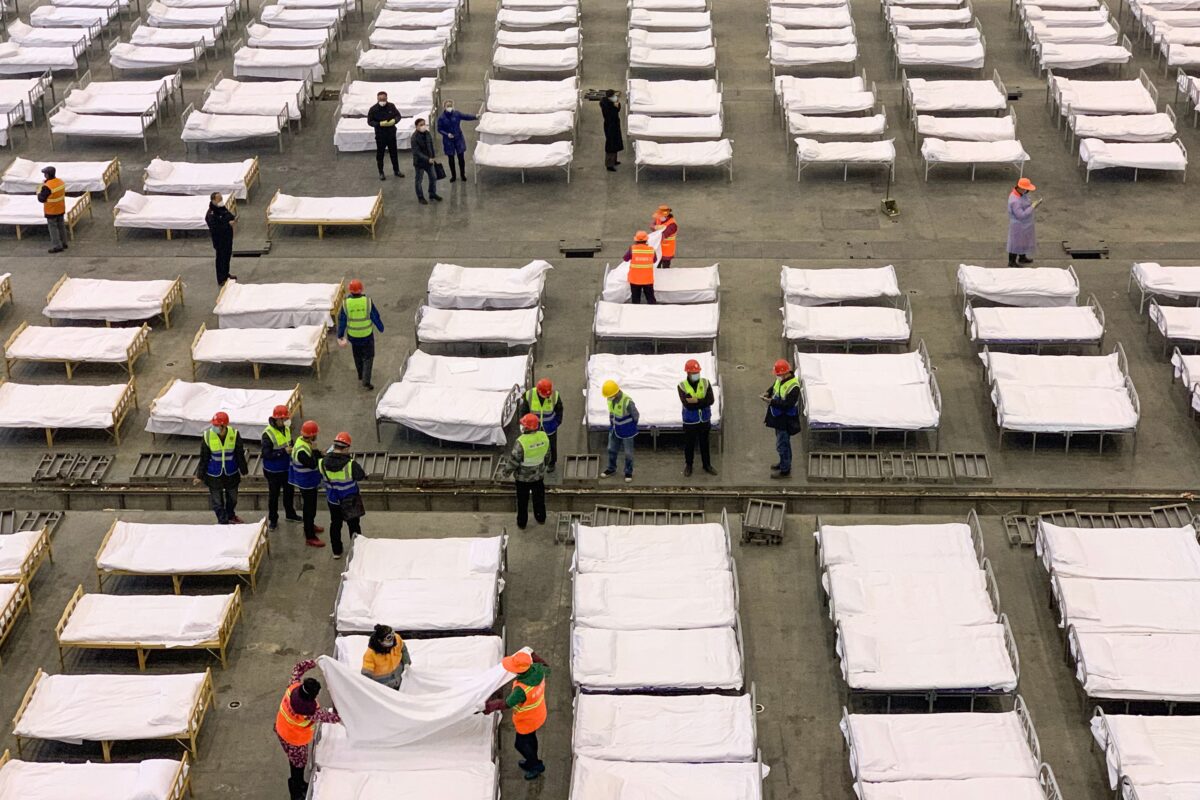
Commonly known in China as battlefield hospitals, these facilities are often used during wartime or natural disasters to efficiently care for the wounded and sick. Beds are arranged row by row in an open space.
State media revealed photos and videos of the facilities, which showed that the beds did not have any physical barriers separating them, save for several boards to wall off a group of about a dozen beds.
Chinese netizens expressed concerns that cross-contamination could take place.
On Feb. 4, Chinese state-run media dismissed those claims, saying doctors would ensure it would not happen.
But Sean Lin, a U.S.-based expert in microbiology and former virology researcher for the U.S. Army, explained that such makeshift facilities should have been set up earlier in the response to the outbreak.
Lin said that in a situation where thousands are infected and many residents cannot get treatment due to overfilled hospitals, such venues could allow medical staff to take care of more patients efficiently.
For example, a nurse can distribute medicine more easily using a cart, delivering to dozens of patients within several minutes.
“But the Wuhan government is too late. It should have set up these hospitals before locking down the city”—a measure that indicates the disease had already spread widely and could not be contained, Lin said.
Upon observing the facilities’ photos and videos, Lin noted that the distance between the beds was too close, risking cross-infection. “The distance between two beds should be at least three feet.”
Epoch Times Photo
Workers set up beds at a Fangcang hospital in Wuhan, China on Feb. 4, 2020. (STR/AFP via Getty Images)
He added that medical staff should be alert about patients whose conditions are worsening, as they are likely to be more contagious due to active viruses in his body, which could potentially spread through bodily fluids, airborne particles, or stool.
“Once a patient’s condition turns to severe, medical staff must remove this patient to a designated hospital as soon as possible,” Lin said.
The Wuhan government first reported the outbreak on Dec. 31, 2019, though official data shows that authorities knew of a human-to-human transmission prior to that date. The virus has since spread all around China and to more than 20 other countries.
https://www.theepochtimes.com/china-builds-makeshift-hospitals-to-treat-coronavirus-patients-but-expert-expresses-concern-about-sanitary-conditions_3228818.html

Celsion reports favorable safety profile of higher dose of GEN-1 in ovarian cancer

Celsion (CLSN -1.7%) reports that the Independent Data Safety Monitoring Board has completed its initial safety review of data from the first 15 ovarian cancer patients who received the first four neoadjuvant doses of DNA-based immunotherapy GEN-1 at 100 mg/m² in the ongoing Phase 1/2 OVATION 2 study, the highest dose yet assessed.
In six evaluable patients, no dose-limiting toxicities were observed. GEN-1, administered intraperitoneally, was well-tolerated when given with neoadjuvant chemo (NACT). After the six have completed interval debulking surgery, the company will report surgical results and overall tumor response rates for all 15 Phase 1 subjects later this quarter.
The safety of up to 17 weekly doses of GEN-1 will be evaluated before the Phase 2 portion will be initiated. Unless something unexpected happens, enrollment should commence next quarter, expected to be completed in Q1 2021.
https://seekingalpha.com/news/3539296-celsion-reports-favorable-safety-profile-of-higher-dose-of-genminus-1-in-ovarian-cancer

Karuna updates on R&D efforts in CNS

Aimed at facilitating its drug discovery efforts, Karuna Therapeutics (KRTX -1.4%) has opened an office in Indianapolis, IN and inked a multiyear collaboration agreement with Charles River Laboratories (CRL +0.8%). Financial terms are not disclosed.
https://seekingalpha.com/news/3539287-karuna-updates-on-r-and-d-efforts-in-cns