China Builds Makeshift Hospitals to Treat Coronavirus Patients
The central Chinese city of Wuhan has set up 11 new makeshift hospitals as of Feb. 5 in order to accommodate the large numbers of coronavirus patients.
Wuhan is the capital of Hubei Province. According to the provincial government-run media Hubei Daily, the 11 new facilities have a total capacity of 10,100 beds.
They are mostly set up within stadiums, exhibition centers, and school gyms within the city.
The city’s Wuhan Coronavirus Command Center released
regulations on Feb. 5, explaining that coronavirus patients with mild
or moderate symptoms would be sent to the makeshift hospitals.
Patients in severe condition or who are older than 65 would stay at
the 14 hospitals and two newly-built hospitals designated for treating
the coronavirus. Patients suspected of having coronavirus and some
confirmed patients with mild symptoms will be isolated in community
quarantine centers, most of which are hotels converted in response to
the outbreak.
State-run media Xinhua reported that there are plans to build 12 more of such makeshift hospitals in Wuhan.
Commonly known in China as battlefield hospitals, these facilities
are often used during wartime or natural disasters to efficiently care
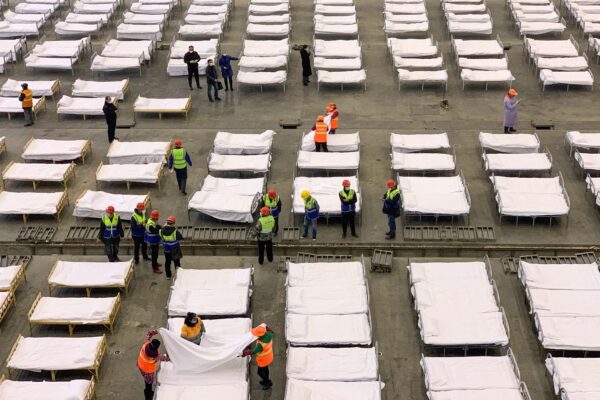
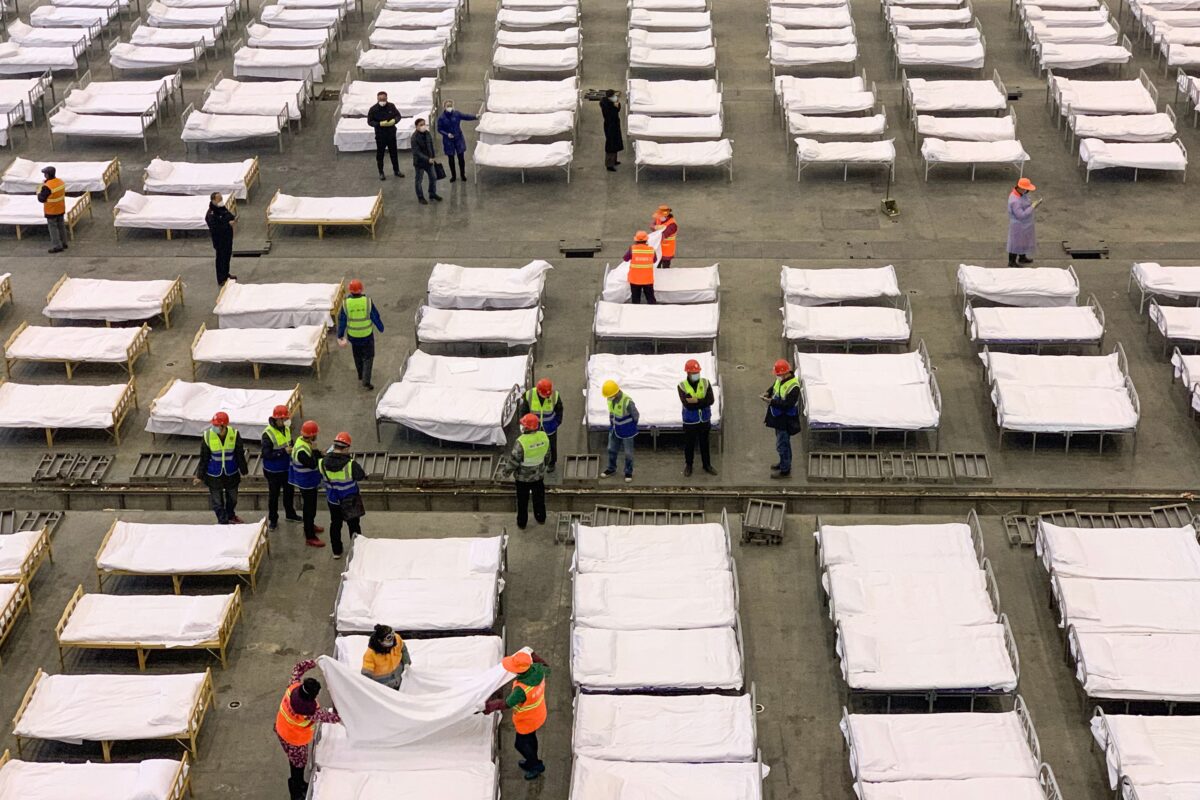
for the wounded and sick. Beds are arranged row by row in an open space.
State media revealed photos and videos of the facilities, which
showed that the beds did not have any physical barriers separating them,
save for several boards to wall off a group of about a dozen beds.
Chinese netizens expressed concerns that cross-contamination could take place.
On Feb. 4, Chinese state-run media dismissed those claims, saying doctors would ensure it would not happen.
But Sean Lin, a U.S.-based expert in microbiology and former virology
researcher for the U.S. Army, explained that such makeshift facilities
should have been set up earlier in the response to the outbreak.
Lin said that in a situation where thousands are infected and many
residents cannot get treatment due to overfilled hospitals, such venues
could allow medical staff to take care of more patients efficiently.
For example, a nurse can distribute medicine more easily using a cart, delivering to dozens of patients within several minutes.
“But the Wuhan government is too late. It should have set up these
hospitals before locking down the city”—a measure that indicates the
disease had already spread widely and could not be contained, Lin said.
Upon observing the facilities’ photos and videos, Lin noted that the
distance between the beds was too close, risking cross-infection. “The
distance between two beds should be at least three feet.” Workers set up beds at a Fangcang hospital in Wuhan, China on Feb. 4, 2020. (STR/AFP via Getty Images)
He added that medical staff should be alert about patients whose
conditions are worsening, as they are likely to be more contagious due
to active viruses in his body, which could potentially spread through
bodily fluids, airborne particles, or stool.
“Once a patient’s condition turns to severe, medical staff must
remove this patient to a designated hospital as soon as possible,” Lin
said.
The Wuhan government first reported the outbreak on Dec. 31, 2019,
though official data shows that authorities knew of a human-to-human
transmission prior to that date. The virus has since spread all around
China and to more than 20 other countries. https://www.theepochtimes.com/china-builds-makeshift-hospitals-to-treat-coronavirus-patients-but-expert-expresses-concern-about-sanitary-conditions_3228818.html
No comments:
Post a Comment
Note: Only a member of this blog may post a comment.

No comments:
Post a Comment
Note: Only a member of this blog may post a comment.