Search This Blog

Friday, August 7, 2020

What athletes should know about COVID-19, heart damage and working out

With evidence mounting that COVID-19 can damage the heart, experts urge people to take precautions when doing vigorous exercise.
Up to 30% of patients hospitalized with have signs of cardiac injury, according to Dr. Sunal Makadia, health director of sports cardiology at LifeBridge Health in Baltimore.
The prevalence of heart damage in milder cases of COVID-19 is unknown. Still, experts worry about the potential for serious heart complications from engaging in while infected with the virus.
The American College of Cardiology’s Sports and Exercise Council recommends that people get a COVID-19 test and heart screening before playing sports or exercising.
Even if they show no symptoms, those who test positive for COVID-19 should avoid exercise for at least two weeks, Makadia recommended.
“After this, you can return to activity after being evaluated by a medical professional or cardiologist,” he said in a health system news release.
Symptoms such as shortness of breath, , a fluttering or a rapid heartbeat, lightheadedness, leg swelling, muscle pains and unexplained fatigue may indicate a severe heart problem.
“We’re still learning more, but those with , high cholesterol, obesity, diabetes, and previous heart issues such as , stents or coronary bypass surgery and are susceptible to the most severe complications of COVID-19,” Makadia said.
Experts suggest exercising outdoors rather than indoors.
While training alone is ideal, Makadia said people who elect to exercise with a group should double the standard social distancing guideline from 6 feet to 12 feet.
When running in a group, do not place yourself “downstream,” or directly behind another runner, to avoid aerosolized droplets that can spread the coronavirus.
“Wear masks unless you are absolutely alone,” Makadia added.
Finally, as gyms and communal training facilities reopen, remember to practice good hygiene. Wash your hands and any equipment you use, bring your own towels, and avoid water fountains and crowded areas.

Electric cooker an easy, efficient way to sanitize N95 masks August 7, 2020

Owners of electric multicookers may be able to add another use to its list of functions, a new study suggests: sanitization of N95 respirator masks.
The University of Illinois, Urbana-Champaign study found that 50 minutes of dry heat in an electric cooker, such as a rice cooker or Instant Pot, decontaminated N95 respirators inside and out while maintaining their and fit. This could enable wearers to safely reuse limited supplies of the respirators, originally intended to be one-time-use items.
Led by civil and environmental engineering professors Thanh “Helen” Nguyen and Vishal Verma, the researchers published their findings in the journal Environmental Science and Technology Letters.
N95 respirator masks are the gold standard of personal protective equipment that protect the wearer against airborne droplets and particles, such as the coronavirus that causes COVID-19.
“A cloth mask or surgical mask protects others from droplets the wearer might expel, but a respirator mask protects the wearer by filtering out that might carry the virus,” Nguyen said.
High demand during the COVID-19 pandemic has created severe shortages for and other essential workers, prompting a search for creative approaches to sanitization.
Electric cooker an easy, efficient way to sanitize N95 masks, study finds
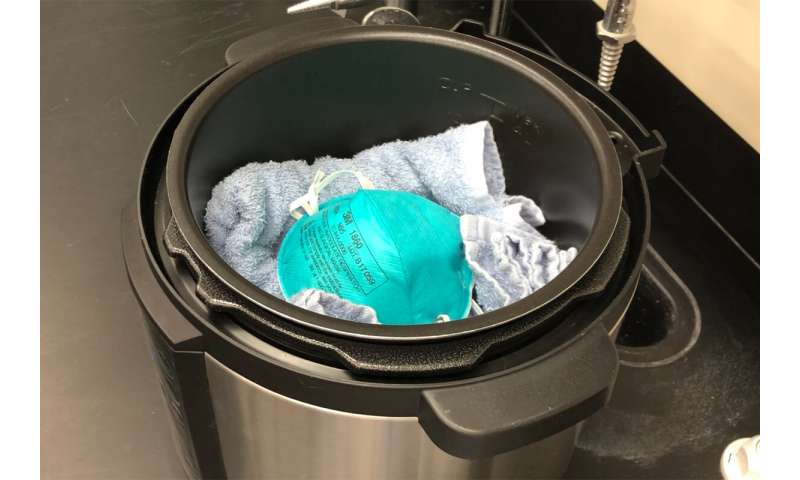
A towel keeps the respirator from touching the heating element on the bottom of the cooker. Credit: Chamteut Oh
“There are many different ways to sterilize something, but most of them will destroy the filtration or the fit of an N95 respirator,” Verma said. “Any sanitation method would need to decontaminate all surfaces of the respirator, but equally important is maintaining the filtration efficacy and the fit of the respirator to the face of the wearer. Otherwise, it will not offer the right protection.”
The researchers hypothesized that dry heat might be a method to meet all three criteria—decontamination, filtration and fit—without requiring special preparation or leaving any chemical residue. They also wanted to find a method that would be widely accessible for people at home. They decided to test an electric cooker, a type of device many people have in their pantries.
They verified that one cooking cycle, which maintains the contents of the cooker at around 100 degrees Celsius or 212 Fahrenheit for 50 minutes, decontaminated the masks, inside and out, from four different classes of virus, including a coronavirus—and did so more effectively than ultraviolet light. Then, they tested the filtration and fit.
“We built a chamber in my aerosol-testing lab specifically to look at the filtration of the N95 respirators, and measured particles going through it,” Verma said. “The respirators maintained their filtration capacity of more than 95% and kept their fit, still properly seated on the wearer’s face, even after 20 cycles of decontamination in the electric cooker.”
The researchers created a video demonstrating the method. They note that the heat must be dry heat—no water added to the cooker, the temperature should be maintained at 100 degrees Celsius for 50 minutes and a small towel should cover the bottom of the cooker to keep any part of the respirator from coming into direct contact with the heating element. However, multiple can be stacked to fit inside the cooker at the same time, Nguyen said.
The researchers see potential for the electric-cooker method to be useful for and first responders, especially those in smaller clinics or hospitals that do not have access to large-scale heat sanitization equipment. In addition, it may be useful for others who may have an N95 at home—for example, from a pre-pandemic home-improvement project—and wish to reuse it, Nguyen said.

Explore further

More information: Chamteut Oh et al, Dry Heat as a Decontamination Method for N95 Respirator Reuse, Environmental Science & Technology Letters (2020). DOI: 10.1021/acs.estlett.0c00534

Kaiser to launch study of Amarin’s Vascepa in COVID-19

Investigators at Kaiser Permanente plan to launch a study evaluating the effects of Amarin’s (AMRN +0.4%) Vascepa (icosapent ethyl) on upper respiratory infection (URI) rates and clinical outcomes, especially involving acute viral respiratory infection from SARS-CoV-2, in adults with established atherosclerotic cardiovascular disease (ASCVD) at elevated risk of experiencing moderate-to-severe COVID-19.
The trial, MITIGATE COVID-19, will recruit 1,500 subjects at least 50 years old with established ASCVD and no prior history of COVID-19 infection to receive 4 gm of Vascepa each day for at least six months.
The co-primary endpoints will be the rate of moderate-to-severe laboratory-confirmed viral URI, including COVID-19 and influenza, prompting urgent care encounters, emergency department visits, or hospitalization and the worst clinical status due to a laboratory-confirmed viral URI based on an ordinal scale taking hospitalization, death, supplemental oxygen, and other clinical factors into account. A control group will consist of 15,000 adults meeting the same eligibility criteria who will be passively followed through Kaiser’s electronic health record system for outcome ascertainment.
“Amarin does not have multiple ‘shots on goal’, has divergent analyst opinions on it, has a critical legal battle going on and is a volatile stock,” Seeking Alpha’s Bret Jensen wrote at the end of July “This disqualifies it from being a large or core holding. However, the name sets up quite well for a covered call candidate.”

FDA OKs Guardant Health liquid biopsy test for tumor mutation profiling

The FDA approves Guardant Health’s (GH +4.2%) Guardant360 Dx for tumor mutation profiling in patients with any solid malignant tumor.
Previously, the liquid biopsy test was approved as a companion diagnostic for AstraZeneca’s (AZN -1.7%) Tagrisso (osimertinib).

Asymptomatic COVID-19 Patients May Shed Virus Even Longer

Viral loads were similar among asymptomatic and symptomatic COVID-19 patients and remained that way for weeks after diagnosis, according to South Korean researchers, who suggested that public health efforts to contain the pandemic should focus more on those without symptoms.
In a study of some 300 patients with positive PCR tests for SARS-CoV-2, asymptomatic individuals had a slightly shorter median time to negative conversion than symptomatic patients that trended towards significance (17 vs 19 days, respectively, P=0.07).
But cycle threshold values in PCR tests (a quantitative indicator of viral loads) for lower respiratory tract samples showed viral loads stayed about the same or even decreased more gradually in the asymptomatic patients from diagnosis to discharge from isolation, reported Eunjung Lee, MD, of Soonchunhyang University Seoul Hospital in Seoul, and colleagues, writing in JAMA Internal Medicine.
The authors noted that, while asymptomatic transmission of COVID-19 is “an important factor” in controlling the spread of the virus, the clinical course of patients with asymptomatic infection remains somewhat mysterious.
“An important implication of our findings is there may be substantial underreporting of infected patients using the current symptom-based surveillance and screening,” they wrote.
Lee and colleagues examined data from 303 patients with SARS-CoV-2 infection from March 6 to March 26 who were isolated at a community treatment center. Median patient age was 25, and two-thirds were women. Twelve patients had comorbidities, ten of whom had hypertension.
RT-PCR testing was performed on both the upper respiratory tract (from a nasopharynx and oropharynx swab) and lower-tract sputum specimens.
In the study sample, 193 patients were symptomatic at the time of isolation and of the 110 without symptoms, 21 developed them while in isolation. That left 89 who remained asymptomatic during follow-up (median 24 days).
Proportions of patients with negative conversion at days 14 and 21 were only slightly higher in asymptomatic patients (33.7% and 75.2%, respectively) compared to symptomatic patients (29.6% and 69.9%).
The authors also found that cycle threshold values of the env viral envelope gene in sputum dropped more gradually in asymptomatic versus symptomatic/presymptomatic patients, with a β value of -0.065 (P=0.005). Declines for other genetic segments did not drop markedly faster in the asymptomatic group.
“It appears that the env target signal was aberrant owing to fragmented or degraded genomes,” Lee and colleagues wrote. “In a recent study, viral shedding from sputum has been shown to extend beyond symptom duration.”
However, they added that detection of viral RNA does not equal detection of infectious virus, and larger epidemiological studies and experiments are needed to understand the link between viral shedding and transmissibility. They also noted they did not determine the role that viral molecular shedding played in transmission from asymptomatic patients. As well, the relatively young age of the study sample and other specifics (geography, timeframe) may limit generalizability.
Nevertheless, the findings don’t support notions that asymptomatic patients are less likely to transmit the virus, or stop transmitting it sooner than those with clear symptoms. Lee and colleagues concluded that because asymptomatic transmission may play a key factor in community spread, “population-based surveillance and isolation of asymptomatic patients may be required.”

Disclosures
This study was supported by the Soonchunhyang University Research Fund.
Lee disclosed no conflicts of interest.
One co-author disclosed support from Seqirus, Sanofi, the World Health Organization, and Pfizer.

Largest School System in U.S. Cleared to Reopen

The state of New York, which includes the nation’s largest school district in New York City, on Friday authorized reopening schools, as long as cases remain stable and schools undertake proper COVID-19 infection control procedures.
New York City’s school system has more than 1 million students; city officials had previously said they hoped to reopen on a so-called hybrid model, with children attending in person up to three days per week and via remote learning the other days.
“Every region is well below our COVID infection limit, therefore all school districts are authorized to open,” Gov. Andrew Cuomo (D) wrote in a tweet. “If the infection rate spikes, the guidance will change accordingly.”
In a Twitter thread, Cuomo added that school districts are required to submit their plans to the state’s departments of health and education for review, which includes contact tracing plans, their district’s plans for remote learning, and setting time for discussion with both teachers and parents. He also stressed the importance of mask wearing by all students at all times.
With Cuomo’s decision, New York City has cleared a major hurdle in its plan to reopen, if partially, with in-person classes — a departure from most other major U.S. cities, which currently expect to start the year with remote-only learning. These include Chicago, Los Angeles, Miami, and Houston, as well as nearly every other large East Coast city. Boston is the lone exception, with plans also to attempt a hybrid reopening.
Cuomo is using the World Health Organization’s recommendation of an average 5% positivity rate for COVID-19 community testing. As long as a region is under that threshold, schools there may reopen.
Reports noted that Cuomo’s decision may run afoul of teachers’ unions. The New York State United Teachers and the United Federation of Teachers on Wednesday demanded “clearer health protocols,” according to AP. The unions want schools shut down immediately for 2 weeks if anyone there tests positive. Teacher strikes are forbidden in New York, although that does not preclude other job actions or illegal walkouts.
According to WABC, New York City schools lost 74 employees to COVID-19 this year, including 30 teachers and 28 paraprofessionals. Food service staffers, administrators, facilities staff, school aides, and guidance counselors also died of coronavirus.
New York still has the highest COVID-19 death count in the U.S., with 32,756 people who died from the virus as of Friday afternoon, though its 419,642 total cases rank behind California, Florida, and Texas. COVID deaths in New York peaked in mid-April, though, with daily tolls in June and July of a few dozen at most. Unlike most other states, New York also has shown no signs of rebound in cases or deaths.

Hearing Loss Tied to Dementia Pathology

Hearing impairment was linked to neuropathological hallmarks of dementia, an autopsy study suggested.
In older adults who were cognitively normal, impaired hearing was associated with tau neurofibrillary degeneration, reported Willa Brenowitz, PhD, MPH, of the University of California San Francisco (UCSF), and co-authors.
And in people with dementia, hearing loss was tied to microinfarcts but not to tau tangles, the team wrote in Neurology.
“This is really important as it’s the first study to show a direct link between hearing loss and greater dementia-related neuropathology,” said senior author Kristine Yaffe, MD, also of UCSF.
“It suggests these conditions are related, and we need to determine whether hearing loss leads to greater dementia pathology, or vice versa, or both,” Yaffe told MedPage Today.
“While we don’t exactly know the direction of the association, this study suggests there is a true link between hearing loss and neurodegeneration,” added Brenowitz.
“We are particularly curious about the association of hearing loss prior to dementia onset with tau, and whether hearing loss could be used as part of a screening tool to predict dementia in patients or help identify those who should be followed up for cognitive decline,” Brenowitz told MedPage Today.
Several pointers show a possible connection between age-related central auditory processing and dementia, Francesco Panza, MD, PhD, of the National Institute of Gastroenterology Saverio de Bellis Research Hospital in Bari, Italy, and co-authors explained in an accompanying editorial.
“The most plausible association is based on the dynamic interaction between auditory and cognitive processing,” they wrote. “The evidence for a strong link between age-related central auditory processing disorder and cognition has led to the provocative term ‘the cognitive ear’ that implies other associative cortical areas process hearing functions in addition to the ear and the auditory cortex.”
Sensorial impairment from age-related hearing loss may be a proxy for frailty, Panza and colleagues observed.
“Given that hearing and visual loss in older age are frequent conditions included in many models of frailty, the link between age-related hearing loss and cognitive impairment/dementia in later life may derive from sensorial frailty, a particular frailty phenotype,” the editorialists wrote. “Increased perceptual demands due to degraded sensory input, considered as a model of sensorial frailty, recruit cognitive resources into auditory processing.”
In their study, Brenowitz and colleagues assessed 2,755 autopsied participants age 55 and older from the National Alzheimer’s Coordinating Center (NACC) database. Participants had been followed at one of approximately 30 National Institute on Aging-funded Alzheimer’s Disease Centers between 2005 and 2018 and had at least one clinical evaluation no more than 2 years before death.
Baseline clinician reports assessed whether a participant had functional hearing, with or without a hearing aid. People with hearing aids who reported no functional impairment were classified as non-hearing impaired.
Neuropathologies included Alzheimer’s disease changes measured by Consortium to Establish a Registry for Alzheimer’s Disease scores of neuritic plaque densities (extracellular deposits of amyloid beta) and Braak stages for neurofibrillary tangle pathology. The researchers also looked at Lewy body disease, gross infarcts, and microinfarcts.
Nearly a third of participants (32%) had impaired hearing. A total 580 people were cognitively normal at baseline and 2,175 had dementia, ranging from mild to severe.
In cognitively normal participants, impaired hearing was associated with higher Braak stage (RR 1.33 per two-stage increase, 95% CI 1.06- 1.66), but not with other pathologies.
In participants with dementia, impaired hearing was positively associated with microinfarcts (RR 1.18, 95% CI 1.00-1.39) and inversely associated with neuritic plaque density (RR 0.91 per score increase, 95% CI 0.85-0.99). Impaired hearing in dementia participants was not related to Braak stage, neocortical Lewy bodies, or gross infarcts (all P >0.05).
Over about 4 years of follow-up, development of impaired hearing in people with cognitive impairment was associated with neocortical Lewy bodies (RR 1.26, 95% CI 1.02-1.55).
In a secondary analysis, Brenowitz and her team added autopsy results of 704 people with frontotemporal lobar degeneration (FTLD) to the study, including 415 people with FTLD-tau and 247 with non-tauopathy FTLD. Impaired hearing at baseline was about 20% less likely in FTLD-tau, and there was no association between non-tauopathy FTLD and impaired hearing.
“We saw an inverse association with FTLD-tau,” the researchers noted. “Future studies evaluating other tauopathies, such as chronic traumatic encephalopathy, aging-related tau astrogliopathy, etc. may be informative.”
The study has several limitations, the researchers said. It relied on clinical judgment of hearing impairment, which could encompass both deficits in peripheral or central auditory processing, muddying the interpretation of the findings. In addition, NACC Alzheimer’s Disease Center participants differ from a broader population — they are mostly white older adults with relatively high socioeconomic status and at high risk for clinical Alzheimer’s disease.

Disclosures
This research relied on the National Alzheimer’s Coordinating Center and was also supported by grants from the National Institute on Aging, the Alzheimer’s Association, the Nancy and Buster Alvord Endowment, and the UCSF Claude D. Pepper Older Americans Independence Center.
The editorial was funded by a grant from the Italian Ministry of Health.
Neither the researchers nor the editorialists reported disclosures relevant to the manuscripts.