Search This Blog

Wednesday, December 16, 2020

Serious allergic reaction to COVID-19 vaccine reported in Alaska

 A health worker in Alaska was hospitalized after suffering a serious allergic reaction to Pfizer’s COVID-19 vaccine, according to a report.

The person is believed to have suffered a similar anaphylactic reaction as two patients in the UK, three people familiar with the US case told the New York Times.

The worker became ill on Tuesday, a day after the new vaccine against the coronavirus rolled out to all 50 states in the US. They are now in stable condition.

It’s not immediately clear if the person has a history of allergies. Officials in the US are working on learning more about the case.

The shot, developed by Pfizer and German biotechnology company BioNTech, caused an anaphylactoid reaction in two health workers in the UK last week.

That prompted UK health officials to issue a warning that people who’ve had anaphylactic reactions to food, medicines or vaccines may not be able to get the COVID-19 vaccine.

One of the British patients who got sick was a 49-year-old woman with a history of egg allergies, Pfizer said. The other was a 40-year-old woman who had a history of allergies to certain medications.

Both carried devices, like EpiPens, to treat anaphylaxis. They have since recovered.

No serious adverse side effects were reported in the more than 40,000 participants of Pfizer’s clinical trial.

The Food and Drug Administration, which approved the drug for use in the US on Friday, noted common side effects included headaches, muscle pain, chills, fatigue and pain at the injection site.

https://nypost.com/2020/12/16/serious-allergic-reaction-to-covid-19-vaccine-reported-in-alaksa/

Rite Aid Q3 2021 Earnings Preview


BAT's COVID-19 vaccine candidate gets U.S. approval for human trials

 A COVID-19 vaccine being developed by British American Tobacco from tobacco leaves has been approved for human trials by the U.S. health regulator, the maker of Dunhill and Lucky Strike cigarettes said on Wednesday.

The enrolment for the study is expected to start shortly, with results likely by mid-2021, the company said.

The world’s No.2 cigarette company raised eyebrows in April when it said it was developing a COVID-19 vaccine and would be able to produce 1 million to 3 million doses a week if it had the support of government agencies and the right manufacturers.

The approval for Phase 1 trials comes at a time when Britain and the United States have started rolling out vaccines made by Pfizer and German drug company BioNTech over the past two weeks.

“Moving into human trials with both our COVID-19 and seasonal flu vaccine candidates is a significant milestone,” BAT’s Director of Scientific Research David O’Reilly said.

The COVID-19 vaccine is being developed by the company’s biotech arm Kentucky BioProcessing.

https://www.reuters.com/article/us-britishamericantobacco-vaccine/bats-covid-19-vaccine-candidate-gets-u-s-approval-for-human-trials-idUSKBN28Q0SG

U.S. monitoring winter storm as COVID-19 vaccine ships out - Azar

 U.S. officials are monitoring the potential impact of a pending snowstorm as shipments of Pfizer Inc’s COVID-19 vaccine make their way across the country, U.S. Health and Human Service Secretary Alex Azar said on Wednesday.

“We’re following all of that,” he told Fox News in an interview. “We have prepositioned CDC (Centers for Disease Control and Prevention) people at each place receiving people. This is FedEx, this is UPS express shipping - they know how to deal with snow and bad weather, but we are on it and following it.”

https://www.reuters.com/article/health-coronavirus-vaccines-weather/u-s-monitoring-winter-storm-as-covid-19-vaccine-ships-out-azar-idUSKBN28Q1W1

Congress 'closing in' on $900 billion COVID-19 aid bill

U.S. congressional negotiators on Wednesday were “closing in on” a $900 billion COVID-19 aid bill that will include a new round of stimulus checks and extended unemployment benefits, lawmakers and congressional aides said.

One source familiar with the talks said the deal also focused on providing aid to state and local governments. But it was not clear what form such aid would take, since Republicans have resisted another round of direct payments to those entities.

“Other avenues” were being discussed to deliver such aid, the source said, without providing details. The aid bill is not expected to include new protections for companies and universities from lawsuits related to the pandemic, the source said.

Congressional leaders made substantial progress toward finalizing a new coronavirus aid plan during talks that stretched into the night on Tuesday. Facing a deadline to avert a government shutdown on Friday night, lawmakers also want to come up with some way to address the pandemic’s heavy human and economic toll.

Republican Senate Majority Leader Mitch McConnell said he felt optimistic.

“We made major headway toward hammering out a targeted pandemic relief package,” McConnell said as he opened the Senate. “We need vaccine distribution money, we need to re-up the Paycheck Protection Program to save jobs, we need to continue to provide for laid-off Americans.”

PPP is the federal loan and grant aid to small businesses suffering from the pandemic.

“It’s not a done deal yet, but we are very close,” Senate Democratic leader Chuck Schumer said.

With pressure building to deliver more help - and a U.S. death toll that has passed 304,000 - McConnell and House of Representatives Republican Leader Kevin McCarthy met twice on Tuesday with Democratic counterparts House Speaker Nancy Pelosi and Schumer.

“I think both sides are sufficiently motivated given the time of the year and everything that’s at stake and trying to get virus relief out there,” Senator John Thune, the Senate’s No. 2 Republican, told reporters.

Thune said the proposed direct payments to individuals would be around $600 to $700 per person.

Mark Ritacco, director of governmental affairs for the National Association of Counties, said some steps Congress could take include providing a one-year extension of unusual funds provided by the CARES Act, a COVID-19 relief bill enacted in March.

His organization also hopes Congress will expand the number of counties that can receive aid. Current funding is aimed at counties with populations of 500,000 and more, but he said those with populations of 300,000 and up also face significant costs, particularly as they must administer the new vaccines.

WEAKENING ECONOMY

The apparent breakthrough comes at a key moment for a U.S. economy clearly weakening after an initial rebound from recession triggered by the pandemic earlier this year. Consumer spending, buoyed through the summer and early fall by more than $3 trillion in federal assistance, has hit a wall in the fourth quarter as new lockdowns limit business activity and keep people home.

Commerce Department data on Wednesday showed retail sales fell unexpectedly sharply in November, with consumer outlays on goods and services showing softness across the board.

As lawmakers worked on the deal, officials at the U.S. Federal Reserve were also meeting to debate whether additional stimulus from the central bank was also warranted. The Fed has already cut interest rates to near zero and is buying $120 billion of bonds a month to ensure borrowing costs for consumers and businesses remain cheap and help encourage spending.

Fed policymakers were to unveil their decision on Wednesday afternoon. Chairman Jerome Powell - who has repeatedly said additional fiscal stimulus is needed to support the economy until the time a vaccine is in broad enough use to encourage consumers to come out of their shells - will discuss the Fed’s decision afterward at a news conference.

https://www.reuters.com/article/health-coronavirus-usa-congress/u-s-congress-closing-in-on-900-billion-covid-19-aid-bill-idUSKBN28Q1W7

Here's What The Fed Will Say Today, According To Goldman

 In its preview of the Fed's statement today, Deutsche Bank notes that though positive news on the vaccine front has likely brightened the medium-term outlook for the Fed, near-term uncertainty on the trajectory of the virus and the fiscal outlook should result in a still-cautious tone to the FOMC meeting statement. In turn, the bank sees few material changes to the assessment of current economic conditions or the outlook for the expected path of the fed funds rate. With most policymakers reiterating since the November 5 meeting that the current level of accommodation remains “appropriate”, the Committee is expected to keep the pace and composition of asset purchases unchanged. However, the main innovation in the meeting statement, where there will be changes to the forward guidance language on the Fed’s asset purchase program, which the FOMC has been mulling for the last several months.

Specifically, DB thinks that the Fed will adopt language along the lines of increasing "its holdings of Treasury securities and agency mortgage-backed securities at least at the current pace…until substantial progress has been made toward the Committee's goal of maximum employment, and inflation is on track to reach 2% on a sustained basis.”

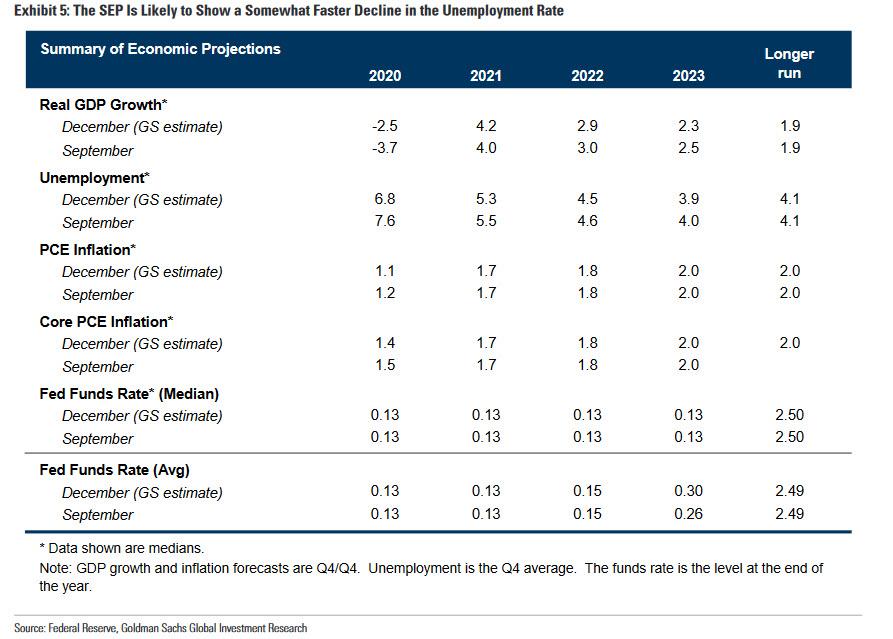
Goldman agrees and writes that Fed officials are likely to see larger near-term risks but a brighter medium-term outlook as they head into their December meeting next week.  While the winter virus resurgence has grown much worse since the last meeting, the vaccine news should inspire more confidence in 2021 recovery prospects than when Fed officials last wrote down projections in September. This brighter outlook should translate to slightly rosier economic projections including a 2021 growth forecast of just over 4%, about half-way between consensus and Goldman's own forecast. Goldman also expects a somewhat lower unemployment rate path, but no changes to the inflation projections beyond this year.

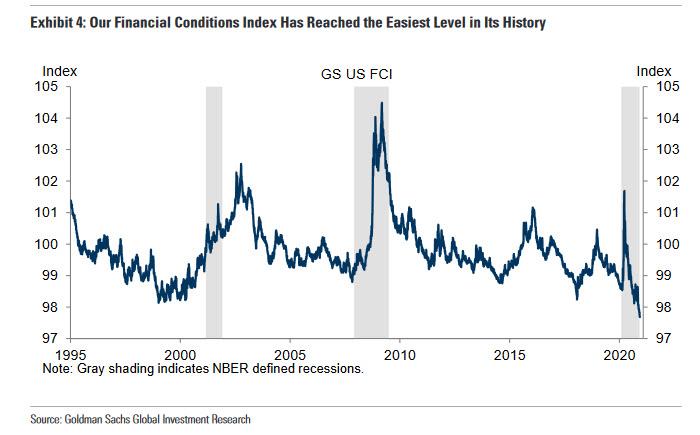
Markets have largely looked through the winter virus resurgence, focusing instead on the economy’s likely reacceleration next year as vaccines reduce virus spread. Goldman's financial conditions index now stands at the easiest level in its history, as shown in the chart below, led by a further rally in the equity market.

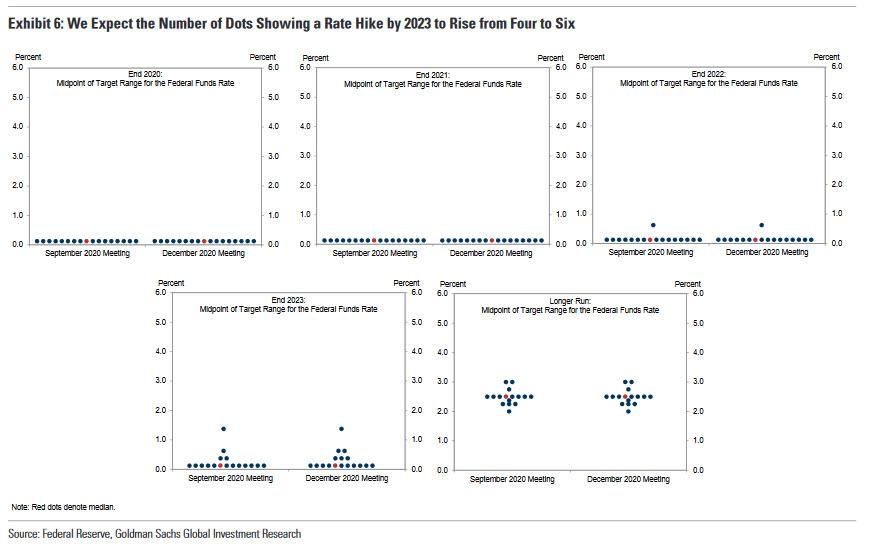
The encouraging vaccine news is likely to inspire a couple more FOMC participants to project a rate hike by 2023, raising the total from four to about six.However, most participants will probably need to see stronger evidence that the new liftoff thresholds might be met before penciling in a hike, and a strong majority is expected to show a flat funds rate through 2023.

As noted above, however, markets will be most focused on possible changes to the Fed’s asset purchase policy next week.  The minutes to the November meeting indicate that the FOMC discussed both forward guidance for asset purchases and possible changes to the composition or size of asset purchases.

Goldman expects the FOMC to adopt outcome-based forward guidance indicating that purchases will continue “until the labor market is on track to reach maximum employment and inflation is on track to reach 2 percent,” a softer version of the thresholds used for liftoff of the funds rate.

What might that mean in practice?  The FOMC will want to maintain asset purchases as a core component of its policy response for much of the recovery period. To avoid having to tighten too rapidly later, the FOMC will aim to begin tapering asset purchases about 1-1½ years before liftoff so that it can taper at a gradual pace and leave a buffer between the end of asset purchases and the first rate hike. Here is how Goldman believes the Fed's latest redline statement will look:

The guidance would probably be somewhat more dovish than consensus expectations, which anticipate an earlier tapering that begins further ahead of liftoff.  The November Primary Dealer Survey indicated that the median respondent expected tapering to begin in late 2021H2 or early 2022H1, as shown below, 2½-3 years before the median respondent expected liftoff.  Goldman does not think the FOMC will deliberately phase out asset purchases quite that far ahead of liftoff, though a longer gap is of if inflation surprises to the downside after tapering and delays liftoff.

The Fed is also more likely than not to extend the weighted average maturity of its Treasury purchases, though it is a close call: Goldman says there are two key arguments for an extension.  First, as the purpose of asset purchases shifts to providing accommodation, it would be sensible to reduce purchases of shorter maturities in order to maximize their per-dollar impact.  Second, Fed officials might see the winter virus resurgence as the obvious moment to shoot their last bullet, or at least a moment not to disappoint market expectations. 

That said, the bank's economists do not see a clear signal from Fed officials, and view this as a close call.  First, financial conditions are already very easy and some Fed officials have expressed concern that a maturity extension would do more for markets than the economy.  Second, recent Fed commentary on the issue has been unclear and at times skeptical, and a recent article in the Wall Street Journal suggested that the FOMC is unlikely to change the composition of its purchases next week.  Third, the FOMC might value preserving the option to make a move similar to the Bank of Canada’s—reducing the pace of purchases but increasing the average maturity in an offsetting manner—but it seems unlikely to attempt it next week without having sufficiently presented the idea to financial markets in advance.  If a fiscal deal materializes before the FOMC meeting, it would further lower the odds of a maturity extension.

https://cms.zerohedge.com/markets/heres-what-fed-will-say-today-according-goldman

Small Caps Tumble After JPMorgan Warns 'Equity Rally Is Overdone'

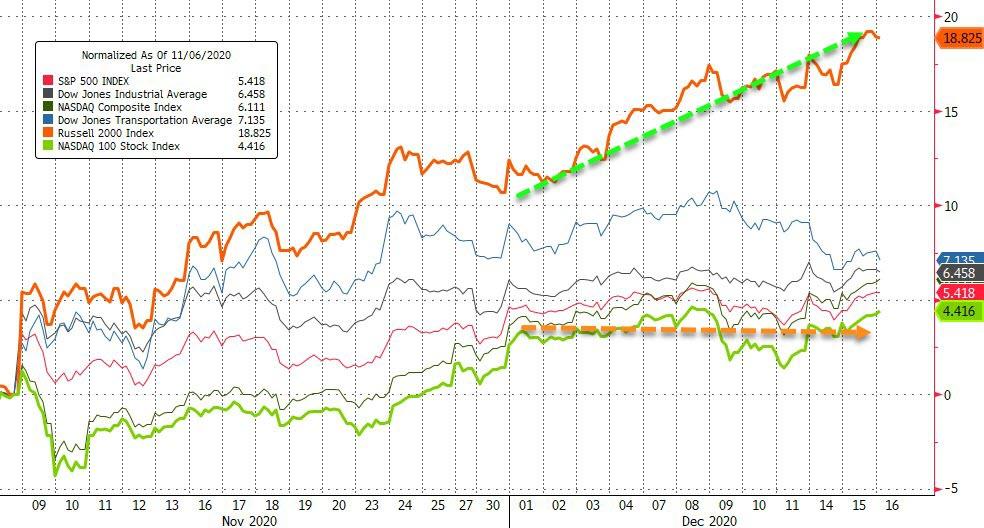
 Small Cap stocks have been on a tear in the last month or so, massively outperforming big tech.

Small stocks tend to be more sensitive to changes in inflation than larger firms. Big tech companies are also notoriously volume monetizers, meaning incremental margin is acquired through volume gains rather than price increases.

That’s why the small cap to big tech ratio (red line above) is so important in the context of confirming inflation expectations.

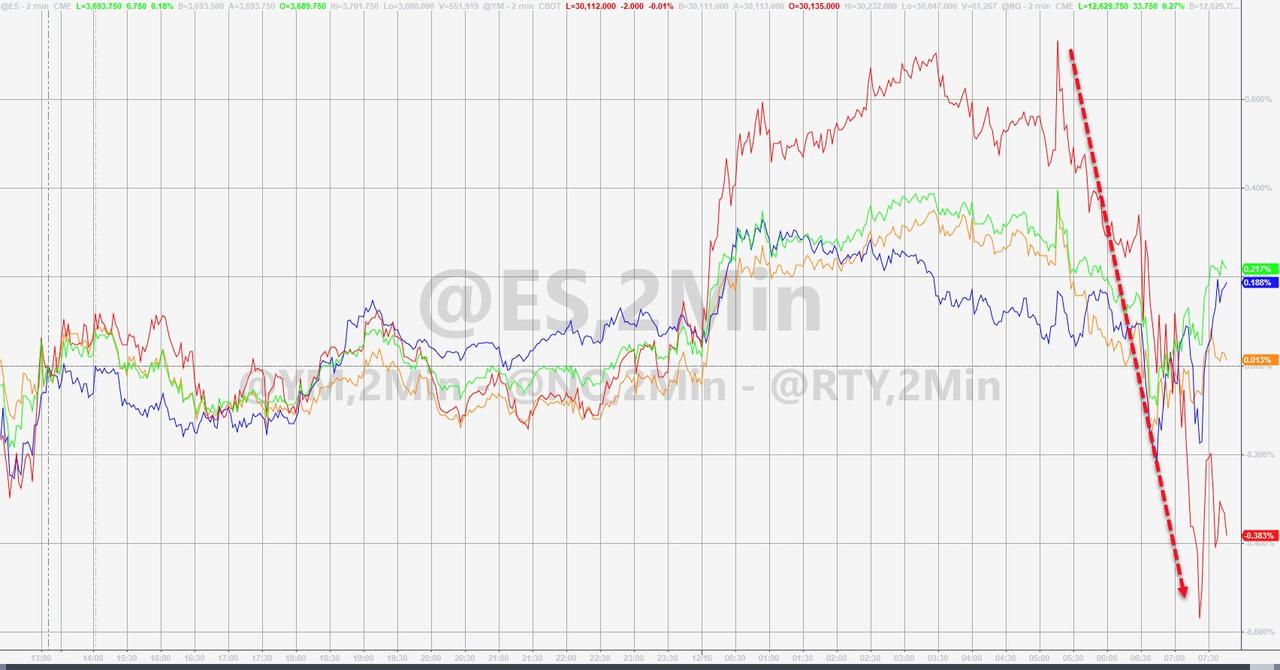
But, this morning, Small Caps are taking a beating as JPMorgan says that global small and mid-caps should take a breather in the coming weeks, as the rally since November is overdone.

Specifically, strategists Eduardo Lecubarri and Siddharth Dash write that every time the global market cap has surpassed global GDP, the market has corrected, adding the ratio is not only above 100% but also at all-time high:

With many small and mid-cap indexes up double digits despite global GDP expected to fall 4% (and with technicals are at overbought levels), perhaps fear is about to come back into the market (or at least less greed and complacency).

https://cms.zerohedge.com/markets/small-caps-tumble-after-jpmorgan-warns-equity-rally-overdone