Search This Blog

Monday, February 15, 2021

Early links between cardiovascular risk and brain metabolism

 Spanish scientists uncover early links between cardiovascular risk and brain metabolism

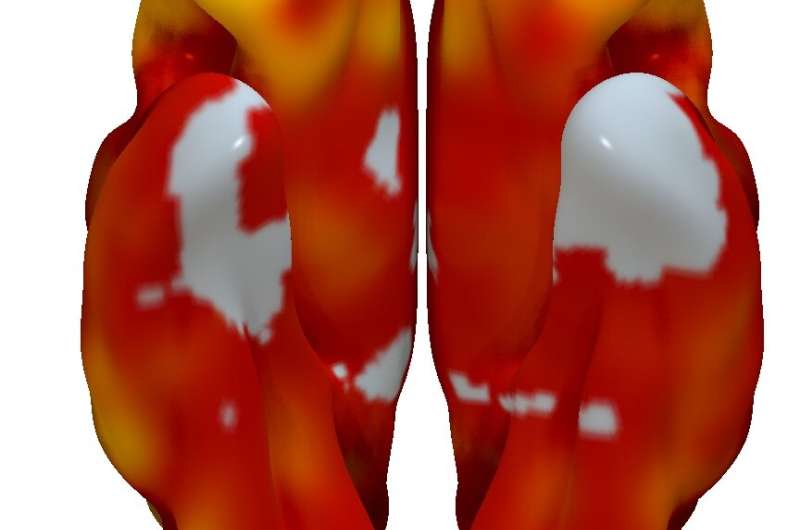
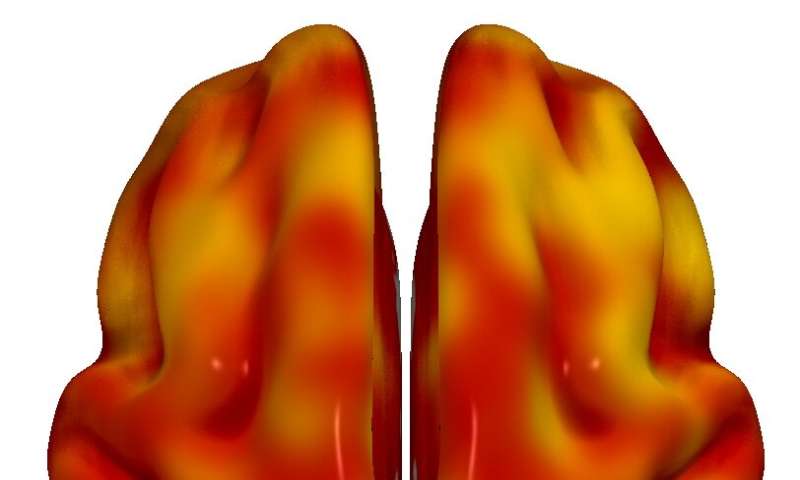
3D reconstructions of superior (left) and inferior (right) brain regions, showing regions with lower metabolism associated with the presence of atherosclerotic plaques in the carotid arteries. The color code indicates the magnitude of the observation (yellow, strong association; red, lower association). Gray indicates areas showing no association with carotid plaque presence. Credit: CNIC

The links between cardiovascular disease and cognitive impairment begin years before the appearance of the first clinical symptoms of either condition. In a study carried out at the Centro Nacional de Investigaciones Cardiovasculares (CNIC) in partnership with Santander Bank and neuroimaging experts at the Barcelonaβeta Brain Research Center (BBRC, the research center of the Fundación Pasqual Maragall), the investigators have identified a link between brain metabolism, cardiovascular risk, and atherosclerosis during middle age, years before the first appearance of symptoms.

The report, published in the Journal of the American College of Cardiology (JACC), is important because it suggests that intervention in a modifiable condition () could prevent the development of dementia, a disease for which there is currently no cure.

Dr. Valentín Fuster, CNIC and Mount Sinai Heart general director, physician-in-chief of the Mount Sinai Hospital and a lead author on the study, said, "Although everybody knows about the importance of caring for ourselves and controlling  factors in order to avoid a heart attack, the association of these same risk factors with  may increase awareness of the need to acquire healthy habits from the earliest stages of life."

Moreover, the results provide yet more support for the importance of implementing primary cardiovascular prevention strategies in  as a valuable therapeutic approach to slowing or even halting  alterations that could contribute to future cognitive decline.

Cognitive impairment

The advanced stages of vascular disease and dementia often occur together, but until now this association has not been documented at earlier stages. The CNIC-coordinated study, led by Dr. Marta Cortés Canteli, shows that in middle age, years before any clinical signs appear, atherosclerosis and  already show an association with low metabolism in  implicated in the future development of dementia, especially Alzheimer's disease.

The advanced stages of neurodegenerative and vascular diseases often occur together, and research in recent years has established close links between cognitive decline and a number of cardiovascular risk factors, including hypertension, obesity, and high cholesterol.
Spanish scientists uncover early links between cardiovascular risk and brain metabolism
3D reconstructions of superior (left) and inferior (right) brain regions, showing regions with lower metabolism associated with the presence of atherosclerotic plaques in the carotid arteries. The color code indicates the magnitude of the observation (yellow, strong association; red, lower association). Gray indicates areas showing no association with carotid plaque presence. Credit: CNIC

Using advanced imaging by positron emission tomography (PET), the research team quantified  in more than 500 participants in the PESA-CNIC-Santander study. The participants had an average age of 50 years and no symptoms, but already had evidence of atherosclerosis in their arteries.

PESA-CNIC-Santander, directed by Dr. Valentín Fuster, is a prospective study of more than 4000 asymptomatic middle-aged participants who have been exhaustively assessed for the presence and progression of subclinical atherosclerosis since 2010.

The new study reveals a link between elevated risk of a cardiovascular event and low brain metabolism. "When brain metabolism declines, the brain's ability to handle adverse events can be compromised. Depending on the brain area affected, this can lead to a range of distinct problems," explained study co-first author Dr. Cortés Canteli, a CNIC investigator and Miguel Servet fellow.

Cardiovasular risk

"We found that a higher cardiovascular risk in apparently healthy middle-aged individuals was associated with lower brain metabolism in parietotemporal regions involved in spatial and semantic memory and various types of learning," said Dr. Cortés Canteli. Dr. Juan Domingo Gispert, head of the Neuroimaging group at the BBRC, noted that "the brain areas showing low metabolism in participants with higher cardiovascular risk are the same areas affected in Alzheimer's disease, suggesting that these individuals may have higher than normal vulnerability to this disease."

"We think that cardiovascular risk factors the affect the large vessels carrying blood from the heart to the brain also affect the small vessels in the brain," asserted Dr. Fuster.

The study is the largest of its type to date in a healthy middle-aged population and could signal a paradigm change in the understanding of the links between vascular and brain disease, say the authors.

Among the modifiable cardiovascular risk factors most closely associated with a reduction in brain metabolism, the investigators saw the biggest effect with hypertension. "We found that the same risk factors that damage the heart and the large arteries, and especially hypertension, are closely linked to the decline in brain metabolism years before the appearance of symptoms," said Dr. Fuster.

Atherosclerotic plaques

The research team also found that a higher number of plaques in the carotid arteries, which carry blood to the brain, was associated with lower brain metabolism in areas of the limbic system and the parietal lobe, both of which are intimately linked to the development of Alzheimer's disease.

"The next step will be to determine whether individuals with subclinical atherosclerosis in the carotid arteries and low brain  at the age of 50 go on to experience cognitive decline 10 years later," said Dr. Cortés Canteli.

Dr. Juan Domingo Gispert remarked that "there is abundant evidence linking cardiovascular  and Alzheimer's disease. If we can gain a more precise understanding of this relationship at asymptomatic disease stages, we will be in a position of design new strategies to prevent Alzheimer, matching the success of current strategies to prevent cardiovascular disease."

These results will be a major stimulus for the implementation of early intervention strategies to reduce the incidence of cognitive decline in old age.


Explore further

Advanced imaging technology predicts cardiovascular risk from inflammation detected in arteries

More information: Jose A. de la Chica et al. Reply, Journal of the American College of Cardiology (2021). DOI: 10.1016/j.jacc.2020.12.002
https://medicalxpress.com/news/2021-02-scientists-uncover-early-links-cardiovascular.html

Preview Of Exact Sciences's Earnings

 Exact Sciences (NASDAQ:EXAS) announces its next round of earnings this Tuesday, February 16. Here is Benzinga's look at Exact Sciences's Q4 earnings report.


Earnings And Revenue

Exact Sciences EPS loss is expected to be around $0.22, according to sell-side analysts. Sales will likely be near $446.22 million. In the same quarter last year, Exact Sciences reported EPS of $0.37 on revenue of $295.57 million.

What Are Analyst Estimates And Earnings Surprises, And Why Do They Matter?

Analysts who cover this company will publish forward-looking estimates of its revenue and EPS each quarter. Averaging together every EPS and revenue prediction that each analyst makes about a company in a quarter yields the "consensus estimates." A company posting earnings or revenue above or below the consensus estimate is known as an "earnings surprise" and may move the stock by a considerable margin.

View more earnings on EXAS

If the company were to match the consensus estimate when it reports Tuesday, EPS would be up 40.54%. Revenue would be up 50.97% from the year-ago period. Here is how the company's reported EPS has stacked up against analyst estimates in the past:

Quarter

Q3 2020

Q2 2020

Q1 2020

Q4 2020

EPS Estimate

-0.52

-0.63

-0.61

-0.34

EPS Actual

-0.07

-0.58

-0.66

-0.37

Revenue Estimate

337.37 M

228.42 M

350.39 M

281.78 M

Revenue Actual


https://finance.yahoo.com/news/preview-exact-sciencess-earnings-153416759.html

408.36 M

268.87 M

347.82 M

295.57 M

1918 influenza provides warning for potential future pandemic reemergence

 Caution: 1918 influenza provides warning for potential future pandemic reemergence

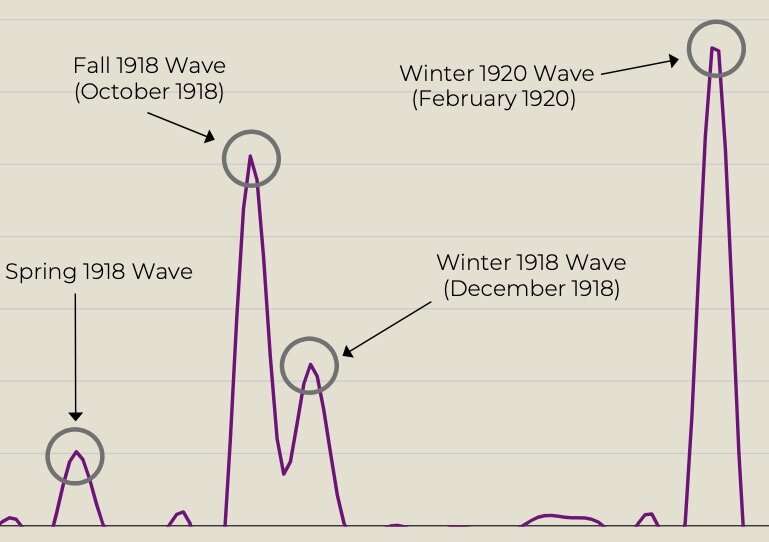
This graph shows the four distinct waves. Wave #1 March 1918 (Spring 1918 Wave), #2 October 1918 (Fall 1918 Wave), #3 December 1918 (Winter 1918 Wave) and #4 February 2020 (Winter 1920 Wave). Credit: Siddarth Chandra

The 1918 influenza pandemic provides a cautionary tale for what the future may hold for COVID-19, says a Michigan State University researcher.

After a decade studying a flu virus that killed approximately 15,000 Michigan residents, Siddharth Chandra, a professor in MSU's James Madison College, saw his research come to life as he watched the spread of the COVID-19 pandemic.

"It was so surreal," said Chandra, who has a courtesy appointment in epidemiology and biostatistics. "All of a sudden, I was living my research."

Chandra's research is published in the American Journal of Public Health with co-authors Julia Christensen, a graduate of James Madison College; Madhur Chandra, Senior Community Epidemiologist with the Ingham County Health Department and graduate of the Department of Epidemiology and Biostatistics at MSU; and Nigel Paneth, professor of epidemiology and biostatistics and pediatrics at MSU.

Using influenza infection and  on Michigan from 1918-1920, Chandra identified four distinct waves. The first large peak was in March 1918. "After a second spike in cases in October 1918, the governor instituted a statewide ban on public gatherings," Chandra said. "Much like the restrictions that were put in place during the COVID-19 pandemic."

Caution: 1918 influenza provides warning for potential future pandemic reemergence
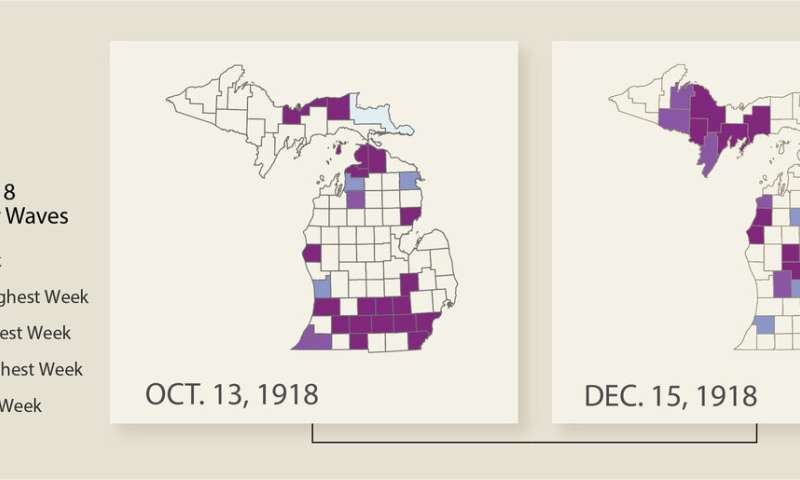
This map shows the counties in Michigan with the highest numbers of flu cases during the spike and peak in cases for October and December 1918. Credit: Michigan State University

After three weeks, the number of cases decreased and the ban was lifted, which led to another peak in December 1918. "The ban didn't stop the spread of the flu. It just delayed the spike in cases," he said.

Chandra mapped the data showing the peaks and spikes in cases from October 1918 and December 1918 and tracked  case growth by county over time. In October, counties in the southern part of the state and near the Mackinac Straits had the highest numbers but by December, the highest numbers of cases were in the heart of the state.

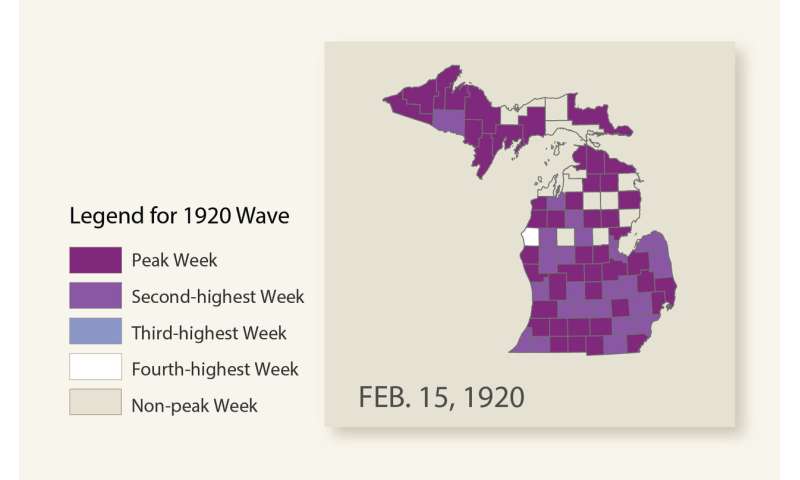
The most surprising piece of data came 18 months later in February 1920, when a statewide explosion of cases created a massive spike even larger than the one in October 1918. For Chandra, it is an educated guess as to the reasons for this delayed increase.

"Assuming it's the same , World War I ended in 1918 and the men were coming home to their families," he said. "We had a mobile agent that brought the virus home to infect family members, which would explain the increase in cases among children and the elderly."

Unfortunately, there is not a way to confirm this, Chandra noted. "We would need samples from patients in 1920 from across the state. Then, we would need to compare those with samples from patients in 1918 from across the state, and that's not likely to happen."

Caution: 1918 influenza provides warning for potential future pandemic reemergence
This map shows the counties in Michigan with the highest number of flu cases during the spike in cases in February 1920. Credit: Michigan State University

The weather may have also been a factor since cool temperatures with low humidity likely provided optimal conditions for the virus to live and spread. Another factor that played a role was the absence of a vaccine.

"In 1918, there was no hope for a vaccine. In 2021, we have a vaccine available," he said.

One of the key insights from the 1918 pandemic that can inform the public health response to the 2020 COVID-19 pandemic is the number of people who are susceptible to the virus. Which means that it is possible that a spike like the February 1920 one will occur in late 2021 or early 2022.

"So many people will remain susceptible until they get vaccinated," Chandra said. "Bad things can still happen a year or two from now even if we see a decrease in the number of cases now. We still have over 200 million people walking around who are susceptible to the , including myself."

More information: Siddharth Chandra et al. Pandemic Reemergence and Four Waves of Excess Mortality Coinciding With the 1918 Influenza Pandemic in Michigan: Insights for COVID-19, American Journal of Public Health (2021). DOI: 10.2105/AJPH.2020.305969

https://medicalxpress.com/news/2021-02-caution-influenza-potential-future-pandemic.html

Smartphone app to change your personality

 How quickly can personality traits be modified? An international research team led by the University of Zurich has shown that daily use of a smartphone app can lead to desired personality changes within three months. And three months after the daily interventions, the changes are still noticeable.

Personality traits such as conscientiousness or sociability are patterns of experience and behavior that can change throughout our lives. Individual changes usually take place slowly as people gradually adapt to the demands of society and their environment. However, it is unclear whether certain  traits can also be psychologically influenced in a short-term and targeted manner.

Researchers from the universities of Zurich, St. Gallen, Brandeis, Illinois, and ETH Zurich have now investigated this question using a digital intervention. In their study, around 1,500 participants were provided with a specially developed  for three months and the researchers then assessed whether and how their personalities had changed. The five major personality traits of openness, conscientiousness, sociability (extraversion), considerateness (agreeableness), and emotional vulnerability (neuroticism) were examined. The app included elements of knowledge transfer, behavioral and resource activation, self-reflection, and feedback on progress. All communication with the digital coach and companion (a chatbot) took place virtually. The chatbot supported the participants on a daily basis to help them make the desired changes.

Changes after three months

The majority of participants said that they wanted to reduce their emotional vulnerability, increase their conscientiousness, or increase their extraversion. Those who participated in the intervention for more than three months reported greater success in achieving their change goals than the  who took part for only two months. Close friends and  also observed changes in those participants who wanted to increase expression of a certain personality trait. However, for those who wanted to reduce expression of a trait, the people close to them noticed little change. This group mainly comprised those participants who wanted to become less emotionally vulnerable, an inner process that is less observable from the outside.

"The participants and their friends alike reported that three months after the end of the intervention, the  brought about by using the app had persisted," says Mathias Allemand, professor of psychology at UZH. "These surprising results show that we are not just slaves to our personality, but that we can deliberately make changes to routine experience and behavior patterns."

Important for health promotion and prevention

The findings also indicate that development of the personality structure can happen more quickly than was previously believed. "In addition, change processes accompanied by digital tools can be used in everyday life," explains first author Mirjam Stieger of Brandeis University in the U.S., who did her doctorate at UZH. However, more evidence of the effectiveness of digital interventions is needed. For example, it was unclear whether the changes achieved were permanent or only reflected temporary fluctuations.

The present findings are not only interesting for research, but could also find application in a variety of areas of life. In  and prevention, for example, such apps could boost the resources of individuals, as people's attitude to their situation and personality traits such as conscientiousness have an influence on health and healthy aging.

The Smartphone App PEACH (PErsonality coACH)

The smartphone application PEACH was developed as part of a project funded by the Swiss National Science Foundation (SNSF) to study personality change through a digital . The application provides scalable communication capabilities using a digital agent that mimics a conversation with a human. The PEACH app also includes digital journaling, reminders of individual goals, video clips, opportunities for self-reflection and feedback on progress. Weekly core topics and small interventions aim to address and activate the desired changes and thus the development of .

The app was developed as a research tool. In the future, however, it is thought that research apps such as PEACH will be made widely available.


Explore further

Few changes seen in 'Big Five' personality traits during early days of COVID-19

More information: Mirjam Stieger et al. Changing personality traits with the help of a digital personality change intervention, Proceedings of the National Academy of Sciences (2021). DOI: 10.1073/pnas.2017548118
https://medicalxpress.com/news/2021-02-smartphone-app-personality.html

Blood biomarker detects COVID-19 severity and enables early triage

 Dr. Kulasinghe, from QUT Centre for Genomics and Personalised Health and School of Biomedical Sciences, delivered the findings to a special virtual meeting of the American Association of Cancer Research (AACR) on "COVID-19 and Cancer" earlier this month.

He said results of the test could inform doctors those patients that were likely to develop a severe infection and require a ventilator when they first present and thus differentiate them from patients likely to experience a milder case and who could go home and self-isolate.

"This is extremely important for the triage of patients when hospitals are running near or beyond capacity," Dr. Kulasinghe said.

"We used spatial transcriptomic profiling (a technique which enables researchers to map cell-to-cell interactions and genes) to study lung samples from COVID-19 patients who had died.

"These spatial profiling biology approaches to understand complex tissues were voted the method of the year in 2020 Nature Methods.

"We drew upon our  in spatial profiling of lung cancer to study COVID-19 in the lungs.

"Using  and genomic profiling, we were able to map the presence of the virus in the lungs down to the single cells present in the lung tissue.

"We discovered a handful of pro-inflammatory genes which were upregulated (higher expression) in COVID-19 cases when compared with the closest pandemic virus, swine flu or H1N1, and the lungs of healthy people.

"The pro-inflammatory genes, including one called ifi27, are involved in type 1 interferon response—an inflammatory response to defend the body from viruses and other pathogens.

"The value of measuring this biomarker, ifi27, in a nasal swab or  is in triaging patients because it can tell us how severe the COVID-19 disease is as soon as the patient seeks medical help with COVID symptoms."

Dr. Kulasinghe said the researchers had measured ifi27 in asymptomatic, mild, moderate and severe COVID-19 cases.

"We saw that ifi27 is elevated in a step-wise manner with severe cases having high ifi27 levels."

Dr. Kulasinghe said researchers knew that ifi27 was elevated in the blood of COVID-19 patients.

"But there had not been any evidence of where the signal for the high ifi27 levels was coming from.

"By spatial profiling  tissue of COVID-19  who had died we got a much deeper picture of the cellular changes driven by viral infection and that the lungs were a source of the raised ifi27.

"This technique also allowed us to identify which cells in the lungs the virus was binding to."

This collaborative research project with University of Queensland Diamantina Institute and the Walter and Eliza Hall Institute of Medical Research was awarded the Ausbiotech Johnson & Johnson Industry Excellence Collaboration Award and Industry Choice Award in 2020.

"Spatial Profiling of Lung SARS-CoV-2 and Influenza Virus Infection Dissects Virus-Specific Host Responses and Gene Signatures" is published on the MedRxiv pre-print server.


Explore further

Study uncovers two phases of infection in patients with severe COVID-19 pneumonia

More information: Arutha Kulasinghe et al. Spatial Profiling of Lung SARS-CoV-2 and Influenza Virus Infection Dissects Virus-Specific Host Responses and Gene Signatures, (2020). DOI: 10.1101/2020.11.04.20225557
https://medicalxpress.com/news/2021-02-blood-biomarker-covid-severity-enables.html

Harris contradicts Fauci on White House COVID vaccine plan

 Vice President Kamala Harris ​is claiming in a new interview that the Biden administration is “starting from scratch” to develop a ​national ​vaccine distribution plan because former President Donald Trump​ left them with nothing​, ​contradicting comments from Dr. Anthony Fauci, who disputed that contention last month.

“There was no national strategy or plan for vaccinations, we were leaving it to the states and local leaders to try and figure it out,” Harris told ​”Axios on HBO” Sunday evening. 

“In many ways, we are starting from scratch on something that’s been raging for almost an entire year,” she added.

Harris said she constantly asks the White House coronavirus team whether there is “capacity to do more?”

​​”The suffering,” she said, “is so immense in terms of both the public health crisis, the number of people who have died, the number of people who’ve contracted it, and the economic crisis.”

“We’ve got to figure out a way ​–​ that has to be our standard. Our standard has to be: ‘Everything is possible, but we’re going to have to work like heck to get it done.’ Which means … no patience for delay, no patience for, ‘It can’t be done.’ You know, that’s how I feel about it​,” Harris said in the interview. 

​But Fauci, chief medical adviser to President Biden, was asked during a White House briefing on Jan. 21 whether the coronavirus team was beginning from scratch with vaccine distribution or whether it is building on what the Trump administration began. 

​”W​e certainly are not starting from scratch because there is activity going on in the distribution,” Fauci said.​

He continued to point out that Biden was trying to develop more community vaccine centers, to get pharmacies more involved and to use the Defense Production Act to ramp up vaccine production and ​manufacturing of needles and syringes.

“​So it’s taking what’s gone on, but amplifying it in a big way​,” said Fauci, the nation’s top infectious diseases expert​.

His comments came just after Biden blasted his predecessor for the lack of a rollout plan. 

“For the past year, we couldn’t rely on the federal government to act with the urgency and focus we needed and we have seen the tragic cost of that failure: 3,000 to 4,000 deaths per day,” Biden told reporters at the White House.

“While the vaccine provides so much hope, the rollout has been a dismal failure thus far.”​

Asked about Biden’s comments at the White House briefing, Fauci said the team is going to quicken the pace from what it was before.

​”We’re coming in with fresh ideas, but also some ideas that were not bad ideas with the ​-​- with the previous administration. You can’t say it was absolutely not usable at all. So we are continuing, but you’re going to see a real ramping-up of it​,” he said.​

https://nypost.com/2021/02/15/starting-from-scratch-harris-contradicts-fauci-on-white-house-covid-vaccine-plan/

Aptar Tech to Protect New SARS Rapid Antigen Test for COVID-19 Diagnosis

 AptarGroup, Inc. (NYSE: ATR), a global leader in drug delivery, consumer product dispensing and active packaging solutions, announced that its Activ-Film™ technology was selected to protect a new SARS Rapid Antigen test for COVID-19 that recently received Emergency Use Authorization (EUA) from the U.S. Food and Drug Administration (FDA).

The QuickVue® SARS Antigen test is a point-of-care rapid antigen test developed by Quidel® Corporation, a leading manufacturer of diagnostic healthcare solutions, that delivers test results in 10 minutes. The visually read test requires no supplemental instrumentation and offers expanded access to affordable and accurate COVID-19 testing that will help meet the urgent testing needs of the global economy, including for those in school systems and rural areas.

Aptar CSP Technologies’ Activ-Film™ technology is integrated into the diagnostic kit to protect against moisture and other environmental conditions that could otherwise impact test accuracy. Activ-Film™ leverages Aptar’s proprietary 3-Phase Activ-Polymer™ technology, which provides a broad spectrum of custom-engineered protection in a variety of configurations, such as Activ-Vial™ for housing diagnostics dipsticks and Activ-Tab integrated within diagnostic cassettes. This material science-based active packaging technology is currently used to protect a range of electrochemical, lateral flow and molecular diagnostic test kits on the market today.

https://www.streetinsider.com/Business+Wire/Aptar%E2%80%99s+Activ-Film%E2%84%A2+Technology+Selected+to+Protect+New+SARS+Rapid+Antigen+Test+for+COVID-19+Diagnosis/17971270.html