Search This Blog

Saturday, May 22, 2021

FDA: Don't use syringes from Chinese firm after safety issues with vaccine injections

 The U.S. Food and Drug Administration on Thursday asked healthcare providers to stop using certain syringes and needles manufactured by Chinese medical device maker Guangdong Haiou Medical Apparatus Co (HAIOU). 

  At least one pharmacist that Reuters spoke to said the syringes had been shipped for use with the Pfizer Inc /BioNTech SE COVID-19 vaccine. 

  An FDA spokesperson said the devices stopped being shipped in COVID-19 vaccination kits as of March 22. The agency does not believe that stopping use of these syringes will cause vaccination delays. 

  The FDA said it has received information about quality issues, including certain HAIOU needles detaching from the syringe and getting stuck to the patient's arm after injection and a few incidents involving accidental needlestick injuries to healthcare providers. 

  The agency has recommended against use of two of HAIOU's syringe-needle combinations - 1mL syringe with 25Gx 1-inch needle and the 1mL syringe with 23G x 1-inch needle - until further notice. 

  Erin Fox, senior director of drug information at University of Utah Health, said it had previously received the syringes with the Pfizer/BioNTech vaccine as part of ancillary supply kits shipped by McKesson Corp. She said they were using those syringes in March, but have not had them for a while and are not currently using them. 

  The FDA issued an import alert on April 30, to prevent these syringe and needle configurations from entering the United States. 

https://news.yahoo.com/1-fda-recommends-not-using-212241343.html

China's Fosun Says Willing to Provide BioNTech Vaccines to Taiwan

 China's Shanghai Fosun Pharmaceutical Group Co Ltd is willing to provide Taiwan with BioNTech COVID-19 vaccines, its chairman Wu Yifang told Xinhua news agency, amid a spike in domestic infections on the island.

Fosun signed a deal with BioNTech to exclusively develop and commercialise COVID-19 vaccine products developed using BioNTech's mRNA technology in mainland China, Hong Kong, Macau and Taiwan.

BioNTech's development and distribution partner for the rest of the world is U.S. firm Pfizer Inc.

Wu said certain groups in Taiwan he did not name had been in touch for an emergency purchase of vaccines and the company was willing to "provide vaccine services to Taiwan compatriots".

Since last year, Fosun has been promoting vaccines for Taiwan, Wu said, adding they hope shots can arrive on the island soon to help prevent a resurgent spread of the virus.

Taiwan's government has said it is talking with BioNTech rather than Fosun, and that the two sides were on the verge of announcing a deal in December when BioNTech pulled the plug.

Taiwan has implied China was to blame for the failed deal, while China has blamed Taiwan for trying to circumvent Fosun.

BioNTech said in February it planned to provide the vaccine to Taiwan, but has not provided further details and declined to comment on the progress of talks in a statement to Reuters this week.

China claims Taiwan as its own territory, and has repeatedly sparred with the island over the coronavirus pandemic. Taiwan has accused China of spreading fake news, which Beijing denies.

Taiwan has received only around 700,000 vaccine doses to date, all from AstraZeneca Plc, and those are rapidly running out as it steps up vaccinations during a spike in domestic infections.

Taiwan has millions more doses on order, including from Moderna Inc, but like many other parts of the world has faced delivery delays due to global shortages.

https://www.usnews.com/news/top-news/articles/2021-05-22/chinas-fosun-says-willing-to-provide-biontech-vaccines-to-taiwan

Unvaccinated Americans are less worried about traveling than vaccinated Americans

 Vaccinated and unvaccinated Americans have different attitudes about the idea of traveling this spring, according to the findings from a marketing technology company. And they’re not different in the way you might assume.

With travel bookings surging, data from New York-based Zeta Global indicates that unvaccinated Americans appear more comfortable traveling — and to more densely-populated places — than vaccinated people.

Vaccinated people waiting longer to travel

Zeta Global conducted a survey of 3,700 U.S. consumers in mid-March and combined the results with information on those respondents’ hotel and airport visits in February and March.      

In the survey, 67% of vaccinated respondents said they will not travel until the end of May, but only 59% of unvaccinated Americans indicated they would wait that long. 

Vaccinated care more about health measures

More than 80% of vaccinated people who took the survey said they were concerned about the public health restrictions in place at intended destinations, compared with only 38% of unvaccinated travelers who shared that concern.

It’s possible that vaccinated people feel more comfortable traveling when there are health restrictions in place, while unvaccinated travelers are more interested in how local restrictions will limit their trip, said David Steinberg, Zeta Global’s CEO.

The survey indicated that 62% of unvaccinated travelers are “not at all” concerned with public health restrictions at their travel destinations, while only 19% of vaccinated travelers said the same.

Traveling to different places

Zeta Global’s data showed the top destinations for travelers overall in February and March were New York City, Denver, Atlanta, Dallas-Fort Worth, Philadelphia and two cities in Florida — Orlando and Tampa.

However, trends diverged when broken down by travelers’ vaccination status, said Neej Gore, the company’s chief data officer.

Top destinations for vaccinated travelers
  • Minneapolis-St. Paul
  • Columbus, Ohio
  • Washington D.C.
  • Boston
  • Baltimore
  • Cincinnati
  • Indianapolis

Source: Zeta Global, hotel and flight visitation

“Vaccinated Americans are choosing locations in the Northeast and Midwest,” Gore told CNBC, adding that the unimmunized traveled to places in the South and spots along the West Coast. 

Top destinations for unvaccinated travelers
  • Houston
  • Miami-Fort Lauderdale
  • Los Angeles
  • Salt Lake City
  • San Antonio
  • Seattle-Tacoma
  • Austin, Texas
  • Little Rock, Ark.

Source: Zeta Global, hotel and flight visitation

April travel data, however, showed a shift in traveler habits. Unvaccinated people headed to densely populated cities, while those who were vaccinated went to wide-open spaces, according to travel data compiled by Zeta.

“Las Vegas is the city with the biggest relative change,” said Gore, referencing data which showed the number of unvaccinated travelers visiting Las Vegas hotels tripled in April from the month prior, while the number of vaccinated visitors decreased there.

Similarly, the number of unvaccinated travelers who went to Florida in April increased (+6%), yet decreased among vaccinated travelers (-16%).

Montana is unofficially known as "Big Sky Country." It attracted more vaccinated travelers than unvaccinated travelers last month.
Unofficially known as “Big Sky Country,” Montana attracted more vaccinated than unvaccinated Americans last month.
Mike Kemp | In Pictures Ltd. | Corbis Historical | Getty Images

The Florida trends are primarily a result of incoming travel to Miami and Fort Lauderdale, said Zeta Global. Travel there was up 77% for unvaccinated travelers and down 33% for vaccinated travelers.

While the Northeast and Midwest remain popular destinations for vaccinated travelers, “vaccinated respondents are currently traveling more to the Northwest,” said Gore, based on data showing an increase in vaccinated travelers to Oregon, Washington, Montana and the Dakotas.

Trips to those states did not increase among unvaccinated people, except for Oregon, which the company said is mostly owing to increased travel to Portland by both groups.

Northeasterners flying less

Adobe’s 2021 Digital Economy Index, which came out last month, showed regional variations in summer travel habits. The report showed Northeasterners are flying less than other Americans, with March flight bookings originating from the region at only 56% of pre-pandemic levels, a number which falls short of booking rebounds originating in the West (63%), South (70%) and Midwest (75%).

Adobe’s research indicates Northeasterners’ flight purchases are more closely tied to regional vaccination rates. For every 1% increase in vaccinations in the Northwest, there was a 3.2% increase in flight bookings, the highest of any region in the United States.

It is those who are unvaccinated who should be afraid of traveling.
Harry Severance
DUKE UNIVERSITY SCHOOL OF MEDICINE

“The Northeast was hit hard in the early days of the pandemic, likely driving residents to self-restrict when it came to things like travel and social interactions,” said Taylor Schreiner, director of Adobe Digital Insights.

The area, however, is densely populated, said Schreiner, so “feasible alternatives for seeing family and friends” exist.

“A large portion of the U.S. population is within driving distance to New York,” he said, which makes “the opportunity cost of not flying lower.”

‘Increased risk’ for unvaccinated

Harry Severance, an adjunct assistant professor at Duke University School of Medicine, said people who were vaccinated early are more likely to be concerned about contracting Covid-19 and have greater knowledge about the acute and chronic effects of the disease.

“Thus, I suspect that this group would retain a significant concern over contracting the disease, even post-vaccination,” he said.

Severance said that thought process is changing, as evidence demonstrates vaccinated people have “little susceptibility” to Covid-19 infections, and if they do get sick, infections are typically mild with a “significantly reduced capability of further spreading the disease.”

“It is those who are unvaccinated who should be afraid of traveling,” he said.

“Those who are unvaccinated are putting themselves at increased risk if they gather in large groups of likewise unvaccinated persons,” said Severance, “especially if these groups are assembling from across the country, as the risk of being exposed to different Covid variants is increased.”

https://www.cnbc.com/2021/05/21/where-are-unvaccinated-americans-traveling-big-cities-study-suggests.html

U.S. recording under 30,000 daily new Covid cases 1st time in nearly a year

 The U.S. is reporting an average of fewer than 30,000 new Covid cases per day for the first time in nearly a year.

The seven-day average of new infections is about 29,100 as of Thursday, according to data compiled by Johns Hopkins University. This marks the first time the average has dipped below 30,000 since June 22, 2020.

Federal data shows the country is reporting 1.8 million daily vaccinations on average over the past week, with 48% of the population having received one shot or more.

U.S. Covid cases

Following roughly 30,100 reported cases on Thursday, the nationwide average of daily new infections stands at 29,100. The country had reported fewer than 30,000 cases for five straight days through Wednesday, another milestone not seen since last summer.

The pace of daily infections is down 18% from one week ago, and a CNBC analysis of Hopkins data shows that daily case counts have declined by 5% or more in 40 states and the District of Columbia over the past week.

U.S. Covid deaths

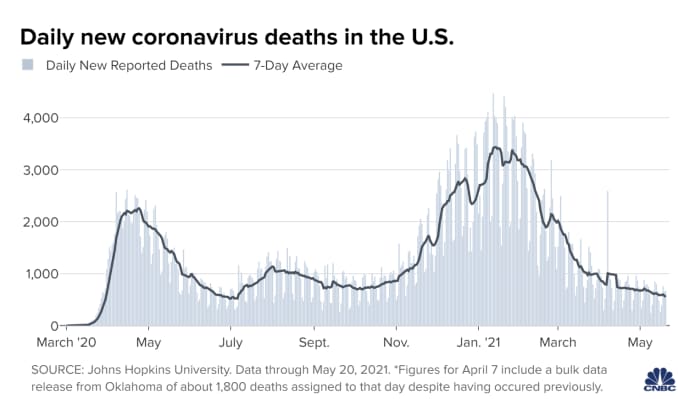
The U.S. is seeing an average of 552 Covid deaths per day, according to Hopkins data, the lowest level since July.

More than 588,000 Covid deaths have been reported in the U.S. since the start of the pandemic.

U.S. vaccine shots administered

Centers for Disease Control and Prevention data shows the U.S. is reporting an average of 1.8 million shots per day over the past week.

The daily average is down 12% from a week ago, but has increased slightly in recent days. The CDC signed off last week on expanded usage of Pfizer and BioNTech’s Covid-19 vaccine for 12- to 15-year-olds, which could help boost the vaccination numbers.

U.S. share of the population vaccinated

About 48% of the U.S. population has received one shot of a vaccine or more, with 38% of the population fully vaccinated.

Of those aged 18 and older, 60.5% are at least partially vaccinated.

https://www.cnbc.com/2021/05/21/covid-19-cases-deaths-vaccinations-daily-update.html

Germany bans travellers from UK due to Indian coronavirus variant concerns

 Germany is banning travellers from the UK from entering the country, due to concerns about a coronavirus variant first found in India.

On Friday, Germany's public health institute declared the UK a "virus variant region", as Covid-19 cases from the B.1.617 strain continue to climb in Britain.

From Sunday, a temporary ban will be imposed on most travellers from the UK.

Only German citizens and people with German residency permits will be permitted to enter the country, and they must quarantine at home for two weeks afterwards.

Travellers transferring from one flight to another and who remain in the airport transit area are also exempt from the ban.

"We want to play it safe," a German government source said. "In this important phase of the vaccination campaign, the entry of problematic mutations must be avoided as far as possible."

Other countries which also face restricted travel include India itself and Brazil, but no other European countries.

Chancellor Angela Merkel expressed concern about the variant “which seems to be somewhat more aggressive” than the currently dominant variant.

Ms Merkel also urged Germans to behave responsibly as large parts of the country relaxed more pandemic restrictions Friday.

German regions have gradually started easing restrictions as new coronavirus cases decline steadily, accompanied by an accelerating vaccination campaign.

Cafes and restaurants in Berlin and elsewhere started serving customers outdoors for the first time in months on Friday – provided they present a negative Covid-19 test or a vaccination certificate.

By Friday, most of Germany’s 400 cities and counties had a weekly case number below the threshold of 100 per 100,000 inhabitants that triggered strict lockdown measures.

But top officials stressed the need to remain vigilant.

“We can be glad that [infection rates] have declined so far in recent days and in the last two weeks that we can think about opening steps,” Ms Merkel told reporters in Berlin.

“I hope that, after the long time with closures and opportunities they didn’t have, that people will treat these opportunities very responsibly,” she added.

“The virus has not disappeared.”

Germany's disease control agency reported 8,769 newly confirmed Covid-19 cases Thursday and 226 deaths. The country has reported 87,128 virus-related deaths since the start of the pandemic.

State authorities have pushed vigorously to reopen hospitality and tourism for the three-day long weekend, despite misgivings from federal officials.

Ms Merkel said continuing to wear masks and observe social distancing is essential. “We must take care,” she said.

“I believe that, with the necessary responsibility and care that hopefully many – most people – will take, we won’t have to talk about having to shut down again.”

About 40 per cent of the population in Germany has received at least one dose of Covd-19 vaccine so far. About one in eight – more than 10 million people – have been fully vaccinated.

https://www.thenationalnews.com/world/europe/germany-bans-travellers-from-uk-due-to-indian-coronavirus-variant-concerns-1.1227186

Merck-partnered Janux seeks $100M IPO on preclinical promise of bispecific pipeline

 Janux Therapeutics has filed to raise up to $100 million in an IPO. The Merck-partnered biotech wants the money to take a clutch of T-cell engager drug candidates into phase 1 clinical trials.

San Diego-based Janux has raised $201 million from investors including Avalon Ventures and RA Capital since setting up shop in 2017. Using the money, Janux has established a preclinical pipeline based on its TRACTr platform. The platform is designed to overcome the limitations of existing T-cell engagers and, in doing so, realize the potential of the modality in solid tumors.

Now, with candidates against PSMA, EGFR and TROP2 going through IND-enabling studies on route to clinical development, Janux is turning to public investors to finance the next stage of its evolution. 

Using the IPO haul, Janux plans to submit four INDs, starting in the first half of next year. The PSMA candidate is leading the way, trailed by the EGFR and TROP2 assets and an early-stage PD-L1xCD28 costimulatory bispecific. 

The areas of focus put Janux up against bigger companies with more advanced assets. Regeneron, for example, took a PSMA bispecific into the clinic in 2019. Bayer, in collaboration with Amgen, moved a candidate into human testing back in 2012, although Janux sees the difficulties that program ran into as evidence of the differentiation of its asset. Amgen now has a different PSMA drug in the clinic. 

Janux is asking public investors to back it on the strength of early-stage evidence. The IPO paperwork features the findings of an initial proof-of-technology study that showed its EGFR prospect did not lead to cytokine release syndrome in nonhuman primates and drove tumor shrinkage in a mouse model. Janux has preclinical data on its other candidates, too.

In addition to the early evidence, Janux has the validation of its investor syndicate and Merck, which teamed up with the biotech late last year to work on TRACTr candidates against two cancer targets.

The Merck collaboration, which is currently Janux’s sole source of revenue, generated $380,000 for the biotech over the first three months of the year. Merck paid $8 million upfront to kick off work on the first collaboration and will pay the same amount when the second target is selected. 

Janux could ultimately receive almost $500 million in success-based fees per target, but the payments are heavily backloaded, with $350 million tied to sales milestones. The development and regulatory milestones are worth up to $142.5 million per target. 

https://www.fiercebiotech.com/biotech/merck-partnered-janux-seeks-100m-ipo-preclinical-promise-bispecific-pipeline

Friday, May 21, 2021

Genmab - Janssen's Darzalex Wins Positive Opinion In Europe For Two New Indications


  • Committee for Medicinal Products for Human Use of the European Medicines Agency has adopted a positive opinion and recommended granting marketing authorization to Genmab A/S GMAB 1.47% and its partner Janssen Biotech Inc's Darzalex (daratumumab) subcutaneous for amyloidosis.
  • The opinion is for daratumumab in combination with bortezomib, cyclophosphamide, and dexamethasone to treat adult patients with newly diagnosed systemic light-chain amyloidosis.
  • The CHMP also issued a positive opinion recommending Darzalex SC in combination with pomalidomide and dexamethasone in pre-treated adult multiple myeloma patients.