Search This Blog

Saturday, May 22, 2021

ADHD is overdiagnosed and overtreated: study


  • ADHD is an extremely contentious disorder in terms of diagnosis and treatment.
  • A research team examined 334 studies on ADHD published between 1979 and 2020.
  • The team concluded that ADHD is being overdiagnosed and overtreated in children with milder symptoms.

    Attention deficit hyperactivity disorder (ADHD) has long been a controversial topic. While the term "mental restlessness" dates back to 1798, English pediatrician George Still described the disorder in front of the Royal College of Physicians of London in 1902. The condition is attributed to both nature and nurture, with a recent study suggesting the disorder is 75 percent genetic.

    According to DSM-IV criteria, ADHD affects five to seven percent of children; but according to ICD-10, only between one and two percent are afflicted. Global estimates state that nearly 85 million people suffer from ADHD, which, like autism, exists on a spectrum.

    Treatment is perhaps the most contentious issue. While a holistic approach includes counseling, lifestyle changes, and medication, due to insurance requirements and other factors, many children only receive the latter. And now a new systematic scoping review published in the journal JAMA Network Open that investigated 334 studies conducted between 1979 and 2020 found that ADHD is being both overdiagnosed and overtreated in children and adolescents.

    ADHD: An epidemic of overdiagnosis

    Researchers from the University of Sydney and the Institute for Evidence-Based Healthcare in Australia initially retrieved 12,267 relevant studies before using a set of criteria that whittled the list down to 334. Only five studies critically investigated the costs and benefits of treating milder cases of ADHD, prompting the team to focus on knowledge gaps in side effects.

    The team writes that public scrutiny has increased along with the increase in diagnoses. The numbers are startling: between 1997 and 2016, the number of children reported to be suffering from ADHD doubled. While the symptoms of ADHD include fidgeting, inattention, and impulsivity, Dr. Stephen Hinshaw compared this disorder to depression, as neither condition has "unequivocal biological markers." He continues, "It's probably not a true epidemic of ADHD. It might be an epidemic of diagnosing it."

    The Australian researchers write that ambiguous or mild symptoms might contribute to diagnostic inflation and the subsequent rise in the prevalence of ADHD. They compare this to cancer, a field that has established protocols for overdiagnosis. ADHD is still understudied in this regard.

    Overdiagnosis is harmful

    This has contributed to an increase in potential harm, not just to children's health (such as the long-term pharmacological impact on developing brains) but to parents' finances. As of 2018, ADHD is a $16.4 billion global industry, with continued revenue growth predicted — ensured by future ADHD diagnoses.

    The costs and benefits of ADHD treatment are mixed. The authors write:

    "We found evidence of benefits for academic outcomes, injuries, hospital admissions, criminal behavior, and quality of life. In addition, harmful outcomes were evident for heart rate and cardiovascular events, growth and weight, risk for psychosis and tics, and stimulant misuse or poisoning."

    For most of these studies, the benefits outweighed the risks in children suffering from more severe ADHD. But this is not true for children with milder symptoms.

    Across the studies, the team noticed that four themes emerged. The first two were positive, and the second two were negative:

    1. For some people, an ADHD diagnosis was shown to create a sense of empowerment because a biological explanation provided a sense of legitimacy.
    2. Feelings of empowerment enabled help-seeking behavior.
    3. For others, a biomedical explanation led to disempowerment because it served as an excuse and provided a way to shirk responsibility.
    4. An ADHD diagnosis was linked to stigmatization and social isolation.
    5. The unfortunate reality is that ADHD is a real condition that should be treated in some children. But for many, the harm of treatment outweighs the benefits.

    https://bigthink.com/surprising-science/adhd-overdiagnosed-children

    Why COVID is surging in the world's most vaccinated country

     The small archipelago nation of Seychelles, northeast of Madagascar in the Indian Ocean, has emerged as the world's most vaccinated country for COVID-19.

    Around 71% of people have had at least one dose of a COVID vaccine, and 62% have been fully vaccinated. Of these, 57% have received the Sinopharm vaccine, and 43% AstraZeneca.

    Despite this, there has been a recent surge in cases, with 37% of new active cases and 20% of hospital cases being fully vaccinated. The country has had to reimpose some restrictions.

    How can this be happening? There are several possible explanations:

    1. the herd immunity threshold has not been reached—62% vaccination is likely not adequate with the vaccines being used
    2. herd immunity is unreachable due to inadequate efficacy of the two vaccines being used
    3. variants that escape vaccine protection are dominant in Seychelles
    4. the B1617 Indian variant is spreading, which appears to be more infectious than other variants
    5. mass failures of the cold-chain logistics needed for transport and storage, which rendered the vaccines ineffective.

    What does the country's experience teach us about variants,  and herd immunity?

    Let's break this down.

    Variants can escape vaccine protection

    There are reports of the South African B.1.351 variant circulating in Seychelles. This variant shows the greatest ability to escape vaccine protection of all COVID variants so far.

    In South Africa, one study showed AstraZeneca has 0-10% efficacy against this variant, prompting the South African government to stop using that vaccine in February.

    The efficacy of the Sinopharm vaccine against this variant is unknown, but lab studies show some reduction in protection, based on blood tests, but probably some protection.

    However, no comprehensive surveillance exists in the country to know what proportion of cases are due to the South African variant.

    The UK variant B117, which is more contagious than the original strain, became the dominant variant in the United States. But the US still achieved a dramatic reduction in COVID-19 cases through vaccination, with most people receiving the Pfizer and Moderna vaccines.

    Israel, where the UK variant was dominant, also has a very high vaccination rate, having vaccinated nearly 60% of its population with Pfizer. It found 92% effectiveness against any infection including asymptomatic infection, and Israel has seen a large drop in new cases.

    The United Kingdom has used a combination of Pfizer and AstraZeneca vaccines. More than 50% of the population have had a single dose and almost 30% are fully vaccinated. The country has also seen a significant decline in case numbers.

    But there's a current surge of cases in northwest England, with most new cases in the city of Bolton being the Indian variant. This variant is also causing outbreaks in Singapore, which had previously controlled the virus well.

    Seychelles needs to conduct urgent genome sequencing and surveillance to see what contribution variants of concern are making, and whether the Indian variant is present.

    If the South African variant is dominant, the country needs to use a vaccine that works well against it. Many companies are making boosters targeted to this variant, but for now, Pfizer would be an option. In Qatar, local researchers found Pfizer had 75% effectiveness against the South African variant.

    We need to use high-efficacy vaccines to achieve herd immunity

    The reported efficacy of Sinopharm is 79% and AstraZeneca is 62-70% from phase 3 clinical trials.

    Our research at the Kirby Institute showed that, in New South Wales, Australia, using a vaccine with 90% efficacy against all infection means herd immunity could be achieved if 66% of the population was vaccinated.

    However, using lower efficacy vaccines means more people need to be vaccinated. If the vaccine is 60% effective, the proportion needing to be vaccinated rises to 100%.

    When you get an efficacy of less than 60%, herd immunity is not achievable.

    However, these calculations were done for the regular COVID-19 caused by the D614G variant which dominated in 2020. This has a reproductive number (R0) of 2.5, meaning people infected with the virus on average infect 2.5 others.

    But the B117 variant is 43-90% more contagious than D614G, so the R0 may be up to 4.75. This will require higher vaccination rates to control spread.

    What's more, the Indian variant B1617 has been estimated to be at least 50% more contagious than B117, which could take the R0 to over 7, and takes us into uncharted territory.

    This could explain the catastrophic situation in India, but also raises the stakes for vaccination, as lower efficacy vaccines will not be able to contain such highly transmissible variants effectively.

    Herd immunity is still possible, but depends on the efficacy of the vaccine used and the proportion of people vaccinated.

    UK modeling study found using very low efficacy vaccines would result in the economy barely breaking even over ten years because it would fail to control transmission. On the other hand, using very high efficacy vaccines would result in much better economic outcomes.

    Vaccinating the world is the only way to end the pandemic

    As the pandemic continues to worsen in some parts of the world, the risk increases of more dangerous mutations that are -resistant or too contagious to control with current vaccines.

    Keeping up with mutations is like whack-a-mole while the pandemic is raging.

    The take-home message for our pandemic exit strategy is that the sooner we get the whole world vaccinated, the sooner we will control emergence of new variants.

    https://medicalxpress.com/news/2021-05-covid-surging-world-vaccinated-country.html

    COVID-19 virus may not insert genetic material into human DNA

     The virus that causes COVID-19, which scientists refer to as SARS-CoV-2, likely does not integrate its genetic material into the genes of humans, according to a study published in the Journal of Virology.

    A separate study recently reported the virus's  was found to have integrated into human DNA in cells in petri dishes. But the scientists conducting the newer research now say that result was most likely caused by genetic artifacts in the testing.

    Majid Kazemian, a Purdue University assistant professor of biochemistry and computer science and one of the three co-lead authors on the research study, said that this finding has two important implications.

    "Relatively little is known about why some individuals persistently test positive for the virus even long after clearing the infection. This is important because it's not clear whether such individuals have been re-infected or whether they continue to be infectious to others. So-called ' invasion' by SARS-CoV-2 has been suggested as an explanation for this observation, but our data do not support this case.

    "If the virus was able to integrate its genetic material into the human genome, that could have meant that any other mRNA could do the same. But because we have shown that this is not supported by current data, this should allay any concerns about the safety of mRNA vaccines, he said."

    It is possible for the genetic material of some viruses to be incorporated into the DNA of humans and other animals, resulting in what scientists call "chimeric events." Human DNA contains approximately 100,000 pieces of DNA from viruses that our species have accumulated over millions of years of evolution. In total, this lost-and-found DNA from viruses makes up a bit less than 10% of the genetic material in our cells.

    Recent scientific journal articles have claimed that the SARS-CoV-2 virus can also cause these chimeric events. Even before this new research team conducted experiments showing this was not the case, the researchers suspected it was unlikely, said Dr. Ben Afzali, an Earl Stadtman Investigator of the National Institutes of Health's National Institute of Diabetes and Digestive and Kidney Diseases and a co-lead author on the study.

    "While an earlier study suggested that, in cells infected with SARS-CoV-2, genetic material from the virus copied and pasted itself into human DNA, our group thought this seemed unlikely," Afzali said. "SARS-CoV-2, like HIV, has its genetic material in the form of RNA but, unlike HIV, does not have the machinery to convert the RNA into DNA. SARS-CoV-2 is unlikely to paste itself into the genome and coronaviruses, in general, does not go near human DNA. As our study shows, we find it highly improbable that SARS-CoV-2 could integrate into the human genome."

    Christiane Wobus, associate professor of microbiology and immunology at the University of Michigan Medical School, also a co-lead author on the study, said that although the collective understanding of RNA viruses is that integration of SARS-CoV-2 into the human genome would be very unlikely, it was important to examine the question.

    "Unexpected findings in science—when confirmed independently—lead to paradigm shifts and propel fields forward. Therefore, it is good to be open-minded and examine unexpected results carefully, which I believe we did in our study," she said. "However, we did not find conclusive evidence for SARS-CoV-2 integration, but instead showed that during the RNA sequencing methodology, chimeras are produced at a very low level as an artifact of the laboratory technique."

    To examine the proposed integration event, the researchers developed a novel technique in which they extracted the genetic material from infected cells and then amplified or reproduced the genetic material 30-fold. If there were chimeric events in the host cell DNA, these bits of genetic material from SARS-CoV-2 should also increase 30 times. The data did not show this.

    "We found the frequency of host- chimeric events was, in fact, not greater than background noise," Kazemian said. "When we enriched the SARS-CoV-2 sequences from the bulk RNA of infected cells, we found that the chimeric events are, in all likelihood, artifacts. Our work does not support the claim that SARS-CoV-2 fuses or integrates into human genomes."

    More information: Bingyu Yan et al, Host-virus chimeric events in SARS-CoV2 infected cells are infrequent and artifactual, Journal of Virology (2021). DOI: 10.1128/JVI.00294-21

    Liguo Zhang et al, Reverse-transcribed SARS-CoV-2 RNA can integrate into the genome of cultured human cells and can be expressed in patient-derived tissues, Proceedings of the National Academy of Sciences (2021). DOI: 10.1073/pnas.2105968118


    https://medicalxpress.com/news/2021-05-covid-virus-insert-genetic-material.html

    Presentation of multisystem inflammatory syndrome varies in adults

     Patients with multisystem inflammatory syndrome in adults (MIS-A) after severe acute respiratory syndrome coronavirus 2 (SARS-CoV-2) infection have a heterogeneous clinical presentation, according to a research letter published online May 19 in JAMA Network Open.

    Giovanni E. Davogustto, M.D., from Vanderbilt University Medical Center in Nashville, Tennessee, and colleagues conducted a single-center study to describe the spectrum of MIS-A presentation after SARS-CoV-2 infection. Of 839 patients admitted with a positive SARS-CoV-2 test result, 156 were classified as being at risk for MIS-A, and of these patients, 15 met the criteria for MIS-A.

    The researchers found that patients with MIS-A were younger than those admitted for acute COVD-19 symptoms (, 45.1 versus 56.5 years) and were more likely to have evidence of SARS-CoV-2 infection documented by serological testing (60.0 percent versus no patients). Nine of the 15 patients (60.0 percent) with MIS-A had acute COVID-19 symptoms and 20.0 percent required admission for acute COVID-19 before MIS-A admission. During MIS-A admission, 33.3 percent of patients required intensive care treatment for hemodynamic monitoring, vasopressor support, or noninvasive ventilator support (three, one, and one patients, respectively). Three  (20.0 percent) had MIS-A as a  during MIS-A admission; 26.7 and 46.6 percent received immunosuppressive therapy and antibiotic therapy, respectively. There were no deaths. A median of four  were involved, with the most commonly affected being the gastrointestinal, hematologic, and renal systems.

    "These data suggest that, although uncommon, MIS-A has a more heterogeneous clinical presentation than previously appreciated and is commonly underdiagnosed," the authors write.

    One author disclosed ties to the pharmaceutical industry.


    Explore further

    Risk for severe effects low after SARS-CoV-2 without hospitalization

    More information: Giovanni E. Davogustto et al, Characteristics Associated With Multisystem Inflammatory Syndrome Among Adults With SARS-CoV-2 Infection, JAMA Network Open (2021). DOI: 10.1001/jamanetworkopen.2021.10323
    https://medicalxpress.com/news/2021-05-multisystem-inflammatory-syndrome-varies-adults.html

    Coronavirus transmission in Queens drove the 1st wave of NYC pandemic

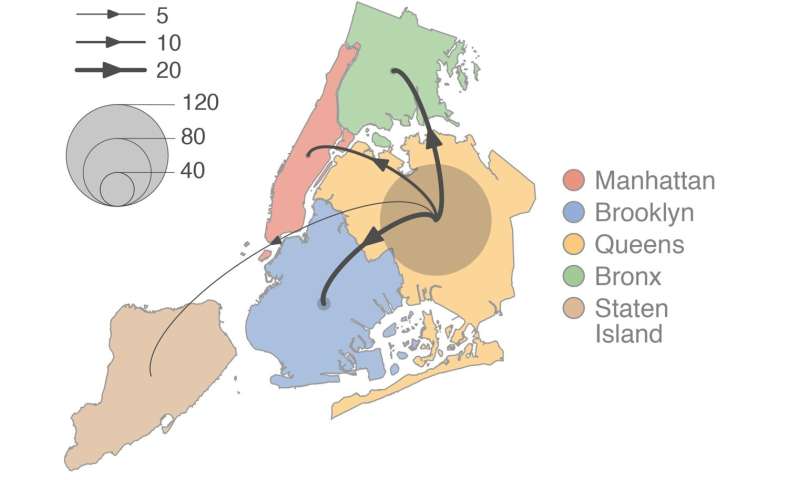
     The most populous boroughs in New York City, Queens and Brooklyn, likely served as the major hub of COVID-19 spread in the spring of 2020, a new study finds.

    Led by researchers at NYU Grossman School of Medicine, the new investigation analyzed over 800 coronavirus  to trace the path of the virus as it traveled across New York City during the pandemic's deadly first wave. It identified Queens and, to a lesser extent, Brooklyn as the likely origin point of most cases sampled, with more cases circulating within their borders and spreading from these parts of the city into Manhattan and the outer boroughs than in the other direction.

    "Our findings appear to confirm Queens' role as the early epicenter of coronavirus transmission throughout the rest of the New York metropolitan area," says study co-senior author Ralf Duerr, MD, Ph.D. "Now that we understand how viral outbreaks can spread between neighborhoods, we can better plan for future contagions and prioritize testing in the most vulnerable areas."

    Duerr, a research assistant professor in the Department of Pathology at NYU Langone Health, notes that if a disease that transmits similarly to the coronavirus strikes New York again, it could likely follow the same basic path through the region.

    Although more research is needed to identify the underlying reasons behind the spread, the study researchers suspect that commuting likely played a key role. Duerr notes that 35 percent of Queens and Brooklyn workers travel daily to Manhattan by car, subway, and bus. In addition, both of the city's main airports, LaGuardia and J.F.K., are located in Queens. That Black and Hispanic Americans, who were hit particularly hard by the pandemic, disproportionally use public transportation and live in these two boroughs may have been another possible factor, says Duerr.

    Past studies revealed that the coronavirus first took root in New York in late February 2020, with more than a hundred separate outbreak sources bursting into chains of infection rather than from a single "patient zero." However, the dynamics of viral spread within and between individual boroughs had remained unclear.

    New research maps COVID-19 dispersal dynamics in New York's first wave of epidemic
    Representative reconstruction of the dispersal dynamics of SARS-CoV-2 in New York City in the spring of 2020 indicates that Queens, and to a smaller extent Brooklyn, acted as the main transmission hubs, with higher local circulation of the virus enabling spill into the other boroughs. Credit: Dellicour S et al., 2021, PLOS Pathogens

    The new study, publishing May 20 in the journal PLOS Pathogens, was designed to precisely track the dispersal of the coronavirus within the five New York City boroughs and Long Island during the first wave of the pandemic, according to Duerr.

    In gene sequencing, researchers compare small snips of genetic code to identify mutations that are only found in a particular strain of the virus. These "flags," researchers say, can then be used to map when and where the strains had spread over time, similarly to tests used to trace ancestry in people. Experts have previously used this technique to follow outbreaks of influenza, methicillin-resistant Staphylococcus aureus (MRSA), and Ebola, among other epidemics.

    For the new investigation, the researchers analyzed viral genetic information gathered from hundreds of nasal swabs. Samples were taken from men and women who had tested positive for COVID-19 in New York City and Long Island from March to May of 2020. Using the different mutation flags, the date the samples were collected, and patient ZIP codes, the study investigators created  that traced the virus' path through the region. The research was carried out in the Genome Technology Center at NYU Langone.

    They found that eight out of 10 simulations pointed to Queens as the major hub of viral spread in the first wave of infection. Meanwhile, the other two simulations identified Brooklyn and the Bronx respectively as the pandemic epicenter, which the study authors say suggests that these two boroughs played important, albeit smaller, roles in viral transmission throughout the city.

    Past research has relied on hospitalization data to infer how the outbreak traveled. The new findings, the study authors say, provide a more direct map of the infections' movement.

    "These gene sequencing and computer modeling techniques can be used by any community looking to track how a virus might spread when mass testing and contact tracing are in limited supply," says study co-senior author Adriana Heguy, Ph.D.

    Heguy, a professor in the Department of Pathology at NYU Langone, encourages other public health officials in the US and abroad to use these methods to map how the pandemic spread in their cities as well.

    She says the research team next plans to apply the methods used in the investigation to study  spread during the second wave of the pandemic in New York City.

    More information: Dellicour S, Hong SL, Vrancken B, Chaillon A, Gill MS, Maurano MT, et al. (2021) Dispersal dynamics of SARS-CoV-2 lineages during the first epidemic wave in New York City. PLoS Pathog 17(5): e1009571. doi.org/10.1371/journal.ppat.1009571

    https://medicalxpress.com/news/2021-05-coronavirus-transmission-queens-drove-york.html

    Vast under-treatment of diabetes seen in global study

     Nearly half a billion people on the planet have diabetes, but most of them aren't getting the kind of care that could make their lives healthier, longer and more productive, according to a new global study of data from people with the condition.Many don't even know they have the condition.

    Only 1 in 10 people with diabetes in the 55 low- and middle-income countries studied receive the type of comprehensive care that's been proven to reduce diabetes-related problems, according to the new findings published in Lancet Healthy Longevity.

    That comprehensive package of care—low-cost medicines to reduce blood sugar, blood pressure and ; and counseling on diet, exercise and weight—can help lower the  of under-treated diabetes. Those risks include future heart attacks, strokes, nerve damage, blindness, amputations and other disabling or fatal conditions.

    The new study, led by physicians at the University of Michigan and Brigham and Women's Hospital with a global team of partners, draws on data from standardized household studies, to allow for apples-to-apples comparisons between countries and regions.

    The authors analyzed data from surveys, examinations and tests of more than 680,000 people between the ages of 25 and 64 worldwide conducted in recent years. More than 37,000 of them had diabetes; more than half of them hadn't been formally diagnosed yet, but had a key biomarker of elevated blood sugar.

    The researchers have provided their findings to the World Health Organization, which is developing efforts to scale up delivery of evidence-based diabetes care globally as part of an initiative known as the Global Diabetes Compact. The forms of diabetes-related care used in the study are all included in the 2020 WHO Package of Essential Noncommunicable Disease Interventions.

    "Diabetes continues to explode everywhere, in every country, and 80% of people with it live in these low- and middle-income countries," says David Flood, M.D., M.Sc., lead author and a National Clinician Scholar at the U-M Institute for Healthcare Policy and Innovation. "It confers a high risk of complications such as including heart attacks, blindness, and strokes. We can prevent these complications with comprehensive diabetes treatment, and we need to make sure people around the world can access treatment."

    Flood worked with senior author Jennifer Manne-Goehler, M.D., Sc.D., of Brigham and Women's Hospital and the Medical Practice Evaluation Center at Massachusetts General Hospital, to lead the analysis of detailed global data.

    Key findings

    In addition to the main finding that 90% of the people with diabetes studied weren't getting access to all six components of effective diabetes care, the study also finds major gaps in specific care.

    For instance, while about half of all people with diabetes were taking a drug to lower their blood sugar, and 41% were taking a drug to lower their blood pressure, only 6.3% were receiving cholesterol-lowering medications.

    These findings show the need to scale-up proven treatment not only to lower glucose but also to address cardiovascular disease risk factors, such as hypertension and high cholesterol, in people with diabetes.

    Less than a third had access to counseling on diet and exercise, which can help guide people with diabetes to adopt habits that can control their health risks further.

    Even when the authors focused on the people who had already received a formal diagnosis of diabetes, they found that 85% were taking a medicine to lower , 57% were taking a blood pressure medication, but only 9% were taking something to control their cholesterol. Nearly 74% had received diet-related counseling, and just under 66% had received exercise and weight counseling.

    Taken together, less than one in five people with previously diagnosed diabetes were getting the full package of evidence-based care.

    Relationship to national income and personal characteristics

    In general, the study finds that people were less likely to get evidence-based diabetes care the lower the average income of the country and region they lived in. That's based on a model that the authors created using economic and demographic data about the countries that were included in the study.

    The nations in the Oceania region of the Pacific had the highest prevalence of diabetes—both diagnosed and undiagnosed—but the lowest rates of diabetes-related care.

    But there were exceptions where low-income countries had higher-than-expected rates of good diabetes care, says Flood, citing the example of Costa Rica. And in general, the Latin America and Caribbean region was second only to Oceania in diabetes prevalence, but had much higher levels of care.

    Focusing on what countries with outsize achievements in diabetes care are doing well could provide valuable insights for improving care elsewhere, the authors say. That even includes informing care in high-income countries like the United States, which does not consistently deliver evidence-based care to people with diabetes.

    The study also shines a light on the variation between countries and regions in the percentage of cases of diabetes that have been diagnosed. Improve reliable access to diabetes diagnostic technologies is important in leading more people to obtain preventive care and counseling.

    Women, people with higher levels of education and higher personal wealth, and people who are older or had high body mass index were more likely to be receiving evidence-based diabetes care. Diabetes in people with "normal" BMI is not uncommon in low- and , suggesting more need to focus on these individuals, the authors say.

    The fact that -related medications are available at very low cost, and that individuals can reduce their risk through lifestyle changes, mean that cost should not be a major barrier, says Flood. In fact, studies have shown the medications to be cost-effective, meaning that the cost of their early and consistent use is outweighed by the savings on other types of care later.


    Explore further

    Consumer health: Alcohol, tobacco and diabetes

    More information: David Flood et al, The state of diabetes treatment coverage in 55 low-income and middle-income countries: a cross-sectional study of nationally representative, individual-level data in 680 102 adults, The Lancet Healthy Longevity (2021). DOI: 10.1016/S2666-7568(21)00089-1
    https://medicalxpress.com/news/2021-05-vast-under-treatment-diabetes-global.html

    Russians infected with crossover flu virus suggests possibility of another pandemic

     Two virus researchers in China are recommending security measures after seven Russian farm workers became infected with a crossover flu virus last year. In their Perspectives piece published in the journal Science, Weifeng Shi and George Gao, both of whom are affiliated with multiple institutions in China, suggest that the makeup and history of the H5N8 strain of avian influenza virus threaten the possibility of another pandemic.

    As Shi and Gao note, the new strain of influenza virus was first discovered in a duck in China back in 2010. By 2014, outbreaks had been seen in Japan and South Korea in both domestic and . And by 2016, it had been found in birds in India, Russia Mongolia, the U.S. and parts of Europe. By 2020, outbreaks had been seen in 46 countries. Shi and Gao note that this history indicates that the virus is able to spread very rapidly. Even more concerning was a report of crossover infections in seven Russian farm workers this past December. The authors note that the infected workers did not have any symptoms (they were tested for ) and there was no indication that the virus was transmissible from one person to the next. But they point out, that once a crossover has been made, it generally does not take a virus long to adapt to spread to other victims—they note how quickly the virus mutated to jump from duck to duck and then to other bird species. They also note that the virus has been found to be quite lethal, with massive die-offs in multiple outbreaks. The Russian workers were tested, for example, after 101,000 hens died.

    On a more optimistic note, Shi and Gao note that it is not too late to take  that could prevent a pandemic. They suggest that vigilant surveillance of farms, live markets and wild birds, along with the implementation of standard infection control measures, could slow the spread of the , giving pharmaceutical companies time to develop a vaccine for it.


    Explore further

    Tracing and controlling high pathogenicity avian influenza

    More information: Emerging H5N8 avian influenza viruses, Science  21 May 2021: Vol. 372, Issue 6544, pp. 784-786. DOI: 10.1126/science.abg6302 , science.sciencemag.org/content/372/6544/784
    https://medicalxpress.com/news/2021-05-russians-infected-crossover-flu-virus.html