Search This Blog

Sunday, May 23, 2021

CureVac works to boost production capacity ahead of expected vaccine approval

 Germany's CureVac expects European approval of its COVID-19 vaccine in June at the latest and is working to expand production capacity, the Augsburger Allgemeine newspaper quoted a company spokeswoman as saying.

Since starting out in 2000, the biotech company has focused on so-called messenger RNA (mRNA), a drug and vaccine technology that has also become the recent focus of the European Union's procurement negotiations.

The mRNA approach has been validated by the wide use of coronavirus vaccines developed by pioneers BioNTech and its partner Pfizer, as well as by Moderna, in Europe and North America.

But more volumes will be needed to boost lagging immunisation coverage in Europe and potentially for repeated booster shots.

"We hope for approval in the course of the second quarter," the newspaper quoted the spokeswoman as saying in comments released on Sunday. "We are working to further expand production capacity with a growing network of partners."

The Nasdaq-listed firm, which is backed by investor Dietmar Hopp, GlaxoSmithKline as well as the German government, has said it aims to produce up to 300 million doses of the vaccine in 2021 and up to 1 billion in 2022.

https://www.marketscreener.com/quote/stock/GLAXOSMITHKLINE-PLC-9590199/news/GlaxoSmithKline-nbsp-CureVac-works-to-boost-production-capacity-ahead-of-expected-vaccine-approval-33333021/

U.S. CDC investigating heart problem in few young vaccine recipients

 The U.S. Centers for Disease Control and Prevention is looking into reports that a very small number of teenagers and young adults vaccinated against the coronavirus may have experienced heart problems, The New York Times reported on Saturday, citing the agency's vaccine safety group.

The group's statement was sparse in details, saying only that there were "relatively few" cases and that they may be entirely unrelated to vaccination, the report said.

https://www.marketscreener.com/news/latest/U-S-CDC-investigating-heart-problem-in-few-young-vaccine-recipients-NYT--33325644/

Saturday, May 22, 2021

2 Health Systems Join the Club in Mandating COVID Vaccines

 The University of Pennsylvania Health System and RWJBarnabas Health have joined Houston Methodist in mandating employees get vaccinated against COVID-19, spokespeople for the two health systems confirmed Thursday.

Penn Medicine in Philadelphia is dictating all clinical and other employees get fully inoculated by September 1. RWJBarnabas in New Jersey is requiring supervisors and executives to be fully vaccinated by June 30; the system has not issued a mandate for all employees, but "it is anticipated that it will eventually be required," its spokesperson wrote in an email to MedPage Today. Both systems are allowing employees to apply for medical or religious exemptions.

The two health systems cited the need to set an example for the public, as well as evidence supporting the vaccines' efficacy and safety, echoing sentiments shared earlier this spring by Houston Methodist.

"As an institution grounded in the science and art of healthcare, we believe it is imperative for Penn Medicine to take the lead in requiring employee vaccinations to protect our patients and staff and to set an example to the broader community," said CEO Kevin B. Mahoney, MBA, in a news release.

"The evidence is clear that COVID-19 vaccines have proven to be very safe and highly effective at preventing transmission, hospitalizations, and death from the virus," said Chief Medical Officer and Senior Vice President Patrick J. Brennan, MD, in the release. In addition, he noted that Penn researchers contributed to the development of the mRNA technology used in the Pfizer-BioNTech and Moderna vaccines -- which "further buoys our confidence in the science."

"As a healthcare leader in the state, we must set the precedent to always provide the safest environment," said Barry H. Ostrowsky, president and CEO of RWJBarnabas, in their own news release.

Penn Medicine's decision makes it the largest health system to issue a vaccine mandate, according to the release. It is the largest private employer in Philadelphia, the Philadelphia Inquirer reported.

Almost 70% of their roughly 44,000 employees are already fully vaccinated. Starting July 1, new hires must be vaccinated or get vaccinated 2 weeks before beginning work there. They will be holding vaccine educational sessions and making experts available to answer employees' questions through this summer.

RWJBarnabas counts 9,000 physicians, 1,000 residents and interns, and more than 35,000 employees at 11 acute care hospitals, among other facilities, in nine New Jersey counties. Among the system's staff at the supervisor level and above, 83% have been vaccinated.

How the systems will handle employees who decline to get vaccinated may vary. While Houston Methodist is terminating uncooperative employees, Penn Medicine employees who do not follow the new mandate "will be subject to disciplinary actions, including firing," according to the Inquirer, citing a Wednesday memo to employees.

"We recognize that not everyone [at Penn] will agree with this decision," the memo said. "The threat of further harm and the possibility of more dangerous viral mutants emerging before we reach herd immunity compels us to take this step."

RWJBarnabas is finalizing its policy "over the next several days," its spokesperson said.

Houston Methodist's mandate did not motivate RWJBarnabas to instill its own, the spokesperson added. "Our decision was made because this mandate is in the best interest of our patients and our staff."

Penn Medicine leaders have been "discussing when a mandate might be appropriate to implement" since the system started vaccinating staff in December, its spokesperson noted. Leaders are "hopeful that other organizations will follow our lead and that of Houston Methodist in taking this step."

Houston Methodist has also been allowing employees to apply for exemptions, which are based on U.S. Equal Employment Opportunity Commission guidelines, a spokesperson wrote in an email to MedPage Today. The system does not have updated data on how many exemptions have been granted.

Some employees have opposed Houston Methodist's mandate -- with one executive being terminated for refusing to be inoculated, two others resigning rather than get the shot, and a nurse taking her grievances public. The system has not adjusted its requirements and has no plans to do so, according to an email from CEO Marc Boom, MD, shared by a spokesperson.

Jefferson Health in Philadelphia is also considering a vaccine mandate, the Inquirer reported.

https://www.medpagetoday.com/special-reports/exclusives/92728

2 COVID shots effective against India variant - English health body

 A double dose of COVID-19 vaccines is almost as effective against the fast-spreading variant of the coronavirus first identified in India as it is against Britain's dominant strain, English health officials said on Saturday.

Britain's health minister said the data was groundbreaking and he was increasingly hopeful that the government would be able to lift more COVID restrictions next month.

A study by Public Health England found the Pfizer-BioNTech vaccine was 88% effective against symptomatic disease from the B.1.617.2 variant two weeks after the second dose.

That compared with 93% effectiveness against the B.1.1.7 "Kent" strain which is Britain's dominant COVID variant.

Two doses of the AstraZeneca vaccine were 60% effective against symptomatic disease from the Indian variant compared with 66% effectiveness against the Kent variant, PHE said.

"I'm increasingly confident that we're on track for the roadmap, because this data shows that the vaccine, after two doses, works just as effectively (against the Indian variant)," Health Secretary Matt Hancock told broadcasters.

Under the government's plans, a lifting of remaining coronavirus restrictions is due to take place from June 21.

Britain has rushed out Europe's fastest vaccination programme so far but it has faced a new challenge from the spread of the variant first found in India.

Data published on Saturday showed new COVID cases reported in Britain rose by 10.5% in the seven days to May 22 although it remained a fraction of levels seen earlier this year.

Prime Minister Boris Johnson this month ordered an acceleration of remaining second doses to the over 50s and people who are clinically vulnerable.

PHE said a first dose of both vaccines was 33% effective against symptomatic disease from B.1.617.2 after three weeks, lower than its 50% effectiveness against B.1.1.7.

Hancock said that showed that getting both doses of the vaccine was "absolutely vital."

Concern about rising cases in Britain of the variant first found in India prompted Germany to say on Friday that anyone entering the country from the United Kingdom would have to quarantine for two weeks on arrival.

Also on Friday, the head of Germany's public health institute said existing COVID-19 vaccines might be less effective against the B.1.617.2 variant. 

https://www.marketscreener.com/quote/stock/ASTRAZENECA-PLC-4000930/news/AstraZeneca-nbsp-Two-COVID-shots-effective-against-India-variant-English-health-body-33325629/

Delaying COVID Vaccine’s Second Dose Boosts Immune Response in Elderly

 Facing a limited vaccine supply, the United Kingdom embarked on a bold public-health experiment at the end of 2020: delaying second doses of COVID-19 vaccines in a bid to maximize the number of people who would be at least partially protected from hospitalization and death.

Now, a study suggests that delaying the second dose of the Pfizer–BioNTech mRNA vaccine could boost antibody responses after the second inoculation more than threefold in those older than 80.

It is the first direct study of how such a delay affects coronavirus antibody levels, and could inform vaccine scheduling decisions in other countries, the authors say. “This study further supports a growing body of evidence that the approach taken in the UK for delaying that second dose has really paid off,” Gayatri Amirthalingam, an epidemiologist at Public Health England in London and a co-author of the preprint, said during a press briefing.

Many COVID-19 vaccines are given in two doses: the first initiates an immune response, and the second, ‘booster’ shot strengthens it. Clinical trials of the three vaccines used in the United Kingdom generally featured a three- to four-week gap between doses.

But for some existing vaccines, a longer wait between first and second doses yields a stronger immune response. Delaying the COVID-19 booster shots could also expand partial immunity among a greater swathe of the population than could the shorter dosing schedule. On 30 December, the United Kingdom announced that it would delay the second dose by up to 12 weeks after the first.

To determine whether the delay paid off, Amirthalingam and her colleagues studied 175 vaccine recipients older than 80 who received their second dose of the Pfizer vaccine either 3 weeks or 11–12 weeks after the first dose. The team measured recipients’ levels of antibodies against the SARS-CoV-2 spike protein and assessed how immune cells called T cells, which can help to maintain antibody levels over time, responded to vaccination.

Peak antibody levels were 3.5 times higher in those who waited 12 weeks for their booster shot than were those in people who waited only 3 weeks. Peak T-cell response was lower in those with the extended interval. But this did not cause antibody levels to decline more quickly over the nine weeks after the booster shot.

The results are reassuring, but are specific to the Pfizer vaccine, which is not available in many low-to-middle income countries, says Alejandro Cravioto, chair of the World Health Organization’s Strategic Advisory Group of Experts on Immunization. Countries will need to consider whether the variants that are circulating in their particular region might raise infection risk after only one vaccine dose, he says.

For the United Kingdom, extending the interval between doses was clearly the right choice, but the country’s lockdown deserves part of the credit for that success, says Stephen Griffin, a virologist at the University of Leeds, UK. “People are theoretically vulnerable between their first and second jab,” he says. “What’s worked in the UK is maintaining restrictions at the same time as vaccinating.”

https://www.scientificamerican.com/article/delaying-a-covid-vaccine-rsquo-s-second-dose-boosts-immune-response-in-the-elderly/

Nearly 3 in 5 Unvaccinated Adults Say Big Financial Incentive Would Sway Them to Get a Shot


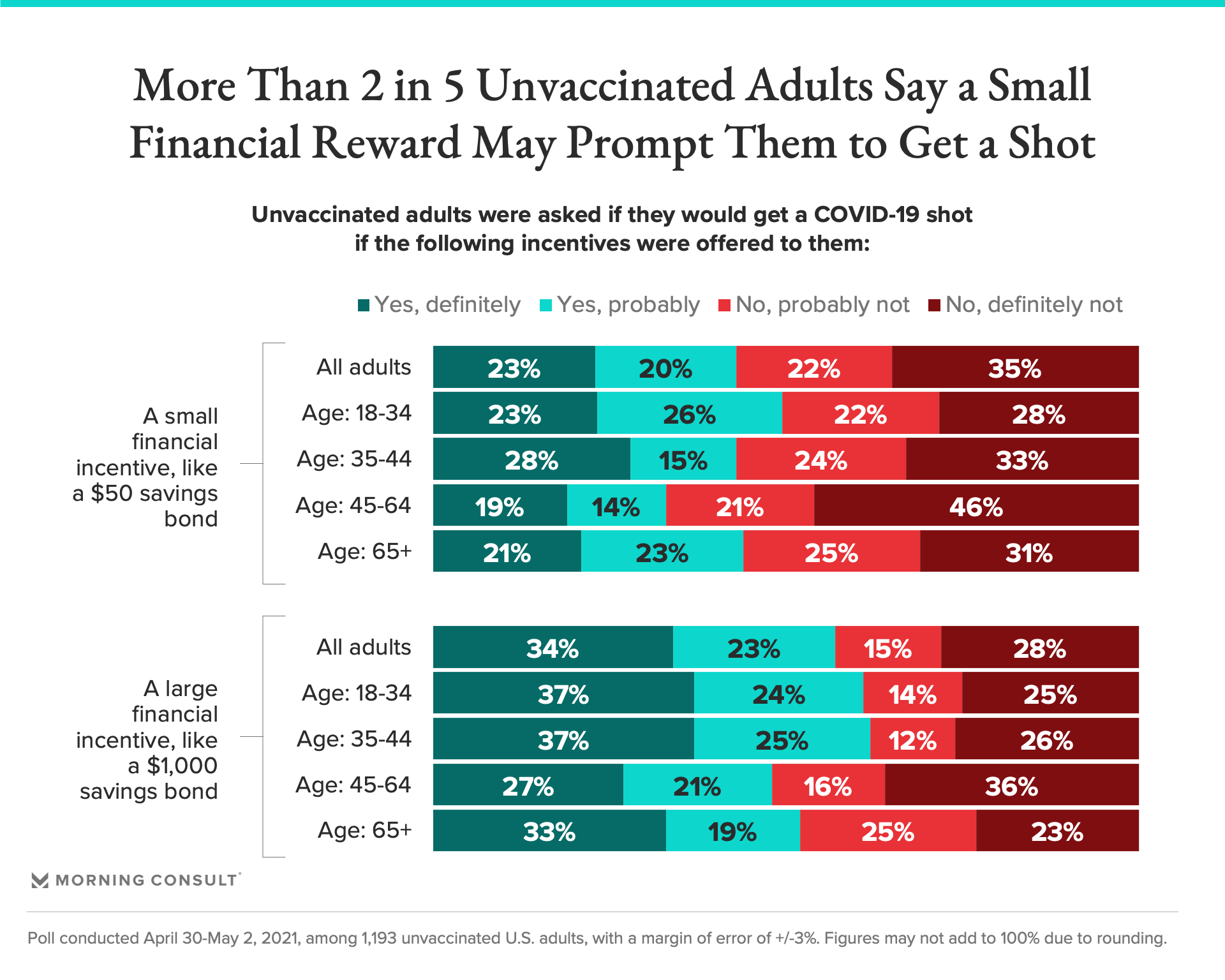
  • 57% of unvaccinated adults said a $1,000 savings bond would sway them to get a COVID-19 shot, while 43% said as much about a smaller $50 reward.

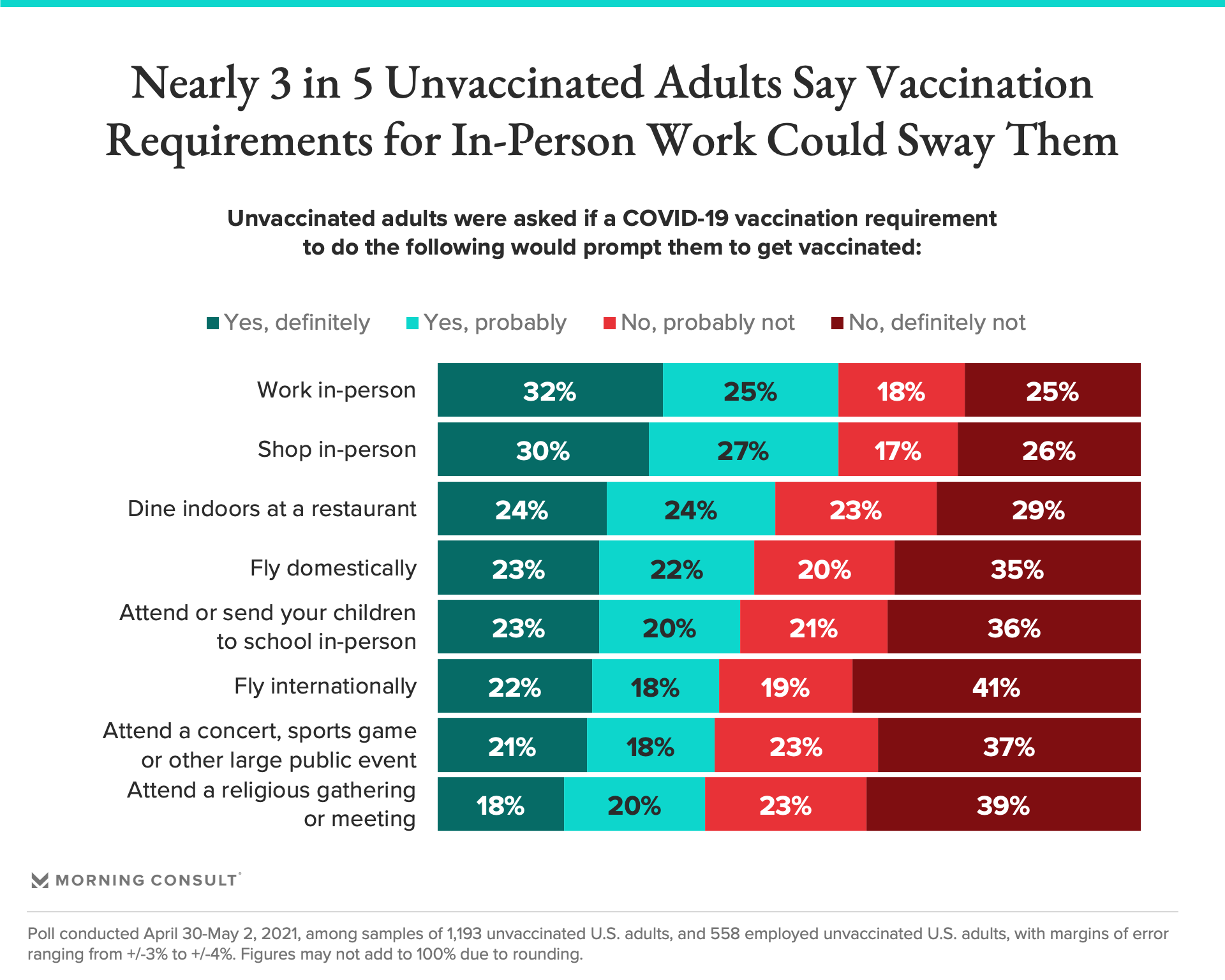
  • 57% of unvaccinated adults who are employed said they’d get a COVID-19 shot if it were required to work in-person.

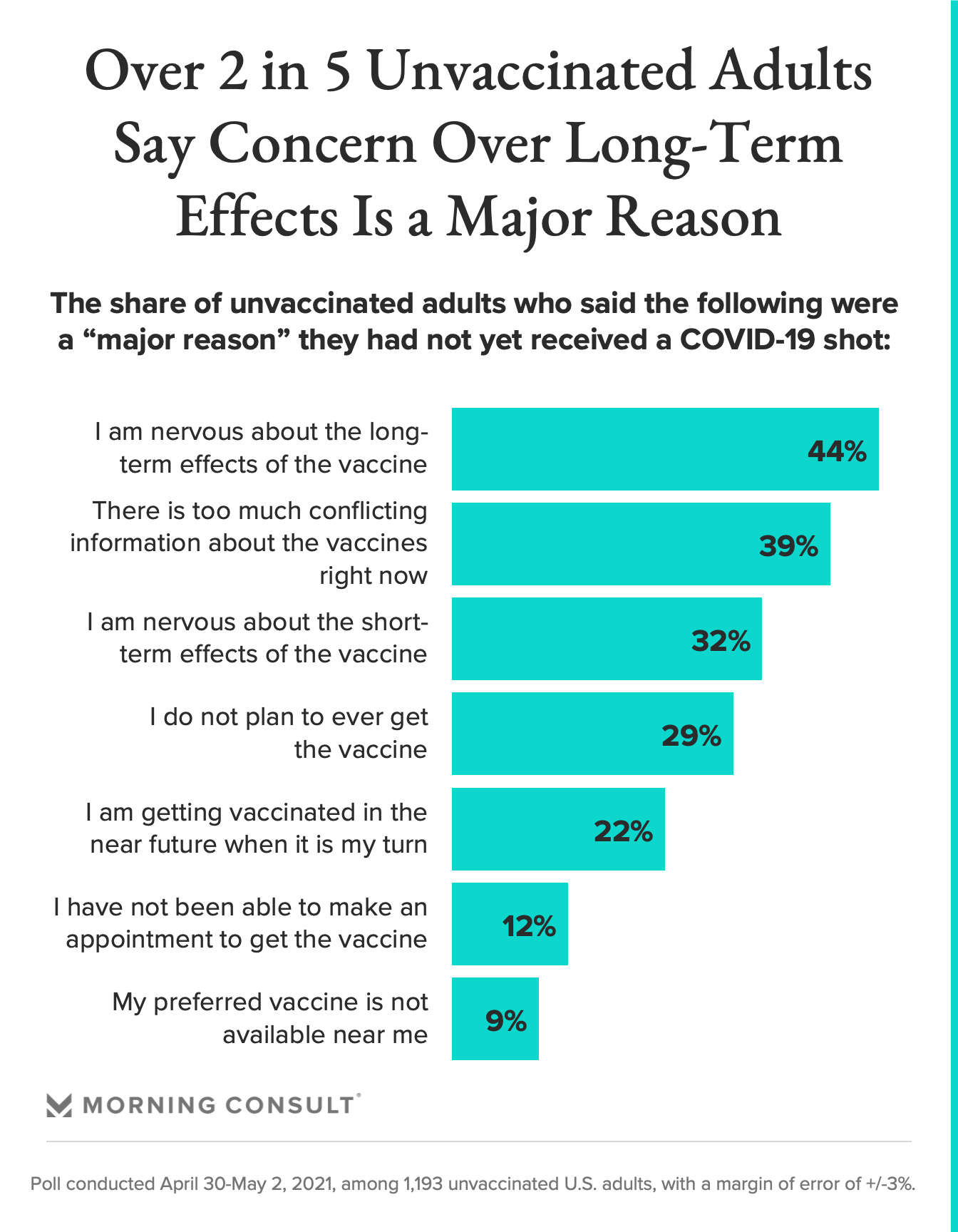
  • 44% of unvaccinated adults said they were nervous about the potential long-term effects of the vaccine, while 32% are concerned about the short-term effects and 39% believe there is too much conflicting information about the shot right now.

The state of West Virginia is offering young people a $100 savings bond to get the COVID-19 vaccine. In New Jersey and Connecticut, vaccinated adults can get a free beer. The governor of Ohio announced a million-dollar lottery drawing for vaccinated state voters. And Maryland will pay state employees who get vaccinated — and take the money back if they don’t get booster shots that could be recommended in the future.

But as states and communities attempt to entice unvaccinated Americans to get a COVID-19 shot, new Morning Consult polling indicates some vaccination incentives and requirements could be more effective than others.

When it comes to incentives, for example, 57 percent of unvaccinated adults said a big cash payment, such as a $1,000 savings bond, would sway them, while 43 percent said they’d probably or definitely get vaccinated if they were offered a smaller reward, such as a $50 bond. Adults under age 45 were more likely to say a big financial incentive would make them more willing to get a vaccine.

Proponents of the incentives have billed them as a way to improve vaccination uptake among younger adults who may not have reservations about the shot but rather feel less urgency about getting it. Brands have touted freebies for vaccinated people, and a growing number of governments and universities are considering their own rewards.

“My guess is that’s probably going to work,” President Joe Biden said of vaccine incentives during a call with governors Tuesday.

But in the survey — and in new global tracking data — unvaccinated adults largely listed vaccine concerns as major reasons they hadn’t yet gotten a shot. For example, 44 percent said they were nervous about the potential long-term effects of the vaccine, while 32 percent said they were concerned about the short-term effects. And 39 percent said there is too much conflicting information about the shot right now.

Another 22 percent said they planned to get vaccinated soon when it was their turn, while 12 percent said they hadn’t been able to make an appointment and 9 percent said their preferred shot was unavailable near them.

Unvaccinated people were about as receptive to the stick as they were the carrot: 57 percent said they’d get a COVID-19 shot if it were required to work or shop in-person, while 48 percent said they’d do so if it were required to dine indoors at a restaurant and 45 percent said they’d likely or definitely get vaccinated if they had to in order to fly domestically.

Health officials say making vaccination more convenient could spur more people to get a shot. The poll suggests it could help: About half of unvaccinated adults said they would probably or definitely get a shot if their employer provided vaccinations at the workplace; if their primary care doctor provided vaccinations during routine visits; or if a walk-up vaccination site that does not require an appointment opened near their workplace.

They were slightly less likely to say a walk-up site near home would affect their decision, with 42 percent saying they’d likely or definitely get vaccinated if that were the case.

The prospect of paid time off from work to get vaccinated, which the Biden administration called on all employers to offer last month, could also move the needle for some people. Unvaccinated adults were roughly split down the middle on whether paid time off for vaccine appointments or related sick days would sway them to get a shot.

Word of mouth continues to play an important role in the vaccine rollout, too.

In the survey, 45 percent of unvaccinated adults said they’d get vaccinated if someone they trusted recommended it. Another 23 percent said there was one person who could encourage them to get vaccinated, with most listing family members such as their parents or their romantic partners in an open-ended question.

The survey was conducted April 30-May 2 among 2,200 U.S. adults and carries a margin of error of 2 percentage points. The subsamples of 1,193 unvaccinated adults and 558 unvaccinated employed adults had margins of error of 3 and 4 points, respectively.


https://morningconsult.com/2021/05/13/covid-19-vaccine-incentives-penalties-poll/

Why do we get shots in the arm? It’s all about the muscle

 Millions have rolled up their sleeves for the COVID-19 vaccine, but why haven’t they rolled up their pants legs instead? Why do we get most shots in our arms?

As an associate professor of nursing with a background in public health, and as a mother of two curious kids, I field this question fairly often. So here’s the science behind why we get most vaccines in our arm.

It’s worth noting that most, but not all, vaccines are given in the muscle – this is known as an intramuscular injection. Some vaccines, like the rotavirus vaccine, are given orally. Others are given just beneath the skin, or subcutaneously – think of the measles, mumps and rubella vaccine. However, many others are given in the muscle.

But why is the muscle so important, and does location matter? And why the arm muscle – called the deltoid – in the top of the shoulder?

Muscles have immune cells

Muscles make an excellent vaccine administration site because muscle tissue contains important immune cells. These immune cells recognize the antigen, a tiny piece of a virus or bacteria introduced by the vaccine that stimulates an immune response. In the case of the COVID-19 vaccine, it is not introducing an antigen but rather administering the blueprint for producing antigens. The immune cells in the muscle tissue pick up these antigens and present them to the lymph nodes. Injecting the vaccine into muscle tissue keeps the vaccine localized, allowing immune cells to sound the alarm to other immune cells and get to work.

Once a vaccine is recognized by the immune cells in the muscle, these cells carry the antigen to lymph vessels, which transport the antigen-carrying immune cells into the lymph nodes. Lymph nodes, key components of our immune system, contain more immune cells that recognize the antigens in vaccines and start the immune process of creating antibodies.

Clusters of lymph nodes are located in areas close to vaccine administration sites. For instance, many vaccines are injected in the deltoid because it is close to lymph nodes located just under the armpit. When vaccines are given in the thigh, the lymph vessels don’t have far to travel to reach the cluster of lymph nodes in the groin.

Muscles keep the action localized

Muscle tissue also tends to keep vaccine reactions localized. Injecting a vaccine into the deltoid muscle may result in local inflammation or soreness at the injection site. If certain vaccines are injected into fat tissue, the chance of irritation and inflammation reaction increases because fat tissue has poor blood supply, leading to poor absorption of some vaccine components.

Vaccines that include the use of adjuvants – or components that enhance the immune response to the antigen – must be given in a muscle to avoid widespread irritation and inflammation. Adjuvants  act in a variety of ways to stimulate a stronger immune response.

Yet another deciding factor in vaccine administration location is the size of the muscle. Adults and children ages three and older tend to receive vaccines in their upper arm in the deltoid. Younger children receive their vaccines mid-thigh because their arm muscles are smaller and less developed.

Another consideration during vaccine administration is convenience and patient acceptability. Can you imagine taking down your pants at a mass vaccination clinic? Rolling up your sleeve is way easier and more preferred. Infectious disease outbreaks, as in flu season or amid epidemics like COVID-19, require our public health system to vaccinate as many people as possible in a short time. For these reasons, a shot in the arm is preferred simply because the upper arm is easily accessible.

All things considered, when it comes to the flu shot and the COVID-19 vaccine, for most adults and kids, the arm is the preferred vaccination route.

https://theconversation.com/why-do-we-get-shots-in-the-arm-its-all-about-the-muscle-161259