Search This Blog

Friday, July 16, 2021

COVID-19 sniffing dogs being deployed in Massachusetts

 Starting today, a Massachusetts county will be turning to dogs to help fight COVID-19.

The Bristol County Sheriff’s office is adding a team of COVID-19 sniffing dogs to its force, a first for the country, CBS 4 WBZ reports.

The K-9s have been specifically trained to detect the coronavirus, which has a certain scent, in a way that mirrors how they sniff out drugs or bombs, the outlet notes.

"It’s best to think of it as a decontamination tool," Bristol County Capt. Paul Douglas told WBZ. "The dogs can detect the COVID odor on a counter or table if it was recently touched by a COVID-positive individual, or even detect the odor on a tissue used by someone with COVID."

The two dogs, Huntah and Duke, graduated from their training program, developed by Florida International University’s International Forensic Research Institute, on Wednesday.

The two nine-month-old labs will be deployed for detection at public facilities including schools, town buildings, nursing homes and more.

"Our new COVID-19 detection program is one way the people of Bristol County can stay ahead of the curve," Bristol Count Sheriff Thomas Hodgson said.

https://thehill.com/homenews/state-watch/563212-covid-19-sniffing-dogs-being-deployed-in-massachusetts

Facebook shelves plans for consumer mind-reading device

 The spring of 2017 may be remembered as the coming-out party for Big Tech’s campaign to get inside your head. That was when news broke of Elon Musk’s new brain-interface company, Neuralink, which is working on how to stitch thousands of electrodes into people’s brains. Days later, Facebook joined the quest when it announced that its secretive skunkworks, named Building 8, was attempting to build a headset or headband that would allow people to send text messages by thinking—tapping them out at 100 words per minute.

The company’s goal was a hands-free interface anyone could use in virtual reality. “What if you could type directly from your brain?” asked Regina Dugan, a former DARPA officer who was then head of the Building 8 hardware dvision. “It sounds impossible, but it’s closer than you realize.”

Now the answer is in—and it’s not close at all. Four years after announcing a “crazy amazing” project to build a “silent speech” interface using optical technology to read thoughts, Facebook is shelving the project, saying consumer brain-reading still remains very far off.

In a blog post, Facebook said it is discontinuing the project and will instead focus on an experimental wrist controller for virtual reality that reads muscle signals in the arm. “While we still believe in the long-term potential of head-mounted optical [brain-computer interface] technologies, we’ve decided to focus our immediate efforts on a different neural interface approach that has a nearer-term path to market,” the company said.

Facebook’s brain-typing project had led it into uncharted territory—including funding brain surgeries at a California hospital and building prototype helmets that could shoot light through the skull—and into tough debates around whether tech companies should access private brain information. Ultimately, though, the company appears to have decided the research simply won’t lead to a product soon enough.

“We got lots of hands-on experience with these technologies,” says Mark Chevillet, the physicist and neuroscientist who until last year headed the silent-speech project but recently switched roles to study how Facebook handles elections. “That is why we can confidently say, as a consumer interface, a head-mounted optical silent speech device is still a very long way out. Possibly longer than we would have foreseen.”

Mind reading

The reason for the craze around brain-computer interfaces is that companies see mind-controlled software as a huge breakthrough—as important as the computer mouse, graphical user interface, or swipe screen. What’s more, researchers have already demonstrated that if they place electrodes directly in the brain to tap individual neurons, the results are remarkable. Paralyzed patients with such “implants” can deftly move robotic arms and play video games or type via mind control.

Facebook’s goal was to turn such findings into a consumer technology anyone could use, which meant a helmet or headset you could put on and take off. “We never had an intention to make a brain surgery product,” says Chevillet. Given the social giant’s many regulatory problems, CEO Mark Zuckerberg had once said that the last thing the company should do is crack open skulls. “I don’t want to see the congressional hearings on that one,” he had joked.

In fact, as brain-computer interfaces advance, there are serious new concerns. What would happen if large tech companies could know people’s thoughts? In Chile, legislators are even considering a human rights bill to protect brain data, free will, and mental privacy from tech companies. Given Facebook’s poor record on privacy, the decision to halt this research may have the side benefit of putting some distance between the company and rising worries about “neurorights.”

Facebook’s project aimed specifically at a brain controller that could mesh with its ambitions in virtual reality; it bought Oculus VR in 2014 for $2 billion. To get there, the company took a two-pronged approach, says Chevillet. First, it needed to determine whether a thought-to-speech interface was even possible. For that, it sponsored research at the University of California, San Francisco, where a researcher named Edward Chang has placed electrode pads on the surface of people’s brains.

Whereas implanted electrodes read data from single neurons, this technique, called electrocorticography, or ECoG, measures from fairly large groups of neurons at once. Chevillet says Facebook hoped it might also be possible to detect equivalent signals from outside the head.

The UCSF team made some surprising progress and today is reporting in the New England Journal of Medicine that it used those electrode pads to decode speech in real time. The subject was a 36-year-old man the researchers refer to as “Bravo-1,” who after a serious stroke has lost his ability to form intelligible words and can only grunt or moan. In their report, Chang’s group says with the electrodes on the surface of his brain, Bravo-1 has been able to form sentences on a computer at a rate of about 15 words per minute. The technology involves measuring neural signals in the part of the motor cortex associated with Bravo-1’s efforts to move his tongue and vocal tract as he imagines speaking.

To reach that result, Chang’s team asked Bravo-1 to imagine saying one of 50 common words nearly 10,000 times, feeding the patient’s neural signals to a deep-learning model. After training the model to match words with neural signals, the team was able to correctly determine the word Bravo-1 was thinking of saying 40% of the time (chance results would have been about 2%). Even so, his sentences were full of errors. “Hello, how are you?” might come out “Hungry how am you.”

But the scientists improved the performance by adding a language model—a program that judges which word sequences are most likely in English. That increased the accuracy to 75%. With this cyborg approach, the system could predict that Bravo-1’s sentence “I right my nurse” actually meant “I like my nurse.”

As remarkable as the result is, there are more than 170,000 words in English, and so performance would plummet outside of Bravo-1’s restricted vocabulary. That means the technique, while it might be useful as a medical aid, isn’t close to what Facebook had in mind. “We see applications in the foreseeable future in clinical assistive technology, but that is not where our business is,” says Chevillet. “We are focused on consumer applications, and there is a very long way to go for that.”

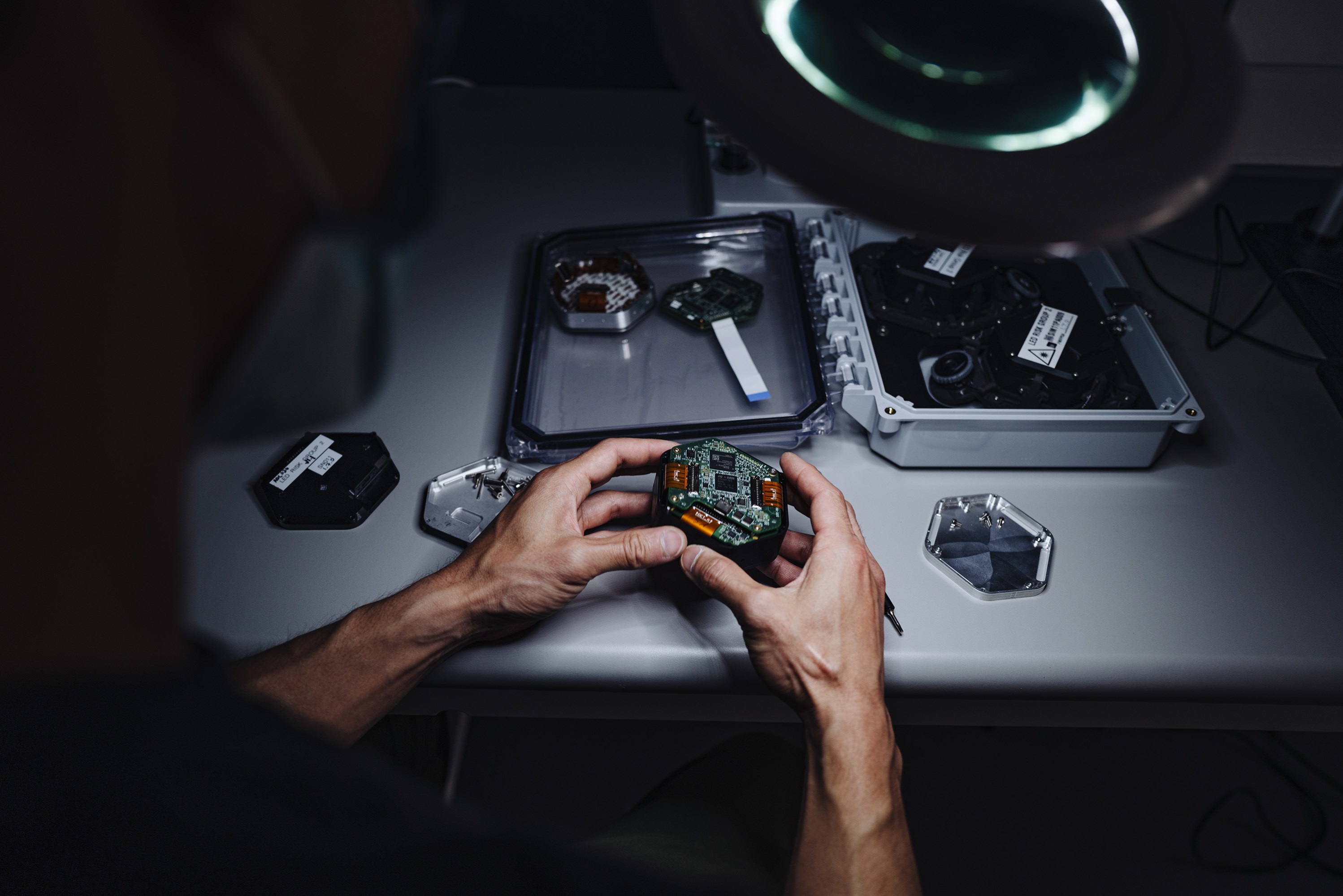
FRLR BCI research hardware module
Equipment developed by Facebook for diffuse optical tomography, which uses light to measure blood oxygen changes in the brain.
FACEBOOK

Optical failure

Facebook’s decision to drop out of brain reading is no shock to researchers who study these techniques. “I can’t say I am surprised, because they had hinted they were looking at a short time frame and were going to reevaluate things,” says Marc Slutzky, a professor at Northwestern whose former student Emily Mugler was a key hire Facebook made for its project. “Just speaking from experience, the goal of decoding speech is a large challenge. We’re still a long way off from a practical, all-encompassing kind of solution.”

Still, Slutzky says the UCSF project is an “impressive next step” that demonstrates both remarkable possibilities and some limits of the brain-reading science. He says that if artificial-intelligence models could be trained for longer, and on more than just one person’s brain, they could improve rapidly.

While the UCSF research was going on, Facebook was also paying other centers, like the Applied Physics Lab at Johns Hopkins, to figure out how to pump light through the skull to read neurons noninvasively. Much like MRI, those techniques rely on sensing reflected light to measure the amount of blood flow to brain regions.

It’s these optical techniques that remain the bigger stumbling block. Even with recent improvements, including some by Facebook, they are not able to pick up neural signals with enough resolution. Another issue, says Chevillet, is that the blood flow these methods detect occurs five seconds after a group of neurons fire, making it too slow to control a computer.

“Facebook dropping it isn’t an indictment of optical technology—it’s an assessment of the things they are trying to use it for,” says Bryan Johnson, the CEO and founder of Kernel, which this year started to commercialize a helmet that measures the brain using near-infrared beams. He says that like MRI, the technology is better for measuring overall brain states, which he believes has applications such as detecting emotion or attention. “The goal they have is improving control, and this technology does not fit that objective. It measures a hemodynamic signal, and that signal is slow,” says Johnson.

What’s next

Facebook now plans to focus on a technology it acquired in September 2019, when it bought a startup called CTRL-Labs for more than $500 million, one of its largest public acquisitions since its takeover of Oculus. That company has been developing a wrist-worn device that captures electrical signals in a person’s muscles through a technique known as EMG. This can detect gestures or figure out which finger someone is moving.

That’s not a brain interface, but it may be a simpler way of engaging in the virtual world that Facebook is building with its VR googles. Imagine, for instance, drawing a bow in an adventure game and then releasing the arrow with a small shift in your fingers. According to Krishna Shenoy, a Stanford University neuroscientist who is an advisor to CTRL-Labs, the device can record electrical activity in the muscles “at a remarkably detailed level” and can capture movements “from multiple fingers and with very little actual movement at all.”

In its blog post, Facebook said that “it makes sense to focus our near-term attention on wrist-based neural interfaces using EMG, a proven viable technology we believe has a nearer-term path to market for AR/VR input.”

The company says it now plans to open-source the software it developed for brain decoding and also provide access to prototype devices, so other researchers can benefit from its work. “We tackled these key problems: whether you can decode speech at all from brain activity, and then, can you decode it with a wearable optical device,” says Chevillet.

“We think eventually it will be possible.”

https://www.technologyreview.com/2021/07/14/1028447/facebook-brain-reading-interface-stops-funding/

Panel puts Fibrogen project to an almost certain death

 Fibrogen’s roxadustat was never expected to get an easy ride in front of yesterday’s FDA advisory panel, but few foresaw an almost outright rejection. US approval of the novel anaemia pill is now highly unlikely – at least not without a severely restricted label – an outcome that has repercussions for several other developers.

Firstly this means Astrazeneca, Fibrogen’s US partner; after spending years and billions of dollars buffing Brilinta’s benefits, the pharma giant might have little appetite for another "hearts and minds" battle. And in what cannot be a coincidence Glaxosmithkline today disclosed a successful pivotal programme of its trailing daprodustat, though there are no data in its release, and as Fibrogen has so amply demonstrated the devil is always in the detail.

That detail caused Fibrogen’s stock to plunge 45% in early trade, with the market clearly considering roxadustat to be over. The company’s future does not look too bright either.

Fibrogen’s handling of roxadustat’s clinical programme has long been criticised, with complaints of opaque and confusing presentations culminating in a staggering admission that the wrong data had been presented and initially filed with the FDA.

In a note that will be highly damaging for executives, analysts at SVB Leerink pointed out today that investors were unaware of imbalances in several new safety issues that emerged at the panel. As well as increased risk of death and thrombosis, these included rates of stent occlusion, serious infections, seizures, and metabolic and gastrointestinal adverse events.

Class effect?

These disclosures will only firm up suspicions that certain adverse events are a feature of HIF-PH inhibitors, of which roxadustat is the leading project. Akebia’s disclosure of a much clearer cardiac safety signal last year with its contender vadadustat now looks even more like supportive evidence of a class effect.

The FDA last month accepted vadadustat’s filing, with a decision due in March. The already dim hopes for approval must surely be lowered again in light of roxa’s reception.

Thus Glaxo’s daprodustat represents the last chance for the HIF-PH inhibitors to prove their potential. This rests on them being more convenient than, and at least as safe as, the standard of care – erythropoietin stimulating agents (ESAs) – in treating anaemia.

Daprodustat met its primary endpoint in all five studies that comprise the Ascend pivotal programme, Glaxo said today. The incidence of treatment-related adverse events was said to be similar in the patient groups tested across the 8,000-subject programme, while daprodustat was found to be non-inferior to an ESA in the risk of major adverse cardiovascular events.

But with no hard data in the release, and little detail beyond the topline results, it is what lies behind these claims that remains crucial.

Death knell

What is patently clear is that the FDA’s cardio-renal advisory committee does not want roxadustat on the market. The panel voted 13-1 and 12-2 against approval in the two indications being sought: to treat anaemia associated with chronic kidney disease, in patients on and pre-dialysis.

The latter setting, comprising less sick patients, was always the longer shot. Panellists made it clear that another large trial should be required before approval to clear up concerns mainly of cardiac toxicity. This would likely take several years to run.

Even in dialysis-dependent patients the panel had grave doubts that roxa was any safer than ESAs. There is a sliver of hope for approval in a subset of patients who do not respond to ESAs, but this represents only around 10% of the dialysis-dependent population, according to Stifel analysts.

With criticisms of Fibrogen’s statistical analyses and trial conduct also emerging, and the company’s apparent admission of a damaging dose response – essentially, that giving more roxadustat causes more deaths – it is hard to see a way forward. The group proposed a dose-titration schedule, but any notion that this would be authorised without being tested in another large trial is fantasy.

As if the situation could not get any worse, readthrough to the EU must be considered. Although the CHMP recommended approval a few weeks ago, the EMA has yet to give its final authorisation, and will no doubt have been following yesterday’s panel with interest.

Perhaps Glaxo will finally realise the promise of HIF-PH inhibition. But the sorry story of roxadustat’s development, and Fibrogen's fumbling and false promises, will not make this any easier.

Regeneron plans $1.8B upgrade at Tarrytown campus, to add 1,000 new staffers over 5 years

 The Empire State's biggest biotech Regeneron Pharmaceuticals is plotting a hefty investment to beef up R&D in Tarrytown. And it plans to add a significant number of jobs along the way.

The company, which gained national prominence for its COVID-19 antibody research, laid plans for a six-year, $1.8 billion expansion at its existing Westchester County campus, according to a release from the Governor’s office.

Regeneron will use the funds to boost research, preclinical production and support facilities at the site. With the expansion, the biotech plans to add 1,000 staffers over the next five years.

Set to grow the company’s campus by roughly 900,000 square feet—about the size of 19 football fields—the expansion will cover the design and build-out of up to eight buildings, three parking garages and a central utility plant. The project will take place in two phases over the next six years, bringing on new preclinical manufacturing and process development suites, labs and offices, the Governor’s office said.

If Regeneron hits its hiring target, the company is in line for up to $100 million in tax credits from Empire State Development, the release noted. The project's economic benefit to New York could be somewhere in the range of $2 billion, Cuomo’s office said.

Regeneron is a fixture in the New York business scene. The company debuted in New York City in 1988 with founder Leonard Schleifer, M.D., Ph.D., at the helm. It received $250,000 from Empire State Development the following year, the Governor’s office said. Today, it holds the distinction of being “the largest biotech company” in New York State, the governor's office said.


This isn't the first rumbling about Regeneron's Westchester County expansion plans this year. In late April, Westfair Online reported the company was blueprinting a $480 million manufacturing and process development facility in the town of Greenburgh, New York, where the village of Tarrytown is located. The company had originally planned to spend $150 million on the plant, but said at the time it was looking to add another $330 million, Westfair said, citing requests heard by the Westchester Industrial Development Agency. 

Regeneron's major success story last year centered on its emergency authorization for its COVID-19 antibody cocktail, REGEN-COV. Regeneron's drug snagged the silver right behind Eli Lilly's monoclonal antibody drug bamlanivimab, but since then, the tables have largely turned in Regeneron's favor. 

Federal Officials in June paused nationwide distribution of Lilly's second antibody treatment, which combines bamlanivimab and etesevimab, citing the cocktail's struggles against virus variants. With that treatment on the outs, the Assistant Secretary for Preparedness Response and the FDA urged healthcare providers to pivot to other antibodies like Regeneron’s cocktail and GlaxoSmithKline and Vir Biotechnology's solo agent sotrovimab, both of which are “likely to retain activity” against certain variants of concern. 

https://www.fiercebiotech.com/biotech/regeneron-eyes-1-8b-r-d-upgrade-at-tarrytown-campus-where-it-plans-to-enlist-1-000-new

Novartis has most new drug approvals, Roche, Lilly and AbbVie launches win on value: Evaluate

 New drug approvals are the holy grail for pharmas big and small, but a slate of regulatory nods doesn't automatically translate to top performance. 

In the last five years, the world’s top 11 drugmakers have brought 76 new meds to market, Evaluate Vantage said in a recent report. Novartis sits pretty in the No. 1 spot with a dozen green lights to its name, including those for gene therapy Zolgensma and the first-ever approved CAR T-cell therapy, Kymriah.

Bristol Myers Squibb rounds out last place with just three—and all of them courtesy of its $74 billion Celgene buyout.

Meanwhile, Roche, Eli Lilly and AbbVie seem to be getting the most out of their new launches, thanks to the advent of new and upcoming blockbusters like Roche and Lilly’s respective cancer drugs Tecentriq and Verzenio, plus AbbVie’s autoimmune up-and-comers Rinvoq and Skyrizi, Evaluate said.

Roche's Tecentriq generated 2.7 billion Swiss francs (about $2.94 billion) in 2020, according to the company's annual report. Lilly's Verzenio ginned up $912.7 million for the year. And Rinvoq and Skyrizi pulled in $731 million and $1.59 billion, respectively, in 2020, AbbVie said earlier this year. 


It’s important to note that Evaluate’s analysis only covers projects owned by the companies when they were approved. The report doesn’t weigh the effects of drugs bought after approval, even though that’s a “legitimate way of building a pharma company,” Evaluate said.

The other piece of the R&D puzzle missing from the report? Expanding the use of existing drugs—a popular strategy in cancer and immunology, and especially relevant to Bristol Myers Squibb, which has been “heavily invested” in broadening the scope of its PD-1 med Opdivo over the past five years, Evaluate noted.

Beyond the Novartis and BMS bookends, the spread breaks down like this: Merck and Roche are neck-and-neck for second place with nine approvals apiece, while Eli Lilly boasts eight and Pfizer and GlaxoSmithKline each have seven. For its part, Sanofi has bagged six approvals in the last half-decade, while AbbVie, Johnson & Johnson and AstraZeneca all have five.

Roche, Lilly and AbbVie’s sales seem to be getting the biggest boost from approvals, with new launches accounting for more than a third of the net present value (NPV) for each drugmakers’ marketed products and new meds, Evaluate said.

Roche’s combined NPV sits at $217.22 billion, with nearly 65% of that coming from recent approvals; around 52% of Lilly’s NPV is fueled by new products at $105.24 billion; and AbbVie can credit about 36% of its $209.48 billion NPV on recent launches, according to the report.


By that same metric, GSK doesn’t “come off too poorly in this analysis,” Evaluate said. About a third of its $128.56 billion NPV comes from recent approvals. Its NPV stats include two novel HIV meds that GSK splits with ViiV Healthcare.

While the company sits comfortably in the middle of the approval rankings, GSK’s marketed portfolio value is “second-smallest” ahead of Lilly, Evaluate said.

Glaxo and its leadership have come under fire in recent months thanks to a string of “serial” R&D setbacks, as SVB Leerink analyst Geoffrey Porges put it earlier this year. Meanwhile, activist investor Elliott Management has picked up a significant stake in the company and recently called for a leadership shake-up ahead of its planned consumer health spinoff. 

https://www.fiercepharma.com/pharma/novartis-may-have-most-new-drug-approvals-but-roche-lilly-and-abbvie-s-launches-win-value

Takeda, AbbVie, BMS, Sanofi, Lilly, others join list of pharma's July price hikes

 As drug pricing chatter gains steam once again in Washington, D.C., pharma companies have been quietly raising prices on dozens of drugs behind the scenes.

So far this month, pharma companies large and small have driven up prices on 65 drugs, mostly brand name, by an average of 3.5%, according to GoodRx’s counting. That’s double the count from just two weeks ago and just shy of the July 2020 tally.

While smaller drugmakers dealing in rare disorders dominated the initial price jumps to start the month, a sprinkle of big pharma players such as Pfizer, Eli Lilly, Sanofi, AstraZeneca, Bristol Myers Squibb, Novartis and AbbVie have also gotten involved. Many of the price hikes are in the low single-digit percentages.

Sanofi and Bristol, for instance, raised prices on four medicines each by 1.5% to 2.5%, including a slight bump for Bristol’s blockbuster checkpoint inhibitor Opdivo. Meanwhile, Takeda upped the charge for its leukemia therapy Iclusig by 4%.


AbbVie’s subsidiary Allergan increased the cost of its blockbuster wrinkle treatment Botox by 3.6%. To a surprise to some analysts, Botox has already made a strong bounce back from a slight pandemic slump.

Topping the price-hike list by far is Aytu Biopharma’s oral insomnia spray Zolpimist, which saw a July price hike by nearly 16%. That medicine overtook Zogenix’s 9.5% increase for its rare childhood epilepsy drug Fintepla, which now sits in second.

Not far behind in the rankings is Acadia Pharmaceuticals’ Nuplazid to treat Parkinson's-related hallucinations and delusions. Further down the list sits Jazz Pharmaceuticals, which bumped the price for two of its drugs, Zepzelca and Defitelio, by 4% and 3%, respectively.

Compared with January, July is typically a slower month when it comes to price increases. Earlier this year, companies increased the cost of drugs by an average of 4.5% on more than 800 drugs, according to GoodRx's tally. 

But despite the global coronavirus pandemic, drugmakers haven’t shied away from upping their prices. During this time in 2019, GoodRx only found 37 drugs with higher price tags. 

“We were expecting the best and expecting that maybe during a pandemic we’d see fewer price increases,” Tori Marsh, GoodRx’s director of research, said in an interview. “Nothing surprises me anymore with pricing.” 


Some drugs on the list already grew in price earlier this year. For instance, Recordati had raised the price of Isturisa, approved to treat Cushing’s disease, by 9% in January. The company kicked off July with another 5% hike, GoodRx reports.

While it wasn’t uncommon for pharma companies to raise prices twice per year, many drugmakers moved to a once-per-year schedule in recent years amid scrutiny. 

Some may argue that since these are list prices and don’t include discounts and patient assistance programs, they won’t mean anything for patients at the pharmacy counter, Marsh said. But the people who will feel pain in their wallets will be financially vulnerable patients with high deductibles or those with no insurance, she argued. 

“They’re really going to be feeling the impact of these increases,” Marsh said. 

https://www.fiercepharma.com/pharma/sanofi-bms-allergan-lilly-and-others-join-growing-list-pharma-s-july-price-hikes-report

Budget proposal to allow Medicare to negotiate prices should 'enrage' seniors: PhRMA

 Industry lobbying association PhRMA responded with ire to the sweeping drug pricing reforms Congress is considering and President Joe Biden’s executive order last week, which encourages biosimilar and generic competition and Medicare to negotiate drug costs. The group blasted the initiatives as “an attempt to upend Medicare to help pay for Tesla tax credits and other government programs at seniors’ expense.”

“The budget should enrage every senior who relies on Medicare for their life-saving medicines,” wrote Debra DeShong, PhRMA’s executive VP of public affairs. “This plan puts in motion a system that will allow government bureaucrats to tell seniors which medicines they can have while repealing a policy that would immediately lower what they pay at the pharmacy counter.”

Yet, as a group of 15 Democrats who this week are urging Speaker Nancy Pelosi (D-Calif.) and Senate Majority Leader Charles Schumer (D-N.Y.) to allow Medicare to negotiate prices wrote, “Empowering Medicare in this way and making these negotiated prices available to the private sector will bring down the coast of prescription drugs.”

Biden’s initiative renews his call to allow Medicare to negotiate drug prices. The stance was a staple of his campaign and he reiterated his support for the measure after he was elected. But the president’s American Families and America Jobs plans did little to address drug pricing reforms, leaving the matter in the hands of Congress.

The group of 15 Democrats calling for action wrote “With public support of Medicare price negotiation of prescription drugs at nearly 90%, it is time to take action.” The group is led by Rep. Susan Wild (D-Pa.) and all are up for re-election in 2022. 

According to the letter sent by the 15 Democrats, the Congressional Budget Office claims that Pelosi’s H.R. 3, The Lower Drug Costs Now Act, would save approximately $456 billion over a decade.

Even among Democrats, though, there is some debate about how far drug pricing reforms should go. Senate Democrats led by Finance Committee Chairman Ron Wyden (D-Ore.) are countering with a narrower proposal that would still have some element of price negotiation, he told reporters this week.

Democrats opposed to the sweeping reforms say that they would damage the ability of drug companies to develop new drugs. In her statement, DeShong called the reforms “extreme.”

On the other hand, House Oversight Committee Chairwoman Carolyn Maloney, who is not among the 15 battleground-district Democrats urging the reform, told reporters Thursday, “Industry documents show how pharmaceutical companies exploit the U.S in part because the law won’t allow Medicare to negotiate drug prices. These companies are attempting to mislead the public by saying that any price reforms will hurt innovation. This simply is not true.”


Biden’s executive order last week directs the Department of Health and Human Services to lay out a strategy to take on “price gouging.” It also instructs the Federal Trade Commission to examine anticompetitive “pay for delay” strategies used by pharmaceutical companies to stave off biosimilar and generic competition.

https://www.fiercepharma.com/pharma/budget-proposal-to-allow-medicare-to-negotiate-prices-should-enrage-seniors-phrma-says