In an interview with Les Echos, Emmanuel Macron revived the idea of changing the ECB's mandate to take growth and employment into account. The ECB has long been criticized for focusing solely on inflation, to the detriment of a monetary policy that is more favorable to growth.
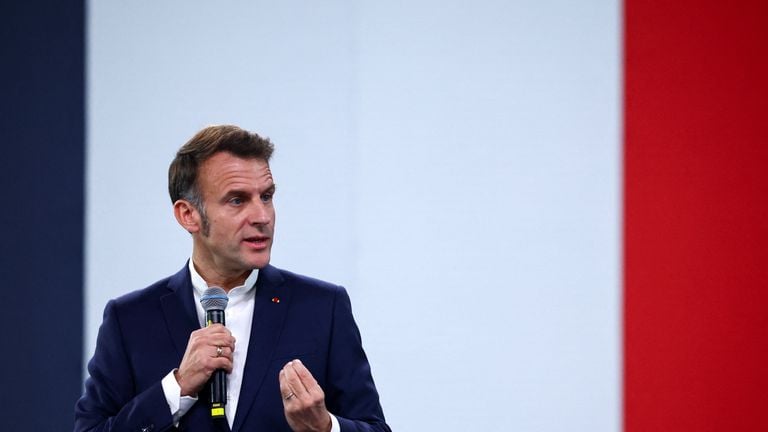
"The European monetary policy seems to me to be clearly adjustable today... we cannot have inflation as the sole objective," the French President said, in an interview published on Sunday.
These remarks echo his April 2024 speech at La Sorbonne, where he called for changing the ECB's mandate to add "at least one growth objective, or even a decarbonization objective, in any case a climate objective."
The head of state is not the first to propose this idea. The ECB has long been criticized for focusing solely on inflation, to the detriment of a monetary policy that is more favorable to growth.
A hawkish central bank
The European Central Bank in a sense has a restrictive bias, dating back to its origins. The ECB was created in 1998 on the model of the Bundesbank (the German central bank). It thus has a single mandate: price stability.
This is the major difference with the Fed, which has a double mandate: price stability and maximum employment. This means that the Fed must keep inflation under control, while also supporting growth.
That is what currently enables the US central bank to cut rates even when inflation is closer to 3% than 2%. The Fed is thus expected to make a third 25bp rate cut this year.
By contrast, no one imagines the ECB lowering rates in the near future. Yet inflation was 2.2% in November, and most projections (including those of the ECB) anticipate inflation below the 2% target in 2026.

EBC Economic Projections - September 2025
A growth problem
This argues for a change in the ECB's strategy, as the euro zone indeed has a growth problem. At the turn of the century, GDP per capita in the US and the euro zone were similar. Since then, Europe has clearly fallen behind.

Evolution of GDP per capita in the euro zone and the United States. Source: Financial Times
Although monetary policy cannot solve all competitiveness problems (the euro zone is too fragmented, too regulated...), an ECB that does not keep its foot on the brake at all times would nonetheless be welcome.
Beyond interest rates, there is also the issue of the balance sheet. While the Fed stopped shrinking its balance sheet on December 1, the ECB continues to shrink it at a significant pace (around €420bn this year and next according to Generali's calculations).
Mechanically, this puts pressure on long-term rates. However, European countries need lower rates at a time when they must issue a lot of debt, notably to invest in their defense.
According to Generali's estimates, net issuances by euro-zone member states should reach €900bn in 2026.
Higher rates are of course a drag on growth, while also constraining governments' budgets.
A board to renew
There are thus arguments in favor of a more accommodative ECB stance. However, for now, the hawks are watching carefully. In an interview with Bloomberg News published on Monday, Isabel Schnabel said that the next ECB move could be a rate hike, while adding that "this will not happen soon."
And this while the ECB has just brought its main policy rate back to 2% - the consensus estimate of the "neutral" rate - and inflation is expected to be below target next year.
One can nonetheless hope to see the ECB change in the future. Remember that this year Germany broke with budgetary orthodoxy. An about turn, which seemed impossible not long ago.
One of the factors that could push the ECB to change its posture is the renewal of the board. Indeed, four important Executive Board members will see their terms expire in the next two years: Vice-President Luis de Guindos (May 2026), Chief Economist Philipp Lane (May 2027), President Christine Lagarde (October 2027), and Isabel Schnabel (December 2027).
ECB members hold non-renewable eight-year terms. They are appointed by the European Council, by qualified majority. Strategic nominations that are always the subject of tough negotiations amongst heads of state and government.
https://www.marketscreener.com/news/should-the-ecb-s-mandate-change-ce7d51ddd081f224

No comments:
Post a Comment
Note: Only a member of this blog may post a comment.