Search This Blog

Friday, July 16, 2021

How SARS-CoV-2 infects brain cells

 3D "assembloid" shows how SARS-CoV-2 infects brain cells

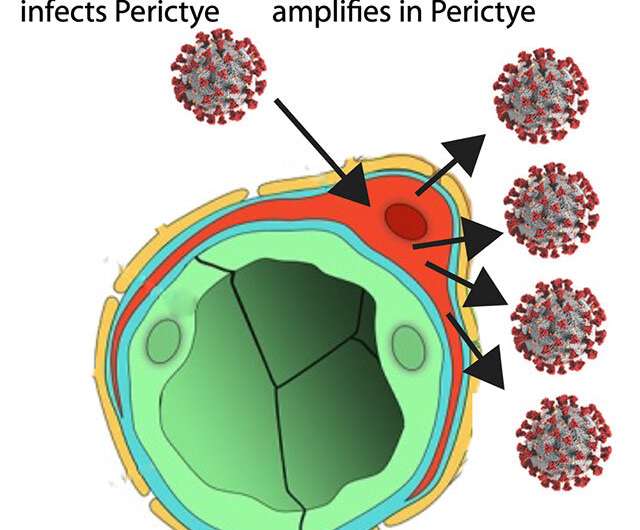
Figure depicts SARS-CoV-2 spreading through blood vessels (green) to infect pericytes (red), which amplify infection and can spread infection to other cell types in the brain. Credit: UC San Diego Health Sciences

Researchers at University of California San Diego School of Medicine and Rady Children's Institute for Genomic Medicine have produced a stem cell model that demonstrates a potential route of entry of SARS-CoV-2, the virus that causes COVID-19, into the human brain.

The findings are published in the July 9, 2021 online issue of Nature Medicine.

"Clinical and epidemiological observations suggest that the brain can become involved in SARS-CoV-2 infection," said senior author Joseph Gleeson, MD, Rady Professor of Neuroscience at UC San Diego School of Medicine and director of neuroscience research at the Rady Children's Institute for Genomic Medicine.

"The prospect of COVID19-induced  has become a primary concern in cases of 'long COVID,' but human neurons in culture are not susceptible to infection. Prior publications suggest that the cells that make the spinal fluid could become infected with SARS-CoV-2, but other routes of entry seemed likely."

Gleeson and colleagues, who included both neuroscientists and infectious disease specialists, confirmed that human neural cells are resistant to SARS-CoV-2 infection. However, recent studies hinted that other types of brain cells might serve as a 'Trojan horse.'

Pericytes are specialized cells that wrap around blood vessels—and carry the SARS-CoV2 receptor. The researchers introduced pericytes into three-dimensional neural cell cultures—brain organoids—to create "assembloids," a more sophisticated stem cell model of the human body. These assembloids contained many types of brain cells in addition to pericytes, and showed robust infection by SARS-CoV-2.

The coronavirus was able to infect the pericytes, which served as localized factories for production of SARS-CoV-2. These locally produced SARS-CoV-2 could then spread to other cell types, leading to widespread damage. With this improved model system, they found that the supporting cells known as astrocytes were the main target of this secondary infection.

The results, said Gleeson, indicate that one potential route of SARS-CoV-2 into the brain is through the blood vessels, where SARS-CoV-2 can infect pericytes, and then SARS-CoV-2 can spread to other types of brain cells.

"Alternatively, the infected pericytes could lead to inflammation of the blood vessels, followed by clotting, stroke or hemorrhages, complications that are observed in many patients with SARS-CoV-2 who are hospitalized in intensive care units."

Researchers now plan to focus on developing improved assembloids that contain not just pericytes, but also  capable of pumping blood to better model the intact human brain. Through these models, Gleeson said, greater insight into infectious disease and other  disease could emerge.


Explore further

Scientists prove SARS-CoV-2 potential to infect human brain organoids

More information: Lu Wang et al, A human three-dimensional neural-perivascular 'assembloid' promotes astrocytic development and enables modeling of SARS-CoV-2 neuropathology, Nature Medicine (2021). DOI: 10.1038/s41591-021-01443-1
https://medicalxpress.com/news/2021-07-3d-assembloid-sars-cov-infects-brain.html

New Merck pneumonia vaccine OK'd in US weeks after Pfizer's

 U.S. regulators have approved a new pneumonia vaccine from Merck, more than a month after OK'ing an improved version of rival Pfizer’s shot.

Both new shots offer better protection against bacteria that can cause pneumonia, meningitis and blood infections, as well as garden-variety ear and sinus infections.

Merck said Friday that the Food and Drug Administration approved its shot, called Vaxneuvance, for people aged 18 and up. It protects against 15 of the roughly 100 pneumococcal strains, including those most responsible for severe disease.

Merck hasn’t disclosed its shot’s price or when it will be launched.

Pfizer’s updated vaccine, Prevnar 20, was approved on June 8 for adults. It has a list price of $232, but Pfizer said insured patients likely can be vaccinated for free or at low cost.

A panel of U.S. Centers for Disease Control and Prevention vaccine experts is set to review both vaccines in October and recommend who should get them.

Pfizer’s new vaccine protects against seven more strains than the decade-old Prevnar 13, long the world’s most-lucrative vaccine with nearly $6 billion in annual revenue. In one large study, the new shot was 75% effective against the most serious disease.

Merck said testing showed its new vaccine works as well as Prevnar 13 against the strains both vaccines fight, but that it’s more effective against one strain.

Merck and Pfizer have been testing their shots in children and infants and plan to seek approval for those age groups.

Meanwhile, Merck will continue selling its 38-year-old Pneumovax 23 vaccine, which protects against 23 strains and is approved for kids. It uses an older technology that doesn't cause as strong or long-lasting an immune response as the two newly approved shots.

https://www.marketscreener.com/quote/stock/PFIZER-INC-23365019/news/Pfizer-New-Merck-pneumonia-vaccine-OK-d-in-US-weeks-after-Pfizer-s-35881971/

Vaccine vial maker Stevanato valued at over $5 billion in tepid NYSE debut

 Italy’s Stevanato Group S.p.A. made a tepid debut on the New York Stock Exchange as its shares slid, giving the world’s second largest glass vial maker a valuation of $5 billion.

Stevanato’s shares fell more than 20% to open at $16.65 on Friday. The company had priced its initial public offering (IPO) of 32 million shares, down from 40 million shares earlier, at the lower end of its target range of $21 to $24 per share.

The maker of COVID-19 vaccines vials and other healthcare products raised about $672 million in its IPO on Thursday.

“IPO is the best way to further finance the business...most of the proceeds of the IPO, we are going to invest in the new greenfield plants, one in Indiana, and one in China,” said Franco Stevanato, executive chairman of the company’s board.

The company saw demand for its products and service go up due to the COVID-19 pandemic. It provides vials to about 90% of currently marketed COVID-19 vaccine programs, according to Stevanato’s estimates.

Majority of the company’s total revenue comes from its biopharmaceutical and diagnostic solutions segment that makes vials, cartridges and drug delivery systems, among others, according to a recent filing by the company.

The medical packaging company, originally founded as specialty glass manufacturer by billionaire Sergio Stevanato in 1949, has more than 700 customers, including 41 of the top 50 pharmaceuticals companies, the filing showed.

Morgan Stanley, BofA Securities and Jefferies were the lead underwriters for the offering.

https://www.reuters.com/article/stevanato-group-ipo/update-1-vaccine-vial-maker-stevanato-valued-at-over-5-bln-in-nyse-debut-idUSL4N2OS37E

How micro-circuits in the brain regulate fear

 Fear is an important reaction that warns and protects us from danger. But when fear responses are out of control, this can lead to persistent fears and anxiety disorders. In Europe, about 15 percent of the population is affected by anxiety disorders. Existing therapies remain largely unspecific or are not generally effective, because the detailed neurobiological understanding of these disorders is lacking.

What was known so far is that distinct nerve cells interact together to regulate fear responses by promoting or suppressing them. Different circuits of nerve cells are involved in this process. A kind of "tug-of-war" takes place, with one brain circuit "winning" and overriding the other, depending on the context. If this system is disturbed, for example if fear reactions are no longer suppressed, this can lead to anxiety disorders.

Recent studies have shown that certain groups of neurons in the amygdala are crucial for the regulation of fear responses. The amygdala is a small almond-shaped brain structure in the center of the brain that receives information about fearful stimuli and transmits it to other brain regions to generate fear responses. This causes the body to release stress hormones, change heart rate or trigger fight, flight or freezing responses.

Now, a group led by Professors Stephane Ciocchi of the University of Bern and Andreas Luthi of the Friedrich Miescher Institute in Basel has discovered that the amygdala plays a much more active role in these processes than previously thought: Not only is the central amygdala a "hub" to generate fear responses, but it contains neuronal microcircuits that regulate the suppression of fear responses. In animal models, it has been shown that inhibition of these microcircuits leads to long-lasting fear behaviour. However, when they are activated, behaviour returns to normal despite previous fear responses. This shows that neurons in the central amygdala are highly adaptive and essential for suppressing fear. These results were published in the journal Nature Communications.

"Disturbed" suppression leads to long-lasting fear

The researchers led by Stephane Ciocchi and Andreas Luthi studied the activity of neurons of the central amygdala in mice during the suppression of fear responses. They were able to identify different cell types that influence the animals' behaviour. For their study, the researchers used several methods, including a technique called optogenetics with which they could precisely shut down -- with pulses of light -- the activity of an identified neuronal population within the central amygdala that produces a specific enzyme. This impaired the suppression of fear responses, whereupon animals became excessively fearful. "We were surprised how strongly our targeted intervention in specific cell types of the central amygdala affected fear responses," says Ciocchi, Assistant Professor at the Institute of Physiology, University of Bern. "The optogenetic silencing of these specific neurons completely abolished the suppression of fear and provoked a state of pathological fear."

Important for developing more effective therapies

In humans, dysfunction of this system, including deficient plasticity in the nerve cells of the central amygdala described here, could contribute to the impaired suppression of fear memories reported in patients with anxiety and trauma-related disorders. A better understanding of these processes will help develop more specific therapies for these disorders. "However, further studies are necessary to investigate whether discoveries obtained in simple animal models can be extrapolated to human anxiety disorders," Ciocchi adds.

This study was carried out in partnership with the University of Bern, the Friedrich Miescher Institute and international collaborators. It was funded by the University of Bern, the Swiss National Science Foundation and the European Research Council (ERC).

Systems Neuroscience Group, Institute of Physiology, University of Bern

Neuronal diversity is a hallmark of cortical networks. In the hippocampus, distinct neuronal cell-types interact together by selective synaptic contacts and neural activity patterns. We investigate how different forms of emotional and cognitive behaviours emerge within intricate neuronal circuits of the ventral CA1 hippocampus, a brain region instrumental for context-specific emotional memories, anxiety and goal-directed actions. We hypothesize that distinct behavioural programs are implemented by the selective recruitment of micro- and large-scale neural circuits of the ventral CA1 hippocampus. To identify these circuit motifs, we are combining single-unit recordings of ventral CA1 GABAergic interneurons and projection neurons, selective optogenetic strategies, cell-type specific viral tracing and behavioural paradigms in rodents. The results of our experimental approaches will determine fundamental neural computations underlying learning and memory within higher cortical brain regions.


Story Source:

Materials provided by University of BernNote: Content may be edited for style and length.


Journal Reference:

  1. Nigel Whittle, Jonathan Fadok, Kathryn P. MacPherson, Robin Nguyen, Paolo Botta, Steffen B. E. Wolff, Christian Müller, Cyril Herry, Philip Tovote, Andrew Holmes, Nicolas Singewald, Andreas Lüthi, Stéphane Ciocchi. Central amygdala micro-circuits mediate fear extinctionNature Communications, 2021; 12 (1) DOI: 10.1038/s41467-021-24068-x

Blood immune and clotting components could contribute to psychosis

 A scientific review has found evidence that a disruption in blood clotting and the first line immune system could be contributing factors in the development of psychosis.

The article, a joint collaborative effort by researchers at RCSI University of Medicine and Health Sciences, Cardiff University and the UCD Conway Institute, is published in Molecular Psychiatry.

Recent studies have identified blood proteins involved in the innate immune system and blood clotting networks as key players implicated in psychosis.

The researchers analysed these studies and developed a new theory that proposes the imbalance of both of these systems leads to inflammation, which in turn contributes to the development of psychosis.

The work proposes that alterations in immune defense mechanisms -- including blood clotting -- lead to an increased risk of inflammation, which is thought to contribute to the development of psychosis.

The new theory further refines the prevailing 'two-hit' hypothesis, where early genetic and/or environmental factors disrupt the developing central nervous system (the "first-hit") and increases the vulnerability of the individual to subsequent, late environmental disruptions (the "second-hit").

"Early identification and treatment significantly improves clinical outcomes of psychotic disorders. Our theory may provide a further step to biomarkers of psychosis and allow the identification of therapeutic targets for early and more effective treatment," said Dr Melanie Föcking, joint first author on the paper and Lecturer in Psychiatric Neuroscience at RCSI Department of Psychiatry.

"While the idea of psychosis resulting from some form of inflammation and immune activation is not new, our data suggest a new understanding and change of focus towards a combined function of the innate immune complement system and coagulation pathways to the progression to psychotic disorder," said Dr Meike Heurich, joint first author on the paper and lecturer at School of Pharmacy and Pharmaceutical Sciences, Cardiff University.

"The works builds on our recent studies which increasingly implicate dysregulation of the complement and coagulation pathways both in and preceding psychotic disorder," said Professor David Cotter, senior author of the paper and Professor of Molecular Psychiatry at RCSI Department of Psychiatry.


Story Source:

Materials provided by RCSINote: Content may be edited for style and length.


Journal Reference:

  1. Meike Heurich, Melanie Föcking, David Mongan, Gerard Cagney, David R. Cotter. Dysregulation of complement and coagulation pathways: emerging mechanisms in the development of psychosisMolecular Psychiatry, 2021; DOI: 10.1038/s41380-021-01197-9

T-cell 'training grounds' behind robust immune system response of adenovirus vaccines

 Adenovirus vaccine vectors, such as the ChAdOx1 nCov-19 construct which has risen to prominence as a major vaccine for COVID-19, may generate robust long-term immune system responses, according to scientists from the Universities of Oxford and the Cantonal Hospital St.Gallen, Switzerland.

Writing in the journal Nature Immunology, they detail an investigation into one of the key features of adenovirus vaccines -- their ability to generate strong and sustained populations of the 'killer' T-cell element of the immune system.

In an animal model, they observed that adenoviruses are able to get into long-lived tissue cells, known as fibroblastic reticular cells, which in turned formed small, well organised clusters, acting as 'training grounds' for these T-cells, appearing to explain how these vaccines sustain robust immune system responses.

Paul Klenerman, Sidney Truelove Professor of Gastroenterology at the University of Oxford's Nuffield Department of Medicine, and one of the lead authors of the paper, said:

"Millions of people will have received adenovirus vaccines around the world, not only the Oxford-AstraZeneca vaccine, but the J&J vaccine, and also the Chinese and Russian versions. The ultimate goal with these vaccines is the induction of long-term immune system protection using both antibodies and T-cells. This research helps us to understand more on the process of vaccination, and why the effects on killer T-cells are so prolonged."

The researchers show that adenovirus vectors can target specific cells -- known as stromal cells in tissues such as the lung -- generating antigen 'depots' in these long-lived cells. These stromal cells were originally thought just to provide an inert scaffold for the tissues, but it appears that they are very dynamic cells with a major role in immune control. The long lived nature of the cells means that the antigen can be 'shown' to the immune system many times, effectively boosting the response, a critical element of generation of protective T-cells.

They were also able to investigate other mechanisms which may explain the particular efficacy of adenovirus vectors, including the key chemical messenger involved in signalling to T cells. This is a factor called IL-33 -- a so-called "alarmin" released when the stromal cells receive signals of distress. IL-33 acts to strongly boost to the metabolism of the T cells, resulting in effectively more energetic cells and a highly protective immune response.

Burkhard Ludewig, Professor at the University of Zurich, and Head of the Medical Research Center, Cantonal Hospital St. Gallen, Switzerland, also a lead author of the paper, said:

"Adenoviruses have co-evolved with humans over a very long time, and learned a lot about the human immune system in the process. Viruses are always the best teachers, and here they have taught us an important lesson about how best to boost killer T cell responses. The T cells that come from these cellular training camps appear to have a very high level of "fitness." Hopefully we can put this to good use in designing new vaccines -- vaccines that we still desperately need for diseases such as TB, HIV, hepatitis C and cancers."

The researchers will now continue to investigate these particular pathways for immunization against emerging pathogens, both in pre-clinical models, and clinical studies, with the goal of helping to accelerate further development of crucial vaccines.


Story Source:

Materials provided by University of OxfordNote: Content may be edited for style and length.


Journal Reference:

  1. Jovana Cupovic, Sandra S. Ring, Lucas Onder, Julia M. Colston, Mechthild Lütge, Hung-Wei Cheng, Angelina De Martin, Nicholas M. Provine, Lukas Flatz, Annette Oxenius, Elke Scandella, Philippe Krebs, Daniel Engeler, Paul Klenerman, Burkhard Ludewig. Adenovirus vector vaccination reprograms pulmonary fibroblastic niches to support protective inflating memory CD8+ T cellsNature Immunology, 2021; DOI: 10.1038/s41590-021-00969-3

FDA to temporarily allow distribution of anti-smoking pill with some impurities

 The U.S. drug regulator said on Friday it will temporarily allow manufacturers to distribute versions of Pfizer Inc's anti-smoking drug Chantix with elevated levels of an impurity that may cause cancer, in order to maintain supplies.

Drugmaker Pfizer in June halted distribution of Chantix, or varenicline, and recalled a number of lots after finding elevated levels of cancer-causing agents called nitrosamines in the pills. (https://reut.rs/3Bd8SJh)

The Food and Drug Administration (FDA) will temporarily allow some manufacturers to distribute varenicline containing impurities above its acceptable intake limit of 37 nanograms (ng) per day, but below an interim acceptable intake limit of 185 ng per day, until the impurity can be eliminated or reduced to acceptable levels.

The regulator said the health benefits of stopping smoking outweigh the cancer risk from the nitrosamine impurity in varenicline.

Canadian generic drugmaker Apotex will be temporarily allowed to distribute Apo-Varenicline tablets in the United States to help maintain adequate varenicline supply in the country for the near term, the FDA said.

The nitrosamine impurity, called N-nitroso-varenicline, may be associated with a potential increased cancer risk in humans, but there is no immediate risk to patients taking this medication, the FDA said.

Risk of exposure to the carcinogen at interim acceptable intake levels up to 185 ng per day presents minimal additional cancer risk, compared with a lifetime exposure at the 37 ng per day level, the agency said.

The FDA determined that Pfizer's recalled varenicline poses an unnecessary risk to patients, and recommended healthcare professionals to consider other available treatment options.

https://www.marketscreener.com/news/latest/U-S-FDA-to-temporarily-allow-distribution-of-anti-smoking-pill-with-some-impurities--35881921/