Shares of Enlivex Therapeutics Ltd. ENLV,
Monday, August 16, 2021
Enlivex gets OK to start Phase 2b trial of COVID-19 treatment

Travere Therapeutics: Positive Topline Interim Results in Phase 3 Sparsentan Study
Sparsentan treatment group experienced 49.8 percent mean reduction of proteinuria from baseline after 36 weeks, more than threefold the reduction of active comparator; interim primary efficacy endpoint achieved, p<0.0001
To date in the study, sparsentan has been generally well-tolerated and consistent with the previously observed safety profile
Submission of an NDA under Subpart H accelerated approval pathway in the U.S. expected in first half 2022
Company to host conference call and webcast today at 8:30 a.m. ET
Travere Therapeutics will host a conference call and webcast today, Monday, August 16, 2021, at 8:30 a.m. ET to discuss the study results. To participate in the conference call, dial +1 (855) 219-9219 (U.S.) or +1 (315) 625-6891 (International), confirmation code 9558913 shortly before 8:30 a.m. ET. The webcast can be accessed at travere.com, in the Events and Presentations section of the Investors & Media page and will be archived for at least 30 days. A replay of the call will be available from 11:30 a.m. ET, August 16, 2021, to 11:30 a.m. ET, August 23, 2021. The replay number is +1 (855) 859-2056 (U.S.) or +1 (404) 537-3406 (International), confirmation code 9558913.
https://finance.yahoo.com/news/travere-therapeutics-announces-positive-topline-110000690.html
NanoVIbronix to introduce PainShield therapy for OTC use
NanoVibronix, Inc., (NASDAQ: NAOV), a Healthcare device company that produces the UroShield® and PainShield® Surface Acoustic Wave (SAW) Portable Ultrasonic Therapeutic Devices, today announced that it intends to enter the Over-the-Counter (OTC) pain relief market with the introduction of PainShield RELIEF™, a non-prescription ultrasound therapy device that delivers fast pain relief for nerve and soft tissue damage.
Brian Murphy, Chief Executive Officer of NanoVibronix Inc., commented, "Entering the OTC pain relief market with our newest product in the PainShield family significantly expands our total addressable market and opens up new opportunities for growth through several additional revenue streams. Those suffering from pain will have ready access to the device with no need for clinician prescription. Plans are under way for an official launch in the U.S. and select parts of the world and product reveal in the coming months at a number of trade shows targeting a variety of athletic interests including tennis and golf. We are targeting the specific pain relief indications and the retail channels to address them as an OTC alternative to less effective interventions. The company expects widespread availability by early to mid-2022.”
https://finance.yahoo.com/news/nanovibronix-announces-plan-expand-product-123000383.html
Sunday, August 15, 2021
600,000+ doses of Medigen vaccine to be rolled out by Taiwan
The Central Epidemic Command Center (CECC) said Saturday it will begin administering the locally developed Medigen COVID-19 vaccine in Taiwan on Aug. 23.
At least 600,000 doses manufactured by Medigen Vaccine Biologics Corp. will be distributed across the island soon so that vaccination can take place between Aug. 23 and Aug. 29, the CECC said.
From 10 a.m. on Aug. 16 to noon on Aug. 18, the government's online system will allow people who are 36 years-of-age and over and who have indicated a willingness to receive the Medigen vaccine, to book vaccination appointments, the CECC said.
Those who are aged 20-35 and suffer from rare or serious illnesses or injuries can also do so during the same period, it added.
Those people will receive a text message sent by the system notifying them that they can book a vaccination appointment, the CECC said.
Approximately 1.13 million people have indicated on the system that they are willing to receive a Medigen vaccine, among other brands, since the domestically produced vaccine was added to the nationwide vaccination program on July 27, the CECC said Friday.
However, demand is likely lower because some of those people may have received the Moderna vaccine in recent days, it added.
The vaccine manufactured by the American pharmaceutical company is being administered to seniors aged 65 and over, as well as those who are aged 53-64 and listed as belonging to an at-risk group due to their health condition in the current round of vaccination.
The current vaccination round also targets medical personnel, flight crews, employees in other jobs at high risk of COVID-19, and pregnant women who received their first Moderna shot at least four weeks ago.
Taiwan's government has purchased 5 million doses of Medigen's COVID-19 vaccine, which requires two doses given 28 days apart.
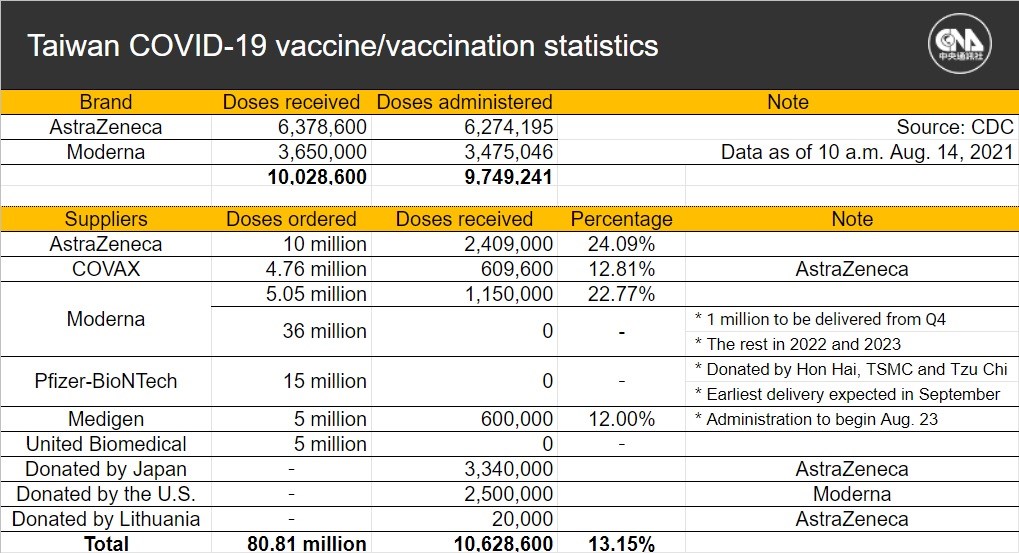
The company was awarded emergency use authorization (EUA) for its vaccine by Taiwan's Food and Drug Administration in July.
The decision has been controversial, however, as the Taiwanese vaccine maker has yet to conduct Phase 3 trials which are the standard for determining whether a vaccine offers protection against a particular virus.
Approval was given because the neutralizing antibodies generated in Medigen vaccine recipients compared favorably to those generated in AstraZeneca vaccine recipients, a concept known as immunobridging. The concept has been discussed internationally, but no consensus or standards have been reached on its use.
As of Saturday, 2.76 percent of the population, or 648,746 people, had received two shots produced by either AstraZeneca or Moderna in order to be fully vaccinated against the disease, CECC data showed.
Meanwhile, 38.7 percent, or about 9.1 million people have received a first dose, the data showed.
COVID Booster Shots May Halt Rise in Serious Cases in Next Week: Israeli Official
The Health Ministry director-general said Sunday he expects Israel's pioneering COVID booster shot campaign to stop a rise in serious cases "over the next week", which have been steadily going up since late July amid the spread of the delta variant, raising concerns the health system may be nearing full capacity.
Meanwhile, according to Health Ministry figures released on Sunday, there are currently 524 patients in serious condition, the highest figure since mid-March. A vast majority of them, the data shows, are not fully vaccinated.
The rate of positive tests is now at 5.38 percent, also the highest figure reported since late February. There are currently 49,608 confirmed active cases in Israel, 4,145 of them reported on Saturday.
Prof. Nachman Ash told 103FM radio he was "watching the data with concern. The figures are expected to go up. We truly hope to see the effect of the third vaccine (dose) in curbing the upward trend in the number of patients in serious condition, but the number of new confirmed cases will surely keep going up."
Asked whether he thinks another lockdown is needed to curb the rise in new cases, Ash said: "I think we should wait to see the effects of the third vaccine. I hope it reduces the number of serious cases, and the next few days will tell."
In the past two weeks Israel has been offering a third dose of the Pfizer coronavirus vaccine to people aged 60 and up, last week expanding the inoculation drive to Israelis 50 and up, as well as health workers, prisoners and prison staff, and other groups considered at a higher risk.
According to the latest figures issued by the Health Ministry, more than 866,000 people received a third dose, representing more than half of Israelis 60 and up.
5.9 percent of Israelis aged 50-59 have received a booster shot since Israel's vaccination drive was expanded on Friday to include them too.
"We have initial information about the influence of the third dose (in preventing) infection," Ash said, giving "an initial estimate" of reducing the number of new cases by 50 percent.
He added hospitals are overburdened, "but not only because of the coronavirus," stressing "we are still at the stage we can provide the best care possible." Ash called for "cautious optimism," saying he hopes that "what we are doing will bring serious cases down."
Some experts have raised doubts about this strategy, arguing there is insufficient data regarding the effectiveness of the third dose.
Israel launched its booster shot campaign about two weeks before the U.S. Food and Drug Administration authorized on Thursday a booster dose for people with compromised immune systems.
A model prepared by Prof. Eran Segal from the Weizmann Institute and presented at a cabinet meeting last week suggested that a third dose administered to people aged 40 and up would reduce the daily number of infections by 10,000. If the third dose was given only to people over 60, it claimed, there would be more than 20,000 confirmed infected people by the end of September. If the booster was given to people over 40, there would be 10,000 infections a day.
Israel was the first country to administer a third dose of the vaccine at a large scale, but a handful of other countries have since followed its lead.
The move has raised calls for desisting, for reasons other than its effectiveness.
The head of the World Health Organization, Dr. Tedros Adhanom Ghebreyesus, called for stopping the administration of a booster shot, arguing that it was unacceptable that countries with high vaccination rates would administer a third dose while other countries suffer a surge of infections and deaths due to low vaccination rates.
How do vaccinated people spread Delta?
When early field data showed that vaccinating people cuts transmission of the SARS-CoV-2 virus, researchers were cautiously optimistic. But they warned that many of those studies, although promising, took place before the fast-spreading Delta variant proliferated worldwide. Now, reports from various countries seem to confirm what scientists feared after the variant tore through India with alarming speed in April and May: Delta is more likely than other variants to spread through vaccinated people.
Data from COVID-19 tests in the United States, the United Kingdom and Singapore are showing that vaccinated people who become infected with Delta SARS-CoV-2 can carry as much virus in their nose as do unvaccinated people. This means that despite the protection offered by vaccines, a proportion of vaccinated people can pass on Delta, possibly aiding its rise.
People who have a Delta virus and happen to have ‘breakthrough’ infections can carry these really high levels of virus, and can unwittingly spread the virus to others,” says David O’Connor, a virologist at the University of Wisconsin–Madison.
The findings underscore the importance of protective measures such as wearing masks indoors to reduce transmission. Researchers stress that COVID-19 vaccines are protective against serious illness and death, but the data on Delta transmission show that “people who are vaccinated still need to take precautions”, O’Connor says.
Testing transmissibility
O’Connor and colleagues at the Madison and Dane County health department looked at infections in Wisconsin in June and July.
The team used PCR tests, which are widely used to confirm COVID-19 infections, to estimate the concentration of virus in nasal-fluid samples. The tests detect the virus’s genetic material by amplifying DNA until it is detectable as a fluorescent signal. The number of amplification cycles needed to get a signal — a measure called the cycle threshold value or Ct — serves as a proxy for viral concentration in the sample. The lower a sample’s Ct, the more viral genetic material present.
In a preprint study published on medRxiv on Aug 111, the researchers compared Ct values for 719 people between 29 June and 31 July, during which 90% of the 122 coronavirus samples they sequenced were the Delta variant. Of the 311 vaccinated people who tested positive for SAR-CoV-2 in that group, most had Ct values of less than 25, a level at which researchers expect the presence of infectious SARS-CoV-2. To confirm this, the team cultured 55 samples that had Ct values less than 25, from vaccinated and unvaccinated people, and detected infectious virus in nearly every one. Most unvaccinated people also had Ct values below this level.
“The bottom line is, this can happen — it can be true that vaccinated people can spread the virus. But we do not yet know what their relative role in overall community spread is,” says co-author Thomas Friedrich, a virologist at the University of Wisconsin–Madison.
Data from Provincetown, Massachusetts, suggest similar findings. An August report from the US Centers for Disease Control and Prevention (CDC) showed that following large gatherings in the beach town, nearly three-quarters of 469 new COVID-19 cases that occurred in the state were in vaccinated people2. Both vaccinated and unvaccinated people had comparably low Ct values, indicating high viral loads, and of the 133 samples sequenced, 90% were identified as Delta. The findings prompted the CDC to update its guidance on 27 July and once again recommend that people in areas of high transmission wear masks indoors.
The Provincetown results were linked to big gatherings, but Wisconsin didn’t have similar activity, suggesting that small household gatherings could also help Delta to spread, Friedrich says.
Different biology
In Houston, Texas, where a Houston Methodist Hospital team has been sequencing and logging SARS-CoV-2 variants for almost every COVID-19 case in the hospital system, about 17% of Delta cases are in vaccinated people since March 2021, nearly three times the rate of breakthrough infections compared with all other variants combined. Patients with Delta SARS-CoV-2 also stayed in hospital slightly longer than did people infected with other variants. “There’s potentially a slightly different biology to the infection,” says James Musser, a molecular pathologist and director of the hospital’s Center for Molecular and Translational Human Infectious Diseases Research. His team found that Ct levels were similar in vaccinated and unvaccinated people3.
However, vaccinated people with Delta might remain infectious for a shorter period, according to researchers in Singapore who tracked viral loads for each day of COVID-19 infection among people who had and hadn’t been vaccinated. Delta viral loads were similar for both groups for the first week of infection, but dropped quickly after day 7 in vaccinated people4. “Given the high virus levels seen in the first week of illness with Delta, measures such as masks and hand hygiene which can reduce transmission are important for everyone, regardless of vaccination status,” says co-author Barnaby Young, an infectious-disease clinician at the National Centre for Infectious Diseases in Singapore.
One massive analysis of Delta transmission comes from the UK REACT-1 programme, led by a team at Imperial College London, which tests more than 100,000 UK volunteers every few weeks. The team ran Ct analyses for samples received in May, June and July, when Delta was rapidly replacing other variants to become the dominant driver of COVID-19 in the country. The results suggested that among people testing positive, those who had been vaccinated had a lower viral load on average than did unvaccinated people. Paul Elliott, an epidemiologist at Imperial, says that these results differ from other Ct studies because this study sampled the population at random and included people who tested positive without showing symptoms.
These findings — along with an increase in cases in younger people who have not yet received both jabs — underscore the effectiveness of double vaccination against Delta, Elliott says. “We think it’s really, really important to get as many people double vaccinated, and particularly those younger groups, as soon as possible.”
US mulls COVID vaccine boosters for elderly as early as fall
Warning of tough days ahead with surging COVID-19 infections, the director of the National Institutes of Health said Sunday the U.S. could decide in the next couple weeks whether to offer coronavirus booster shots to Americans this fall.
Among the first to receive them could be health care workers, nursing home residents and other older Americans.
Dr. Francis Collins also pleaded anew for unvaccinated people to get their shots, calling them “sitting ducks” for a delta variant that is ravaging the country and showing little sign of letting up.
“This is going very steeply upward with no signs of having peaked out,” he said.
Federal health officials have been actively looking at whether extra shots for the vaccinated may be needed as early as this fall, reviewing case numbers in the U.S. “almost daily” as well as the situation in other countries such as Israel, where preliminary studies suggest the vaccine’s protection against serious illness dropped among those vaccinated in January.
Israel has been offering a coronavirus booster to people over 60 who were already vaccinated more than five months ago.
No U.S. decision has been made because cases here so far still indicate that people remain highly protected from COVID-19, including the delta variant, after receiving the two-dose Pfizer or Moderna regimen or the one-shot Johnson & Johnson vaccine.
But U.S. health officials made clear Sunday they are preparing for the possibility that the time for boosters may come sooner than later.
“There is a concern that the vaccine may start to wane in its effectiveness,” Collins said. “And delta is a nasty one for us to try to deal with. The combination of those two means we may need boosters, maybe beginning first with health care providers, as well as people in nursing homes, and then gradually moving forward” with others, such as older Americans who were among the first to get vaccinations after they became available late last year.
He said because the delta variant only started hitting the U.S. hard in July, the “next couple of weeks” of case data will help the U.S. make a decision.
Moderna President Stephen Hoge said seeing some “breakthrough” infections emerge among the vaccinated within six months has been surprising, even if most symptoms so far have not been life-threatening. “I think that suggests we are going to need booster vaccines to get through the winter,” he said.
Last week, the Food and Drug Administration said p eople with weakened immune systemscan get an extra dose of the Pfizer or Moderna vaccines to better protect them as the delta variant continues to surge.
“If it turns out as the data come in, we see we do need to give an additional dose to people in nursing homes, actually, or people who are elderly, we will be absolutely prepared to do that very quickly,” said Dr. Anthony Fauci, who is President Joe Biden’s chief medical adviser.
While the U.S. currently is seeing an average of about 129,000 new infections a day — a 700% increase from the beginning of July — that number could jump in the next couple weeks to 200,000, a level not seen since among the pandemic’s worst days in January and February, Collins said.
Both he and Fauci stressed that the best way to stem the virus is for the unvaccinated to get their shots.
Currently, about 60% of the U.S. population has gotten at least one dose and nearly 51% are fully vaccinated, according to the Centers for Disease Control and Preventio n. Areas with low vaccination rates have been particularly hit hard with infections, such as Louisiana, Texas, Florida and Mississippi.
The rapidly escalating surge in infections across the U.S. has caused a shortage of intensive care-unit beds, nurses and other front-line staff in virus hot spots that can no longer keep up with the flood of unvaccinated patients. Health officials also warn that more children who are not yet eligible for vaccines could get infected, though it’s not clear whether the delta variant leads to more severe illness among them.
“That’s heartbreaking considering we never thought we would be back in that space again,” Collins said of rising U.S. infections overall. “But here we are with the delta variant, which is so contagious, and this heartbreaking situation where 90 million people are still unvaccinated who are sitting ducks for this virus, and that’s the mess we’re in. We’re in a world of hurt.”
Fauci said as more people get their shots, in many places everyone — both the vaccinated and unvaccinated — will have to do their part with “mitigation,” such as mask-wearing in schools and other public spaces.
“We’ve just got to realize that we’re dealing with a public health crisis,” he said. “The more you get infections, the more spread you get, the greater opportunity the virus has to continue to evolve and mutate.”
Collins spoke on “Fox News Sunday,” Fauci appeared on CBS’ “Face the Nation” and Hoge was on Fox News Channel’s “Sunday Morning Futures.”
https://pix11.com/news/coronavirus/us-mulls-covid-vaccine-boosters-for-elderly-as-early-as-fall/