Search This Blog

Wednesday, September 8, 2021

Enough Covid vaccines to cover global population: industry

 There will be enough COVID-19 vaccine doses produced by the end of this year to cover the global population, industry representatives said Tuesday.

There is a yawning gap in vaccination rates between rich and poor countries, but the threshold of 7.5 billion vaccine doses will be reached in September, Thomas Cueni, the head of the International Federation of Pharmaceutical Manufacturers and Associations (IFPMA) told a news conference in Geneva.

Up to 70 percent of adults have received two vaccine doses in richer nations while in Africa the figure is a mere six percent.

About 1.5 billion doses are being manufactured every month, according to Airfinity, a scientific data analysis firm.

The global production of coronavirus vaccine doses is projected to reach 12 billion by the end of 2021.

This means that even if  want to vaccinate everyone aged 12 and over, there will be at least 1.2 billion doses available for redistribution to , Airfinity said.

"It also means that governments still holding back doses stocks in case of shortages no longer need to do so," Cueni said.

IFPMA said that the production of  would reach 24 billion by the middle of next year—a figure it said was greater than .

Albert Bourla, head of US pharmaceuticals giant Pfizer, which makes a  in collaboration with Germany's BioNTech, said the cost of the jab was not an issue.

He said his company priced the doses according to the economic strength of the country where it was being sold.

Paul Stoffels, the scientific director of US drug maker Johnson & Johnson, said lifting patents, as demanded by some non-governmental organisations, was also not an issue currently.

"At the moment it's all about optimising existing manufacturing capacity of vaccines by those people who know how to produce," he said.

"If it takes us 18 months to get to upscaling manufacturing in existing plants... it will take different companies so much longer and so it doesn't help."

https://medicalxpress.com/news/2021-09-covid-vaccines-global-population-industry.html

COVID doesn't account for troubling trend of unexplained US deaths

 COVID doesn't account for troubling trend of unexplained deaths

Credit: Rice University

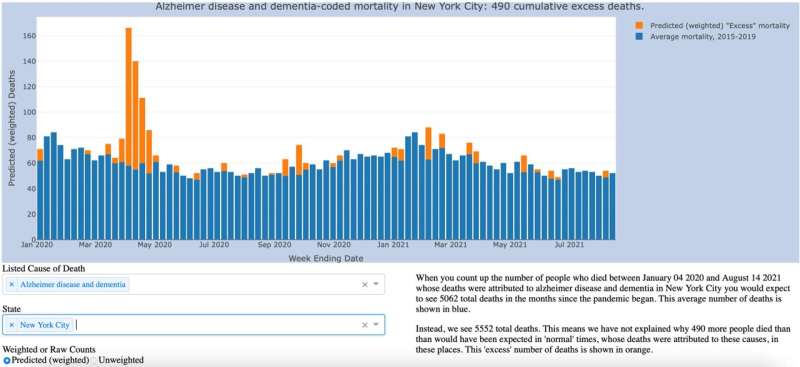
Since the onset of the COVID-19 pandemic, deaths attributed to many other health conditions have spiked in the U.S.: Alzheimer's, heart disease, cancer and diabetes, for example, have killed far more Americans than would be expected in a pre-pandemic year.

This "excess mortality" data from the Centers for Disease Control (CDC) underpins a new dashboard created by Rice humanities computing researcher John Mulligan that sheds light on this troubling trend.

"COVID numbers are not the end of the story," Mulligan said.

In Texas, for example, when you tally the number of people who died of  or hypertension between December 2019 and August 2021, you would expect to see about 53,000 total deaths, based on the average from previous years' CDC data. Instead, 60,264 Texans died of these afflictions during this time, about 7,500 more than would have been expected in a non-pandemic year.

Since last year, the Journal of the American Medical Association and other publications have warned that official counts are underestimating the number of deaths associated with the pandemic. Ongoing studies indicate the number of people who would not have died in any other year has been undercounted by 20% to 36%.

"This is not a normal year," Mulligan said. "You get rid of COVID deaths, and we are still well above the average."

These excess deaths represent a large, looming and mostly unaddressed public health crisis, especially as recent spikes in rates of positive cases show the pandemic is simply not over. Mulligan's dashboard, developed in partnership between Rice's Center for Research Computing and the Medical Futures Lab, shows this ongoing crisis unfolding in stark detail.

Take, for instance, the well-documented surge in Alzheimer's deaths in the early months of the pandemic, "pointing to how the coronavirus pandemic has exacted a higher fatality toll than official numbers have shown," the Washington Post reported.

For example, a nursing home patient with Alzheimer's might recover from COVID-19, but lose the sense of taste or smell. Soon, that patient might stop eating. A couple of weeks later, that patient might die.

"Was that COVID?" Mulligan asks. "Do you want to add that to the number of COVID deaths your nursing home has on the books? That sort of thing starts to shade into the more unsavory implications of the undercount."

Also implicated in this widespread undercount are rampant problems within the American health care system and public health programs. As emergency rooms become overcrowded, as beds fill up and as hospital systems strain under the pressure of COVID-19 outbreaks, more and more Americans put off seeking treatment for other medical conditions—or are unable to see a doctor—until it's too late.

Last month, just outside of Houston, U.S. Army veteran Daniel Wilkinson died due to gallstone pancreatitis, a treatable illness, because there were no ICU beds available. As CBS News reported, Wilkinson lived three houses down from an emergency room and 60 miles from the Texas Medical Center, the largest hospital campus in the world.

Was his death attributable to COVID-19?

And as outbreaks continue to cripple the nation's health care system, Mulligan said the CDC excess mortality data exposes "a slow-burning background crisis" that's "absolutely the effect of underinvesting in public health."

Because the U.S. hasn't provided its health care system "the sort of heavy-duty investing in infrastructure that you would need to buffer against the next hit," Mulligan said, this excess mortality crisis isn't going anywhere, and will likely worsen.

"How do you deal with that?" Mulligan said. "There's no shot for that."

Since the onset of the pandemic, the "inconvenient data" showing this growing gap in unexplained excess mortality "has been sort of this sleeper, that I think points towards the very long-term effects that we're going to be seeing here," Mulligan said.

Mulligan said there are more rigorous ways of estimating excess mortality using the CDC's data. But he developed this visualization to be easily accessible and because state-by-state and regional trends can be unpacked with the dashboard, which also shows data on deaths in 12 different categories (such as sepsis and renal failure).

"We are going to be working to understand the full impact of COVID for a long time, because it has touched so many parts of our lives in ways that are not visible based on just the narrow counts of infections and deaths that are directly attributed to COVID," said Kirsten Ostherr, the Gladys Louise Professor of English and chair of the Department of English, who is also director of Rice's Medical Futures Lab.

"Who has not been touched by COVID in some way and how do you even capture that?" Ostherr said. "This excess mortality visualization tool points our thinking to ask those kinds of questions."

Among the other questions Mulligan aims to address with his data visualization: What counts as "excess" mortality in a post-COVID-19 world? How do public health reporting mechanisms feed into public health? What, and who, "counts" according to our current frameworks, and is this acceptable?

"From a humanistic perspective, the visualization uses data to not answer a question, but to raise a lot of questions that have some wide-reaching implications and that are not easy to answer," Mulligan said. "Other researchers have made very interesting uses of this data with much more sophisticated models, such as the Weinberger Lab's early study on excess COVID deaths, and the Preston and Vierboom study out of Penn that turned excess mortality stats on their heads to ask, what counts as normal when we call these deaths excessive?"

"I approached the dataset from a humanistic perspective, attempting to put design-oriented critiques of interactivity to work on a dataset with immediate real-world import. Where interactive data visualizations tend to give the user a sense of certainty and control over unruly datasets, I wanted, with this dashboard, to allow people to drill down into some of the unanswered and underexplored dimensions of the pandemic."

Life expectancy in the U.S. fell by 1.5 years in 2020, the largest drop since World War II. Those numbers include COVID-19 deaths, of course, but also such "deaths of despair" as suicides and overdoses, which accumulate in step with the isolating effects of the pandemic and the grief and financial strain borne by survivors. Even for those who recover from the virus, the effects of "long COVID" for people with comorbidities like diabetes or high blood pressure can shave more years off their lives.

"How much did their life span go down?" Mulligan said. "We won't know for a while, but that excess mortality is not going away. That gap shows a few things. It shows that we're not addressing the problem. It shows that we're ignoring the problem."

While many news outlets initially reported on this excess mortality gap, attention has since been diverted back to the spikes in COVID-19 infection and mortality rates. Mulligan hopes his data visualization will help draw attention back to the gap.

"We'll have a lot more people dying in the years to come unless we start taking public health seriously, and well beyond the scope of what we are calling COVID," Mulligan said.

The COVID-19 Excess Mortality Data Visualization is updated weekly and can be viewed at www.COVID-excess-mortality.net.


Explore further

Excess deaths due to pandemic much higher than reported COVID toll: WHO

Why do people with diabetes develop severe COVID-19?

 Throughout the COVID-19 pandemic, clinicians have noted that certain patients are at especially high risk of developing severe illness or dying from coronavirus infection. Type 2 diabetes—a condition affecting more than 10 percent of the U.S. population— is one of the main risk factors for severe COVID-19 illness. New research from U-M uncovers why this might be and offers hope for a potential therapy.

The culprit appears to be an enzyme called SETDB2. This same enzyme has been implicated in the non-healing, inflammatory wounds found in people with . Working in the lab of Katherine Gallagher, M.D. of the Michigan Medicine Departments of Surgery and Microbiology and Immunology, researcher W. James Melvin, M.D., and his colleagues decided to probe a possible link between the enzyme and the runaway inflammation they witnessed first-hand in COVID patients in the ICU.

Starting with a mouse model of coronavirus infection, they found that SETDB2 was decreased in  involved in the inflammatory response, called macrophages, of infected mice with diabetes. They later saw the same thing in monocyte-macrophages in the blood from people with diabetes and severe COVID-19.

 "We think we have a reason for why these patients are developing a cytokine storm," said Melvin.

In the mouse and human models, noted Melvin and Gallagher, as SETDB2 went down, inflammation went up. In addition, they revealed that a pathway known as JAK1/STAT3 regulates SETDB2 in macrophages during .

Taken together, the results point to a potential therapeutic pathway. Previous findings from the lab demonstrated that interferon, a cytokine important for viral immunity, increased SETDB2 in response to wound healing. In their new study, they found blood serum from patients in the ICU with diabetes and severe COVID-19 had reduced levels of interferon-beta compared to patients without diabetes.

"Interferon has been studied throughout the pandemic as a potential therapy, with efforts going back and forth between trying to increase or decrease interferon levels," said Gallagher. "My sense is that its efficacy as a therapy will be both patient and timing specific."

To test this, the study team administered interferon beta to coronavirus-infected diabetic mice and saw that they were able to increase SETDB2 and decrease inflammatory cytokines.

"We're trying to home in on what controls SETDB2, which is sort of the master regulator of a lot of these  that you hear about as being increased in COVID-19, such as IL-1B, TNFalpha, and IL-6," explained Gallagher.

"Looking upstream at what's controlling SETDB2, interferon is at the top end, with JaK1 and STAT3 in the middle. Interferon increases both, which increases SETDB2 in a sort of cascade."

This is important, she added, because identifying the pathway presents other potential ways of targeting the enzyme.

Melvin and Gallagher hope the findings of this study will inform ongoing clinical trials of interferon or other downstream components of the pathway, including epigenetic targets, for COVID-19. Their work also highlights the need to understand the timing and cell-specificity of therapy and to tailor its application to patients' underlying conditions, especially patients with diabetes.

"Our research is showing that maybe if we are able to target patients with diabetes with , especially early in their infection, that may actually make a big difference," Melvin said.


Explore further

New discovery points toward possible treatment for diabetic non-healing wounds

More information: Coronavirus induces diabetic macrophage-mediated inflammation via SETDB2, PNASDOI: 10.1073/pnas.2101071118 , https://www.pnas.org/content/118/38/e2101071118
https://medicalxpress.com/news/2021-09-people-diabetes-severe-covid-.html

Fridge-free COVID-19 vaccines grown in plants and bacteria

 Nanoengineers at the University of California San Diego have developed COVID-19 vaccine candidates that can take the heat. Their key ingredients? Viruses from plants or bacteria.

The new fridge-free COVID-19 vaccines are still in the early stage of development. In mice, the vaccine candidates triggered high production of neutralizing antibodies against SARS-CoV-2, the  that causes COVID-19. If they prove to be safe and effective in people, the vaccines could be a big game changer for global distribution efforts, including those in rural areas or resource-poor communities.

"What's exciting about our vaccine technology is that is thermally stable, so it could easily reach places where setting up ultra-low temperature freezers, or having trucks drive around with these freezers, is not going to be possible," said Nicole Steinmetz, a professor of nanoengineering and the director of the Center for Nano-ImmunoEngineering at the UC San Diego Jacobs School of Engineering.

The vaccines are detailed in a paper published Sept. 7 in the Journal of the American Chemical Society.

The researchers created two COVID-19 vaccine candidates. One is made from a , called cowpea mosaic virus. The other is made from a bacterial virus, or bacteriophage, called Q beta.

Both vaccines were made using similar recipes. The researchers used cowpea plants and E. coli bacteria to grow millions of copies of the plant virus and bacteriophage, respectively, in the form of ball-shaped nanoparticles. The researchers harvested these nanoparticles and then attached a small piece of the SARS-CoV-2 spike protein to the surface. The finished products look like an infectious virus so the immune system can recognize them, but they are not infectious in animals and humans. The small piece of the spike protein attached to the surface is what stimulates the body to generate an immune response against the coronavirus.

The researchers note several advantages of using plant viruses and bacteriophages to make their vaccines. For one, they can be easy and inexpensive to produce at large scales. "Growing plants is relatively easy and involves infrastructure that's not too sophisticated," said Steinmetz. "And fermentation using bacteria is already an established process in the biopharmaceutical industry."

Another big advantage is that the plant virus and bacteriophage nanoparticles are extremely stable at high temperatures. As a result, the vaccines can be stored and shipped without needing to be kept cold. They also can be put through fabrication processes that use heat. The team is using such processes to package their vaccines into  and microneedle patches. These processes involve mixing the vaccine candidates with polymers and melting them together in an oven at temperatures close to 100 degrees Celsius. Being able to directly mix the plant virus and bacteriophage nanoparticles with the polymers from the start makes it easy and straightforward to create vaccine implants and patches.

The goal is to give people more options for getting a COVID-19 vaccine and making it more accessible. The implants, which are injected underneath the skin and slowly release vaccine over the course of a month, would only need to be administered once. And the microneedle patches, which can be worn on the arm without pain or discomfort, would allow people to self-administer the vaccine.

"Imagine if vaccine patches could be sent to the mailboxes of our most vulnerable people, rather than having them leave their homes and risk exposure," said Jon Pokorski, a professor of nanoengineering at the UC San Diego Jacobs School of Engineering, whose team developed the technology to make the implants and microneedle patches.

"If clinics could offer a one-dose implant to those who would have a really hard time making it out for their second shot, that would offer protection for more of the population and we could have a better chance at stemming transmission," added Pokorski, who is also a founding faculty member of the university's Institute for Materials Discovery and Design.

In tests, the team's COVID-19 vaccine candidates were administered to mice either via implants, microneedle patches, or as a series of two shots. All three methods produced high levels of neutralizing antibodies in the blood against SARS-CoV-2.

Potential pan-coronavirus vaccine

These same antibodies also neutralized against the SARS virus, the researchers found.

It all comes down to the piece of the coronavirus spike protein that is attached to the surface of the nanoparticles. One of these pieces that Steinmetz's team chose, called an epitope, is almost identical between SARS-CoV-2 and the original SARS virus.

"The fact that neutralization is so profound with an epitope that's so well conserved among another deadly coronavirus is remarkable," said co-author Matthew Shin, a nanoengineering Ph.D. student in Steinmetz's lab. "This gives us hope for a potential pan-coronavirus vaccine that could offer protection against future pandemics."

Another advantage of this particular epitope is that it is not affected by any of the SARS-CoV-2 mutations that have so far been reported. That's because this epitope comes from a region of the spike protein that does not directly bind to cells. This is different from the epitopes in the currently administered COVID-19 vaccines, which come from the spike protein's binding region. This is a region where a lot of the mutations have occurred. And some of these mutations have made the virus more contagious.

Epitopes from a nonbinding region are less likely to undergo these mutations, explained Oscar Ortega-Rivera, a postdoctoral researcher in Steinmetz's lab and the study's first author. "Based on our sequence analyses, the epitope that we chose is highly conserved amongst the SARS-CoV-2 variants."

This means that the new COVID-19 vaccines could potentially be effective against the variants of concern, said Ortega-Rivera, and tests are currently underway to see what effect they have against the Delta variant, for example.

Plug and play vaccine

Another thing that gets Steinmetz really excited about this vaccine technology is the versatility it offers to make new vaccines. "Even if this technology does not make an impact for COVID-19, it can be quickly adapted for the next threat, the next virus X," said Steinmetz.

Making these vaccines, she says, is "plug and play:" grow plant virus or bacteriophage nanoparticles from plants or bacteria, respectively, then attach a piece of the target virus, pathogen, or biomarker to the surface.

"We use the same nanoparticles, the same polymers, the same equipment, and the same chemistry to put everything together. The only variable really is the antigen that we stick to the surface," said Steinmetz.

The resulting vaccines do not need to be kept cold. They can be packaged into implants or . Or, they can be directly administered in the traditional way via shots.

Steinmetz and Pokorski's labs have used this recipe in previous studies to make  candidates for diseases like HPV and cholesterol. And now they've shown that it works for making COVID-19  as well.

Next steps

The vaccines still have a long way to go before they make it into clinical trials. Moving forward, the team will test if the vaccines protect against infection from COVID-19, as well as its variants and other deadly coronaviruses, in vivo.


Explore further

Marrying molecular farming and advanced manufacturing to develop a COVID-19 vaccine

More information: Trivalent subunit vaccine candidates for COVID-19 and their delivery devices, Journal of the American Chemical Society (2021). DOI: 10.1021/jacs.1c06600
https://phys.org/news/2021-09-fridge-free-covid-vaccines-grown-bacteria.html

Maryland governor says elderly, immunocompromised eligible for vaccine boosters

 Maryland Gov. Larry Hogan (R) on Wednesday announced that the elderly and immunocompromised are now eligible to receive COVID-19 vaccine booster shots in the state. 

In a statement, Hogan’s office said that the authorization is immediate.

Those eligible for the boosters will be people in nursing homes, assisted living facilities, drug treatment centers, and Developmentally Disabled Group Homes. 

Hogan’s office also said that pharmacies and medical providers must administer the booster shots to those who are immunocompromised without prescription and or a doctor’s note. 

“For several weeks now, states have had to operate without clear guidance from the federal government regarding these booster shots,” Hogan said in the news conference. 

“The limited guidance we have received has been confusing and contradictory, and it is still unclear when and how more people will become eligible. But all of the evidence makes it abundantly clear that we cannot afford to delay taking decisive action to protect our most vulnerable citizens.”

This comes as the World Health Organization (WHO) shared Wednesday that wealthy countries shouldn’t administer booster shots yet, citing poorer countries still struggling with their initial vaccine rollout. 

Hogan shared on Tuesday that 95 percent of Maryland senior citizens have received one dose of the COVID-19 vaccine. 

Pre-flight COVID testing drastically reduces risk of infection: study

 Air travelers are highly unlikely to contract COVID-19 if their flight requires passengers to test negative, according to a new study conducted by Delta Air Lines, Mayo Clinic and the Georgia Department of Health.

The peer-reviewed study found that out of nearly 10,000 passengers that tested negative 72 hours before flying between the U.S. and Italy, only five tested positive for COVID-19. That 0.05 percent rate of infection on international flights from December 2020 to May 2021 is far lower than the average community transmission rate of 1.1 percent over the same period.

The data demonstrates that international travel can be reopened safely with proper testing, masking and cleaning protocols, said Dr. Henry Ting, Delta’s chief health officer. Many countries have thus far crafted their international travel rules around simulation models.

“This is the first real study. This is not a model, this is not mathematics or physics. These are real passengers who flew from the U.S. to Italy during the height of the third COVID-19 surge,” Ting said.

“There’s so many other activities you could do like going to the grocery store, church or a restaurant where your risk of infection is way higher than flying,” he added.

The study’s release comes as the travel industry pushes the Biden administration to lift a ban on nonessential travel from Europe instituted in the early days of the pandemic. White House officials have said that they are formulating a plan to reopen international travel but have not yet implemented it. 

Ting said that he shared the data with the White House and the National Security Council and received a “very receptive” response. 

European countries this week tightened their restrictions on U.S. travelers following a surge in COVID-19 cases driven by the highly transmissible delta variant. Spain, Denmark and Belgium will require proof of vaccination for U.S. travelers, while Sweden and Norway are blocking all U.S. travelers from entering their borders in most cases, regardless of vaccination status.

Domestic air travel rebounded this summer, but delta variant fears have caused flight bookings to dip. International air travel, inhibited by continued restrictions, remains 55 percent below 2019 levels, according to industry trade group Airlines for America. 

Airlines have enacted stricter rules to combat the virus. Last month, Delta Air Lines required employees to undergo weekly testing or get vaccinated and hit unvaccinated employees with a $200 health care surcharge. United Airlines announced that all of its employees must get the shot. 

https://thehill.com/policy/transportation/aviation/571390-pre-flight-covid-testing-requirement-drastically-reduces-risk

White House signals new COVID-19 measures coming for unvaccinated Americans

 President Biden will announce on Thursday new steps in his administration's COVID-19 response that involves testing, mandates, and school measures depending on a person's vaccination status, the White House said.

White House press secretary Jen Psaki told reporters Wednesday that the new components would affect people across the country.

“There are six steps the president’s announcing, there will be new components,” Psaki said. “Some of that will be related to access to testing, some will be related to mandates, some will be related to how we ensure kids will be protected in schools.” 

The president indicated last week, following the jobs report, that his administration is looking for ways to make it safer for kids to return to school and for workers to return to the office.

Psaki said more will be previewed Thursday when the components are finalized.

“There will be new components that sure, will of course impact people across the country, but we’re also all working together to get the virus under control, to return to our normal lives,” she added. 

Biden’s upcoming remarks comes as cases and hospitalizations have increased in areas around the country, in large part due to the highly contagious delta variant.

When asked if the new steps will affect Americans’ lives, Psaki said, “it depends on if you’re vaccinated or not.”

https://thehill.com/homenews/administration/571364-white-house-signals-new-measures-coming-for-unvaccinated-americans