Search This Blog

Thursday, October 21, 2021

Atreca Inks Licensing Pact With Gates Research On Malaria Antibody


  • Atreca Inc (NASDAQ: BCEL) has entered into a licensing agreement with the Bill & Melinda Gates Medical Research Institute to develop MAM01/ATRC-501 to prevent malaria.

  • MAM01/ATRC-501 is a monoclonal antibody entering preclinical development.

  • Under the agreement, Gates MRI will lead the development of MAM01/ATRC-501 and receive commercial rights in GAVI-eligible countries.

  • Atreca will retain commercial rights in the U.S., Europe, and parts of Asia.

  • MAM01/ATRC-501 is an engineered version of a human monoclonal antibody generated following vaccination with Mosquirix and identified via Atreca's discovery platform.

  • MAM01/ATRC-501 targets the malaria circumsporozoite protein (CSP) and has been shown to protect animals against malaria infection in multiple in vivo mouse studies.

FDA slaps clinical hold on AstraZeneca cancer drug amid heart safety scare in combo test

 We found out, via a small and almost unnoticed ClinicalTrials.gov update today, that AstraZeneca suspended trial work on its experimental blood cancer drug AZD5991. Now, we have learned that things are in fact bleaker for the therapy.

AstraZeneca told Fierce Biotech that signs of a heart issue in a patient treated with AZD5991 were found, or, as the Big Pharma put it, “asymptomatic elevation in cardiovascular laboratory parameters,” specifically in one patient with relapsed/refractory acute myeloid leukemia who also had other comorbidities.

Because of this, the company discontinued treatment and placed the trial on a voluntary hold. AstraZeneca has now confirmed that the study has been hit with an FDA clinical hold, too. That asymptomatic elevation occurred among the patient group receiving AZD5991 in combination with AbbVie/Roche’s approved blood cancer medicine Venetoclax, which was one half of the trial. The cardiovascular issue was not seen among patients who received AZD5991 monotherapy.

An AstraZeneca spokesperson said: “It is important to note that the asymptomatic elevation has since resolved. We are now in the process of conducting a full analysis of the study data and working closely with the FDA for the benefit of the patients.”

Two years ago, heart safety issues also eventually scuppered work on Amgen’s AMG 397, which is also an MCL-1 inhibitor like AZD5991. That trial was also subject of an FDA trial hold. Earlier this year, the company decided to focus on a backup intravenous MCL-1 known as AMG 176.

https://www.fiercebiotech.com/biotech/fda-slaps-clinical-hold-astrazeneca-cancer-drug-amid-heart-safety-scare-combo-test

More activist pressure for Merck $11.5B Acceleron deal as another hedge fund balks; BMS looks ready to deal

 Merck & Co.’s proposed $11.5 billion acquisition of Acceleron Pharma is getting more pushback from another vocal opponent. This time, the activist investor is asking for what seems to be the impossible.

Merck should pay at least twice its current $180-per-share offer price to justify Acceleron’s value, Darwin Global Management said Wednesday. The hedge fund recently built a 3.84% stake in the Massachusetts biotech.

Darwin’s opposition follows similar opinions from Avoro Capital—which owns about 7% Acceleron shares—and Holocene Advisors. However, Bristol Myers Squibb, which is Acceleron’s biggest shareholder with a 11.5% stake, intends to tender its shares, Bloomberg reported, citing people with knowledge of the matter. The news service previously reported that the New York pharma had engaged in deal talks to buy out Acceleron but backed down.

Merck didn’t reply to a request for comment by publication time, and BMS declined to comment. But Merck doesn’t seem likely to up its offer—certainly not to the level Darwin’s asking. Merck CEO Rob Davis had rejected Acceleron CEO Habib Dable’s request to increase its offer during the deal discussion after media reports of the sale in late September, a securities filing shows.

BMS’ decision to not pursue Acceleron at a higher price at least suggests the Big Pharma company doesn’t believe topping Merck’s bid is worthwhile. But the dissidents argue that Acceleron, and specifically its pulmonary arterial hypertension (PAH) candidate sotatercept, is worth a lot more than Merck’s offer.

The acquisition premium of about 34%, calculated against Acceleron’s closing price Aug. 31, is far less than previous biotech transactions, Darwin said. The investment firm pointed to Johnson & Johnson’s 2017 buyout of PAH-focused Actelion, noting its premium was 82%.

The Actelion deal established J&J as the leader in PAH with a portfolio of drugs including Opsumi, Tracleer and Uptravi. But those meds “lacked sotatercept’s transformative disease-modifying potential,” Abhishek Trehan, Darwin’s chief investment officer, said in an open letter to Acceleron shareholders asking them not to tender their shares to Merck. Trehan previously headed biopharma investments at D.E. Shaw, a known activist, before launching Darwin last year.

Merck started the tender offer process last week, and it needs to collect at least a majority of outstanding Acceleron shares as a condition for the deal to go through.

In sotatercept, Merck is buying a modulator of TGF-beta signaling that could potentially address the underlying disease of PAH. Existing treatment options ameliorate symptoms by dilating blood vessels.

The current deal price suggests Merck is valuing sotatercept at about $5 billion to $7 billion, Darwin said; it reached that number after calculating the value of Acceleron’s royalty share from BMS-partnered blood disorder drug Reblozyl at about $4 billion to $6 billion based on BMS’ sales projection. However, Darwin said sotatercept’s net present value should be around $17 billion to $21 billion. The company thinks the drug could hit $5 billion in annual peak sales in PAH alone, not to mention potential upside in other forms of pulmonary hypertension.

That estimate is far more bullish than Wall Street analysts’ expectations. Piper Sandler’s Christopher Raymond, for example, has put sotatercept’s 2027 sales at $1.4 billion for PAH. SVB Leerink’s Geoffrey Porges had said the drug could reach $2 billion at peak. By comparison, J&J’s entire pulmonary hypertension portfolio brought in $3.15 billion in 2020 sales.

All told, Darwin believes Acceleron’s equity value should be $22 billion to $28 billion, which translates to a per-share price of $353 to $451, way higher than the current $180 offer.

Citing from a recent Merck investor call, Trehan said, “just as Merck is ‘very confident [that sotatercept] is a multibillion-dollar peak sales potential drug,’ we are very confident that Merck is underpaying to acquire it.”

https://www.fiercepharma.com/pharma/activist-pressure-for-merck-s-11-5b-acceleron-deal-hedge-fund-asks-for-twice-price

As Aduhelm forecasts plunge, all eyes turn to coverage decision

 The FDA’s verdict on Biogen’s Aduhelm was the biggest biopharma event of 2021, and next year the controversial Alzheimer’s drug will once again dominate sector catalyst trackers. The CMS’s National Coverage Decision, which will set out how Medicare will reimburse the drug, is due in the opening months of 2022. The meagre $300,000 in third-quarter sales that Biogen reported for the product yesterday amply illustrates the importance of the NCD; many physicians are waiting for it before prescribing, the company claims. That third-quarter figure substantially missed sellside consensus and prompted a wave of downgrades, although until CMS decides who is eligible for Aduhelm future demand is hard to gauge. The extent to which the medical community will actually use the antibody is also a big unknown, but most analysts assume that Aduhelm will become a blockbuster eventually. Still, a number of crucial readouts and regulatory moves are nearing for competitor projects; while three months ago Roche rubbished the idea of an early gantenerumab filing yesterday its stance shifted, and it would not rule out applying for accelerated approval. In reality Aduhelm’s long-term outlook remains just as hard to predict as near-term demand.

$mGoing down: Aduhelm's tumbling outlook(Sellside consensus)New consensus?Current consensus202120222023202401k2k3k4kEvaluate Pharma2021 New consensus?: $3m

Note: Current consensus from Evaluate Pharma. New consensus compiled by Evaluate Vantage from available sellside notes.

https://www.evaluate.com/vantage/articles/news/snippets/aduhelm-forecasts-plunge-all-eyes-turn-coverage-decision

B. Riley Sees 'Significant Potential' In This Beaten-Up Biotech


  • B. Riley analyst calls Seelos Therapeutics Inc  his top "Battered Bastions" pick with the stock down 60% from intra-year highs. 
  • According to the analyst Mayank Mamtani, the Company's fundamentals have strengthened due to the competitive positioning of its two lead late-stage candidates, SLS-002 for acute suicide ideation & behavior and trehalose for amyotrophic lateral sclerosis.
  • The analyst is "encouraged" by the cross-read from Sage Therapeutics Inc  recent regulatory strategy update of zuranolone in major depressive disorder to SLS-002's indication expansion plans. 
  • Also, Seelos is progressing with gene therapy candidate SLS-004. Preclinical data demonstrated that a single dose reduced alpha-synuclein mRNA by 27% and SNCA protein expression by 40%. 
  • He sees "significant potential upside optionality" to the firm's $11 price target and reiterates a Buy rating on the shares.

Bluebird Bio To Withdraw Marketing Of Skysona Gene Therapy In Europe


  • Bluebird Bio Inc (NASDAQ: BLUE) will withdraw the regulatory marketing authorization for Skysona (elivaldogene autotemcel) in the European Union.

  • The update comes as a part of the company's winding down of operations there.

  • Bluebird will also withdraw marketing authorization of the biologic in the UK.

  • Skysona (elivaldogene autotemcel, Lenti-D), one-time gene therapy, is indicated for early cerebral adrenoleukodystrophy (CALD) in patients under 18 years of age with an ABCD1 genetic mutation.

  • Adrenoleukodystrophy (ALD) is a disease linked to the X chromosome due to fatty acid buildup caused by a defect in the very long chain of fatty acids transporter in peroxisomes, resulting in damage to the myelin sheath of the nerves, hence seizures and hyperactivity.

  • In addition, the company will withdraw authorizations for Zynteglo (betibeglogene autotemcel) in the EU and UK in early 2022.

  • The company does not intend to initiate any new trials in Europe for beta-thalassemia, cerebral adrenoleukodystrophy, or sickle cell disease programs.

NIH Admits Funding Gain-Of-Function COVID Experiments; Gives EcoHealth 5 Days To Report Data

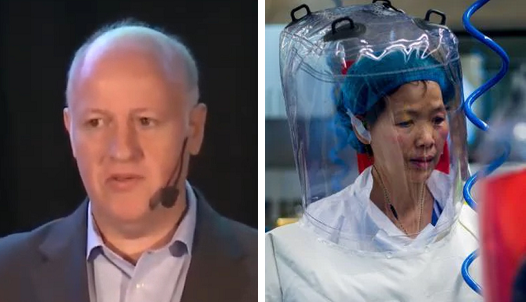
 A top NIH official admitted in a Wednesday letter that the US-funded so-called "gain-of-function" research in Wuhan, China - and that the US nonprofit which conducted it, EcoHealth Alliance - led by the controversial Peter Daszak, "failed to report" that they had created a chimeric bat coronavirus which could infect humans.

In a letter addressed to Rep. James Comer (R-KY), NIH Principal Deputy Director Lawrence A. Tabak cites a "limited experiment" to determine whether "spike proteins from naturally occurring bat coronaviruses circulating in China were capable of binding to the human ACE2 receptor in a mouse model." According to the letter, humanized mice infected with the modified bat virus "became sicker" than those exposed to an unmodified version of the same bat coronavirus.

Daszak failed to report this finding, and has been given five days to submit "any and all unpublished data from the experiments and world conducted" under the NIH grant.

Rutgers University Board of Governors Chemistry Professor Richard H. Ebright sums it up. :

While Tabak's letter goes to great lengths to insist that EcoHealth's work couldn't have produced SARS-CoV-2, it absolutely vindicates Sen. Rand Paul (R-KY), who Fauci repeatedly called a liar in July for accusing him of funding GoF research in Wuhan, China.


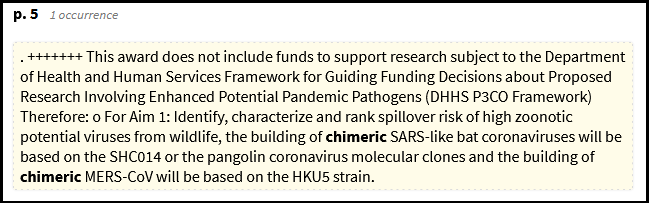
As we noted in Septemberproof that the US funded of GoF research was blown wide open thanks to materials (here and here) released through a Freedom of Information Act lawsuit by The Intercept against the National Institutes of Health, revealing that EcoHealth was paid to make chimeric SARS-based Covid that they confirmed could infect human cells.

While evidence of this research has been pointed to in published studies, the FOIA release provides a key piece to the puzzle which sheds new light on what was going on.

"This is a roadmap to the high-risk research that could have led to the current pandemic," said Gary Ruskin, executive director of U.S. Right To Know, a group that has been investigating the origins of Covid-19 (via The Intercept).

We also learned in September that 18 months before the Pandemic, Daszak applied for a grant to release enhanced airborne coronaviruses into the wild in an effort to inoculate them against diseases that could have otherwise jumped to humans, according to The Telegraph, citing leaked grant proposals from 2018.

New documents show that just 18 months before the first Covid-19 cases appeared, researchers had submitted plans to release skin-penetrating nanoparticles containing “novel chimeric spike proteins” of bat coronaviruses into cave bats in Yunnan, China.

They also planned to create chimeric viruses, genetically enhanced to infect humans more easily, and requested $14million from the Defense Advanced Research Projects Agency (Darpa) to fund the work.

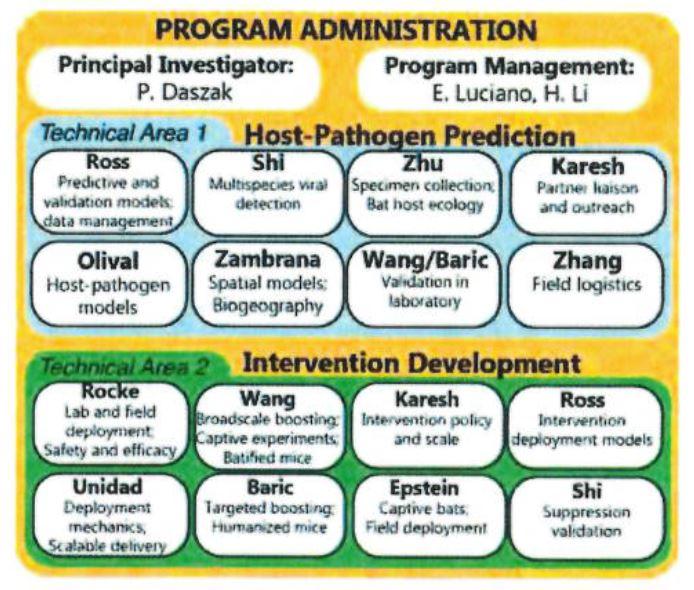
Daszak hoped to use genetic engineering to cobble "human-specific cleavage sites" onto bat Covid 'which would make it easier for the virus to enter human cells' - and included plans to commingle high-risk natural coronaviruses strains with more infectious, yet less deadly versions. His 'bat team' of researchers included Dr. Shi Zhengli from the Wuhan Institute of Virology, as well as US researchers from the University of North Carolina and the US Geological Survey National Wildlife Health Center.

Defuse Project Drastic Anal... by Zerohedge Janitor

Darpa refused the contract - saying "It is clear that the proposed project led by Peter Daszak could have put local communities at risk," while warning that Daszak hadn't fully considered the dangers involved in enhancing the virus via gain-of-function research, or by releasing a vaccine into the air.

Angus Dalgleish, Professor of Oncology at St Georges, University of London, who struggled to get work published showing that the Wuhan Institute of Virology (WIV) had been carrying out “gain of function” work for years before the pandemic, said the research may have gone ahead even without the funding.

This is clearly a gain of function, engineering the cleavage site and polishing the new viruses to enhance human cell infectibility in more than one cell line,” he said. -Telegraph

In short, after a massive drop of receipts proved that Fauci, and his boss Francis Collins, lied, the NIH itself has finally acknowledged funding Gain-of-Function research.

https://www.zerohedge.com/covid-19/nih-admits-funding-gain-function-covid-experiments-gives-ecohealth-five-days-report