Search This Blog

Wednesday, November 17, 2021

Nursing home visiting rules rolled back to pre-pandemic standards

 Family members of nursing home residents are now allowed to visit loved ones whenever they want — and regardless of vaccination status — in a stunning reversal of pandemic-era restrictions imposed almost two years ago. 

The state Department of Health quietly updated its visitation guidance Tuesday evening, bringing the state’s rules in line with federal Centers of Medicare and Medicaid Services standards released Nov. 12.

“While all residents have a right to visitation, fully open and unrestricted visitation posed a clinical health and safety risk to other residents during this [public health emergency], and therefore, it was reasonable to place limits on visitation,” the guidance says. 

“However, at this time, continued restrictions on this vital resident’s right are no longer necessary.”

Family members may now visit loved ones without first making appointments, may meet indoors or outdoors and without needing to show proof of vaccination status or a negative COVID-19 test.

Nursing home advocates have sought better access to facilities, arguing the continued limitations negatively impact the mental and physical health of residents.

The New York Department of Health updated its nursing home visitation guidelines so that people can make visits whenever they want.
AP Photo/Kathy Willens, File
Barbara Goldstein visiting her father Melvin Goldstein at their first in-home visit since the pandemic started at Hebrew Home at Riverdale on March 28, 2021.
AP Photo/Kathy Willens

“For almost two years, families have been under the directive of the government…telling us when we can put our hands on our loved ones,” said Marcella Goheen, whose husband Robert “Bobby” Viteri has lived at the Isabella Center for Rehabilitation and Nursing Care in Manhattan for five years.

On Tuesday, she visited Bobby — who has a rare neurological degenerative disorder called leukodystrophy that prevents him from eating, talking or even moving on his own — telling The Post now that she no longer needs to schedule visits it “doesn’t feel like we’re visiting them in prison.”

“We went to hell and back,” she added. 

Marcella Goheen — whose husband Robert Viteri  is at the Isabella Geriatric Rehab Center in Manhattan — said that scheduling visits made them feel like "prison."
Marcella Goheen — whose husband Robert Viteri is at the Isabella Geriatric Rehab Center in Manhattan — said that scheduling visits made them feel like “prison.”
James Messerschmidt for NY Post

The change comes as COVID-19 vaccination rates have risen — right now 89 percent of all nursing home residents statewide are fully vaccinated, according to the DOH. 

Ninety-four percent of all nursing homes staffers have completed their vaccination series, following a requirement issued earlier this fall that all healthcare workers get the shot or face termination. 

“Visits should be conducted in a manner that adheres to the core principles of COVID-19 infection prevention and does not increase risk to other residents,” reads the CMS guidance, referring to protocols such as mask wearing, physical distancing and disinfection practices by elder care facilities. 

Family members will be able to visit at any time regardless of COVID-19 vaccination status.
AP Photo/Seth Wenig

Facilities are also required to adhere to guidance so long as visits don’t “impose on the rights of another resident” — for example unvaccinated residents and visitors should be kept separate —  and failing to do so “would constitute a potential violation and the facility would be subject to citation and enforcement actions.”

However, visitors “should not enter the facility” if they have tested positive for the disease or exhibiting symptoms, per the guidance.  

“I think it’s good that some restrictions have been taken off and families have a better ability to visit loved ones, but I’m just concerned that it might go too far by allowing unvaccinated and potentially infectious people in the building,” said Jim Clyne, president of LeadingAge New York, which represents non-profit senior care facilities.

“They’re trying to get to a place where residents are allowed to make a decision on how much risk they want to take, which is fine, but the problem is they’re living in a congregate setting. So that person could be in a building with other unvaccinated people. 

The state's new visitation guidelines are in line with the Centers of Medicare and Medicaid Services updated guidelines.
The state’s new visitation guidelines are in line with the Centers of Medicare and Medicaid Services updated guidelines.
AP Photo/Yuki Iwamura, File

Over 15,000 residents have died of confirmed or presumed virus cases in facilities or hospitals since March 2020.

The FBI/US Eastern District of New York launched an investigation into the state’s handling of the virus in these homes after The Post exclusively reported that disgraced ex-Gov. Andrew Cuomo and his top aides refused to release nursing home death data to the US Department of Justice under then-President Donald Trump.

The state Assembly Judiciary Committee is also conducting its own probe into the data and is expected to release a report detailing its findings later this month.

Gov. Kathy Hochul has publicly apologized to family members who lost loved ones and has pledged to release more data pertaining to long term care facilities.

https://nypost.com/2021/11/17/nursing-home-visiting-rules-rolled-back-to-pre-pandemic-standards/

Elimination versus mitigation of SARS-CoV-2 in the presence of effective vaccines


PDF: https://www.thelancet.com/action/showPdf?pii=S2214-109X%2821%2900494-0

Summary

There is increasing evidence that elimination strategies have resulted in better outcomes for public health, the economy, and civil liberties than have mitigation strategies throughout the first year of the COVID-19 pandemic. With vaccines that offer high protection against severe forms of COVID-19, and increasing vaccination coverage, policy makers have had to reassess the trade-offs between different options. The desirability and feasibility of eliminating SARS-CoV-2 compared with other strategies should also be re-evaluated from the perspective of different fields, including epidemiology, public health, and economics. To end the pandemic as soon as possible—be it through elimination or reaching an acceptable endemic level—several key topics have emerged centring around coordination, both locally and internationally, and vaccine distribution. Without coordination it is difficult if not impossible to sustain elimination, which is particularly relevant in highly connected regions, such as Europe. Regarding vaccination, concerns remain with respect to equitable distribution, and the risk of the emergence of new variants of concern. Looking forward, it is crucial to overcome the dichotomy between elimination and mitigation, and to jointly define a long-term objective that can accommodate different political and societal realities.

Correlation of SARS-CoV-2-breakthrough infections to time-from-vaccine


https://doi.org/10.1038/s41467-021-26672-3

Abstract

The short-term effectiveness of a two-dose regimen of the BioNTech/Pfizer mRNA BNT162b2 severe acute respiratory syndrome coronavirus 2 (SARS-CoV-2) vaccine was widely demonstrated. However, long term effectiveness is still unknown. Leveraging the centralized computerized database of Maccabi Healthcare Services (MHS), we assessed the correlation between time-from-vaccine and incidence of breakthrough infection between June 1 and July 27, the date of analysis. After controlling for potential confounders as age and comorbidities, we found a significant 1.51 fold (95% CI, 1.38–1.66) increased risk for infection for early vaccinees compared to those vaccinated later that was similar across all ages groups. The increased risk reached 2.26- fold (95% CI, 1.80–3.01) when comparing those who were vaccinated in January to those vaccinated in April. This preliminary finding of vaccine waning as a factor of time from vaccince should prompt further investigations into long-term protection against different strains.

https://www.nature.com/articles/s41467-021-26672-3

SARS-CoV-2 spike protein causes blood coagulation, thrombosis by competitive binding to heparan sulfate

 YiZhenga1JinxiangZhaob1JiaqiLia1ZhimouGuoaJiajingShengbXianlongYeaGaowaJinaChaoranWangaWengangChaicJingyuYanaDongLiubXinmiaoLianga

DOI: https://doi.org/10.1016/j.ijbiomac.2021.10.112

PDF: https://www.sciencedirect.com/science/article/pii/S0141813021022704/pdfft?md5=8bc46c4cad3a72d2000107daa81fe36d&pid=1-s2.0-S0141813021022704-main.pdf

Highlights

S protein competitively binds to HS/heparin inducing an increase in thrombin activity.

S protein directly promoted blood coagulation and thrombosis in zebrafish model.

Exogenous heparin and HS significantly reduced the coagulation caused by S protein.

Abstract

Thrombotic complication has been an important symptom in critically ill patients with COVID-19. It has not been clear whether the virus spike (S) protein can directly induce blood coagulation in addition to inflammation. Heparan sulfate (HS)/heparin, a key factor in coagulation process, was found to bind SARS-CoV-2 S protein with high affinity. Herein, we found that the S protein can competitively inhibit the bindings of antithrombin and heparin cofactor II to heparin/HS, causing abnormal increase in thrombin activity. SARS-CoV-2 S protein at a similar concentration (~10 Î¼g/mL) as the viral load in critically ill patients can cause directly blood coagulation and thrombosis in zebrafish model. Furthermore, exogenous heparin/HS can significantly reduce coagulation caused by S protein, pointing to a potential new direction to elucidate the etiology of the virus and provide fundamental support for anticoagulant therapy especially for the COVID-19 critically ill patients.

https://www.sciencedirect.com/science/article/pii/S0141813021022704#!

Full protection from all 4 SARS-CoV-2 variants of concern in hamsters requires revision of spike antigen used for vaccination

 Sapna Sharma, Thomas Vercruysse, Lorena Sanchez-Felipe, Winnie Kerstens, Rana Abdelnabi, Caroline Foo, Viktor Lemmens, Dominique Van Looveren, Piet Maes, Guy Baele, Birgit Weynand, Philippe Lemey, 

Johan NeytsHendrik Jan ThibautKai Dallmeier

Children and COVID: Youngest Vaccinees Off to a Slower Start

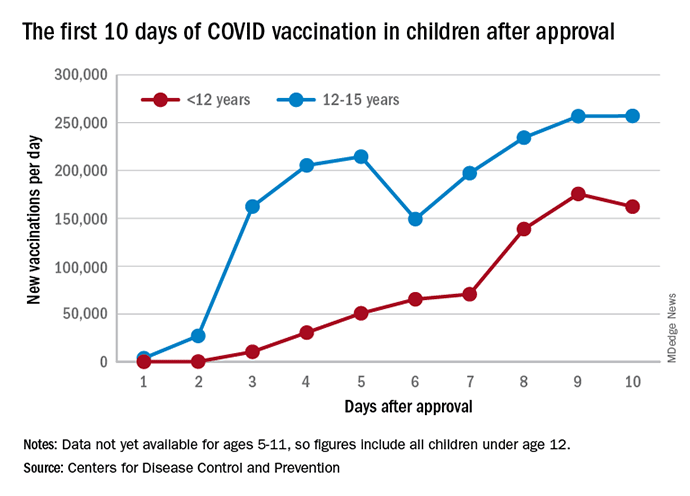
 Just over 1.35 million children under age 12 years have received the COVID-19 vaccine since it was approved on Nov. 2, putting them behind the initial pace set by 12- to 15-year-olds in the spring, based on data from the Centers for Disease Control and Prevention.


Specific figures for children aged 5-11 years are not yet available, but CDC data show that 1.55 million children under the age of 12 years had received at least one dose of COVID-19 vaccine as of Nov. 15, of whom almost 204,000 already had been vaccinated before Nov. 2. For children aged 12-15, the first 2 weeks after approval on May 12 produced almost 2.1 million vaccine initiations, according to the CDC's COVID Data Tracker.

That dataset reveals several other noteworthy differences between the two age groups in the 10 days after approval:

  • There were over 7,000 vaccine initiations on the first day in the 12-15 group; the younger group had 32.

  • The older children reached 100,000 per day in 3 days; the younger children took 8 days.

  • The older group topped 200,000 vaccinations per day on six different days; the younger group didn't get above 175,000.

Children under 12 made up 27.5% of vaccine initiations in all age groups during the 2 weeks from Nov. 2 to Nov. 15, versus 3.4% for 12- to 15-year-olds and 1.2% for 16- and 17-year-olds, the CDC said, while also reporting that 3.6% of children under age 12 had received at least one dose of the COVID vaccine, compared with 57.8% of those aged 12-15 and 64.4% of 16- to 17-year-olds.

Meanwhile, the first full week of November marked the second consecutive increase in the number of weekly child COVID cases, with 122,000 reported for Nov. 5-11. The number of new cases has now surpassed 100,000 for 14 consecutive weeks, the American Academy of Pediatrics and the Children's Hospital Association said in their weekly COVID report. That report, which covers state health departments, has not included current information from Alabama, Nebraska, and Texas since the summer.

Regionally, the increases over the past 2 weeks were spread out among the East, the Midwest, and the West, while the decline that had been going on for several weeks in the South has largely come to a halt. The states with the highest percent increases over those 2 weeks are all in New England: Maine, New Hampshire, and Vermont, the AAP and CHA noted. In a separate report, the AAP said that Vermont has the second-highest child vaccination rate (81%) in the country, just behind Massachusetts (82%).

https://www.medscape.com/viewarticle/963079

NYC Officials Push COVID-19 Boosters Amid Rise in Cases

 New York City health officials urged COVID-19 vaccine providers Monday to make booster shots widely available to most adults who want one amid a statewide spike in infections over the past two weeks.

U.S. health officials have yet to authorize booster shots for all adults, but current federal guidance says they may be taken by anyone age 65 or older, or who has an underlying health condition or lives and works in a "high-risk" setting.

City Health Commissioner Dr. Dave Chokshi said patients are better positioned than doctors to decide what qualifies as a high-risk setting, and he was advising doctors to provide booster shots to any adult patient who wants one as long as it has been at least six months since they received their second dose of the Moderna or Pfizer vaccines or at least two months since they received the single-dose Johnson & Johnson vaccine.

Dr. Mitchell Katz, the CEO of the city's public hospital system, added that he considered all of New York City a high-risk setting because of its density.

Meanwhile, across New York state, the number of people testing positive each day for the virus has gone up 45% since Halloween. As of Monday, New York was averaging around 5,400 new cases per day over the past seven days.

Officials in Erie and Monroe counties said in a joint online briefing that they were especially concerned about more stress on hospitals that are already near or over capacity.

"I understand systemic pandemic fatigue is real. I'm feeling it too, and it's intense," said Erie County Health Commissioner Dr. Gale Burstein. "We are living through another holiday season in the shadow of this pandemic, but with one significant change. Now we have a safe and effective vaccine to protect us all."

Gov. Kathy Hochul said in a statement that she believes "no one who feels they are at risk should be turned away from getting a COVID-19 booster shot."

https://www.medscape.com/viewarticle/963055