Search This Blog

Tuesday, February 1, 2022

Japan's Kowa: Ivermectin Has 'Antiviral Effect' Against Omicron, All Other Covid 'Mutant Strains'

 A Japanese pharmaceutical company, Kowa Co, said on Monday that the drug ivermectin has an "antiviral effect" against Omicron and other Covid-19 variants.

The finding was made with Tokyo's Kitasato University on a joint non-clinical research project, which has been testing the drug as a potential treatment for the disease, according to Reuters.

Kowa says that ivermectin showed the "same antiviral effect" on all "mutant strains," including Alpha, Delta and Omicron. The company also noted that ivermectin suppresses invasion of the virus and inhibits its replication.

"[Ivermectin] is expected to be applied as a therapeutic drug (tablet) for all new coronavirus infectious diseases," reads the report.

Of note, Reuters changed their original headline from "effective" against Omicron to having an "antiviral effect," and corrected a statement that the finding occurred during "Phase III clinical trials."

Ivermectin is at the heart of an ongoing 'medical misinformation' campaign surrounding podcaster Joe Rogan and several expert guests who have advocated for the use of the anti-parasitic drug as an early treatment option for Covid-19 patients. Rogan himself used ivermectin as part of a cocktail of treatments when he contracted Covid-19.

Controversy over free speech erupted last week after singers Neil Young and Joni Mitchell demanded that Spotify remove their music catalog unless Rogan was silenced.

Rogan responded to the drama on in a Monday Instagram video, in which he said he only seeks to have conversations on his podcast with people who have "differing opinions," and that he isn't "trying to promote misinformation."

He noted that he's booked experts from all sides, including CNN's chief medical correspondent Dr. Sanjay Gupta, Dr. Michael Osterholm, who is a member of President Joe Biden’s COVID-19 advisory board, and Dr. Peter Hotez from Baylor College of Medicine.

Rogan also pointed out that many previously-verboten Covid claims have turned out to be true.

According to ivmmeta.comIvermectin showed an average 64% improvement as an early treatment, a 39% improvement as a late treatment and an 83% improvement as a prophylaxis, across 77 studies.
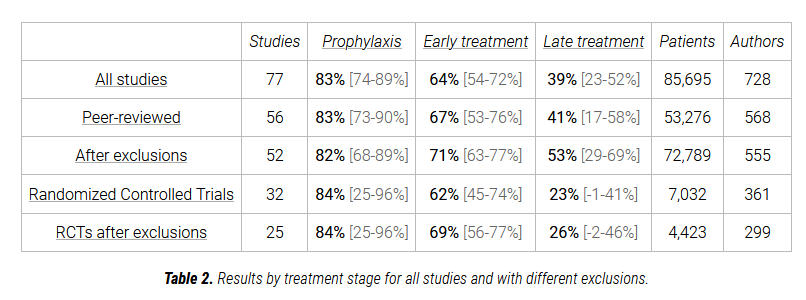
As The Epoch Times notes;

Ivermectin has been used by the World Health Organization for over 30 years to treat parasitic infections. Volunteers have distributed the drug in African countries where it has been found to be extremely effective, said the Kowa report.

However, the treatment has been mired in controversy during recent times as the U.S. Food and Drug Administration (FDA) has not approved the use of ivermectin as a treatment for COVID-19, even though the drug is used in humans to treat a variety of conditions.

The FDA has refused to respond to a Freedom of Information Act request (FOIA) asking for details about any reports of side effects related to the use of ivermectin in treating COVID-19 while publicly denouncing its usage.

The federal government pays hospitals across the country to treat COVID-19 patients, but the payment is tied to approved methods, and ivermectin is not part of the protocol.

However, families desperate to save their loved ones are resorting to secretly sneaking the drug into hospitals as a last-ditch effort that often ends up helping the infected person recover.

All or part of 22 countries around the globe have approved the use of ivermectin in the treatment of COVID-19, based on multiple studies. Japan has not yet approved ivermectin for the treatment of COVID-19.

A bill has been presented to make New Hampshire the first state in the country to make ivermectin part of the approved COVID-19 treatments and offer it as an over-the-counter medication.

https://www.zerohedge.com/covid-19/ivermectin-has-antiviral-effect-against-omicron-and-all-other-mutant-strains-covid-19

AbbVie's new migraine meds could each pull in $2B at peak thanks to class growth: analyst

 There’s plenty of growth ahead for the CGRP class of migraine meds, according to analysts at Evercore ISI who recently surveyed 25 neurologists. And with two of the most promising drugs in the class, that’s good news for AbbVie.

AbbVie predicts Ubrelvy, a pill taken for acute relief from migraine attacks, and Qulipta, a pill to prevent attacks, will each generate peak sales of more than $1 billion. But Evercore’s survey of 25 neurologists indicates that AbbVie’s estimates might be conservative for the drugs, which the company gained in its 2020 acquisition of Allergan.

“It seems to us that peak sales potential for each could be closer to $2 billion-plus, instead of $1 billion," Evercore’s Josh Schimmer wrote in a note to investors.

Still, Biohaven’s Nurtec ODT represents a formidable competitor because it's endorsed both to treat and prevent migraine attacks. While Evercore sees Ubrelvy’s share of the CGRP acute market falling from 38% to 31%—largely thanks to gains made by Nurtec—the analysts say there is enough momentum for the class overall to benefit both players.

Evercore cites Biohaven’s pre-announced fourth quarter sales of $190 million, a 40% increase from the third quarter, as evidence of a “robust outlook for the CGRP class.”

Over the next five years, Evercore projects the use of CGRP drugs in the acute setting to grow by 200%. In the preventative setting, the analysts believe the CGRP growth will be 150% over the same period.

In the preventative arena, Qulipta’s share of the market will grow to between 9% and 18% of the market. That field is presently ruled by injectable CGRP treatments from Amgen, Eli Lilly and Teva.

After their own survey of 99 primary care doctors last fall, Piper Sandler analysts projected more success for Biohaven’s drug at the expense of Ubrelvy. Based on the survey results, Piper Sandler estimated 2023 sales of $1.38 billion for Nurtec versus $769 million for Ubrelvy and $437 million for Amgen’s injectable Aimovig.

The analysts were highly optimistic over Qulipta’s opportunity for quick uptake, pegging 2023 sales at $735 million, nearly twice the Wall Street consensus of $370 million. 

https://www.fiercepharma.com/pharma/abbvie-set-to-benefit-from-growth-cgrp-class-migraine-treatments-says-analysts-after-survey

Youngkin, Justice seek relief from health worker vax rule

 Warning of hospitals and other health providers facing “an urgent staffing crisis,” the Republican governors of Virginia and West Virginia on Monday asked the Biden administration for a limited waiver to the federal vaccine mandate for health care workers.

The U.S. Supreme Court recently ruled the federal government can proceed with the rule, which covers most health care workers in the U.S. Virginia Gov. Glenn Youngkin and West Virginia Gov. Jim Justice acknowledged in a letter Monday that the legal process had left the rule in place but asked for “relief” for rural and state-run facilities.

The governors proposed such relief could come in multiple forms, such as broader conscience exemptions, flexibility on enforcement or a six-month delay in implementation. Without such flexibility, they wrote, the rule will compound existing staffing shortages.

“The impact in Southwest Virginia and throughout West Virginia will be particularly acute. In these rural areas, access to lifesaving care could be threatened and we may displace a generation of healthcare professionals in a region already battling health disparities,” the letter said.

It was sent Monday to Chiquita Brooks-LaSure, administrator of the Centers for Medicare and Medicaid Services. CMS did not immediately respond to a request for comment.

Justice said at a COVID-19 briefing Monday that while the mandate can be met at hospitals in more populated areas, “it is putting an additional level of strain on our rural hospitals that is just destroying us.”

Justice, who has been a constant bullhorn for vaccinations since the start of the pandemic, announced in December that West Virginia will use $48 million in federal stimulus funding to aggressively recruit and train nurses over the next four years.

The National Guard has also responded to the staffing shortage by sending hundreds of trained members to help at dozens of hospitals along with some long-term nursing and psychiatric facilities.

“We can’t afford to lose anybody. We can’t absolutely afford to be firing people,” Justice said. “We should be respectful of their values. But we should encourage them in every way to be vaccinated. Nevertheless, we can’t shut the hospital down. That’s all there is to it.” he said.

Justice also said Monday he has not received a “substantive” response from the CDC on his request from early January for West Virginians to receive a second booster shot.

About 52% of West Virginia residents are fully vaccinated against the virus and about 61% have received at least one dose. West Virginia has seen the five highest confirmed weekly virus cases during the pandemic in the past five weeks, including nearly 17,700 last week, according to state health figures.

In addition, a record 1,700 people are currently hospitalized for the virus, 69.1% of whom are unvaccinated.

Overall vaccination rates are higher in Virginia, where about 79.1% of the population has received at least one dose and 68.8% are fully vaccinated. The commonwealth has also broken case count and hospitalization records during the latest surge due to the highly contagious omicron variant.

Youngkin, who was sworn in earlier this month, is also a vocal advocate for vaccination efforts, though he opposes vaccine and mask mandates.

He was scheduled to meet Monday afternoon with officials from Ballad Health — a system that serves a swath of northeast Tennessee, southwest Virginia, northwest North Carolina and southeast Kentucky — at a hospital in Abingdon. A spokesperson said he planned to discuss the letter with staff there.

Ballad CEO Alan Levine, who has been advising Youngkin on Virginia’s pandemic response, has previously been outspoken about staffing concerns arising from the mandate.

Last week, the health system said it would allow workers who had tested positive for COVID-19 but were asymptomatic to keep working under certain circumstances.

The federal mandate ultimately will cover 10.4 million health care workers at 76,000 facilities. Health care workers in about half the states face a Thursday deadline to get their first dose of the vaccine.

It is taking effect first in jurisdictions that did not challenge the requirement in court. Virginia, which until mid-January was under Democratic control, is among them.

https://apnews.com/article/coronavirus-pandemic-joe-biden-business-health-west-virginia-d7c61610428acae859128ab3bdbfc64b

Pennsylvania adding long-term care beds to ease COVID crunch

 Pennsylvania is setting up four regional support sites with as many as 120 beds to help hospitals and nursing homes under strain from COVID-19, state officials said Monday.

The temporary sites will be located in existing skilled nursing facilities in Philadelphia and Pittsburgh, as well as in Blair and Clarion counties, and will allow hospitals to more rapidly discharge patients in need of long-term care.

Pennsylvania nursing homes have been reporting dire staffing shortages that forced many of them to stop accepting new residents, which in turn has prevented hospitals jammed with COVID-19 patients from discharging patients who require skilled nursing care.

Though pandemic-related hospitalizations are dropping in Pennsylvania, the state still has thousands of people in the hospital with COVID-19. Acting Secretary of Health Keara Klinepeter on Monday called it an “acute situation.”

“COVID-19 hospitalizations remain at historically high levels and healthcare workers need some support to get through this current surge,” she said.

General Healthcare Resources will supply clinical staff to the long-term-care support facilities under contract with the state, with workers to be recruited from outside Pennsylvania. The Pennsylvania National Guard will provide non-clinical staffing. The support sites will be open about 90 days based on demand, officials said.

Separately, state-directed pandemic “strike teams” of health care workers have been deployed at two Philadelphia-area hospitals, while federal strike teams are working at hospitals in Scranton and York.

https://apnews.com/article/coronavirus-pandemic-health-pittsburgh-pennsylvania-philadelphia-f1d124ef6f8d0c0ab284f529b8b4b5b7

California moves to toughen state’s nursing home oversight

 California lawmakers on Monday moved to strengthen the state’s oversight of nursing homes, barring anyone from operating a skilled nursing facility without a license.

Democratic Assemblyman Al Muratsuchi said his bill would give the California Department of Public Health stronger authority to block unqualified and unethical owners by shutting down what he said is an increasing number of for-profit nursing home chains operating unlicensed nursing homes.

“This bill seeks to fix a broken state licensing system,” Muratsuchi said.

The problem has only been exacerbated by the pandemic, endangering thousands of those who are elderly or disabled, said Democratic Assemblyman Jim Wood.

“Part of what we’re trying to do is protect some of the most vulnerable people in our society,” Wood said. “We’ve seen too many perish in nursing homes during COVID. We’re seeing another wave of it now. They’re a fragile population.”

The Assembly passed the bill on a 47-12 vote, sending it to the Senate.

Muratsuchi cited two chains that he said are collectively running several dozen homes without appropriate state licensing.

Many of their licensing applications were denied years ago due to poor conditions, he said, yet they’ve been allowed to keep operating while buying more nursing homes during the pandemic.

His bill would set licensing standards and bar the use of management agreements that critics say the corporations have used to circumvent state licensure requirements. Violators could be hit with civil penalties of $10,000.

“The state’s failure to screen out unfit operators is like a welcome sign to bad actors,” said California Advocates for Nursing Home Reform, which backed the bill as part of a package of reform legislation in the last year.

It said owners’ decisions on staffing, administration and care “have life and death consequences for nursing home residents in the best of times, and never more so than during the pandemic.”

2018 state audit also faulted the state’s poor oversight.

The California Association of Health Facilities, which represents most of the state’s nursing homes, opposed the bill without further amendments, but agreed that the process needs reform.

It blamed California for having “the most unworkable and lengthy licensure process in the nation.” However, it said, “nursing facilities did not create this backwards process. It has been perpetuated by the state – and it needs to end.”

The bill goes too far, it said, with “stringent disqualifications criteria (that) would eliminate most if not all potential applicants.”

https://apnews.com/article/business-health-california-nursing-homes-7a747abdadefb55ef345a3ed636634b4

NY mask mandate to remain in place during appeal

 New York’s mask mandate will remain in effect while the state appeals a ruling from a lower court judge overturning it, an appellate panel of judges ruled Monday.

The ruling from the four-judge panel followed an appeals court judge’s decision last week temporarily restoring it the day after the initial ruling overturning it.

The state’s health commissioner had reinstated the mask mandate in mid-December over a surge in coronavirus cases, requiring masks in schools, health care facilities, homeless shelters, jails, public transportation, and in any indoor public area where vaccination wasn’t required for entry.

It was initially put in place for a least a month; it has now been extended to Feb. 10.

A group of parents sued over the mandate, and in the initial ruling against it, a judge said the governor and the health department didn’t have the authority to reinstate it.

In the decision from the appeals panel, the judges said the mandate would be in place until the state’s appeal of the lower court ruling was decided, and said the state had until March 2 to file.

https://apnews.com/article/coronavirus-pandemic-health-new-york-nyc-state-wire-98dd566f7605a7f13a9a065945f0d69c

Universal health care bill fails to pass in California

 A bill that would have created the nation’s only government-funded universal health care system died in the California Assembly on Monday as Democrats could not gather enough support to bring it for a vote ahead of a legislative deadline.

The bill had to pass by midnight on Monday to have a chance at becoming law this year. Democrats needed 41 votes for that to happen, a threshold that did not seem impossible given that they control 56 of the 80 seats in the state Assembly and universal health care has long been a priority for the party.

But intense lobbying from business groups put pressure on more moderate Democrats, who face tough reelection campaigns this year in newly-redrawn districts. Plus, Democrats were missing four lawmakers from their caucus — including three of their more liberal members — who had resigned recently to take other jobs.

“Especially with four democratic vacancies in the Assembly, the votes were not there today, but we will not give up,” Assemblymember Ash Kalra, a Democrat from San Jose and the bill’s author, said in a news release.

Kalra’s decision not to bring the bill up for a vote incensed his allies in the California Nurses Association, who have been pushing for this bill for years — including campaigning heavily for Democratic Gov. Gavin Newsom’s 2018 election. While Kalra had authored the bill and gotten it out of two legislative committees to reach the Assembly floor, the Nurses Association said in a statement they were “outraged that Kalra chose to just give up on patients across the state.”

Progressives have dreamed about a universal health care system in the U.S. for decades. Health care is so expensive, they say, in part because the nation’s health care system is paid for by multiple parties, including patients, insurance companies, employers and the government. Instead, they say the U.S. health care system should have a single payer — the government — that would keep prices under control and make health care available to all.

But while other nations have adopted such systems, it’s been impossible to establish in the United States. Vermont enacted the nation’s first such system in 2011, but later abandoned it because it would have cost too much.

In California, voters overwhelmingly rejected a universal health care system in a 1994 ballot initiative. Former Republican Gov. Arnold Schwarzenegger twice vetoed similar legislation in the 2000s. And a 2017 proposal stalled in the state Assembly.

The biggest hurdle is cost. A study of a 2017 proposal for universal health care in California estimated it would cost $331 billion, which is about $356 billion today when adjusted for inflation. Meanwhile, California is expected to account for about $517 billion in health care spending this year, with the largest chunk coming from employers and households, according to an analysis by a commission established by Gov. Gavin Newsom to study universal health care.

For comparison, California’s entire state operating budget — which pays for things like schools, courts, roads and bridges and other important services — is about $262 billion this year.

To pay for the plan, Democrats had introduced a separate bill that would impose hefty new income taxes on businesses and individuals, which fueled much of the opposition to the plan.

“Today’s vote in the Assembly was a vote to protect their constituents from higher taxes and chaos in our health care system,” said Ned Wigglesworth, spokesperson for Protect California Health Care, a coalition of health care providers opposed to the bill.

Supporters say consumers are already paying exorbitant amounts for health care, saying a single-payer system would save money by eliminating deductibles, copays and expensive monthly insurance premiums.

Both bills are now likely dead for the year. But Kalra appeared to indicate he would try again next year, saying “this is only a pause for the single-payer movement.”

He’ll have to navigate a new Legislature next year following the midterm elections that will see lots of turnover in the state Assembly because of term limits. Assembly Speaker Anthony Rendon, a Democrat from the Los Angeles area who will be termed out in 2024, said he was “deeply disappointed” Kalra did not call the bill for a vote on Monday.

“I support single-payer and fully intended to vote yes on this bill,” Rendon said. “With time, we will have better and more successful legislation to bring us closer to this goal. I expect more and more of my colleagues to sign on, so we can make California a health care justice leader.”

Republicans, meanwhile, seemed to welcome Democrats’ persistence.

“The fact that a proposal for a government takeover of our state’s entire health care system even made it this far shows just how out of touch the Democratic party is from the needs of everyday Californians,” Assembly Republican Leader Marie Waldron said.

https://apnews.com/article/business-health-california-legislature-state-legislature-88d57ed5845b47c54e7c0e397ab7de13