Search This Blog

Sunday, February 13, 2022

Biotech week ahead, Feb. 14

Biotech stocks moved back and forth amid some volatility before finishing the week ending Feb. 11 modestly lower, reversing the gains from the previous week. Earnings news flow continued to dominate proceedings, and the week also witnessed presentations at conferences and a couple of initial public offerings.

Pfizer, Inc.'s 

 (Get Free Alerts for PFE) fourth-quarter topline growth trailed expectations, exerting downward pressure on the stock.

Modular Medical, Inc. 

 (Get Free Alerts for MODD) and TC BioPharm (Holdings) plc American Depositary Shares NASDAQTCBP debuted on Wall Street following their IPOs.

Novavax, Inc. 

 came under pressure midweek after a report suggested that the company is lagging very much behind its COVID-19 delivery commitments.

Here are the key catalysts that can move stocks in the biotech space in the coming week:

Conferences

SVB Leerink Global Healthcare Conference (virtual event): Feb. 14-18

17th Congress Of European Crohn's and Colitis Organization, or ECCO (virtual event): Feb. 16-19

ASCO Genitourinary Cancers Symposium (hybrid event): Feb. 17-19, in Moscone Center, San Francisco, California and online

PDUFA Dates

The Food and Drug Administration is scheduled to rule on Agios Pharmaceuticals, Inc.'s 

 new drug application for mitapivat, its most advanced drug candidate, as a treatment option for pyruvate kinase deficiency. PKD is a rare, inherited disease that presents as chronic hemolytic anemia, which is the accelerated destruction of red blood cells.

Adcom Calendar

A joint meeting of the Anesthetic and Analgesic Drug Products Advisory Committee and the Drug Safety and Risk Management Advisory Committee will discuss Avenue Therapeutics, Inc.'s 

 NDA for tramadol hydrochloride injections for the management of moderate to moderately severe pain in adults in a medically supervised healthcare setting. The issues for the committees to discuss include the clinical relevance of tramadol hydrochloride injections, an opioid intended for management of acute pain in a medically supervised healthcare setting, when its onset of action is delayed, and its proposed dosing is a fixed-dosing regimen.


Clinical Readouts/Presentations

BioCardia, Inc. 

 has a catalyst in the form of an announcement regarding the outcome of the Data Safety Monitoring Board review in the CardiAMP cell therapy heart failure trial in early February.

ASCO GU Symposium Presentations

AstraZeneca plc. 

: results from the PROpel Phase 3 trial of Lynparza plus abiraterone, which showed the combination significantly delayed disease progression in 1st-line metastatic castration-resistant prostate cancer regardless of biomarker status (Thursday, 4-4:10 pm) & results of the BAYOU Phase 2 trial evaluating the combination of Lynparza and Imfinzi in unresectable, Stage IV bladder cancer (Friday, 5:42 pm – 5:52 pm)

ECCO Congress Presentations

Galapagos NV 

 & Gilead Sciences, Inc. 

: new analyses from Phase 2/3 SELECTION and Phase 3 SELECTION long-term extension studies of Jyseleca (filgotinib) in ulcertative colitis

Earnings

The earnings list presented is not comprehensive. Click here to access Benzinga's earnings calendar for the complete schedule

Monday

Aethlon Medical, Inc. 

 (after the market close)
Medpace Holdings, Inc. 

 (after the market close)

Tuesday

AtriCure, Inc. 

 (after the market close)
Pacific Biosciences of California, Inc. 

 (after the market close)
Adaptive Biotechnologies Corporation 

 (after the market close)

Wednesday

Blueprint Medicines Corporation 

 (before the market open)
Alkermes plc 

 (before the market open)
10x Genomics, Inc. 

 (after the market close)

Thursday

West Pharmaceutical Services, Inc. 

 (before the market open)
Insmed Incorporated 

 (before the market open)
Repligen Corporation 

 (before the market open)
T2 Biosystems, Inc. 

 (after the market close)
Quidel Corporation 

 (after the market close)
Coherus BioSciences, Inc. 

 (after the market close)
Prothena Corporation plc 

 (after the market close)
Globus Medical, Inc. 

 (after the market close)
Ligand Pharmaceuticals Incorporated 

 (after the market close)
Ironwood Pharmaceuticals, Inc. 

 (after the market close)

https://www.benzinga.com/general/biotech/22/02/25588601/the-week-ahead-in-biotech-feb-13-19-agios-fda-meeting-avenue-adcom-earnings-and-more

CAS Concludes Hearing on Valieva, Decision Expected Monday

The Court of Arbitration for Sport (CAS) has concluded its hearing on Russian figure skater Kamila Valieva after she tested positive for a banned drug but a final decision on the teenager will be announced later on Monday.

The 15-year-old prodigy, who became the first woman to land a quadruple jump at the Olympics en route to winning gold with the Russian Olympic Committee (ROC) in the team competition, tested positive for a banned heart drug on Dec. 25 but it took more than six weeks for the result to be made public.

Her future at the Beijing Games and the team gold won by the ROC now hangs in the balance amid a global outcry over Moscow's doping history.

Valieva is due to compete again on Tuesday in the women's individual event, forcing CAS to rule on her continued participation before then, with the hearing finishing in the early hours of Monday.

"The hearing was concluded. It was a long hearing. Now the panel will deliberate until tomorrow morning, the end of the morning," CAS Secretary General Matthieu Reeb told reporters.

"We hope to be able to announce a final decision tomorrow at around one, two or three p.m. tomorrow afternoon and there should be an announcement which should be either by press release on the website or a public announcement also tomorrow.

"We need to organize that and we still have some work to do... I cannot comment on anything at the hearing but I hope to give you a decision ... in a few hours."

When asked if Valieva gave evidence, Reeb said he could not answer the question.

An automatic provisional suspension, imposed after any positive test, was lifted by the Russian Anti-Doping Agency on Wednesday.

But the International Olympic Committee (IOC) and World Anti-Doping Agency (WADA) filed appeals to CAS to reinstate it.

Initially it was thought the case would be heard by CAS's six-member doping unit, but the court later said its legal disputes unit would be handling it.

WADA also said on Sunday that it would ask its independent Intelligence and Investigations Department to investigate the coaches, doctors and other adults surrounding the athlete.


https://www.voanews.com/a/olympics-cas-concludes-hearing-on-valieva-decision-expected-monday/6440075.html

Bids for £7bn Boots auction due by end of month to Walgreens

 Walgreen Boots Alliance has given a deadline for interested parties to lodge first round bids in the £7 billion auction for health and beauty chain Boots.

Potential buyers – which include a number of the world’s largest private equity groups and the new owners of Asda – have until the end of this month to signal their interest.

According to a report in The Times, Boots UK chief executive Sebastian James has been meeting prospective bidders this week, along with advisers at Goldman Sachs. Discussions have included the opportunity for Boots to offer a wider range of health services (including vaccinations) and an improved range of beauty brands.

The billionaire Issa brothers and private equity group TDR Capital – which bought Asda last year – have been paying close interest to the process. They are expected to make a bid for the business.

Other private equity firms who are widely considered to be strong contenders in the process include Bain and CVC, who have joined forces for the potential takeover. The partnership includes Dominic Murphy, a senior partner at CVC who also has a seat on the Walgreens Boots Alliance board, although he is expected to distance himself from the bid.

Sources also revealed that, despite ongoing speculation that Sainsbury’s would be interested in acquiring Boots, the supermarket was reluctant to have another deal rejected by the Competition and Markets Authority (CMA) after its Adsa merger was rejected last year.

The 172-year-old pharmacy chain has 2,200 stores and 550 opticians in the UK, employing around 51,000 people.

US owner Walgreens acquired it in the early 2010s and has invested £2.8 billion in the company, including £300 million in recent online and store refurbishments. It has also taken hundreds of millions of pounds in dividends from the British business.

https://www.retailgazette.co.uk/blog/2022/02/bids-for-7bn-boots-auction-due-by-end-of-month/

Common Mistakes Traders Make - 2: Acting Before Understanding

 In the first post in this series, we took a look at how traders often lose their ideas when their stop levels are hit.  In this post, we'll examine a different, but related, cognitive mistake.  Many traders will place trades based upon price patterns and "setups" without truly understanding how their market is behaving.  This is a particular problem when market regimes change and markets change their behavior.  Knowledge is necessary, but not sufficient, in trading success.  We also need to understand what is happening in our markets so that we can profit from the behavior of other market participants.


One variable important for understanding is volume and especially changes in trading volume.  If volume is increasing in a stock, index, or other instrument, it means that new participants have entered the market.  We want to examine how our market responds to this expansion of participation, because that will provide us with important clues as to who is in the market and how they are leaning.  For instance, if we're trading a small cap stock with a relatively small float, a meaningful expansion of volume almost certainly indicates speculative interest among small traders.  These traders are active as daytraders and often pile into momentum when a stock moves.  Knowing this, we can get ahead of their activity.  A large cap stock, on the other hand, is dominated by institutional traders who will wait for good prices and execute their orders over a period of time.  If we can study the stock and see how it has moved on high volume in the past, we can reverse-engineer the execution algorithms used by the large traders and front-run their accumulation of shares.  Stocks index volume is often significant as a function of time of day, as different participants are active at different time zones and times within each zone.  When we see volume expanding and a breakout early in the U.S. session, this often has implications for trending through the day.

Another variable important for understanding is the correlation among related market instruments.  If an auto stock is making a move, it pays to check out other auto stocks and the broader list of industrial shares.  We want to determine if this is an idiosyncratic move, specific to the company, or whether institutions are accumulating shares in particular industries and sectors.  Seeing how sectors behave before we trade can help us distinguish between rotational environments, which are often rangebound, and trending environments.

A football team would never call a play without checking out the defense of the opponent.  Similarly, we want to understand the market environment before we call a play with our capital.  When we act before we understand, we implicitly assume that all price patterns are equal in their meaning and significance.  If that were true, wouldn't sophisticated algorithmic participants already have mined such simple "setups"?  It is precisely the complexity of movement at different levels of participation, different times of day, and different co-movements of instruments that makes trading challenging, even for the algos.  Great traders don't have a passion for trading; they have a passion for understanding markets.  That's what makes professional trading different from gambling.

USDA Suspends Mexican Avocado Imports, Stokes Yet More Food Inflation

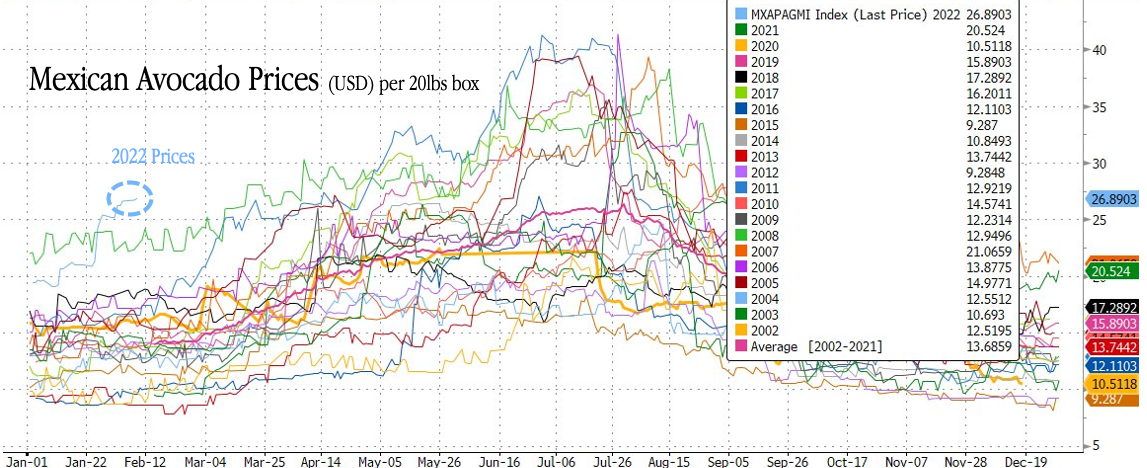
 The U.S. suspended all imports of Mexican avocados that could send prices to near-record highs in the coming weeks on diminishing supplies if the ban remains in place. The reason for the import halt is a U.S. Department of Agriculture (USDA) inspector was threatened by what is presumed to be drug cartel members. 

"U.S. health authorities…made the decision after one of their officials, who was carrying out inspections in Uruapan, Michoacan, received a threatening message on his official cellphone," Mexico's Agriculture Department said in a statement. -AP News 

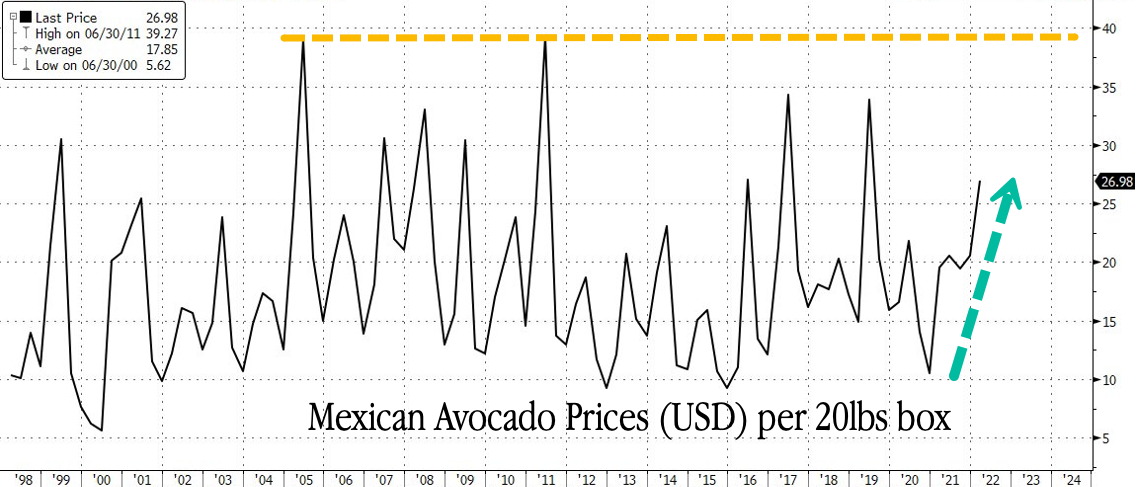
The surprise halt comes as the price of a 20-pound box of avocados from the state of Michoacan, Mexico (the central hub of Mexican avocado production) is approximately $26.89, the highest ever for this time of year with data going back to 1998.

This year alone, avocado prices are up 31%. The import ban came on the eve of the Super Bowl and may send spot prices to record highs on the prospects of tighter supplies. 

Supply woes aren't expected to affect Super Bowl consumption since those avocados had already been shipped, but there are concerns disruptions could be seen in the weeks ahead (if the import ban remains in place). 

The ban also comes as the Avocados From Mexico association unveiled its Super Bowl ad that will be shown during the game. 

Violence against USDA inspectors is nothing new since the Michoacan state is known for cartel turf wars. In 2019, a team of inspectors was threatened by a cartel. 

USDA wrote in a memo at the time, "For future situations that result in a security breach, or demonstrate an imminent physical threat to the well-being of APHIS personnel, we will immediately suspend program activities."

https://www.zerohedge.com/commodities/usda-suspend-mexican-avocado-imports-ahead-super-bowl

Three proteins found to help fine tune movement

 Three members of a family of proteins have been identified that are important to helping us fine tune the activity of brain chemicals which enable us to walk or stand at will, scientists report.

The findings point toward the proteins KCTD5, KCTD17 and KCTD2 as potential new therapeutic targets in conditions like Parkinson's and dystonia where control of movement is lost, says Dr. Brian Muntean, pharmacologist and toxicologist at the Medical College of Georgia at Augusta University and co-corresponding author of the study published in the journal PNAS.

Dr. Kirill A. Martemyanov, chair of the Department of Neuroscience at the Florida Campus of the Scripps Research Institute in Jupiter, Florida, also is a corresponding author.

The fine tuning these KCTD family members appear to enable is called neuromodulation, which involves hundreds if not thousands of proteins inside neurons that are part of the complex pathway that precisely fine tunes the fast-moving sharing of neurotransmitters, or chemical messengers, between these brain cells so we can accomplish a desired function of our brain and body like walking across the room.

It's the first discovery about the role these KCTD proteins play in neurons called striatal neurons, which are essential to movement and a variety of other fundamental functions.

One of the key pathways neuromodulators use is cyclic AMP, or cAMP, which is called a "second messenger" because it's a response inside a cell that occurs in response to something that happens outside a cell.

In the case of movement, a key external influence is the neurotransmitter dopamine, known to be important to controlled movement and known to be deficient in Parkinson's. As a neurotransmitter, dopamine works by interacting with a receptor on the surface of neurons, which triggers a lot of activity inside the cell including triggering proteins, which they now know include these three members of the KCTD family. In this complex scenario, dopamine also functions as a neuromodulator by helping regulate cAMP levels inside neurons.

"People can still move but sometimes they can't stop moving because the neurotransmission keeps going but the cells aren't being modulated correctly to interpret the neurotransmission," Muntean says.

The scientists have found that these three KCTD proteins are doing at least two things simultaneously to modulate the fast work of neurotransmitters.

They are helping regulate the way dopamine is making cAMP both by interacting with the proteins that directly make it and by interacting with proteins that put zinc, which is also known to regulate cAMP, into the neurons.

"Modulating the cAMP level is what can kind of dictate the long-term ability of these neurotransmitters to work perfectly," Muntean says.

KCTD is a family of about two dozen proteins, which scientists have begun to realize are involved in this complicated pathway of regulating the regulators, by binding to some of the proteins in the pathway that regulate cAMP.

The scientists found that the three KCTDs do bind to proteins that make cAMP. But they also found they interact with proteins that put zinc into neurons, something they had not really considered before. Zinc in an essential mineral important to a lot of processes like making proteins and cell division, as well as regulating cAMP levels. About 10% of the proteins inside cells bind to zinc, which can help the proteins work better or less well, so it can modulate the activity of a lot of these proteins in the cell, Muntean notes.

In this scenario, the scientists found zinc appears important in the "very layered" process of modulating cAMP and that KCTD5 regulates zinc levels by controlling levels of the transporter, Zip 14, which brings zinc inside cells.

They started by looking at a total of six members of the KCTD family known to have a role in G protein coupled receptor signaling, the biggest family of receptors on the cell surface including dopamine receptors on neurons.

To learn more about the function of these proteins, they used the precise gene editing ability of CRISPR/Cas9 to selectively stop neurons from the striatum, a small area of the brain key to movement, from making the proteins.

When they eliminated KCTD5, KCTD2 and KCTD17, they found cAMP production enhanced in response to dopamine, with the largest response resulting from eliminating KCTD5. KCTD5 elimination also increased the neurons' sensitivity to dopamine.

To look more closely at exactly what is regulating cAMP activity, they used the root extract forskolin, which is known to regulate the activity of the enzyme adenylyl cyclase which makes cAMP.

When they added forskolin, it generated a "rapid and robust" increase in cAMP in neurons where KCTD2, KCTD5 and KCTD17, were present. When they used CRISPR to eliminate these KCTD family members, it also eliminated the positive response to the root extract. Deletion of the other members of the KCTD family of proteins they were looking at had no effect on generation of cAMP or sensitivity to dopamine.

Additionally, they found that mice without sufficient KCTD5 had major motor deficits that could be reversed by removing some of the now excessive zinc, more evidence that one way KCTD5 helps fine tune movement is by regulating zinc levels and of the importance of that modulation.

Muntean and his colleagues hope that by better understanding what these proteins do to enable this ongoing process of neuromodulation, they can help identify new pathways for treating problems like Parkinson's as well as a number of movement disorders that can put children in wheelchairs like dystonia, in which muscles contract involuntarily as a result of problems such as a lack of oxygen during birth as well as some infections and drug reactions, and chorea, a neurological disorder that can produce jerky, involuntary movement of the shoulders, hips and face, and can result from over activity of dopamine.

"There is no cure," Muntean says flatly, and most often no effective treatment for these movement disorders. "I argue it's because we don't know enough about how brains cells are transferring information. I think our findings help us better understand how the neurons in the brain are transferring information relevant to motor coordination. They help further unravel the complexities of these signaling pathways in neurons, and then hopefully that is going to allow us to have some better therapeutic targets and innovation for treating patients down the line," he says. "I think this opens up a whole new door."

The KCTD gene family has 25 members, which early work indicates are involved in a myriad of neurodevelopmental and neuropsychiatric disorders, including bipolar disorder, autism and schizophrenia. It's known that some patients with dystonia have a mutation in KCTD17 and variations in the gene that makes Zip-14 have recently been implicated in Parkinson's and dystonia, the authors write.

"You perturb the cAMP neuromodulation pathway and, it's very delicate, and that results in movement disorders," Muntean says.

cAMP is a common pathway involved in nearly every cell and tissue type.

In addition to movement, dopamine has key roles in enabling us to feel pleasure, like enjoying a good meal, and pleasure also can prompt our brain to produce more dopamine. Too little dopamine can decrease normal excitement and motivation levels; some foods like dairy foods, fish with high level of omega-3, bananas and dark chocolate can prompt dopamine release.

Several neurotransmitters, including serotonin and acetylcholine, also function as neuromodulators, which essentially help police their own activity.

Muntean joined the MCG faculty in 2020 after completing his postdoctoral studies at the Scripps Research Institute with Martemyanov, whose research focus includes G protein coupled receptors. The published study was supported in part by National Institutes of Health funding to Martemyanov.


Story Source:

Materials provided by Medical College of Georgia at Augusta University. Original written by Toni Baker. Note: Content may be edited for style and length.


Journal Reference:

  1. Brian S. Muntean, Subhi Marwari, Xiaona Li, Douglas C. Sloan, Brian D. Young, James A. Wohlschlegel, Kirill A. Martemyanov. Members of the KCTD family are major regulators of cAMP signalingProceedings of the National Academy of Sciences, 2021; 119 (1): e2119237119 DOI: 10.1073/pnas.2119237119

Multipurpose on-off switch for inhibiting bacterial growth

Researchers in Lund have discovered an antitoxin mechanism that seems to be able to neutralise hundreds of different toxins and may protect bacteria against virus attacks. The mechanism has been named Panacea, after the Greek goddess of medicine whose name has become synonymous with universal cure. The understanding of bacterial toxin and antitoxin mechanisms will be crucial for the future success of so-called phage therapy for the treatment of antibiotic resistance infections, the researchers say. The study has been published in PNAS.

So-called toxin-antitoxin systems, a kind of on-off switch in many bacterial DNA genomes, are increasingly being found to defend bacteria against attack by bacteriophages -- viruses that infect bacteria. Activation of toxins allows bacterial populations to go into a kind of lockdown that limits growth and therefore the spread of the virus. As such, understanding the diversity, mechanisms and evolution of these systems is critical for the eventual success of phage therapy to treat antibiotic resistance infections. -- Toxin-antitoxin pairs consist of a gene encoding a toxin that dramatically inhibits bacterial growth and an adjacent gene encoding an antitoxin that counteracts the toxic effect. It is like keeping a bottle of poison on a shelf next to a bottle of the antidote. While toxin-antitoxin pairs have been seen to evolve to associate with new toxins or antitoxins before, the scale of the neutralisation ability seen with Panacea -- so called hyperpromiscuity -- is unprecedented, explains researcher and group leader Gemma Atkinson at Lund University, who has led the study.

PhD student and co-first author Chayan Kumar Saha made a computer program for analysing the kinds of genes that are found next to each other in bacterial genomes. The team then used this tool to predict new antitoxin genes found next to some very potent toxins that they have previously worked on. "We were startled by the discovery that one particular antitoxin protein fold can be found in toxin-antitoxin-like arrangements with dozens of different kinds of toxins. Many of these toxins are new to science."

The other first author Tatsuaki Kurata, Lund University, has confirmed experimentally that several of these systems are genuine toxins neutralized by the neighbouring antitoxin genes.

The study shows that what we know so far about the diversity of toxin-antitoxin systems probably is just the tip of the iceberg, and that there could be a range of similar systems that have gone under the radar until now. -- As well as being important for understanding the weird and wonderful world of bacterial biochemistry, the discovery of new toxin-antitoxin systems is important for so-called phage therapy against antibiotic resistant infections. As bacteria have increasingly become resistant to antibiotics, other approaches are needed for eliminating infections.

The principle of phage therapy is to treat patients with cocktails of bacteriophages -- viruses that infect bacteria -- in order to kill the bacteria causing infection. However bacteria carry various defence systems to protect themselves from phages, and this includes toxin-antitoxin systems.

"Thus identifying toxin-antitoxin systems of pathogens may help us in the future design phage therapy that can counter this layer of defence," explains Gemma Atkinson.

So, what is the next research step?

"We are now trying to find novel toxin-antitoxin systems on a universal scale, and understand their involvement in phage defence. We are also interested in possible biotechnological applications of toxin-antitoxin systems, given that these systems can be thought of as on-off switches of core aspects of bacterial biology. The full set of toxin-antitoxin systems could be a molecular toolbox for tweaking bacterial metabolism and controlling bacterial cell resources. This can be important in industrial and pharmaceutical manufacture situations where bacteria are used to produce molecules of interest."


Story Source:

Materials provided by Lund University. Original written by Agata Garpenlind. Note: Content may be edited for style and length.


Journal Reference:

  1. Tatsuaki Kurata, Chayan Kumar Saha, Jessica A. Buttress, Toomas Mets, Tetiana Brodiazhenko, Kathryn J. Turnbull, Ololade F. Awoyomi, Sofia Raquel Alves Oliveira, Steffi Jimmy, Karin Ernits, Maxence Delannoy, Karina Persson, Tanel Tenson, Henrik Strahl, Vasili Hauryliuk, Gemma C. Atkinson. A hyperpromiscuous antitoxin protein domain for the neutralization of diverse toxin domainsProceedings of the National Academy of Sciences, 2022; 119 (6): e2102212119 DOI: 10.1073/pnas.2102212119

https://www.sciencedaily.com/releases/2022/02/220208105241.htm