Search This Blog

Friday, October 21, 2022

COVID variants BQ.1, BQ 1.1 make up over 16% of U.S. cases


The U.S. Centers for Disease Control and Prevention (CDC) on Friday estimated that the BQ.1 variant and closely related BQ.1.1 make up for 16.6% of the total circulating coronavirus variants in the United States.

The new emerging variants, BQ.1 and BQ.1.1, have been spreading quickly in the country in the last few weeks, particularly in New York.

They each previously made up 5.7% of circulating variants in the United States in the week of Oct 15.

https://www.marketscreener.com/quote/stock/MODERNA-INC-47437573/news/COVID-variants-BQ-1-BQ-1-1-make-up-over-16-of-U-S-cases-42061302/

Fed's rate debate shifts to how, and when, to slow down


The Federal Reserve, set to approve another large interest rate increase early next month, is shifting to a debate over how much higher it can safely push borrowing costs and how and when to slow the pace of future increases.

The U.S. central bank is likely to provide a signal at its Nov. 1-2 policy meeting as officials weigh what some see as growing risks to economic growth against a lack of obvious progress in lowering inflation from its pandemic-related surge.

"This debate about exactly where we should go, and then become more data-dependent, is going to heat up in the last part of the year here," St. Louis Fed President James Bullard said in a Reuters interview last week.

San Francisco Fed President Mary Daly added her voice to that debate on Friday during an event in Monterey, California. While acknowledging that high inflation made it "really challenging" for the central bank to step down from its rate hikes, Daly said "the time is now to start talking about stepping down. The time is now to start planning for stepping down."

Investors widely expect the Fed next month to raise its benchmark overnight interest rate by three-quarters of a percentage point for a fourth consecutive time, lifting it to a range of 3.75% to 4.00%.

Yet even as markets point to another large increase at the final policy meeting of the year in December, sentiment is building within the Fed to take a breather. While the process of raising interest rates is not yet finished, policymakers feel they may be at the point where further increases can be smaller in size, and are close to where they can pause altogether in order to take stock as the economy adjusts to the rapid change in credit conditions the central bank has set in motion.

That advice has been subtle: In a speech earlier this month, Fed Vice Chair Lael Brainard offered a list of reasons to be cautious about further tightening without overtly calling for a slowdown or pause.

It also has been blunt: In comments this week in Virginia, Chicago Fed President Charles Evans warned of outsized "nonlinear" risks to the economy if the federal funds rate is lifted much beyond the 4.6% level officials projected in September that they would reach next year.

"It really does begin to weigh on the economy," Evans said. Even with the existing rate outlook, it was a "closer call than normal" whether recession can be avoided.

With that view becoming more full-throated, and more economists saying a U.S. recession is likely next year, the November meeting may well be when the Fed signals it is time to slow down - a moment Fed Chair Jerome Powell said in a Sept. 21 news conference would be approaching "at some point."

Powell has not spoken publicly about monetary policy since then.

INFLATION SURPRISES

Data on inflation has offered little relief to the Fed. Headline consumer prices rose in September at an 8.2% annual rate. The U.S. central bank uses a different inflation measure for its 2% inflation target, but that remains roughly three times the target.


GRAPHIC: Rates up, inflation sideways

Job growth continues to be strong, with a still-outsized number of vacancies compared to the number of jobseekers. Employers say it remains difficult to find workers.

Yet even some of the Fed's most hawkish voices appear ready to let the economy have time to catch up with the monetary tightening already underway.

Bullard told Reuters he also sees a federal funds rate of around 4.6% as a point to pause and take stock, though he'd prefer to get there by the end of this year with two more 75-basis-point increases and then let policy evolve in 2023 based on how inflation behaves.

Expectations at the Fed about inflation have begun to settle around three key points that both buttress the calls for caution on further rate hikes, but also leave policymakers wanting to keep their options open.

Inflation, officials acknowledge, has become broader and more persistent than anticipated, and may be slow to decline. Consumer prices are weighted towards rents, which are slow to change, and much of the current inflation is coming from service industries where price changes are harder to influence.

In economic projections released by the Fed in September, a version of policymakers' preferred measure of inflation was seen ending 2023 above 3%. Recent staff estimates, recounted in the minutes of the last Fed meeting, indicated the economy may be much "tighter" than anticipated as high demand strains against potential output that may be more limited than thought.

But policymakers also agree the full impact of their rate hikes may not become clear for months, even as data is starting to show the seeds of an inflation slowdown taking root. Vehicle prices that drove the inflation surge in the early part of the pandemic are falling, and industry executives expect more; month-to-month data show rents are coming down and the housing industry, a barometer of other household spending, is slowing rapidly as the average rate on a 30-year fixed mortgage nears 7%.

Yet, in another point of agreement, risk sentiment among Fed officials is almost uniformly tilted towards the likelihood of more inflation surprises to come, putting the group on what some have described as a hope-for-the-best-prepare-for-the-worst footing. In September, 17 of 19 officials saw inflation risks as "weighted to the upside."


GRAPHIC: Fed risk sentiment

In that situation, even if policymakers are ready to be done with the 75-basis-point rate increases, they won't want the public to equate smaller future hikes with a true policy "pivot" or a softened stance on inflation - a tricky point to communicate.

Even more dovish officials like Evans agree monetary policy needs to hit a more restrictive level and stay there until the back of inflation is broken. Others agree even if the Fed slows to half-percentage-point increases after next month's meeting, that remains fast by recent standards and could quickly push the federal funds rate to a level of 5% or higher, more in line with rate-hiking cycles since the 1990s and a level some economists see as needed before the Fed's work is done.

"How do you step down without giving external observers, financial markets, the wrong impression?" Evans said. "I think that puts a premium on explaining where we think we are, what we're expecting inflation to be doing, and when you're going to be willing to say 'I think I've got the level of the funds rate that is adequately restrictive in order to be consistent with inflation coming down.' It's hard. That's a hard discussion."

https://www.marketscreener.com/news/latest/Fed-s-rate-debate-shifts-to-how-and-when-to-slow-down--42062647/

CMS Hits Misleading Medicare Advantage Sales Pitches

 After reviewing thousands of complaints about "confusing, misleading, and/or inaccurate" Medicare Advantage ads, and using "secret shoppers" to document deceptive telephone sales pitches, the Centers for Medicare & Medicaid Services (CMS) announced it is putting its foot down on Thursday.

Kathryn A. Coleman, director of the agency's Medicare Drug and Health Plan Contract Administration Group, said in a three-page letter that CMS is immediately enhancing its review of marketing materials, which must be submitted under its regulatory "File and Use" authority for Medicare Advantage and Part D drug plans, and "may exercise its authority to prohibit" their use.

Currently, Medicare Advantage marketing materials may go live 5 days after submission, provided that the company submitting them "certifies the material complies with all applicable standards."

However, starting January 1, Coleman said that no television advertisements will qualify to be submitted under its "File and Use" authority, meaning that the ads will not run until CMS approves them. MedPage Today reached out to CMS for a response but did not hear back by press time.

"They're trying to find a way to put the brakes on misleading advertising," said John Greene, vice president of Congressional Affairs for the National Association of Health Underwriters.

Christopher Westfall of Senior Savings Network, which is licensed to sell health plans in 47 states, noted that "we hope that finally the regulators will hold these plans and call centers accountable. We have clients call us all the time telling us they have no idea what they were signed up for, and were shocked that they were not on original Medicare any longer. Now they were in an Advantage plan, with all kinds of restrictions."

n her letter, Coleman said that the agency is "particularly concerned with recent national television advertisements promoting MA [Medicare Advantage] plan benefits and cost savings, which may only be available in limited service areas or for limited groups of enrollees, overstate the available benefits, as well as use words and imagery that may confuse beneficiaries or cause them to believe the advertisement is coming directly from the government."

CMS is also reviewing recordings of agent and broker calls with potential enrollees, and continuing its secret shopping of marketing events "by reviewing television, print, and internet marketing and calling related phone numbers and/or requesting information via online tools."

The agency approved a final rule this spring that requires all Medicare Advantage agents, brokers, and third-party marketing organizations to record all their calls with potential enrollees "in their entirety, including the enrollment process." In her letter, Coleman said reviews of recordings will continue.

"Our secret shopping activities have discovered that some agents were not complying with current regulation and unduly pressuring beneficiaries, as well as failing to provide accurate or enough information to assist a beneficiary in making an informed enrollment decision," she wrote.

Coleman also noted that the agency will take "compliance action against plans for activities and materials that do not comply with CMS' requirements." However, the letter did not specify what form compliance action might take.

Furthermore, she wrote that "CMS may, at any time, determine an accepted material is not in compliance with our rules and require modification and resubmission."

It also will review "all marketing complaints" received during the annual enrollment period, which runs from October 15 to December 7, and will target its "oversight and review on MA organizations and Part D sponsors with higher or increasing rates of complaints."

Greene said CMS shared with his organization some of what they were finding through the secret shopper program, "and some of the stories they told us were just dreadful."

One example of what he considered deceptive is any ad that tells targeted beneficiaries that they will get money back in their Social Security checks if they enroll in a Medicare Advantage plan.

"That [claim] applies to an extremely limited number of people in certain zip codes," Greene explained. "The people who are the so-called agents or the call centers that receive calls from those ads have this expression, 'turn 'em and burn 'em,'" meaning rapidly enrolling a beneficiary in a plan without spending the time to find out what their needs are.

"That is not the sort of behavior that independent agents who are not involved in these call centers or broadcast ads would do," he emphasized. "No independent agent spends 20 minutes with a client, a beneficiary. It takes several hours to go through their drug history. What pharmacies do they use? Do they use mail order? Their health status? Do they travel? What's their financial tolerance? There's all sorts of considerations as to whether they recommend a Medicare Advantage plan or a medical supplement."

In an accompanying FAQ, CMS noted that "agents failed to provide the beneficiary with the necessary information or provided inaccurate information to make an informed choice for more than 80% of the calls reviewed," giving examples such as "beneficiaries being told that if their medication was not on the formulary, the doctor could tell the plan and the plan would simply add it; or incorrectly stating that 'nothing would change' when beneficiaries asked if their current health coverage would stay the same."

Greene said that his organization and many consumer groups "have been complaining for years" about misleading claims and ads, like the one featuring Joe Namath.

"But what changed is that the pandemic allowed for special enrollment periods for COVID-infected individuals, and that allowed the ads to run year-round. So naturally, complaints escalated," Greene said. "That got the attention of [CMS administrator] Chiquita Brooks-LaSure and her deputies that they had to do something to reduce the complaints."

He noted that some plans may advertise that their "extra benefits" include rides to the doctor, dental coverage, hearing aids, and home meals. But after the beneficiary enrolls, they learn that only a small portion of those costs are covered, or they have to go to certain providers who aren't near their home, or that there are co-pays and deductibles.

"Plans are recognizing that this is a problem that they need to be more transparent about," said Greene. "Sometimes they'll give you a card and you can use it in any of those buckets that you want to, but once you spend it, right, it's gone. And then you're on the hook for the rest. There's now a recognition that they have to do a better job of explaining exactly what these benefits are, how far they go, and what they actually cover."

The CMS letter is part of a wide-ranging effort by many federal agencies to crack down on myriad Medicare Advantage plan practices, including delays and denials of care through prior authorization requirements, and concerns that dozens of plans fraudulently inflated the severity of their enrollees' illnesses to receive billions of dollars more from the Medicare Trust Fund that were not needed for their patients' care.

https://www.medpagetoday.com/special-reports/exclusives/101348

'Time for Changes' at the FDA?

 The FDA is in need of structural and cultural changes to bring the agency in line with its original mission of acting as an independent government regulator of the food and drug industries, according to a panel of experts.

Their call for change rested on the "eroded" reputation of the FDA as the gold standard in evaluating drugs, which has been weakened over recent decades by legislation, regulations, external pressures, and internal practices, argued Sharon Batt, PhD, of Dalhousie University in Halifax, Nova Scotia, Canada, and Adriane Fugh-Berman, MD, of Georgetown University Medical Center in Washington, D.C., in a report released by PharmedOut, a project from Georgetown University's department of pharmacology and physiology.

"We're cognizant that FDA has to meet a huge demand now dealing with two pandemics, multiple public health crises," said Reshma Ramachandran, MD, of the Yale School of Medicine in New Haven, Connecticut, who is part of PharmedOut's working group, during a panel discussion. And that's atop the agency's burden of regulatory work across a large group of industries, she added. "However, at the end of the day, it's clear that there needs to be a truly independent FDA."

Batt and Fugh-Berman outlined four areas in which the agency should consider changes to bring it back in line with its mission, including transparency and accountability, commitment to innovation, standards of evidence for drug marketing, and value in the healthcare landscape overall.

They said that to improve transparency and accountability, the agency should clarify every advisory board member's conflicts of interest, increase the diversity of opinions from those members when grappling with politically charged issues, and minimize use of invited speakers with ties to a drug sponsor.

Furthermore, they highlighted the need for more clear internal and public FDA communications on the complexity of drug approval decisions, including sharing any concerns that reviewers may have had about an approved drug after the process.

The authors also recommended accurately using the term "innovation" when it is applied to new drug approvals, noting that the term is typically misused to describe all drugs that are approved by the agency, especially when granted on an expedited approval track.

Panelist John Powers, MD, of George Washington University School of Medicine, who is also part of the working group, emphasized the need for more transparency in these accelerated approvals.

"You want to call it what it is. It's conditional approval," Powers said. "We don't know that the evidence is there yet, and some of these things, like breakthrough therapies, almost seem erroneous on their face. You can't possibly know something is a breakthrough at the point in which they give that designation."

Fellow working group member Susan Molchan, MD, of Walter Reed National Military Medical Center in Bethesda, Maryland, noted that the way the FDA describes its processes and it designations can have far-reaching implications.

"Language is important," she said. "The FDA, who are they working for? More and more, it looks like corporations versus valuing public health."

To further improve standards of evidence for approvals, the authors recommended that the agency rely more on clinical trials that compare different drugs directly as opposed to the standard use of placebo comparisons.

This reliance on placebo comparison and fast-tracking of new drug approvals is problematic, Powers suggested.

"The focus now in the current era seems to be more on speed of drug approvals to market and the quantity of drugs approved, with an assumption that more is better and access is better for patients, even if it's not clear whether those interventions improve patient outcomes," he said.

Overall, Batt and Fugh-Berman suggested that the agency needs to focus on approving new treatments that are "truly innovative" based on evidence that sufficiently assesses how useful the therapy will be for patients.

The wide range of recommended changes will have to be enacted by an equally broad-based coalition, they added. They expect that these changes will require legislative efforts, as well as internal policy updates and cultural shifts in the way that the agency interacts with industry representatives.

Still, they wrote that they were "optimistic" that the agency will be able to make these changes and reaffirm its mission to improve the lives of all Americans.


Disclosures

The report was supported by Arnold Ventures. The authors reported no financial disclosures.


https://www.medpagetoday.com/special-reports/features/101351

Thumbs Down for Genetic Test for Opioid Use Disorder, FDA Advisors Say

 An FDA advisory committee on Thursday voted strongly against AvertD, a prescription genetic risk assessment tool for opioid use disorder (OUD).

In an 11-2 decision, the Clinical Chemistry and Clinical Toxicology Devices Advisory Committee said the probable benefits of the AvertD device did not outweigh its probable risks, taking into account risks and benefits of currently available alternative forms of detecting OUD risk.

AvertD detects the presence of 15 single nucleotide polymorphisms (SNPs) to help identify people who may have an increased risk of OUD. It's intended to be used in combination with clinical evaluations and patient assessments when oral prescription opioids are being considered to treat acute pain.

Currently, no FDA-cleared or -approved devices are indicated for identifying genetic risk for OUD. SOLVD, maker of the AvertD device, submitted an initial de novo classification request for AvertD, which the FDA declined in August 2021. In June 2022, the company resubmitted its request after collecting additional information to address the agency's concerns.

But for many advisory committee members, questions about the device lingered. "My vote was really based on my concerns about the clinical validity of this test," said Laura Bierut, MD, of Washington University School of Medicine in St. Louis, who voted no. "I am concerned about the validity of these 15 SNPs really being able to differentiate people with opiate use disorder."

At the meeting, SOLVD presented results of an observational study that demonstrated an 82.76% sensitivity and a 79.23% specificity for detecting OUD among 385 adults exposed to prescription oral opioids for 4 to 30 days. Slightly more than half (57%) of the sample population were men, and 92% were white.

"There was no safety evaluation of this device, which I thought was a really odd omission," noted panelist Adam Gordon, MD, MPH, of the University of Utah in Salt Lake City, who voted no.

"We have no idea what the prescribing patterns would be after the test was implemented," Gordon pointed out. "We have no patient-level outcomes. We have no assessment of both providers and patients of how they would approach receiving results of this test. And I think that's a really important point because I'm really worried about the false positives."

"I believe 100% of the risk associated with this test is with false positives and false negatives -- both people being untreated or poorly treated because somehow it came back as a positive result, or being given inappropriate treatment because it said negative," observed Timothy Ness, MD, PhD, of the University of Alabama at Birmingham, who also voted no.

For some panelists, the demographic makeup and sample selection of the study helped sway their decision. "I have a lot of concerns about the demographic population that was sampled in the testing, that it's not reflective of the population that would actually be treated out there," noted Sherif Zaafran, MD, president of the Texas Medical Board, who voted no.

And at least one committee member who voted yes did so with reservations. "I voted in favor of approval clearance," said Wilson Compton, MD, MPE, deputy director of the NIH's National Institute on Drug Abuse. "I would have preferred not to be able to answer yes or no but to give sort of a balance, and I just barely kicked into the yes area."

"I heard lots of concerns expressed today about potential risks," Compton acknowledged. "I expressed a number of those myself."

"But the part of the question that tipped the balance for me was the second half where it asked for risks and benefits in comparison to current available technology," he noted. "And to my mind, I think genetic tests are likely to add benefit compared to the currently used risk profile test that clinicians have available at this time."

https://www.medpagetoday.com/painmanagement/opioids/101359

CDC discussing using oral polio vaccine to combat New York outbreak

 The Centers for Disease Control and Prevention (CDC) is discussing the use of an oral polio vaccine for the first time in decades in light of concerns of an outbreak in the New York City metropolitan area, CNBC reported Friday

Jannell Routh, the CDC’s team leader for domestic polio, told CNBC that the agency is discussing the possibility with New York state and New York City colleagues. 

“It will be a process. It’s not something that we can pull the trigger on and have it appear overnight. There will be lots of thought and discussion about the reintroduction of an oral polio vaccine into the United States,” she said. 

The novel oral polio vaccine (nOPV), which the CDC is considering turning to, was taken out of circulation in 2000 because it contains a weakened but live strain of the virus that rarely can mutate into a virulent form that can paralyze unvaccinated people, CNBC reported. 

Officials first detected a case of polio in Rockland County, N.Y., in July. The 20-year-old man developed symptoms of polio, including paralysis, and was unvaccinated. 

A CDC official said in August the case could indicate that “several hundred cases” exist in that community. 

New York State Health Department officials also said in August that the CDC had detected poliovirus in wastewater surveillance. New York Gov. Kathy Hochul (D) declared an emergency in the state last month after the health department found poliovirus in stool samples in five counties.

Most people who are infected with the virus do not show symptoms, but they could put those who are unvaccinated or immunocompromised at risk. 

CNBC reported that scientists believe the outbreak stemmed from someone who was vaccinated with a live virus abroad, and the virus eventually got to the United States. 

The Hill has reached out to the CDC for comment.

https://thehill.com/policy/healthcare/3698921-cdc-discussing-using-oral-polio-vaccine-to-combat-new-york-outbreak-report/

Taxpayer Bait-And-Switch: Biden Loan Forgiveness Will Benefit High Rollers Too

 When President Biden's student loan forgiveness scheme was unveiled in August, the White House assured the public that it was "relief for borrowers who need it most" and promised that "no high-income individual or high-income household – in the top 5% of incomes – will benefit from this action."

However, in what the Washington Free Beacon describes as a "bait-and-switch" of American taxpayers, the election-year handouts are now being offered to people with incomes far above the initially-advertised limits. 

Here's how a fact sheet posted in August by the White House described the program's parameters: "Borrowers are eligible for this relief if their individual income is less than $125,000 ($250,000 for married couples)."

Now that that program has gone live, it's clear the American public was misled. 

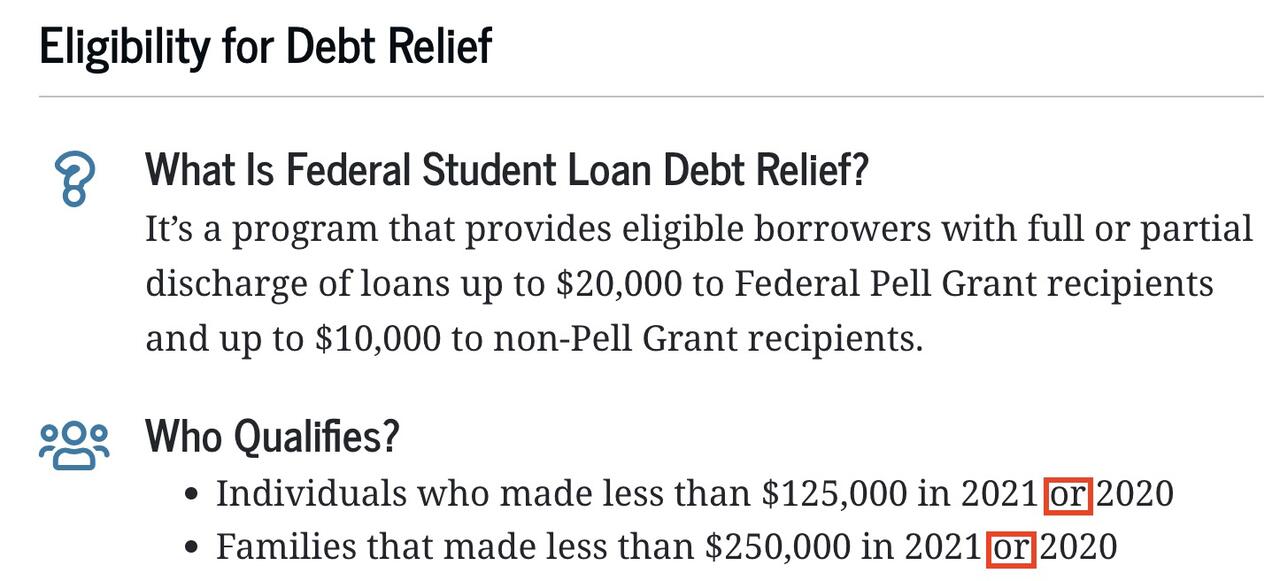
As the Department of Education's online application form explains, debt relief is available to those who made less than $125,000 in 2021 or 2020. With a generous two-year look-back, the word "or" opens the door to people who were below the threshold in 2020 but then blew it away in 2021.  

"That’s good news for recent law school graduates, many of whom are now employed at white-shoe law firms making over $200,000 a year, or for doctors who just completed their residencies," writes the Free Beacon

Critically, the rules also ignore how applicants are doing this year -- which is already more than nine months gone. 

Instructions for debt relief on the official application website  

Put it all together and an individual could be eligible for the program if he, for example, made $124,000 in 2020, $750,000 in 2021 and is knocking down a million in 2022.  

The dollar limits refer to an applicant's Adjusted Gross Income, which excludes various types of income. As The Beacon notes: 

Paycheck Protection Program funds aren’t considered income, nor is inherited wealth, meaning one could have received a cash influx and still qualify for Biden’s helicopter cash drop. Remember this when Biden drones on about how "not a dime will go to those in the top 5 percent of the income bracket."

It gets worse: The program leans hard on the honesty of applicants, which is never a good idea where government handouts are concerned. The application only requires basic information and an assertion that the applicant is eligible -- no proof of income is required.

According to CNBC, the Department of Education "will verify a certain number of borrowers have told the truth about their eligibility as a fraud prevention measure." 

As legal challenges to Biden's unconstitutional debt relief order stack up, debtors are rushing to the application website: More than 8 million applied just during the weekend "beta test" period that proceeded Monday's official launch.  

Any borrower who has already received forgiveness will likely get to keep it, even if the courts block the president’s plan,” higher education funding expert Mark Kantrowitz tells CNBC.  

On Thursday, Supreme Court Justice Amy Coney Bryant bought Biden and his millions of forgiveness-seeking beneficiaries more time, as she denied a request filed Wednesday by the Brown County Taxpayers Association, a Wisconsin group that sought to keep the plan on hold while its legal challenge goes forward.  

According to the Congressional Budget Office, Biden's giveaway will cost the federal government about $400 billion -- for a government that already owes $31 trillion...and counting.