Search This Blog

Friday, October 21, 2022

'Would've Gotten Us Killed': US Army Soldiers Head Sick After Using Microsoft's AR Goggles

 Microsoft Corp's augmented reality headsets are making US Army soldiers sick, according to a Defense Department report, obtained by Bloomberg and Business Insider.

The 79-page DoD report on the Army's testing of Microsoft HoloLens mixed reality headsets has yet to be officially released to the public but a summary via Nickolas Guertin, director of the Defense Department's Operation Test and Evaluation, concluded that 80% of soldiers who used the goggles experienced "mission-affecting physical impairments," such as headaches, eyestrain, and nausea. 

One of the testers told Insider, "the devices would have gotten us killed" on the modern battlefield. 

Last year, the Army awarded a $22 billion contract for 120,000 HoloLens even though the military appears to be aware of the issues. 

Army assistant acquisition secretary Doug Bush allowed the first batch of 5,000 HoloLens in August for soldiers. Microsoft told Bloomberg the goggles are still a "transformational platform" and was moving ahead with further deliveries. 

In a statement to Insider, Brigadier General Christopher Schneider said the goggle testing was successful in "most" criteria, but in some areas, it "fell short," and improvements would be corrected. 

There's also concern the goggles emit a glow from hundreds of meters away that can reveal the soldier's position on the battlefield. The report said the heads-up display, similar to those used by fighter pilots, was also limiting soldier's field of view and too bulky for transport. 

Microsoft has yet to review the DoD report. It said in a statement to Bloomberg that "our close collaboration with the Army has enabled us to quickly build" and adjust the device "to develop a transformational platform that will deliver enhanced soldier safety and effectiveness. We are moving forward with the production and delivery of the initial set" of devices. 

There are no known long-term eye development effects of users using AR and/or VR goggles, but the symptoms the soldiers experienced point to some short-term adverse effects. Many consumers report headaches, eye strain, dizziness, and nausea after using Meta's Oculus Pro headset. 

https://www.zerohedge.com/military/wouldve-gotten-us-killed-us-army-soldiers-head-sick-after-using-microsofts-ar-goggles

Potential therapy derived from a banana protein works against SARS-CoV-2, flu

 On January 13, 2020, a paper touting the creation of a possible therapy that could be used to fight all known strains of the flu was published online.

One week later, the first laboratory confirmed case of SARS-CoV-2 set off the two and a half year-long COVID-19 pandemic in the United States.

Interestingly, prior to the arrival of the virus that temporarily shut down their work, the international study team behind the influenza paper had also investigated the therapy of coronaviruses.

“At the time we thought MERS would be the big target, which we were worried about because of its 35% mortality rate,” said David Markovitz, M.D., professor of internal medicine, Division of Infectious Diseases at the University of Michigan Medical School. (MERS, or Middle Eastern Respiratory Syndrome, caused a brief outbreak in 2015 and resulted in 858 confirmed deaths.)

A paper in Cell Reports Medicine details the efficacy of H84T-BanLec against all known human-infecting coronaviruses, including MERS, the original SARS, and SARS-CoV2, including the omicron variant. Markovitz is joined by two senior authors, Peter Hinterdorfer, Ph.D., of the Johannes Kepler University Institute of Biophysics and Kwok-Yung Yuen, MBBS, M.D., of the University of Hong Kong. The first author on the paper is Jasper Fuk-Woo Chan, M.D., of the University of Hong Kong.

“When COVID-19 occurred, we of course wanted to study the therapy’s potential and discovered it was effective against every type of coronavirus, in vitro and in vivo,” Markovitz said. “Whether delivered systemically or through the nose in animal models, or prophylactically or therapeutically early on in the illness, it worked.”

H84T-BanLec is derived from a lectin (a carbohydrate-binding protein) isolated from banana fruit. It accomplishes its remarkable viral-blocking abilities by binding to high-mannose glycans, polysaccharides that are present on the surface of the viruses, but only very rarely on normal healthy human cells. After binding, the virus cannot enter cells to infect them.

Using atomic force microscopy and related methods, the team confirmed that H84T develops multiple strong bonds with the spike protein, which, said Markovitz, probably explains why it’s hard for a coronavirus to be resistant to the lectin.

Despite their anti-viral potential, lectins have traditionally been avoided as possible therapies because they are proteins that can stimulate the immune system in a potentially harmful way, explains Markovitz. However, H84T-BanLec has been modified to remove this effect and showed no detrimental effects in the animal models.

While several treatments for COVID-19 currently exist, including remdesivir, Paxlovid and monoclonal antibodies, they have varied levels of effectiveness, side effects and ease of use and many have proven less effective as SARS-CoV2 continues to evolve.

H84T-BanLec holds unique promise, according to the team, because it is effective against all coronavirus variants as well as influenza viruses. Markovitz and the team hope to see the therapy take the more difficult step from animal model to testing in humans. The team envisions a nasal spray or drops that can be used to prevent or treat coronavirus and influenza infections in seasonal and pandemic situations. They also hope to examine using H84T-BanLec against cancer—as cancer cells, like viruses, also have high mannose glycans on their surfaces.

Additional authors include Yoo Jin Oh, Shuofeng Yuan , Hin Chu , Man-Lung Yeung , Daniel Canena , Chris Chung-Sing Chan, Vincent Kwok-Man Poon, Chris ChunYiu Chan, Anna Jinxia Zhang, Jian-Piao Cai , Zi-Wei Ye , Lei Wen, Terrence Tsz-Tai Yuen, Kenn Ka-Heng Chik, Huiping Shuai, Yixin Wang, Yuxin Hou, Cuiting Luo, WanMui Chan, Zhenzhi Qin, Ko-Yung Sit, Wing-Kuk Au, Maureen Legendre, Rong Zhu, Lisa Hain , Hannah Seferovic, Robert Tampé, Kelvin Kai-Wang To, Kwok-Hung Chan, Dafydd Gareth Thomas, Miriam Klausberger, Cheng Xu , James J. Moon, Johannes Stadlmann, Josef M. Penninger, and Chris Oostenbrink. Thomas, Xu, Moon and Legendre are all from the University of Michigan.

Chinese Lab’s Purchase Of US Land For Primate Breeding Facility Draws Scrutiny

 by Eva Fu via The Epoch Times (emphasis ours),

A Chinese firm’s purchase of land in Florida to build a lab monkey breeding facility is drawing scrutiny over the company founders’ ties to the Chinese military.

JOINN Laboratories CA Inc., the California subsidiary of a biotech firm headquartered in Beijing, in July purchased more than 1,400 acres of land for building a primate facility in Florida’s Levy County, county records show.

With a combined value of $5.5 million, the 10 parcels of land purchased from L & T Cattle & Timber represents one of the largest known Chinese acquisitions of U.S. land in recent years. While construction has not begun, the deal has attracted public attention at a time of heightened concern about Chinese investments in the United States over security and other risks.

The purchaser’s parent company JOINN Laboratories describes itself as a leader in non-clinical drug screening in China. According to its website, the company was founded in 1995 and employs over 1,500 staff. It has wholly-owned subsidiaries in major Chinese and U.S. cities, including Shanghai, Beijing, Hong Kong, San Francisco, and Boston.

Zhou Zhiwen and Feng Yuxia, the couple who founded and control JOINN Laboratories, both graduated from China’s Academy of Military Medical Sciences, in 1989 and 1992 respectively. The school is the Chinese military’s top medical institute, which was added to a U.S. trade blacklist last year for supplying biotechnology to the Chinese military.

After graduating, both Zhou and Feng went on to work as researchers at the academy before establishing their business venture, according to Chinese media reports. Zuo Conglin, a board member of JOINN Laboratories, also graduated from the same academy.

These links with the Chinese Communist Party (CCP) should raise red flags, according to Rep. Scott Franklin (R-Fla.).

The idea that we would permit a … biotech firm with ties to the Chinese military to breed lab monkeys on U.S. soil is baffling, especially after China unleashed the Covid-19 pandemic on the world,” he told The Epoch Times.

“The Biden administration allowing Chinese Communist Party affiliated companies to buy up American land is unacceptable, especially for these purposes. If the President won’t put his foot down to protect American interests, Congress will.”

Future of Project Uncertain

It’s unclear if JOINN Laboratories can proceed with its plans in Levy County. Because the purchased land is currently zoned for forestry and rural residential, the company would need to rezone the land to industrial to build its lab facility, the county said in a Sept. 22 statement.

The county said that it had been asked about a possible rezoning of the land, and that it replied that “such a request would not receive a favorable staff recommendation” because of “compatibility” issues and that it would create “spot zoning,” referring to the controversial practice of singling out a piece of land for special zoning laws different from the zoning laws around it.

County officials, when reached by The Epoch Times in early October, said it hasn’t received such a formal rezoning request from JOINN Laboratories.

The company did not publicly announce the sale and not much is known about the proposed breeding facility. JOINN Laboratories didn’t respond to an inquiry from The Epoch Times regarding the purchase and its plans for the site.

It’s unclear whether the company intends to sell the lab monkeys in the United States, China, or elsewhere. Both countries have a high demand for primates for experimental use, and the United States exports a large portion of monkeys from China.

According to Chinese media reports, the average cost for a long-tailed macaque, commonly used for lab research, paid by the Chinese regime has soared from around 30,000 yuan ($4,153) in 2019 to over 130,000 yuan (around $18,000) in early 2022.

JOINN Laboratories currently owns about 18 acres of animal testing facilities in Beijing and Suzhou, a major city in eastern China’s Jiangsu Province, according to its 2021 annual report. It is also building another primate breeding base with the capacity of raising 15,000 large animals in Wuzhou of southern China’s Guangxi Province. The quarantine station for the base is now complete, the report stated.

https://www.zerohedge.com/medical/chinese-labs-purchase-us-land-primate-breeding-facility-draws-scrutiny

How Long Can Consumers Rely on Savings?


Summary

Consumers have yet to lose their staying power, and our analysis of household finances suggests consumers still have the ability to rely on their balance sheets for some time yet. The catch: The more consumers rely on their balance sheets to spend today, the larger deterioration we'll see in overall household finances and the worse the eventual economic downturn may be.

We Called It 'Staying Power' for a Reason

There is a lot riding on whether consumers continue to spend. Dialing in on the precise timing of a downturn in some ways comes down to when households decide to pull back on consumption, and recent data indicate consumers have yet to lose their staying power.

Despite decades-high inflation making everything from a tank of gas to a meal out more expensive, households continue to spend, and do so at an elevated pace. That's due to household balance sheets, which remain healthy and are allowing consumers to sustain spending even as high inflation erodes much of the wage gains workers are enjoying. More plainly, real spending is outstripping real income at an unusual rate (Figure 1).

Households are drawing down personal savings stashed away during the early days of the pandemic, saving less of their monthly income and/or putting more on their credit cards to consume. Even as consumers have leaned on their finances, causing some deterioration in overall wealth, we argue households still have the ability to rely on these alternate sources to consume for some time yet. It's thus the willingness rather than ability to consume that becomes most important in understanding the near-term trajectory for consumption.

Source: U.S. Department of Commerce and Wells Fargo Economics

Cashed Out or Stashed Up?

Despite concern over COVID having largely faded to the background for many households, recent resiliency in spending is still in part explained by the massive amount of savings that was accumulated throughout the pandemic.1 In fact, recent data revisions indicate consumers have actually been drawing down excess cash at roughly twice the pace previously reported. Even withstanding the revisions, we estimate households still have roughly $1.3 trillion in accumulated savings through August, which is equivalent to about 8% of annual consumer spending (Figure 2). That translates to over a year's worth of excess capital remaining, as it would take households another 15 months to completely deplete this stockpile if they continued to draw it down at the $85 billion average monthly pace they have over the past six months.

Recall, however, that we do not expect all of this estimated stocked "cash” is sitting idly and ready to be deployed. Due to the simple way personal saving is measured as the inflow of disposable income less the outflow of outlays, the acquisition of assets shows up in saving. Thus, some of this excess savings has likely been used to pay down debt, purchase a home or made its way into brokerage or retirement investments, and is thus not available to use on outlays today.2

Even so, real aggregate checking and saving account balances suggest households have more dry powder ready to deploy over the next few months. Real household deposits peaked in the first quarter and were roughly $2.6 trillion higher than where deposits would have been had they followed the pre-pandemic rate of growth. Since then, the gap between deposits and trend has steadily narrowed, but aggregate household balances remain robust and roughly $1.7 trillion above trend (Figure 3). In fact, if deposits continue to decline at the average rate they have over the past three quarters, the excess savings from 2020 and 2021 will be wiped out by Q3-2023. While real cash assets are starting to deteriorate, households are still to an extent flush with cash.

Source: U.S. Department of Commerce and Wells Fargo Economics
Source: Federal Reserve Board and Wells Fargo Economics

Insert, Tap Today, Pay Tomorrow

Beyond tapping stashed cash, households are also increasingly reaching for their credit cards. Revolving consumer credit, which is mostly composed of credit card debt, has grown in each of the past 17 months, with the level outstanding currently about 5% higher than it was prior to the pandemic (Figure 4). Even with recent momentum exhibited by the three-month annualized change in revolving debt higher than at any point during the past cycle, households are not yet overleveraged.

Outstanding revolving credit still remains nearly 5% below where it would have been in the absence of the pandemic had credit continued to grow at its pre-pandemic trend pace. Furthermore, most liability ratios suggest household monthly and quarterly debt payments remain low. For example, despite revolving credit shooting higher, the amount outstanding still remains near a historically-low level when taken as a share of disposable income. More broadly, household financial obligations and debt-service ratios also remain very manageable on a macro level (Figure 5).

But financing costs are set to only move higher amid tighter Fed policy, which should constrain borrowing. Households are likely already feeling this to a certain extent, with the average annual percentage rate on credit cards reaching 16.3% in August, marking the highest rate in data going back to the mid-1990s. Beyond higher interest on credit cards, however, unless households hold an adjustable-rate mortgage many consumers have relatively low sensitivity in the form of monthly obligations, though rates influence new demand such as purchasing a home or vehicle. Recently announced student loan debt forgiveness also will reduce monthly interest payments for some households, freeing up some cash in monthly budgets.

Source: Federal Reserve Board and Wells Fargo Economics

This Must Be the Rainy Day

With households spending more than they are bringing in, the personal saving rate has plunged and households are saving at rates last sustained in the run-up to the 2008 financial crisis (Figure 6). The deterioration in finances is also evident in the roughly 4% decline in net worth in the second quarter. Historically, there has only been a sharper quarterly reversal in wealth in the fourth quarter of 2008 and first quarter of 2020, corresponding to the recessions in those periods.

Consistent with what we’ve seen in financial markets, the fall in equity values was responsible for most of the decline in net worth, which led to a larger drop in wealthier cohorts who hold more equities as assets. The bottom 50% of households actually saw their net worth increase in the second quarter due to a large rise in the value of real estate, which represents a bulk of their assets at nearly 60% (Figure 7).3

The net worth data are, however, inherently backward-looking. Equity values according to the S&P are off another 5% through the third quarter, and home values have started to reverse, both of which will weigh on net worth and eventually lead consumers to cut back on spending. Key word being eventually. Consumers tend to be more concerned with the directional change in their household wealth than its absolute level when it comes to spending plans. Whatever comfort the consumer may be able to take in it, the absolute level of total household net worth is still about 24% above pre-pandemic levels and signals consumers can sustain spending at an elevated pace. That combined with the ability to continue to take on leverage and draw down cash means consumers likely won’t stop spending just yet. No matter how it's funded, spending will continue to exert modest downward pressure on the personal saving rate, which we expect to hover in the 3% range through the middle of next year.

Source: U.S. Department of Commerce and Wells Fargo Economics
Source: Federal Reserve Board and Wells Fargo Economics

This Isn't Sustainable

While consumer staying power has not yet run out, it's not infinitely sustainable. The more consumers rely on their balance sheets, the larger deterioration we'll see in overall household finances and the worse the eventual economic downturn may be. The recent resilience in spending led us to recently push out the timing of recession in our forecast from the start of next year to the second quarter. With near-term spending coming at a further deterioration in finances, we also now look for a slightly larger decline in real personal consumption expenditures with a peak-to-trough decline of 1.0% compared to 0.6% previously.

A potential near-term and more sustainable source of purchasing power could come if we see a meaningful reprieve in inflation. Easing inflation amid continued wage gains could give way to modest real income growth. The easing in prices needed, however, seems unlikely as high demand is in a way acting in a feedback loop to inflation and preventing price growth from materially falling. Furthermore, as real rates turn positive next year and the lagged effects of tighter policy bite, it is going to be more challenging for consumers to rely on their balance sheets. We suspect this will lead households to pull back more meaningfully on spending, ushering in a mild economic contraction.

https://wellsfargo.bluematrix.com/links2/html/09005eeb-1594-498b-acb9-92996f96a1e4

What Would You Do If You Were Running the Fed Right Now?

 In the spring of 2020 I wrote a piece about how the Fed’s actions during financial crises could make stock market returns lower in the future.

This was the gist of it:

If the stock market during the worst economic contraction in 90 years can be smoothed out by government spending and Fed actions, does this change the risk-return framework in the stock market going forward?

Said another way — if stocks don’t have the risk of a Great Depression-like crash on the table, does that mean expected returns should be lower going forward?

This idea seemed counterintuitive at the time since so many people assumed the Federal Reserve was actively trying to prop up the stock market.

That is certainly not the case anymore.

Fed members are now actively rooting for the stock market to go down to soften financial conditions so inflation will fall. And it’s working. We’re in a bear market. Stocks and bonds have both crashed.

I’m not a fan of the Fed using the stock market as a  barometer of their policies but I see where they’re coming from.

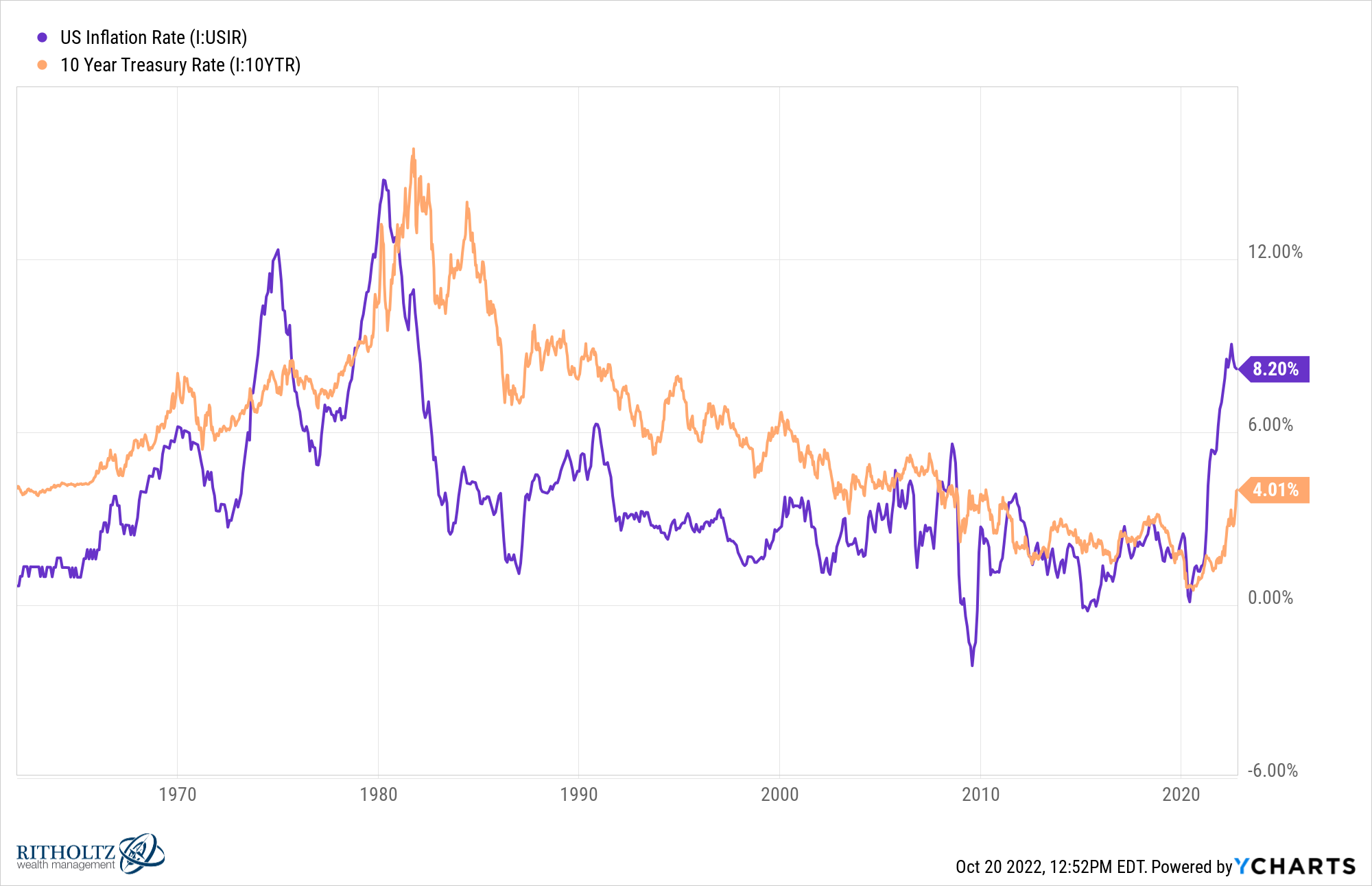
But I don’t agree with everything they’re trying to do right now. Interest rates obviously had to come up to deal with inflation, which remains far above the benchmark 10 year treasury yield:
My problem with the Fed’s current stance is not necessarily the magnitude of the interest rate move but the speed of that move. Just look at how quickly mortgage rates have risen this year:
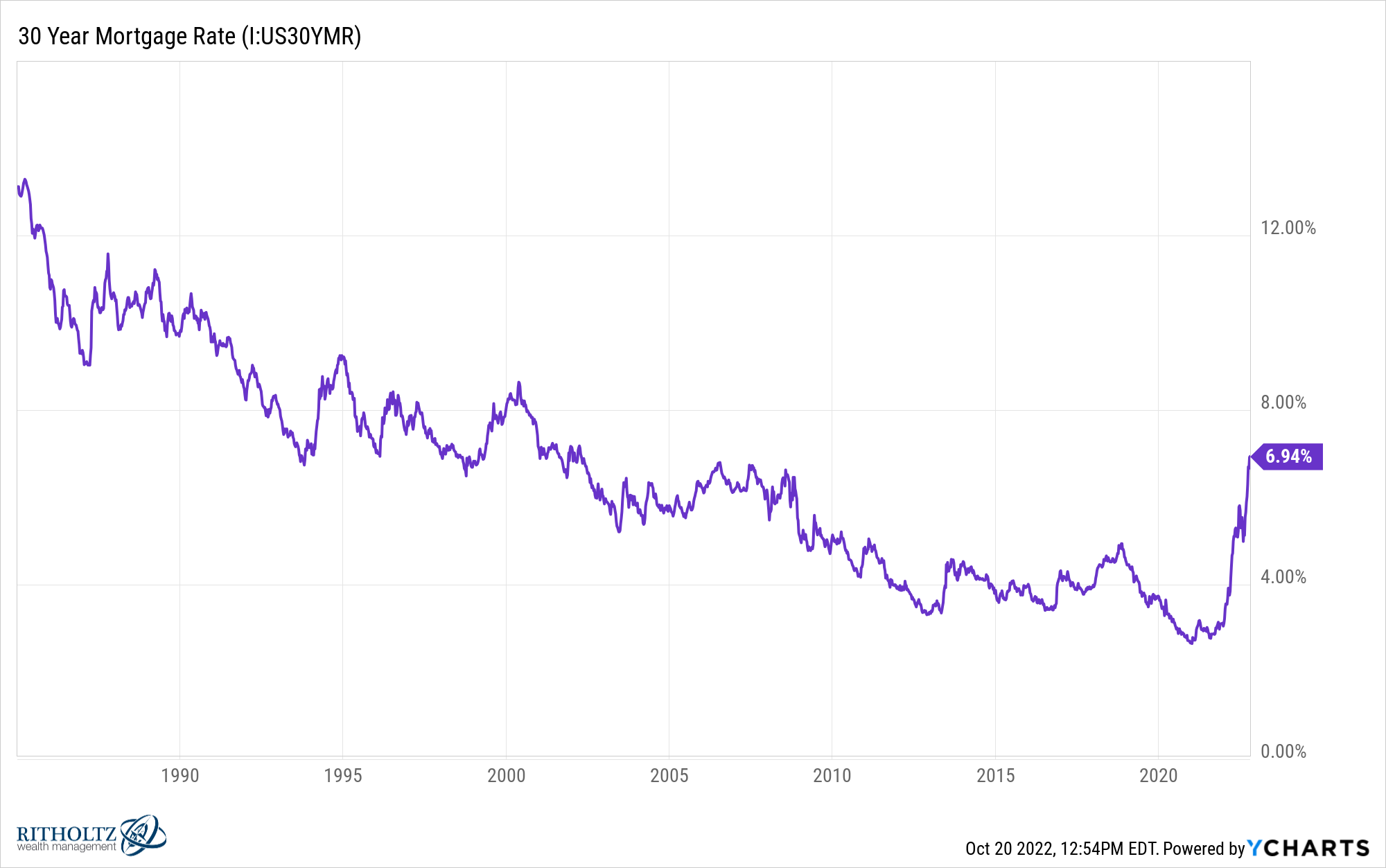
They’ve more than doubled in 10 months.

Forget about the stock and bond markets. It’s never fun to lose money but that’s the contract we’ve signed up for in risk assets. Making money in the long-term sometimes requires losing money in the short-term.

I don’t really have a problem with that.

My problem is with the potential impact on important segments of the economy.

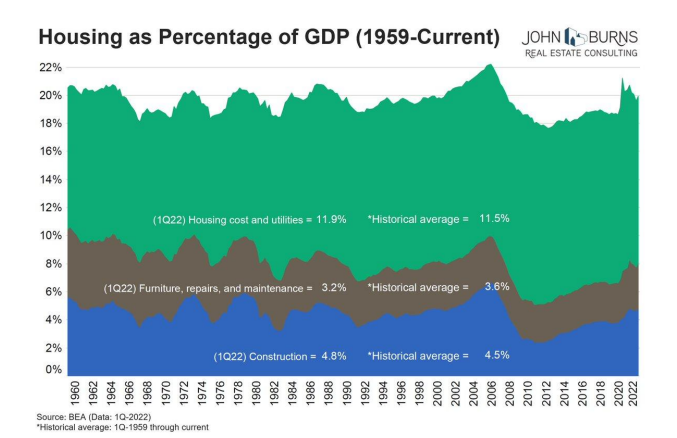
John Burns Real Estate Consulting estimates the housing market makes up roughly one-fifth of the U.S. economy:
Just think about all of the jobs and businesses involved in the housing market.

Building new houses requires homebuilders, architects, construction workers, inspectors and suppliers for building materials.

When you buy or sell a house there are realtors, loan officers, title companies, appraisers and moving companies involved.

And when people move to a new place, you invariably spend a lot of money on ancillary items such as furniture, lawn equipment, maintenance and renovations.

The impact on the housing market is one of the biggest reasons the 2008 crash was so severe. It impacts people personally, but it’s also an important piece of the economy.

Luckily, today’s housing market is different in many ways that what caused the boom and bust of the early-2000s.

Homebuyers have much better credit scores this time around. Most people were able to lock in low borrowing costs before they rose this year. There aren’t a bunch of no-income loans being given out with adjustable rates like the last time.

So the housing market is in a much better place.

The problem is it’s possible for the housing market as a driver of the economy to get much worse from here.

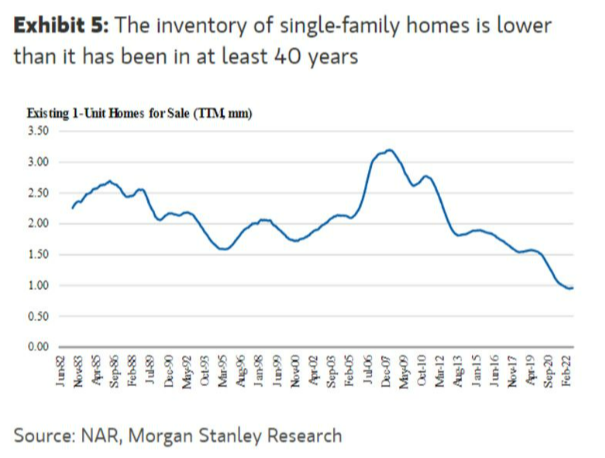
Morgan Stanley shows the inventory of single-family homes for sale is lower than it’s been in at least 40 years:
And home sale transactions are now falling off a cliff at an even faster pace than they did during the last housing crash:
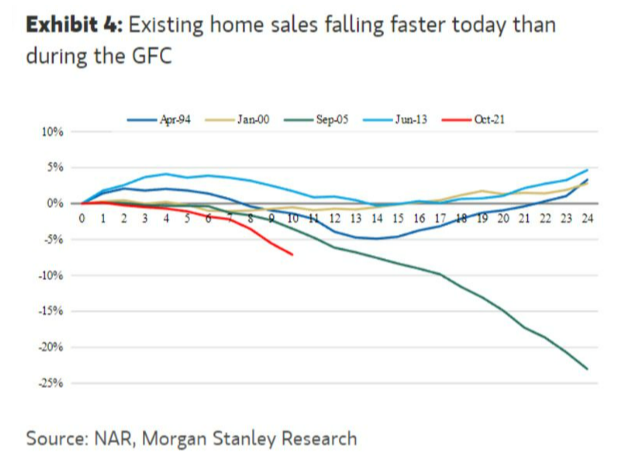
Housing prices have some room to fall considering the massive gains homeowners have been gifted since the start of the pandemic.

I’m not worried about housing prices as much as I am worried about what this could do to the housing industry.

If the number of homes sold remains stagnant it could have ripple effects for years to come in the U.S. economy.

If homebuilders decide it’s not worth it to build more housing stock we could see a shortage of housing availability at a time of increased household formation for young people if there are no incentives for them to add more supply to the market.

Listen, I don’t envy policymakers. It’s not an easy job. The Fed didn’t single-handily cause this inflation so it seems unfair they are the ones tasked with getting it under control.

I’m glad I’m not running the Fed right now.

But if I was Fed Chair Carlson, here’s what I would do:

Take a little breather and see how things shake out for a couple of months. You can’t expect a $23 trillion economy to stop on a dime and change course.

It’s like turning a battleship. The economy typically reacts to new policy measures on a lag.

And the fact that interest rates have risen so much in such a short time frame means the market has already done a lot of the heavy lifting for them.

I understand why the Fed wanted to cool the housing, stock and bond markets.

I am just surprised they are willing they are trying to kick these markets while they are down without considering the potential ramifications of taking things too far and leaving lasting problems in the economy going forward.

https://awealthofcommonsense.com/2022/10/what-would-you-do-if-you-were-running-the-fed-right-now/


The Myth of the Nonviolent Drug Offender

 After President Biden pardoned Americans convicted of federal marijuana possession last week, reform advocates praised his action as a “historic” step away from mass incarceration, while critics lamented it as another blow to public safety. The truth is somewhat less momentous: the pardons affect only about 6,500 people, none of whom is currently in prison, and drug crimes account for only a small portion of America’s prison population.

The extreme reactions on both sides are consistent with the public’s warped perceptions of the effects of drug enforcement on our criminal-justice system, which activists and the media have propagated through books like Michelle Alexander’s The New Jim Crow and documentaries like 13th. This component of the prison-reform narrative is disingenuous and distracts from the more pressing work of finding solutions to violent crime.

Of the approximately 145,000 people in federal prisons and 1,040,000 people in state prisons, less than 3.5 percent are incarcerated for a conviction related to drug possession. Even when one expands the scope beyond mere possession to all other types of drug offenses (many of which are associated with violent cartels and gangs), the proportion rises only to 18 percent.

The hard truth for criminal-justice reformers is that violent offenses are far more prevalent among America’s prisoners. At the state level—where nine in ten prisoners are incarcerated—almost 60 percent of inmates committed violent crimes. Roughly 143,000 people are imprisoned for convictions related to sexual assault and 155,000 for homicide, compared with 146,000 for all drug crimes combined. The idea that America’s “mass” incarceration is a result of drug crimes is absurd.

America’s incarceration “problem” relates directly to its violent-crime problem. The nation’s incarceration rate—roughly 639 per 100,000 people—is four to six times that of its high-income peers in Europe and Asia. Without context, that statistic is alarming, but when we consider that America’s homicide rate is 7.5 times higher than those same peer nations, our incarceration rate seems more justified.

Even the claim that people imprisoned for “nonviolent” crimes are distinct from the rest of the criminal population is suspect. A 2021 Bureau of Justice Statistics report found that people released from prison for drug crimes were actually more likely to be re-arrested for a violent offense than people released for homicide or sexual assault.

My intent in presenting these sobering statistics is not to discourage reform. To the contrary, the dismal performance of our correctional institutions based on metrics like return-to-prison rates, post-release employment, and prisoner and officer health should all energize a commitment to reform. But conversations about how to change the criminal-justice system must be based in reality.

As a starting place, reformers need to stop deluding themselves and the public that “mass decarceration” will be anything other than a bloodbath. We should accept that prison is necessary for public safety and focus on transforming prisons into more effective institutions. Prisons should be centers of intervention and opportunity that equip inmates with the social and professional skills to lead productive, peaceful lives when they return to society. Prisons should develop rehabilitation programs that target anti-social behavior at the root of violent crime and, most importantly, be held accountable for failing to achieve positive outcomes. Prisons should be well-staffed, and correctional officers should be rewarded for making a difference in the lives of the people with whom they work. States around the country have achieved impressive results by funding probation and parole departments based on successful outcomes; the same concept should apply to prisons.

In an era of rising violent crime and increased attention to public safety, the reform movement will not survive unless it admits that the reality of the criminal-justice system is far more complex than the activists’ refrains suggest. Most importantly, reformers’ priorities need to account for violent crime and create workable solutions for making prisons better, rather than continuing to indulge the dangerous fantasy of abolition.

Judge rules letting NYers vote by mail due to fear of COVID unconstitutional

 Allowing New Yorkers to vote by mail due to fear of COVID-19 is unconstitutional, a state judge said Friday in a ruling that Republican and Conservative Party leaders hailed as a victory for fair elections.

The 28-page ruling by Saratoga County Supreme Court Justice Dianne Freestone ordered local boards of election to stop counting the absentee ballots they’ve already received.

Instead, officials have to “preserve” the ballots until after Election Day or the resolution of a pending suit filed by state and local GOP and Conservative Party leaders.

Democratic officials immediately filed a notice saying they would appeal the judge’s decision.

In her ruling, Freestone said that the Democrat-controlled Legislature “appears poised to continue the expanded absentee voting provisions of New York State Election Law … in an Orwellian perpetual state of health emergency and cloaked in the veneer of ‘voter enfranchisement.'”

Rejecting arguments made by a lawyer for the state Board of Elections at a hearing earlier this month, Freestone said that “there are uncounted reasons for this Court to second-guess the wisdom of the Legislature.”

The judge stopped short of invalidating absentee ballots that have already been cast.

But her decision could lead to the overturning of a state law that blocks people from changing their mail-in votes by showing up to cast in-person ballots on Election Day.

That scenario could hurt Democratic Gov. Kathy Hochul, who’s been losing ground to Republican challenger Lee Zeldin in recent polls.

State GOP Chairman Nick Langworthy, a plaintiff in the case, said in a statement, “The (state) constitution has been on our side and we will continue to fight to uphold the will of the voters and to ensure honest elections in New York.”

Another plaintiff, Conservative Party Chairman Gerald Kassar, said, “This decision helps uphold the integrity of the electoral process, a major victory for New York voters and the rule of law.”

“Absentee-ballot voters have had the right to amend their votes on Election Day for decades, and cynical attempts by Gov. Hochul and the Democrat Party to strip them of those rights were wrong,” he added.

Last year, state voters rejected a proposed constitutional amendment that would have allowed no-excuse absentee voting in New York.

But lawmakers subsequently enacted a measure that allowed people to vote by mail if they feared catching COVID-19 by voting in person. That expansion of absentee voting is set to expire at the end of this year. 

A spokesperson for the state BOE said Friday, “Our office is still reviewing the ruling and its impact on the upcoming election.”

Common Cause New York, a nonpartisan election-reform group, said that Freestone’s decision “might not even go into effect for this election.”

“And, even if it does, it would only affect the time and way absentee ballots are counted — you can still vote absentee as planned, and your ballot will still be counted,” the group added.

https://nypost.com/2022/10/21/ny-republicans-score-win-in-legal-wager-against-absentee-voting/