Search This Blog

Thursday, February 9, 2023

A New (Old) Drug Joins the COVID Fray, and Guess What? It Works

 Welcome to Impact Factor, your weekly dose of commentary on a new medical study. I'm Dr F. Perry Wilson of the Yale School of Medicine.

With SARS-CoV-2 sidestepping monoclonal antibodies faster than a Texas square dance, the need for new therapeutic options to treat — not prevent — COVID-19 is becoming more and more dire.
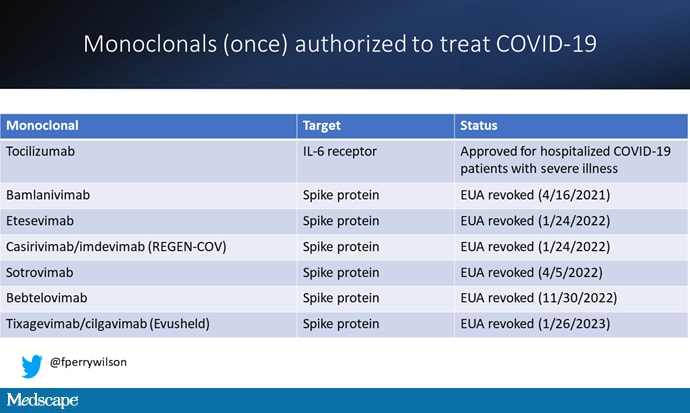


At this point, with the monoclonals found to be essentially useless, we are left with remdesivir with its modest efficacy and Paxlovid, which, for some reason, people don't seem to be taking.

Part of the reason the monoclonals have failed lately is because of their specificity; they are homogeneous antibodies targeted toward a very specific epitope that may change from variant to variant. We need a broader therapeutic, one that has activity across all variants — maybe even one that has activity against all viruses? We've got one. Interferon.

The first mention of interferon as a potential COVID therapy was at the very start of the pandemic, so I'm sort of surprised that the first large, randomized trial is only being reported now in The New England Journal of Medicine.

Before we dig into the results, let's talk mechanism. This is a trial of interferon-lambda, also known as interleukin-29.

The lambda interferons were only discovered in 2003. They differ from the more familiar interferons only in their cellular receptors; the downstream effects seem quite similar. As opposed to the cellular receptors for interferon alfa, which are widely expressed, the receptors for lambda are restricted to epithelial tissues. This makes it a good choice as a COVID treatment, since the virus also preferentially targets those epithelial cells.

In this study, 1951 participants from Brazil and Canada, but mostly Brazil, with new COVID infections who were not yet hospitalized were randomized to receive 180 µg of interferon lambda or placebo.

This was a relatively current COVID trial, as you can see from the participant characteristics. The majority had been vaccinated, and nearly half of the infections were during the Omicron phase of the pandemic.
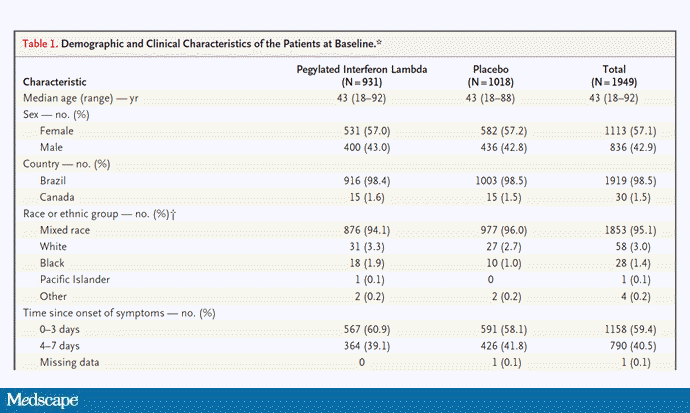


If you just want to cut to the chase, interferon worked.

The primary outcome — hospitalization or a prolonged emergency room visit for COVID — was 50% lower in the interferon group.
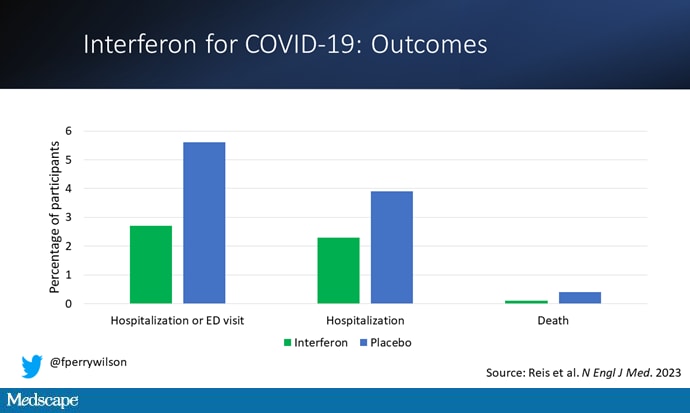


Key secondary outcomes, including death from COVID, were lower in the interferon group as well. These effects persisted across most of the subgroups I was looking out for.
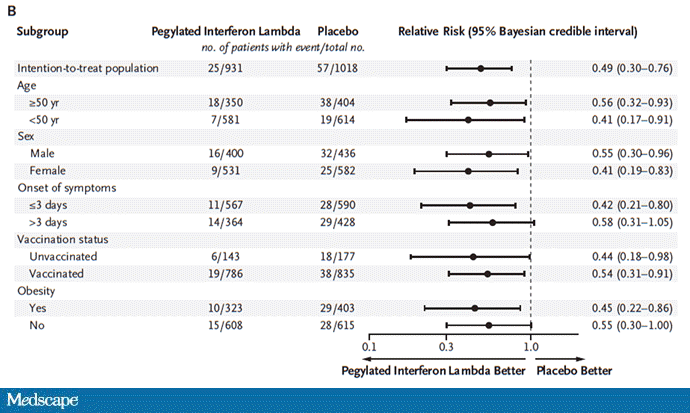


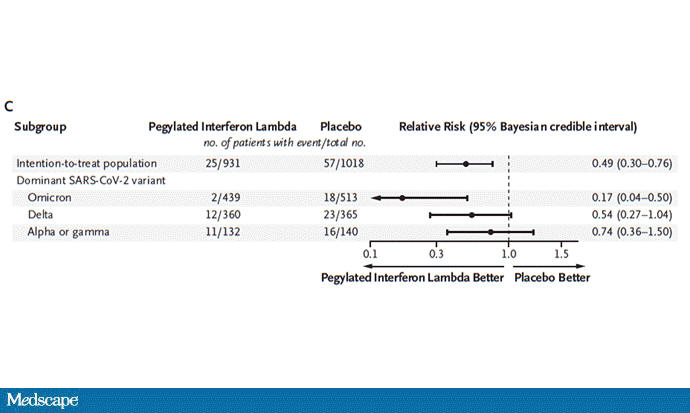
Interferon seemed to help those who were already vaccinated and those who were unvaccinated. There's a hint that it works better within the first few days of symptoms, which isn't surprising; we've seen this for many of the therapeutics, including Paxlovid. Time is of the essence. Encouragingly, the effect was a bit more pronounced among those infected with Omicron.


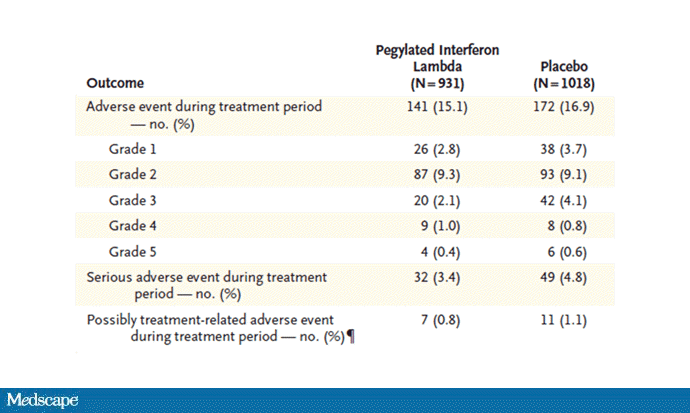
Of course, if you have any experience with interferon, you know that the side effects can be pretty rough. In the bad old days when we treated hepatitis C infection with interferon, patients would get their injections on Friday in anticipation of being essentially out of commission with flu-like symptoms through the weekend. But we don't see much evidence of adverse events in this trial, maybe due to the greater specificity of interferon lambda.


Putting it all together, the state of play for interferons in COVID may be changing. To date, the FDA has not recommended the use of interferon alfa or -beta for COVID-19, citing some data that they are ineffective or even harmful in hospitalized patients with COVID. Interferon lambda is not FDA approved and thus not even available in the United States. But the reason it has not been approved is that there has not been a large, well-conducted interferon lambda trial. Now there is. Will this study be enough to prompt an emergency use authorization? The elephant in the room, of course, is Paxlovid, which at this point has a longer safety track record and, importantly, is oral. I'd love to see a head-to-head trial. Short of that, I tend to be in favor of having more options on the table.

For Medscape, I'm Perry Wilson.

F. Perry Wilson, MD, MSCE, is an associate professor of medicine and director of Yale's Clinical and Translational Research Accelerator. His science communication work can be found in the Huffington Post, on NPR, and here on Medscape. He tweets @fperrywilson and his new bookHow Medicine Works and When It Doesn'tis available now.

https://www.medscape.com/viewarticle/987900

More Data Back Guillain-Barré Risk With Janssen COVID Shot

 New surveillance data from the Vaccine Adverse Event Reporting System (VAERS) back previous findings of increased risk for Guillain-Barré syndrome (GBS) after receiving the Janssen COVID-19 vaccine (Ad26.COV2.S).

Over 14 months, GBS reporting rates within 21 and 42 days of administration of Janssen's replication-incompetent adenoviral vector vaccine were approximately 9 to 12 times higher than after administration of the Pfizer-BioNTech (BNT162b2) or the Moderna (mRNA-1273) mRNA COVID vaccines.

Additionally, observed GBS cases after the Janssen shot were 2 to 3 times greater than expected, based on background rates within 21 and 42 days of vaccination.

Conversely, and confirming prior data, there was no increased risk for GBS with the Pfizer or Moderna vaccines and no significant difference between observed and expected numbers of GBS cases after either mRNA COVID-19 vaccine.

The findings were published online February 1 in JAMA Network Open.

More Precise Risk Estimates

Winston Abara, MD, with the US Centers for Disease Control and Prevention, and colleagues analyzed GBS reports submitted to the VAERS between December 2020 and January 2022. 

Among 487.6 million COVID-19 vaccine doses administered, 3.7% were Janssen's Ad26.COV2.S vaccine, 54.7% were Pfizer's BNT162b2 vaccine, and 41.6% were Moderna's mRNA-1273 vaccine.

There were 295 verified reports of GBS identified after COVID-19 vaccination. Of these, 209 occurred within 21 days of vaccination and 253 within 42 days.

Within 21 days of vaccination, GBS reporting rates per 1 million doses were 3.29 for the Janssen vaccine vs 0.29 and 0.35 for the Pfizer and Moderna vaccines, respectively. Within 42 days of vaccination, reporting rates per 1 million doses were 4.07, 0.34, and 0.44, respectively.

Also within 21 days of vaccination, GBS reporting rates were significantly higher with the Janssen vaccine than the Pfizer vaccine (reporting rate ratio [RRR], 11.40) and the Moderna vaccine (RRR, 9.26). Similar findings were observed within 42 days after vaccination.

The observed-to-expected ratios were 3.79 for 21-day and 2.34 for 42-day intervals after receipt of the Janssen vaccine, and less than 1 (not significant) after the Pfizer or Moderna vaccine within both post-vaccination periods.

"Unlike prior studies, our analysis included all US reports of verified GBS cases that met the Brighton Collaboration GBS case definition criteria (Brighton Levels 1, 2, and 3) submitted over a 14-month surveillance period to the to the Vaccine Adverse Event Reporting System," Abara told Medscape Medical News,

"Because we used all US reports, the sample of verified GBS cases in this analysis is larger than other studies. Therefore, it may provide a more precise estimate of the GBS risk within 21 and 42 days after mRNA and Ad26.COV2.S vaccination," he said.

"Remarkably Low" Use

Commenting on the new data for Medscape Medical News, Nicola Klein, MD, PhD, Kaiser Permanente Vaccine Study Center, Oakland, California, noted that this is a "nice confirmatory analysis that supports and further expands what's been observed before."

Last year, as reported by Medscape Medical News, Klein and colleagues reported data from the Vaccine Safety Datalink confirming a small but statistically significant increased risk for GBS in the 3 weeks after receipt of the Janssen COVID-19 vaccine, but not the Pfizer or Moderna vaccines.

Unlike VAERS, the Vaccine Safety Datalink is not a reporting system. It's an active surveillance of medical records in the Kaiser Permanente system. The VAERS is a passive system so it requires individuals to report GBS cases to the VAERS team, Klein explained.

So although the two studies are slightly different, overall, the VAERS data is "consistent with what we found," she said.

Also weighing in, C. Buddy Creech, MD, MPH, director of the Vanderbilt Vaccine Research Program and professor of pediatrics at the Vanderbilt University School of Medicine, Nashville, Tennessee, said it is "important to realize that GBS had been observed after adenovirus-vectored vaccines earlier in the pandemic, both for the AstraZeneca vaccine and the Janssen vaccine."

The Advisory Committee on Immunization Practices (ACIP) preferentially recommends that people age 18 years and older receive an mRNA COVID-19 vaccine rather than the Janssen adenoviral vector vaccine when both types of COVID-19 vaccine are available.

"Thus, the use of the Janssen vaccine is remarkably low in the US right now," Creech said.

"Nevertheless, we have a firm commitment, both scientifically and ethically, to track potential side effects after vaccination and to make sure that the vaccines in use for COVID, and other important infectious diseases, are safe and effective," he added.

The study had no commercial funding. Abara and Creech have reported no relevant financial relationships. Klein reported having received grants from Pfizer research support for a COVID vaccine clinical trial, as well as grants from Merck, GlaxoSmithKline, Sanofi Pasteur, and Protein Science (now Sanofi Pasteur).

JAMA Netw Open. Published online February 1, 2023. Full text

https://www.medscape.com/viewarticle/987838

Viking Therapeutics higher


after the company reported Q4 earnings results

https://www.benzinga.com/wiim/23/02/30842433/viking-therapeutics-shares-are-trading-higher-after-the-company-reported-q4-earnings-results

Raymond James, Oppenheimer cut Viking targets


Raymond James Adjusts Price Target on Viking Therapeutics to $12 From $11, Maintains Outperform Rating


Oppenheimer Adjusts Viking Therapeutics' Price Target to $17 From $15, Maintains Outperform Rating


'Should Future COVID Boosters Include the Ancestral Strain?'

 The current COVID-19 mRNA vaccine boosters are bivalent, meaning they contain equal amounts of spike protein mRNA for the original Wuhan virus sequence and for the BA.4/5 Omicron variants that emerged in mid-2022. How well does this type of bivalent booster perform?

The question is relevant because FDA's recent Vaccines and Related Biological Products Advisory Committee (VRBPAC) meeting discussed COVID-19 vaccine composition ahead of key decisions to be made later this year. For now, the FDA advisors voted to harmonize vaccine formulations; the same bivalent vaccineopens in a new tab or window currently authorized will be used for both primary and booster vaccinations. But should any new vaccine continue to include the ancestral strain's sequence? Or should it be based only on an Omicron lineage variant?

A Review of the Latest Evidence

We now have better data from a large, randomized, controlled trialopens in a new tab or window conducted in the U.K. in early 2022 during the first BA.1 Omicron wave. Early in the trial, study participants were given a BA.1 monovalent booster or the original monovalent booster. But over the course of the trial, the virus continued to mutate in the real world and new Omicron subvariants emerged. It was hypothesized that a bivalent booster targeting BA.1 and the ancestral strain would elicit better cross-protection to the subvariants, and thus in the second half of the trial, study participants were given a BA.1 bivalent booster or the original monovalent booster.

image
Credit: FDA Vaccines and Related Biological Products Advisory Committee presentation, January 26, 2023

Although the monovalent and bivalent COVID vaccines studied in this trial were targeted at the BA.1 Omicron variant, not the later BA.4/5 Omicron variant, the results are highly relevant. Note that although the total dose in bivalent vaccines is identical to that of the monovalent vaccines, the current formulations deliver only half a dose of vaccine against the Omicron subvariants.

The main clinical outcome, a secondary endpoint in the study, was COVID-19 as defined in the COVE trial. The BA.1 monovalent vaccine appeared to be the most effective booster of the three, followed by the BA.1 bivalent booster, and then the original monovalent booster. However, the differences were small. Relative vaccine effectiveness with the BA.1 bivalent booster was a non-significant 11.4% (95% CI -10.2 to 28.7) when compared with the original monovalent vaccine. Immunological data paralleled the clinical data. The monovalent BA.1 booster elicited marginally higher neutralizing antibody (NAb) titers against the BA.1 subvariant than did the bivalent booster, as did the BA.1 bivalent booster as compared to

opens in a new tab or window the original monovalent booster.

This randomized controlled trial demonstrated that the BA.1 bivalent booster is only marginally better at preventing COVID than the original monovalent booster, and that the best performer, although not by much, was the monovalent BA.1 Omicron booster. These findings are in line with what we suggested last year. Furthermore, the BA.1 bivalent booster elicited only a 1.5 times higher NAb titer than did the original monovalent booster, which is concordant with a body of literature on bivalent boosters that we previously summarizedopens in a new tab or window, as well as with twoopens in a new tab or window recent papersopens in a new tab or window on the performance of the BA.4/5 bivalent booster. NAbs are the principal correlate of protection for prevention of infectionopens in a new tab or window. Consistent with the predictions of an influential modelopens in a new tab or window, slightly higher NAb titers had limited impact on the clinical endpoint.

We do not have comparable randomized trial data on the BA.4/5 bivalent boosters, so we may never know with certainty the extent to which they were an "upgrade" over the original monovalent booster. However, in recent months, federal officials

opens in a new tab or window and othersopens in a new tab or window have claimed that the bivalent boosters are "better" than the original monovalent booster. These statements are based on the results of clinical or laboratory studies performed under non-comparable conditions and not from a randomized controlled trial.

In observational studies, the clinical performance of the BA.4/5 bivalent booster has been assessed and compared with historic data on the original monovalent booster. What these studies show is the beneficial impact of the bivalent booster at reducing the incidence of a clinical endpoint. However, comparisons of how different boosters performed at different intervals since last vaccination or infection are inexactopens in a new tab or windowLonger intervalsopens in a new tab or window between booster doses allow for greater time-dependent affinity maturationopens in a new tab or window of NAbs and thus higher NAb titer boosts with an additional dose of vaccine. Such differences in intervals since last vaccination do not arise when the serum samples are collected in a randomized controlled trial, as in the phase III trialopens in a new tab or window of monovalent and bivalent boosters in the U.K., or when factored into the study design. Observationalopens in a new tab or window studiesopens in a new tab or window may also be confounded by COVID-cautiousnessopens in a new tab or window and other behavioral differences between those who do or don't get boosted. People who get boosted are more likely to make use of other mitigation measures like masking or testing to further reduce the risk of COVID. For example, a recent studyopens in a new tab or window from Israel demonstrated instantaneous protection from getting a bivalent vaccine booster over no booster, but we know it takes a few daysopens in a new tab or window before one could plausibly expectopens in a new tab or window to see an immunological responseopens in a new tab or window.

Putting the Evidence Into Practice

Boosting is useful for improving protection against infection, which is particularly important for people at serious risk of severe COVID-19 due to age or underlying medical conditions. The current BA.4/5 bivalent booster performs adequately for this purpose. To the general public, it is a moot point how much "better" the bivalent booster is compared to a monovalent vaccine they can no longer obtain. However, moving forward, we need to understand how well the bivalent boosters work because the FDA will soon be discussing further changes to booster compositionopens in a new tab or window.

We argue, again, that there is no value to continuing with bivalent boosters -- a monovalent Omicron-based vaccine is currently a better option. We also suggest that switching in a few months from targeting the BA.4/5 Omicron subvariant to a new, yet-to-emerge Omicron subvariant would yield only a small incremental improvement in either NAb titers or clinical performance. Another Omicron vaccine boost, of any composition, would act as a "dose twoopens in a new tab or window" for people who have received the BA.4/5 bivalent vaccine, and thereby induceopens in a new tab or window broadly active, affinity-matured NAbs to Omicron-specific epitopes (the bivalent vaccine has already done this in people who were also Omicron virus-infected last year).

"Better" can mean what people want it to mean. A 6-foot 6-inch-tall basketball player may be 2 inches taller than one who is merely 6-foot 4-inches tall, but does the extra 2 inches make him a better player worth a more lucrative contract? There is more to the sport than height, and there is more to vaccine performance than a marginal -- and often inappropriately exaggerated -- increase in NAb titers. Vaccine composition changes are very expensive. At a time when federal resources for COVID-19 are becoming increasingly stretched, the FDA needs to give serious thought to using the available funds most wisely.

John P. Moore, PhD, is a professor of microbiology and immunology at Weill Cornell Medicine in New York City. Céline Gounder, MD, ScM, is an internist, infectious disease specialist, and epidemiologist; a senior fellow and editor-at-large for public health at the Kaiser Family Foundation and Kaiser Health News; and host of the "American Diagnosisopens in a new tab or window" and "Epidemicopens in a new tab or window" podcasts.

https://www.medpagetoday.com/opinion/second-opinions/103017

Damar Hamlin ‘will play professional football again,’ NFL players union doctor says

 Just over a month after Buffalo Bills safety Damar Hamlin went into cardiac arrest after making a tackle in a game against the Cincinnati Bengals, the Buffalo Bills safety has received an optimistic prognosis on his playing future from the NFL players union doctor.

“I guarantee you that Damar Hamlin will play professional football again,” Dr. Thom Mayer, medical director of the NFL Players Association, said on SiriusXM Doctor Radio’s “Heart to Heart” program on Wednesday.

Hamlin collapsed after making a tackle in the first quarter of the game against the Bengals on January 2.

Doctors and trainers administered CPR and used a defibrillator on the field to resuscitate Hamlin before he was taken out of the stadium in an ambulance, leaving players, coaches, fans and the TV audience in shock.

Medical officials said he went into cardiac arrest, meaning his heart abruptly stopped beating. The game was postponed and ultimately canceled.

Hamlin was admitted to the University of Cincinnati Medical Center before being transferred to a Buffalo medical center on January 9 and released on January 11. The cause of his collapse still has not been determined.

Subsequently Hamlin has made remarkable progress, and he was discharged from a Buffalo medical center on January 11.

Hamlin was present at the Bills’ divisional round match-up against the Cincinnati Bengals on January 22, in which the Bills lost 27-10.

Earlier this month, Hamlin launched a campaign, in partnership with the American Heart Association, to increase CPR awareness and education.

CNN Sports anchor and former Bills player Coy Wire said the league’s ability to act quickly to administer life-saving CPR to Hamlin is the biggest positive to take away from this NFL season.

“Outside of the highlight reel players, outside of the comebacks we saw, the parity and the competition that brings excitement – 50% of the playoff teams this year were new to the playoffs – aside from that, perhaps the league’s greatest achievement this year was bringing to light the importance of CPR preparedness,” Wire said.

NFL commissioner Roger Goodell said he was proud of the league and team preparations ahead of the “Monday Night Football” game in Buffalo when Hamlin went into cardiac arrest.

“Our players are getting the best care anywhere,” said Goodell at his annual Super Bowl media conference on Wednesday.

“The work that they [health personnel] have invested in by bringing in these great professionals, by bringing in the best of the best did contribute to saving a young man’s life. And I’m incredibly proud of that.”

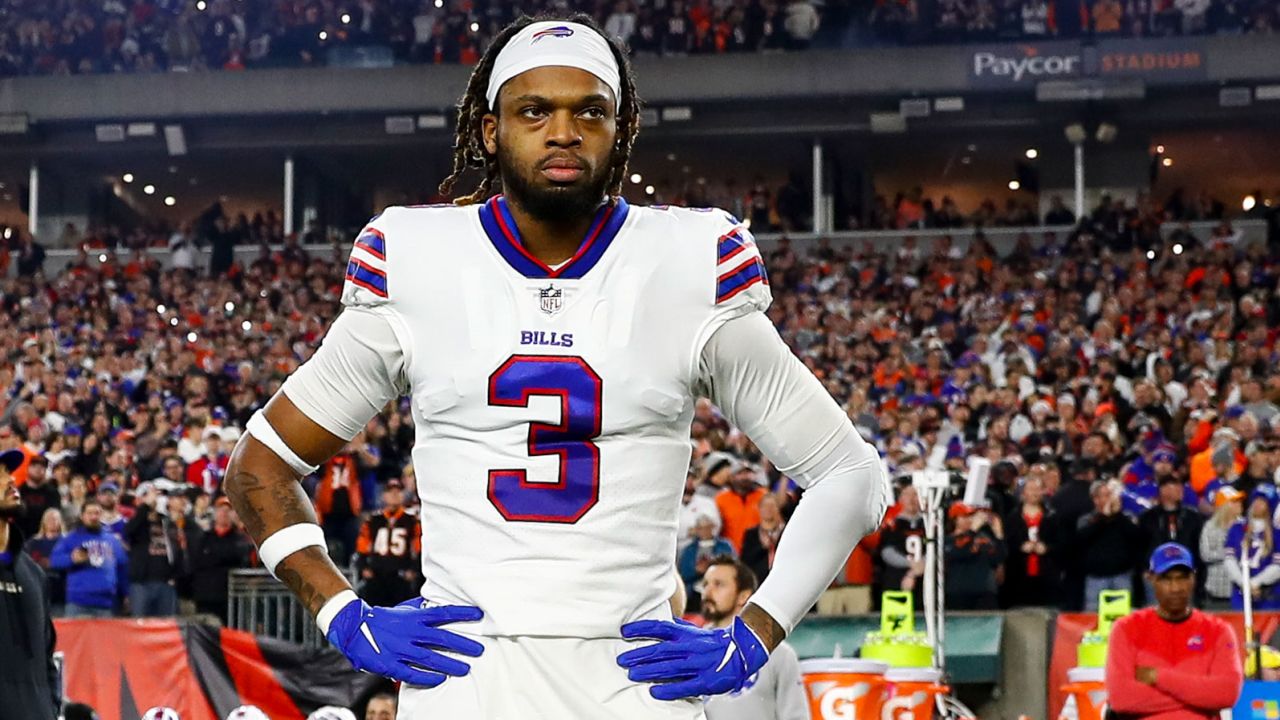
Hamlin stands near the sidelines during introductions prior to the game against the Cincinnati Bengals at Paycor Stadium on January 2, 2023.

‘Profound dedication’

Hamlin was honored on Wednesday as he won the 2023 NFL Players Association Alan Page Community Award.

“I just want to say, ‘thank you’ and just thank God for being here and thank the other guys who was nominated for the award as well who did the work in their community,” Hamlin said.

“Giving back to my community has always been a big part of who I am. Thankful to my father who is right here behind me. Growing up just watching him do community days in our community and I just always waiting on my time when it came.

“I plan to never take this position for granted and always have an urgent approach in making a difference in the community where I come from and also community across the world,” Hamlin added.

The award “recognizes one player who demonstrates a profound dedication to positively impacting his team’s city and communities across the country,” according to the NFLPA.

Hamlin’s Chasing M’s Foundation community toy drive has raised over $9 million as of Saturday.

During his media conference, Goodell said total injuries suffered this past season were down by 6% but the league saw an 18% increase in concussions during the 2022 regular season.

NFL chief medical officer Dr. Allen Sills noted that there were 149 concussions – up from 126 last season – according to the injury data released by the NFL.

Goodell attributed the increase to the league’s “definition of concussions,” which changed during the season.

“We had more evaluations – that’s going lead to more recorded concussions,” said Goodell. “We don’t want concussions to occur, we want to prevent them and we want to treat them, but we are not afraid of having them be diagnosed.”

Goodell added: “We encourage players and coaches and everyone else to come forward when they have symptoms so we can deal with those medically and make sure that they are handled professionally.”

The NFL has been under renewed scrutiny over the issue of concussions this season, beginning on September 25 when Miami Dolphins quarterback Tua Tagovailoa was injured during play but was allowed to return to the field.

One of the biggest concerns about repeated blows to the head and concussions is their association with a deadly brain disease known as chronic traumatic encephalopathy (CTE).

The NFL’s current concussion protocol is triggered if a player receives a blow to the head and exhibits or reports symptoms or signs suggestive of a concussion or stinger – a nerve pinch injury – or key health or athletic personnel initiates the protocol.

The player is removed to the sideline or stabilized on the field and required to undergo testing.

https://www.cnn.com/2023/02/08/sport/damar-hamlin-nfl-players-union-doctor-spt-intl/index.html

20 AI stocks expected by analysts to rise up to 85% over next year

 Artificial intelligence is the hottest area of the stock market right now. A screen of five ETFs points to a list of highly favored companies

There are always fads in the stock market, but now we are in the midst of what could turn out to be a revolutionary trend that will last much longer than any fad -- artificial intelligence.

In the Need to Know column on Feb. 9, Edward Stanley, who leads a team of strategists at Morgan Stanley, was quoted calling AI the real deal: "Generative AI, now popularized by ChatGPT, is showing all the usual hallmarks of hype," he wrote. But then he added that "something suggests the AI hype is worth considering seriously," calling it "the fastest platform to a million users and fastest to 100 million site views."

Stanley called generative AI a "serious contender" for "tech diffusion with real market impact potential."

When screening companies by business focus, it helps to have an industry label, such as "semiconductors." Such isn't the case for AI. One easy way to jump on the trend bandwagon would be to purchase shares of Microsoft Corp. (MSFT), which provided $1 billion in funding for OpenAI when it began to develop ChatGPT, and is now ponying up billions more. Microsoft has been demonstrating how it will integrate ChatGPT with its Bing search engine.

Related:Google's stock dips on demonstration of its AI chatbot, Bard

For a new screen of AI-related stocks, we began by looking at the holdings of five exchange-traded funds with AI in their names:

Taking all the stocks held by the ETFs together, we narrowed the list to 96 stocks held by at least two of the funds. We then narrowed further to 88 companies covered by at least five analysts polled by FactSet.

Among those 88 companies, 30 are rated a "buy" by at least 75% of analysts covering the stocks. Sometimes price targets can get ahead of analysts' targets, especially in such a hot area of the stock market.

So we have narrowed the list further to the 20 stocks for which analysts see the most upside potential over the next 12 months, based on consensus price targets. Prices and targets are in local currencies, where the stocks are listed.

Company                                           Ticker    Country      Share "buy" ratings  Feb.8 price  Cons. price target  Implied 12-month upside potential 
Darktrace PLC                                     UK:DARK   U.K.                         75%         2.43                4.49                                85% 
Taiwan Semiconductor Manufacturing Co. Ltd. ADR     TSM     Taiwan                       90%        94.28              156.34                                66% 
Meituan Class B                                   HK:3690   China                        94%       153.10              238.68                                56% 
JD.com Inc. ADR Class A                             JD      China                        88%        55.35               81.76                                48% 
CrowdStrike Holdings Inc. Class A                  CRWD     U.S.                         89%       114.48              160.46                                40% 
Alibaba Group Holding Ltd. ADR                     BABA     China                        93%       105.11              146.97                                40% 
Amazon.com Inc.                                    AMZN     U.S.                         93%       100.05              134.04                                34% 
Nidec Corp.                                       JP:6594   Japan                        87%     7,223.00            9,462.88                                31% 
Sony Group Corp.                                  JP:6758   Japan                        88%    11,955.00           15,354.71                                28% 
PROS Holdings Inc.                                  PRO     U.S.                         86%        28.40               36.17                                27% 
Alphabet Inc. Class A                              GOOGL    U.S.                         92%        99.37              125.76                                27% 
Denso Corp.                                       JP:6902   Japan                        95%     7,342.00            9,138.24                                24% 
Palo Alto Networks Inc.                            PANW     U.S.                         89%       166.14              205.66                                24% 
Infineon Technologies AG                          XE:IFX    Germany                      80%        35.52               43.90                                24% 
Nice Ltd. ADR                                      NICE     Israel                       92%       222.79              265.94                                19% 
ASML Holding NV ADR                                ASML     Netherlands                  85%       662.79              782.00                                18% 
Samsung Electronics Co. Ltd.                     KR:005930  South Korea                  95%    63,100.00           74,194.45                                18% 
Synopsys Inc.                                      SNPS     U.S.                         93%       360.60              419.07                                16% 
ServiceNow Inc.                                     NOW     U.S.                         89%       463.98              518.18                                12% 
Apple Inc.                                         AAPL     U.S.                         76%       151.92              168.29                                11%