Search This Blog

Thursday, February 9, 2023

Trigger for world's most common liver disease identified

 University of Virginia School of Medicine researchers have discovered a key trigger for non-alcoholic fatty liver disease, a mysterious condition that causes fat to build up in the liver for no clear reason. The new insights help explain the condition in younger people and could lead to the first treatment for the most common liver disease in the world.

The culprit? Wrinkles forming in the cellular compartment that contains our DNA. Prior research by the UVA scientists suggested that these wrinkly cellular nuclei could be involved in common metabolic diseases such as diabetes and  disease and even aging itself. The new results bolster those findings and could lead to treatments targeting the wrinkles to stop fatty —and possibly slow or reverse aging.

"We found a common mechanism involving the nucleus and the nuclear lamina that leads to fat accumulation in the liver in aged individuals and  with ," said senior researcher Irina M. Bochkis, Ph.D., of UVA's Department of Pharmacology. "Our findings could lead to novel treatments aimed at restoring the function of the nuclear lamina to control aberrant genes and reverse fatty liver in  with non-alcoholic fatty liver disease or aged individuals."

Understanding non-alcoholic fatty liver disease

Fatty liver disease is common among people who consume large amounts of alcohol—the excess storage of fat in the liver is a red flag that a person is drinking heavily. But non-alcoholic fatty liver disease strikes people who drink little or not at all, especially older people and people with type 2 diabetes. Approximately 40% of people over age 70 have the condition.

For many people, fatty liver disease causes no symptoms. They may not even be aware they have it. But for others, it can cause weakness, fatigue and abdominal pain, diminishing quality of life. Unfortunately, there is no treatment.

Doctors have struggled to understand what triggers non-alcoholic fatty liver disease, but UVA's new discovery suggests it may be caused, at least in part, by malfunctions inside the "hard drives" that contain our cells' operating instructions. These changes start within the , where our chromosomes are stored, and alter the activity of certain genes—ultimately leading to fat accumulation in the liver.

The new research suggests the fault begins in a portion of the nucleus called the lamina. The lamina acts as a tether between the nuclear membrane and genetic material contained within, called chromatin. The formation of wrinkles in the lamina, Bochkis and her team found, affects the activity of genes that control the storage of fats. When these genes become hyperactive, the liver becomes stuffed with excess fats, leading to non-alcoholic fatty liver disease.

To verify their findings, the researchers looked at liver cells collected from younger human patients, ages 21-51, with non-alcoholic fatty liver disease. The scientists found exactly what they expected: wrinkly lamina. This helps explain why the condition can strike people of any age, the researchers say, and should be useful for identifying those at risk.

By targeting the harmful changes in the lamina, researchers may be able to develop ways to treat or even prevent non-alcoholic fatty liver disease (and possibly other metabolic diseases and even aging). For example, Bochkis has said scientists might be able to use custom-tailored viruses to deliver different lamin proteins to the liver to smooth the membranes' surfaces and restore the cells to proper function.

"Currently there is no treatment for non-alcoholic  and no method to stratify the patients," Bochkis said. "Our findings could lead to improved stratification and a novel treatment without side effects where restoring the lamina function returns the cell to a healthy state with appropriate gene expression."

The study is published in the journal Genome Research.

More information: Xiaolong Wei et al, Redistribution of lamina-associated domains reshapes binding of pioneer factor FOXA2 in development of nonalcoholic fatty liver disease, Genome Research (2022). DOI: 10.1101/gr.277149.122


https://medicalxpress.com/news/2023-02-trigger-world-common-liver-disease.html

New compound inhibits influenza virus replication

 Viruses use the molecular repertoire of the host cell to replicate. Researchers from the Cluster of Excellence ImmunoSensation2 at the University of Bonn, together with Japanese researchers, want to exploit this for the treatment of influenza.

A team led by Prof. Hiroki Kato from the Institute of Cardiovascular Immunology at the University Hospital Bonn has identified a compound that inhibits the body's own methyltransferase MTr1, thereby limiting the replication of . The compound has proven effective in lung tissue preparations and mouse studies, and showed synergistic effects with already approved  drugs. The researchers' study is published in the journal Science.

To replicate, viruses need a . There they introduce their genetic information in the form of the nucleic acids DNA or RNA. These molecular blueprints are used in the host cell to produce new viruses. In order to distinguish foreign acids from its own nucleic acids, the cell uses a kind of labeling system. Its own RNA, for example, is tagged with a molecular cap that identifies it as non-hazardous. This enables the immune system to react specifically to threats.

The stolen cap

The molecular cap is a methylated nucleoside: a small molecule attached to the end of the RNA chain. Tagged in this way, the RNA does not trigger an immune response. However, if there is RNA in the cell that lacks the cap structure, it is recognized by the immune receptor RIG-I, and the immune system is alerted.

To escape this, influenza viruses have developed a special mechanism. They steal the molecular cap from cellular RNA molecules and transfer it to their own RNA. This process is called cap-snatching.

Influenza requires cellular enzyme for replication

The enzyme MTr1 provides cellular mRNA with a cap structure and thus functions as the cell's "nucleic acid labeler." The research team led by Prof. Hiroki Kato of the Institute of Cardiovascular Immunology at the University Hospital Bonn has been able to show how much influenza viruses depend on the function of the enzyme MTr1.

"While other viruses, such as SARS-CoV-2, are able to cap their RNA molecules on their own, influenza viruses rely on stealing existing caps," says Yuta Tsukamoto, lead author of the paper. "If the function of MTr1 is disrupted in the cell, there are no caps available to transfer to viral RNA." The activity of MTr1 is thus essential for the replication of the influenza virus in the cell.

New inhibitor inhibits virus replication

The researchers want to harness this dependence for the treatment of influenza infections. To this end, they searched for inhibitors that specifically inhibit MTr1. The team investigated how the substances in the infected tissue affect the amount of virus particles produced. They tested this both in mouse models and in human lung tissue preparations. These so-called lung explants come from patients who have undergone lung surgery.

"Among thousands of candidates, we were able to identify a molecule that inhibits MTr1 in human lung explants and also in vivo in mice, curtailing influenza replication," reports Prof. Hiroki Kato, a member of the Cluster of Excellence ImmunoSensation2 at the University of Bonn.

The inhibitor is a derivative of a natural product called trifluoromethyl tubercidin (TFMT), which is produced by bacteria of the genus Streptomyces. "We hope this study will lead to the development of new treatments for influenza," says Prof. Hiroki Kato.

In the present study, the researchers have already been able to demonstrate that TFMT works together with approved drugs against influenza infections. It was even possible to show a clear synergistic effect with regard to the number of  particles produced in the tissue.

More information: Yuta Tsukamoto et al, Inhibition of cellular RNA methyltransferase abrogates influenza virus capping and replication, Science (2023). DOI: 10.1126/science.add0875www.science.org/doi/10.1126/science.add0875


https://medicalxpress.com/news/2023-02-compound-inhibits-influenza-virus-replication.html

Disrupted flow of brain fluid may underlie neurodevelopmental disorders

 The brain floats in a sea of fluid that cushions it against injury, supplies it with nutrients and carries away waste. Disruptions to the normal ebb and flow of the fluid have been linked to neurological conditions including Alzheimer's disease and hydrocephalus, a disorder involving excess fluid around the brain.

Researchers at Washington University School of Medicine in St. Louis have created a new technique for tracking circulation patterns of fluid through the . They have discovered, in rodents, that it flows to areas critical for  and function. Further, the scientists found that circulation appears abnormal in young rats with hydrocephalus, a condition associated with cognitive deficits in children.

The findings, available online in Nature Communications, suggest that the fluid that bathes the brain—known as —may play an underrecognized role in normal  and .

"Disordered cerebrospinal fluid dynamics could be responsible for the changes in brain development we see in children with hydrocephalus and other developmental brain disorders," said senior author Jennifer Strahle, MD, an associate professor of neurosurgery, of pediatrics, and of orthopedic surgery. As a pediatric neurosurgeon, Strahle treats children with hydrocephalus at St. Louis Children's Hospital.

"There's a whole host of neurologic disorders in young children, including hydrocephalus, that are associated with developmental delays. For many of these conditions we do not know the underlying cause for the developmental delays. It is possible that in some of these cases there may be altered function of the brain regions through which cerebrospinal fluid is circulating," said Strahle.

Much research has been conducted mapping the drainage of cerebrospinal fluid in the brains of adults. However, it is not well known how cerebrospinal fluid interacts with the brain itself. Cerebrospinal fluid pathways in the brain likely vary with age, as  have not yet developed the mature drainage pathways of adults.

Strahle; first author Shelei Pan, an undergraduate student; and colleagues developed an X-ray imaging technique using  that allowed them to visualize brain circulation patterns in microscopic detail. Using this method on young mice and rats, they showed that cerebrospinal fluid enters the brain through small channels primarily at the base of the brain, a route that has not been seen in adults. In addition, they found that cerebrospinal fluid flows to specific functional areas of the brain.

"These functional areas contain specific collections of cells, many of which are neurons, and they are associated with major anatomic structures in the brain that are still developing," Strahle said.

"Our next steps are to understand why cerebrospinal fluid is flowing to these neurons specifically and what molecules are being carried in the cerebrospinal fluid to those areas. There are  within the cerebrospinal fluid that may be interacting with these specific neuronal populations to mediate development, and the interruption of those interactions could result in different disease pathways."

Further experiments showed that hydrocephalus reduces cerebrospinal fluid flow to distinct neuron clusters. Strahle and colleagues studied a form of hydrocephalus that affects some premature infants. Babies born prematurely are vulnerable to brain bleeding around the time of birth, which can lead to hydrocephalus and developmental delays.

Strahle and colleagues induced a process in young rats that mimicked the process in . After three days, the tiny channels that carry cerebrospinal fluid from the outer surface of the brain into the middle were fewer and shorter, and circulation to 15 of the 24 neuron clusters was significantly reduced.

"The idea that cerebrospinal fluid can regulate neuronal function and brain development isn't well explored," Strahle said. "In the setting of hydrocephalus, it's common to see cognitive dysfunction that persists even after we successfully drain the excess fluid. The disordered cerebrospinal fluid dynamics to these functional regions of the brain may ultimately affect brain development, and normalizing flow to these areas is a potential approach to reducing developmental problems. It is an exciting field, and we are only at the beginning of understanding the diverse functions of cerebrospinal ."

More information: Shelei Pan et al, Gold nanoparticle-enhanced X-ray microtomography of the rodent reveals region-specific cerebrospinal fluid circulation in the brain, Nature Communications (2023). DOI: 10.1038/s41467-023-36083-1


https://medicalxpress.com/news/2023-02-disrupted-brain-fluid-underlie-neurodevelopmental.html

Study: Salt cuts off energy supply to immune regulators

 Eating too much salt, which is common in many Western societies, is not only bad for our blood pressure and cardiovascular system—it could also adversely impact the immune system.

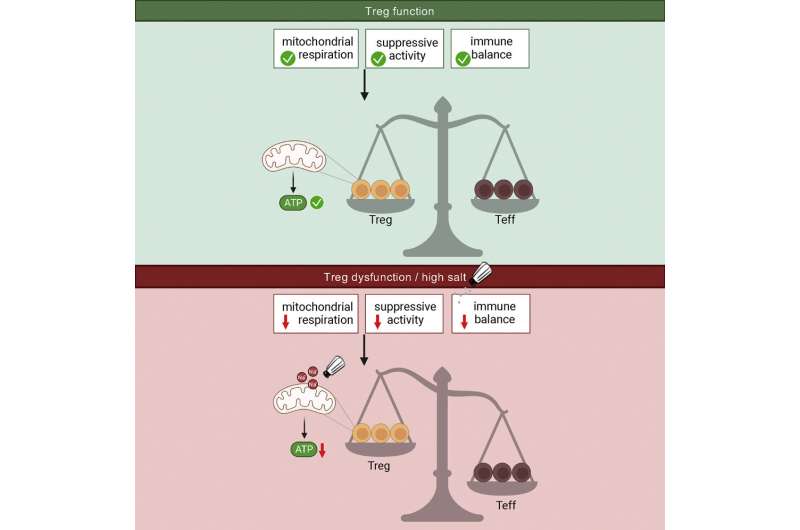
An international research team, coordinated by scientists at the VIB Center for Inflammation Research and Hasselt University in Belgium as well as the Max Delbrück Center in Germany, is now reporting in Cell Metabolism that salt can disrupt key immune regulators called regulatory T  by impairing their energy metabolism. The findings may provide new avenues for exploring the development of autoimmune and cardiovascular diseases.

A few years ago, research by teams led by Professor Dominik Müller at the Max Delbrück Center for Molecular Medicine and the Experimental and Clinical Research Center, a joint institution of Charité—Universitätsmedizin Berlin and Max Delbrück Center (ECRC) in Berlin, Germany and Professor Markus Kleinewietfeld at the VIB Center for Inflammation Research and Hasselt University in Belgium, together with colleagues, revealed that too much salt in our diet can negatively affect the metabolism and energy balance in certain types of innate immune cells called monocytes and macrophages and stop them from working properly.

The researchers further showed that salt triggers malfunctions in the mitochondria, the power plants of our cells. Inspired by these findings, the research groups wondered whether excessive salt intake might also create a similar problem in adaptive immune cells like regulatory T cells.

Salt cuts off the energy supply to immune regulators
Credit: Cell Metabolism (2023). DOI: 10.1016/j.cmet.2023.01.009

Important immune regulators

Regulatory T cells, also known as Tregs, are an essential part of the adaptive . They are responsible for maintaining the balance between normal function and unwanted excessive inflammation. Tregs are sometimes referred to as the "immune police" because they keep bad guys like autoreactive immune cells at bay and ensure that immune responses happen in a controlled way without harming the host organism.

Scientists believe that the deregulation of Tregs is linked to the development of autoimmune diseases like multiple sclerosis. Recent research has identified problems in mitochondrial function of Tregs from patients with autoimmunity, yet the contributing factors remain elusive.

"Considering our previous findings of salt affecting mitochondrial function of monocytes and macrophages as well as the new observations on mitochondria in Tregs from autoimmune patients, we were wondering if  might elicit similar issues in Tregs of healthy volunteers," says Müller, who co-heads the Hypertension-Mediated End-Organ Damage Lab at the Max Delbrück Center and the ECRC.

Previous research has also shown that excess salt could impact Treg function by inducing an autoimmune-like phenotype. In other words, too much salt makes the Treg cells look like those involved in autoimmune conditions. However, exactly how sodium impairs Treg function had not yet been uncovered.

Salt interferes with mitochondrial function of Tregs

The new international study led by Kleinewietfeld and Müller and first-authored by Dr. Beatriz Côrte-Real and Dr. Ibrahim Hamad—both of whom work at the VIB Center for Inflammation Research and Hasselt University in Belgium—has now discovered that sodium disrupts Treg function by altering cellular metabolism through interference with mitochondrial energy generation. This mitochondrial problem seems to be the initial step in how salt modifies Treg function, leading to changes in gene expression that showed similarities to those of dysfunctional Tregs in autoimmune conditions.

Even a short-term disruption of mitochondrial function had long-lasting consequences for the fitness and immune-regulating capacity of Tregs in various experimental models. The new findings suggest that sodium may be a factor that could contribute to Treg dysfunction, potentially playing a role in different diseases, although this must be confirmed in further studies.

"The better understanding of factors and underlying  contributing to Treg dysfunction in autoimmunity is an important question in the field. Since Tregs also play a role in diseases such as cancer or cardiovascular disease, the further exploration of such sodium-elicited effects may offer novel strategies for altering Treg function in different types of diseases," says Kleinewietfeld, who heads the VIB Laboratory for Translational Immunomodulation. "However, future studies are needed to understand the molecular mechanisms in more detail and to clarify their potential relationship to disease."

More information: Beatriz F. Côrte-Real et al, Sodium perturbs mitochondrial respiration and induces dysfunctional Tregs, Cell Metabolism (2023). DOI: 10.1016/j.cmet.2023.01.009


https://medicalxpress.com/news/2023-02-salt-energy-immune.html

Biden Admin Asks Supreme Court To Drop Title 42 Immigration Case

by Matthew Vadum via The Epoch Times (emphasis ours), 

The Biden administration urged the Supreme Court on Feb. 7 to dismiss 19 states’ challenge to the cancellation of the pandemic-era Title 42 policy that allows rapid expulsion of would-be migrants at the border.

The administration argued that its plan to terminate the public health emergency on May 11 would make the case moot. The high court will hear the appeal on March 1.

Open-borders and humanitarian groups say the Title 42 policy prevents those fleeing persecution and violence in their home countries from obtaining legal due process when they arrive in the United States; however, the states say withdrawing the policy would flood already overburdened border facilities with even more illegal aliens.

The states previously told the high court that failing to uphold the policy “will cause a crisis of unprecedented proportions at the border” and that “daily illegal crossings may more than double.”

Before he left office in early January, Arizona Attorney General Mark Brnovich, one of the architects of the legal strategy to keep the policy alive, told The Epoch Times that the states were intervening because the federal government was failing to maintain order at the border.

And the bottom line is … that if [President] Joe Biden is not going to do his job, then [we] have to do everything we can. Because what is going on at our southern border, obviously, is costing us not only fiscally, but it’s costing us in human lives lost. And so it is a life and death issue,” Brnovich, a Republican, said at the time.

Days before that, the Supreme Court blocked the rescission of the policy, which has been used to expel more than 2 million individuals, and scheduled oral arguments in the case, Arizona v. Mayorkas, for March 1.

The anticipated end of the public health emergency on May 11, and the resulting expiration of the operative Title 42 order, would render this case moot,” U.S. Solicitor General Elizabeth Prelogar stated in a filing (pdf) with the court on Feb. 7.

Responding to Republican proposals in Congress to end the national emergency and public health emergency that were declared by the Trump administration three years ago, Biden’s Office of Management and Budget (OMB) said on Jan. 30 that it would extend the soon-to-expire emergencies to May 11 “and then end both emergencies on that date.”

Ending the twin emergency declarations would curb some of the federal agencies’ expansive powers in managing the government’s response to the COVID-19 virus and return agency operations to something closer to normal. Republicans, who took over the U.S. House of Representatives last month, say the emergencies aren’t justified and should be ended sooner.

https://www.zerohedge.com/political/biden-admin-asks-supreme-court-drop-title-42-immigration-case

Prostitution, Pimping Rises In Cal. After Prohibitions Repealed, "Scared" Families Plead With Officials

 by Naveen Anthrapully via The Epoch Times,

Multiple cities in California are now seeing rampant, public prostitution activities, pushing residents in many places into stress and fear, with critics blaming the situation on a Democrat-supported bill that repealed a law against loitering for prostitution purposes.

East 15th Street, a neighborhood in Oakland, used to be a quiet area. However, things changed after prostitution activity rose. Resident Estefani Zarate worries about how this will affect her young children. “I’m scared for them to see (the women) in inappropriate clothes, (then ask) me questions and I don’t have answers for them,” she said to CBS News.

“It shouldn’t be introduced at the age of 4 years old that you’re going down the street and you’re seeing women dress like this (or) you need to learn ‘oh, if you hear gunshots, duck down,’” said Estefani’s sister Marlen Zarate.

Residents from the Capp Street neighborhood in San Francisco are pleading for officials to intervene after prostitution activity rose.

Following resident requests, city officials are reportedly planning to install barriers along a strip of Capp Street which is said to be where prostitution activities are the most concentrated.

In multiple cities across California, scenes of thong-wearing women on street corners, prostitutes twerking at traffic, and pimps tailing mothers who take their kids to school are becoming common.

Democrat Bill Against Loitering

Senate Bill 357, introduced by Democrat state Sen. Scott Wiener, was signed into law last year by California Democrat governor Gavin Newsom. The bill repealed a law that prohibited loitering for prostitution activities. It came into effect on Jan. 1.

Some Republicans are blaming the law for making life difficult for families. “California Democrats’ policy of legalizing crime is creating more victims by the hour,” GOP Assembly leader James Gallagher said in a statement, according to Fox.

“Under Democratic rule, families and businesses are moving out, while human traffickers are moving in. It was clear from the get-go that this law would encourage and enable human trafficking, but that was apparently an acceptable result for the lawmakers who backed it.”

“[The law] hinder[s] law enforcement efforts to identify and prosecute those who commit crimes related to prostitution and human trafficking,” Orange County Sheriff’s Department spokeswoman Carrie Braun told The Epoch Times in November 2022.

“Additionally, it could hinder the ability of identifying those being victimized.”

Vanessa Russell, founder and executive director of the nonprofit Love Never Fails, said that legalizing loitering for prostitution has created an increase in demand in Californian cities.

In areas like San Francisco and Oakland, there has reportedly been a tripling in the number of exploited people, she said.

“The anti-police sentiment that was leveraged to push this bill through touting safer streets for all … [is] unfortunately harming these populations much more than it helps because the police are no longer able to conduct early intervention with violent exploiters and buyers,” Russell stated.

Violence, California Prostitution Law

It is not just the presence of prostitution activities that is troubling the minds of residents. Some are disturbed by gunfire as well as public beatings.

“From the window right there, I’ll see three [people] ganging up on a girl,” resident from Capp Street said to San Francisco Chronicle, gesturing toward a bay window that overlooks a busy intersection.

“They’ll be hitting her … I call the cops; no one comes. There’s nothing I can do.”

According to California law, prostitution is illegal. Charged as a misdemeanor crime, a first offense carries up to six months of jail time and $1,000 in fines. Subsequent offenses can carry higher penalties.

Before Senate Bill 357, those who loitered with an intent to commit prostitution also attracted similar punishment. Senate Bill 357 has not only decriminalized loitering but has also allowed people who have been convicted on these charges to petition a court to get these offenses sealed from their records.

https://www.zerohedge.com/political/prostitution-pimping-rises-california-after-prohibitive-laws-repealed-scared-families

Hunter Biden lawyer refuses House GOP demand for records of biz deals

 Hunter Biden’s attorney has refused to hand over records about the first son’s controversial overseas business dealings, claiming the House Oversight Committee doesn’t have the power to demand the documents.

Hunter’s lawyer, Abbe Lowell, cited a 2020 ruling by the US Supreme Court that found House Democrats’ demands for the financial records and tax returns of former President Donald Trump and his family were too broad and threatened the constitutional separation of powers.

“Peddling your own inaccurate and baseless conclusions under the guise of a real investigation, turns the Committee into ‘Wonderland’ and you into the Queen of Hearts shouting, ‘sentence first, verdict afterwards,'” Lowell told panel chairman James Comer (R-Ky.), referencing “Alice in Wonderland.”

Lowell concluded his four-page letter to Comer by offering “to sit with you and your staff, including the ranking member and his staff, to see whether Mr. Biden has information that may inform some legitimate legislative purpose and be helpful to the Committee.”

James Comer.
Rep. James Comer accused Hunter Biden and his business associates of having “peddled influence to generate millions of dollars for the Biden family.”
REUTERS

Comer had demanded that Hunter Biden turn over any records related to his father’s alleged “involvement” in the family’s financial interests, accusing the 53-year-old and his business associates of having “peddled influence to generate millions of dollars for the Biden family.”

“Evidence shows that you engaged in foreign business deals with individuals who were connected to the Chinese Communist Party and received significant amounts of money from foreign companies without providing any known legitimate services,” he wrote.

“You and your associates’ financial conduct raises significant ethics and national security concerns. The Committee requests documents and communications related to our investigation of President Biden’s involvement in your financial conduct.”

Comer said the committee needed the information to determine whether the 80-year-old president “has compromised our national security at the expense of the American people.”

On Wednesday, the committee held a hearing into Twitter’s acknowledged suppression of The Post’s October 2020 scoop that revealed the existence of Hunter Biden’s infamous laptop.

Comer’s letter gave Hunter Biden a Feb. 22 deadline to turn over any relevant records involving him and his dad beginning from Jan. 20, 2009 — when the elder Biden was sworn in for the first of his two terms as vice president — to Jan. 20, 2021, when he was sworn in as president.

In the wake of the scandal over President Biden’s possession of classified documents, Comer also demanded that Hunter cough up “any document, record, or communication designated classified by any government body, including but not limited to any constituent agency of the US Intelligence Community.”

Similar letters were also sent to President Biden’s brother, James Biden, and Eric Schwerin, a former Hunter Biden business partner.

Joe and Hunter Biden.
The House Oversight Committee will determine if President Biden “has compromised our national security at the expense of the American people.”
AP

A spokesperson for James Biden declined to comment. A request for comment from Schwerin wasn’t immediately returned.

President Biden has repeatedly denied any involvement in his son’s business dealings, including even discussing them.

But emails from Hunter Biden’s laptop showed that he introduced his dad to a top exec at the Ukrainian energy company Burisma in 2015, while Hunter Biden was serving on its board.

James Comer.
Rep. James Comer gave Hunter Biden a Feb. 22 deadline to turn over any relevant records.
Getty Images

Other emails showed how Hunter Biden pursued a lucrative deal with a Chinese energy conglomerate, CEFC China Energy Co., that included a plan for 10% of the equity to be “held by H for the big guy.”

Another partner, former British special forces officer James Gilliar, also referred to Joe Biden as “the Big Guy” in a 2020 message prompted by The Post’s scoop about Hunter Biden’s laptop, Post columnist Miranda Devine reported earlier this year.

CEFC paid entities controlled by Hunter and James Biden a total of $4.8 million during a 14-month period that began in August 2017, according to The Washington Post, which last year independently authenticated nearly 22,000 emails from the laptop.

Last week, Lowell sent letters to the US Justice Department, the IRS and the Delaware Attorney General’s Office seeking probes of several allies of Trump, 76, and others in connection with “the exposure, exploitation, and manipulation of [Hunter] Biden’s private and personal information” on the laptop.

Lowell reportedly followed up those requests with letters directing the potential targets — who include former Mayor Rudy Giuliani and former White House adviser Steve Bannon — to retain any records that might be needed in connection with future litigation.

https://nypost.com/2023/02/09/house-demands-records-on-joe-bidens-involvement-in-hunter-dealings/