Search This Blog

Monday, March 6, 2023

Bloomberg Terminal Users Embrace 'Cash Is No Longer Trash'

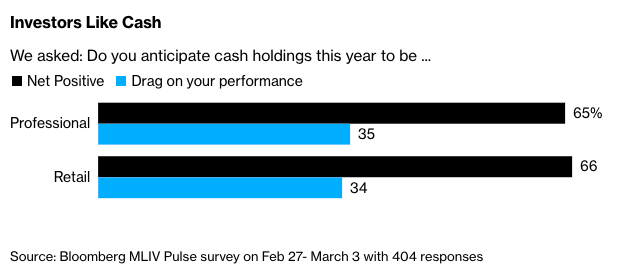
 In a new survey, Bloomberg Terminal users have overwhelmingly agreed that cash in their portfolios would be a net positive this year, supporting the case 'cash is no longer trash' amid signs that higher-than-expected inflation data indicates global central banks will continue their ultra-hawkish stance to keep aggressively raising interest rates. 

Over 400 professional and retail investors participated in the latest MLIV Pulse survey. Two-thirds of professional respondents believe cash will be a net positive on their portfolios, while only 35% answered that cash holdings would drag on performance. Retail traders gave similar responses. 
The appeal of cash stems from increasing nervousness as higher-than-expected inflation data means central banks will continue to raise interest rates through at least June, dashing hopes for a full-blown risk-on rally in equity markets. The Federal Reserve clearly has more work to do as the economy still runs hot. The Fed's benchmark rate implied by overnight index swaps shows at least three more 25bps hikes through June, with a terminal rate of around 544 bps by mid-summer. 

Bank of America Corp. notes, citing EPFR Global data, that during the week ending on March 1, global cash funds experienced inflows of $68.1 billion, whereas equity funds saw outflows of $7.4 billion. The significant inflows into cash suggest that investors are feeling nervous.

BofA's Michael Hartnett wrote last Friday that the end of the bear market would coincide with credit market turmoil and lower home prices. He said until then, cash is as good as bonds and stocks. 


Achondroplasia win propels Bridgebio

 Cut the data any which way, and results from cohort 5 of the Propel2 trial of Bridgebio’s infigratinib in achondroplasia are impressive. The project appears to be promoting substantially faster growth in these short stature children than Biomarin’s Voxzogo, with remarkably clean safety; ahead of the data analysts said a similar annualised height velocity to Voxzogo would be a win. Throw in infigratinib’s oral dosing versus Voxzogo’s subcutaneous injection and little wonder that Bridgebio stock soared as much as 73% today. SVB Securities described the data as setting “a new high water mark” in achondroplasia. True, these new phase 2 results are in only 10 patients, making direct comparisons with Voxzogo’s phase 3, represented in the “existing comparison” column below, full of caveats. Durability and safety need to be proven in a pivotal study, for which Bridgebio is already preparing. Assuming a year to enrol and a year to collect data, a filing in 2026 is probably the best-case scenario. That gives Biomarin plenty of time to make the most of Voxzogo, which sold $169m last year after a strong launch in late 2021. However, with Biomarin shares trading 5% lower, investors apparently believe the infigratinib threat is real.

T-cell receptor behemoths consolidate? Not quite

 Welcome to 2023, where biotechs increasingly find themselves trading well below their cash balances. One result of this is that it leaves them liable to low-ball takeovers, as TCR2 Therapeutics found today when it succumbed to an all-stock buyout from Adaptimmune.

In an upbeat investor presentation today Adaptimmune said the move would create a pre-eminent cell therapy company “poised to be an early leader” in a market worth $27bn in 2026. Behind the hype, however, a more prosaic rationale emerges: Adaptimmune is issuing stock to get its hands on TCR2’s cash, and the transaction is basically a glorified equity raise.

True, the move will see three TCR2 directors join the board, and at present Adaptimmune intends to continue developing TCR2’s technology, which clinically covers the anti-mesothelin projects gavo-cel and TC-510. But, with the risk of Adaptimmune having to undertake a solo launch of its first product next year, it is of vital importance that TCR2 will extend its cash runway from early 2025 into 2026.

Here is how the numbers work: Adaptimmune is issuing around 60 million new shares, increasing its outstanding share capital by around 35%, and these will be exchanged for existing TCR2 stock. The target company says it had $149m of cash at the end of last year, and it will probably have around $122m left at the end of this month.

Considering Adaptimmune’s 25% fall this morning the deal values TCR2 at just $77m. Put simply – and subject to other liabilities and the costs of doing this deal – the transaction can be seen as a way of Adaptimmune issuing $77m of stock to get its hands on $122m of cash, with TCR2’s pipeline thrown in for free.

Running the Adaptimmune/TCR2 numbers
TCR2 Q4 2022 gross cash ($m)149
TCR2 estimated quarterly burn ($m)27
TCR2 estimated Q1 2023 gross cash ($m)122
 
TCR2 shares outstanding (m)38.66
Adaptimmune share ratio1.5117
New Adaptimmune shares issued (m)58.44
Adaptimmune share price ($)*1.31
Implied value of TCR2 ($m)77
Note: *includes 25% fall on 6 Mar 2023. Source: company disclosures.

Why should TCR2 investors have agreed to such an apparently terrible deal? Probably because they had no other option; notwithstanding cash of well over $100m TCR2 was last week worth just $47m, having suffered a 92% fall since its 2019 IPO, and a 96% collapse since its early 2021 peak.

TCR2 this morning opened up 20%, so clearly the deal enables short-term holders to salvage some pride. Those who have held the stock for six months or more, however, must take the loss and move on.

Of course, those TCR2 holders who now stick with Adaptimmune might be rewarded further down the line. Afami-cel, Adaptimmune’s lead project, yielded impressive synovial sarcoma data at Asco 2021, and could be filed for US approval at last this year; if launched in 2024 it would become the world’s first marketed engineered T-cell receptor therapy.

Still, how would what is still a small biotech tackle a solo launch? Surely holders will be hoping for a takeout, and perhaps the TCR2 acquisition raises the chances of this happening.

Amarin Announces Board Departures

 Amarin Corporation plc (NASDAQ: AMRN) (“Amarin” or the “Company”) today announced that, in the interest of the Company to avoid further proxy contests, all seven independent non-Sarissa board members: Adam Berger, Erin Enright, Geraldine Murphy, Kristine Peterson, Dr. Murray Stewart, Jan van Heek and Alfonso “Chito” Zulueta will resign from the Board of Directors, effective immediately.

The departing members of the Amarin Board issued the following statement:

Following the 2023 Special Meeting of Shareholders, we have made the decision to resign from the Amarin Board. Amarin shareholders have strongly backed Sarissa and its slate of directors, and we are stepping down to allow Sarissa, as it has requested, to gain immediate control of the Company. We continue to believe in Amarin’s value potential, and are confident we leave the Company with a strong leadership and management team. We wish the new Sarissa directors good luck as they attempt to realize additional shareholder value.

https://finance.yahoo.com/news/amarin-announces-board-departures-210500276.html

Airlines grounded in South Florida after 'technological' situation

 Some flights in South Florida are being grounded and rerouted after a situation, officials with Punta Gorda Airport confirmed Monday afternoon.

https://www.yoursun.com/charlotte/news/airlines-grounded-in-south-florida-after-technological-situation/article_1094516e-bc54-11ed-a090-136446e69e00.html

FDA Sets July Decision Date for Full Approval of Leqembi

 The FDA has set a decision date of July 6, 2023 for Eisai and Biogen’s recently approved Alzheimer’s drug, Leqembi (lecanemab).

The FDA will hold an advisory committee meeting regarding the application, for which it did not provide a date. 

Leqembi won accelerated FDA approval in early January 2023. Studies of the antibody showed its ability to reduce the accumulation of amyloid beta plaque in the brain, a hallmark biomarker of AD.

Leqembi reduced clinical decline by 27% over placebo in patients with mild cognitive impairment or mild dementia.

In a Phase III trial, researched measured the cognitive decline of 1,800 patients in areas of memory, orientation, problem solving, community affairs, home/hobbies and personal care over 18 months.

Three additional studies of Leqembi are ongoing, Christopher Vancheri, associate director, corporate affairs and advocacy, Eisai told BioSpace in February.  

AHEAD 3-45 focuses on preclinical AD patients with intermediate or elevated levels of amyloid in the brain. A study for dominantly inherited AD is also underway, in addition to a trial studying subcutaneous dosing of Leqembi. 

Eisai submitted its supplemental Biologics License Application immediately following the accelerated nod. The granting of Priority Review status garnered the July 6th action date.

Full approval of the drug is vital for Medicare patients. The Centers for Medicare & Medicaid Services currently only cover anti-amyloid antibody drugs for patients enrolled in clinical trials. CMS made it clear Leqembi needs traditional FDA approval for broader coverage.  

With a price tag of $26,500, patients need the win.

At this point, Leqembi is only approved for patients in mild stages of cognitive impairment or dementia, and many who would qualify medically may still be on private insurance. Private insurers often wait on a CMS decision to make their own coverage determinations.

While full FDA approval isn’t a guarantee for Medicare coverage, the medical community is hopeful.

“[Medicare coverage] would be a game changer for AD treatment...but that still remains to be determined,” Cindy Lemere, Ph.D., a scientist at Brigham & Women’s Hospital, told BioSpace in a previous interview.  

While acknowledging that Leqembi is not a cure, LeMere said, “We are finally on a path to treat Alzheimer’s disease, and in the future, to prevent it.”

https://www.biospace.com/article/fda-sets-july-6-decision-for-leqembi-with-an-adcomm-/

Microsoft expands ChatGPT integration to more developer tools


Microsoft Corp on Monday bundled the technology behind ChatGPT with its Power Platform that allows users to develop applications with little or no coding, the latest integration of artificial intelligence into its products.

Big tech companies from Alphabet Inc to Baidu Inc are speeding up the integration of generative AI - technology that has gained popularity for its ability to generate human-like text responses to queries - into their offerings.

Microsoft said a line of business-intelligence and app-development tools within Power Platform, including Power Virtual Agent and AI Builder, was updated with the new capabilities.

Power Virtual Agent, a tool for businesses to build chatbots, can now connect to internal company resources to generate summaries of weekly reports and customer queries.

Microsoft has also added generative AI capabilities to AI Builder, which lets businesses automate workflows, and Dynamics 365, a business management platform. 

The features will only be available in the United States.

Last month, the software giant added OpenAI's ChatGPT to its Bing search and Edge browser.

https://www.marketscreener.com/quote/stock/BAIDU-INC-120803046/news/Microsoft-expands-ChatGPT-integration-to-more-developer-tools-43170612/