Search This Blog

Wednesday, August 2, 2023

Samsung seeks 'interchangeable' label for Humira biosimilar

 While there are already a number of biosimilars of AbbVie's big-selling Humira on the US market, so far, only one – Boehringer Ingelheim's Cyltezo – is interchangeable with the original, a coveted status that allows it to be switched for the brand without prescriber intervention.

Now, Samsung Bioepis and marketing partner Organon have the clinical data they need to get their Hadlima biosimilar approved as an interchangeable option and seek a leg-up in the competitive market for the lower-priced copycat therapies.

Hadlima – also known as SB5 – was one of several Humira biosimilars that launched in the US on or after 1st July, when AbbVie's patent protection for Humira (adalimumab) finally expired. The first to reach the market was Amgen's Amjevita back in January, which was able to launch early as a result of a patent litigation settlement with AbbVie.

Sales of Amjevita have so far remained relatively modest at $51 million in the first quarter of this year (Amgen is scheduled to report its second-quarter figures tomorrow), and with several other options now available further growth could be hard to come by.

Humira sales hit a high of $21 billion last year after more than a decade of $10 billion-plus growth, but have already shown signs of weakness overseas where biosimilars have been available for a while. Earlier this year, the company and are predicted sales of the immunology blockbuster will fall more than a third this year now that multiple biosimilars are available in the US.

Boehringer and Samsung Bioepis/Organon reckon that interchangeability will be the key to raising their biosimilar brands above the crowd. At the moment, other than Cyltezo all the Humira biosimilars require a physician to write a prescription specifically for them.

To try to change that, Samsung Bioepis and Organon have completed a phase 4 study involving 371 patients with moderate to severe chronic plaque psoriasis.

It compared one group that switched multiple times between Humira and Hadlima to a group that received AbbVie's drug continuously, and showed that the two groups were equivalent across a range of pharmacokinetic measures, as well as efficacy, safety, and immunogenicity profiles.

Organon launched Hadlima in July at an 85% discount to the brand, with a list price of $1,038 per carton containing two pre-filled pens or syringes. Other biosimilars that launched at the same time included products from Sandoz, Celltrion, Biocon, Pfizer, Coherus, and Fresenius Kabi.

https://pharmaphorum.com/news/samsung-seeks-interchangeable-label-humira-biosimilar

Biden Blames USA Downgrade On Trump

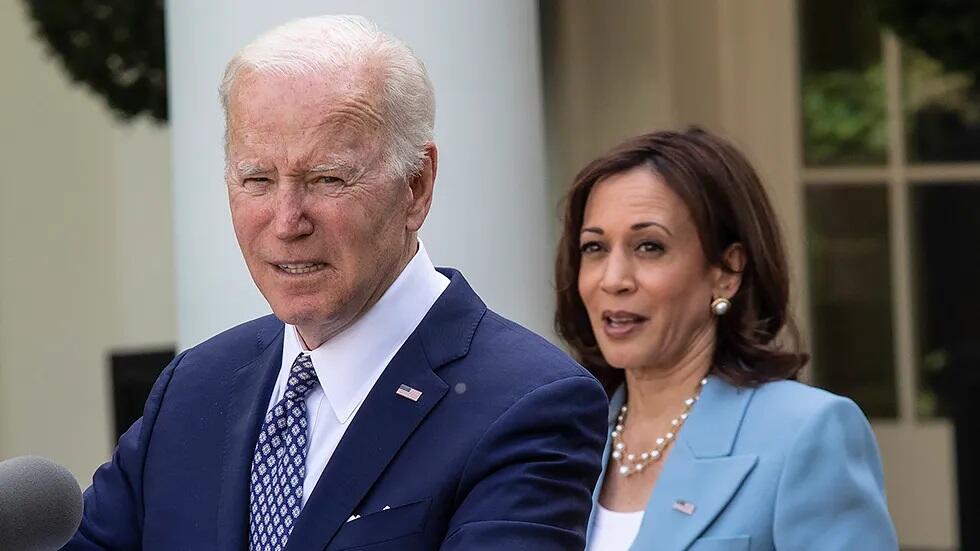
 The new regime talking points are out - namely that Fitch downgraded the US credit rating from AAA  to AA+ on Tuesday because of MAGA Republicans and all things Trump.

But while Fitch cited "the expected fiscal deterioration over the next three years, a high and growing general government debt burden, and the erosion of governance relative to 'AA' and 'AAA' rated peers" as reasons for the downgrade, the Biden administration is of course blaming Donald Trump and his supporters due to one portion of Fitch's explanation: "a steady deterioration in standards of governance over the last 20 years," and that "repeated debt-limit political standoffs and last-minute resolutions have eroded confidence in fiscal management.

Then on Wednesday, Fitch's Richard Francis told Reuters that the downgrade was 'due to fiscal concerns and a deterioration in U.S governance as well as polarization which was reflected in part by the Jan. 6 insurrection.'

"It was something that we highlighted because it just is a reflection of the deterioration in governance, it's one of many," he said, adding "You have the debt ceiling, you have Jan. 6. Clearly, if you look at polarization with both parties ... the Democrats have gone further left and Republicans further right, so the middle is kind of falling apart basically."

And so of course, the Biden administration is blaming Trump.

"This Trump downgrade is a direct result of an extreme MAGA Republican agenda defined by chaos, callousness, and recklessness that Americans continue to reject," said Biden re-election campaign spokesman Kevin Munoz. "Donald Trump oversaw the loss of millions of American jobs, and ballooned the deficit with the disastrous tax cuts for the wealthy and big corporations."

Ah, so now it's the Trump downgrade™

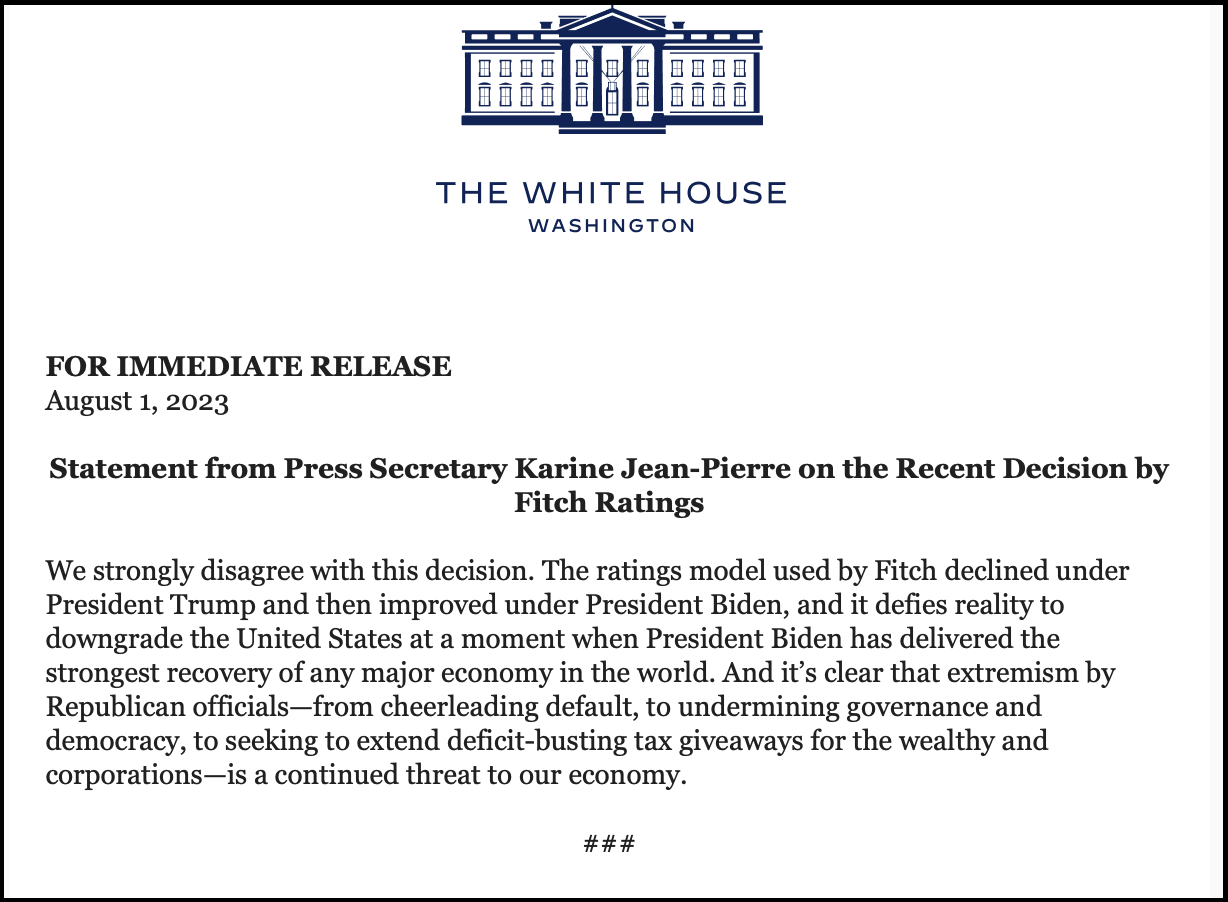
Meanwhile, White House spox Karine Jean-Pierre also blamed Trump on Tuesday, saying that the White House "strongly" disagrees with the decision, adding "it’s clear that extremism by Republican officials — from cheerleading default, to undermining governance and democracy, to seeking to extend deficit-busting tax giveaways for the wealthy and corporations — is a continued threat to our economy."

Former Clinton Treasury Secretary Larry Summers called the decision "bizarre and inept," while former Obama economic advisor Jason Furman called the move "completely absurd."

On Wednesday, CNBC wheeled out Jared Bernstein, chair of Biden's Council of Economic Advisers and former Obama official, who similarly blamed Trump.

"I think again the timing issue is is Jermaine here. The deficit went up every year under President Trump. The debt to GDP ratio rocketed under President trump. It has stabilized admittedly at a higher level under this president but we're doing all we can to try to ameliorate those tensions," he said.

Bernstein reflected on the "cognitive dissonance" he felt at the downgrade amid the success of 'Bidenomics' commenting that "creditworthiness deteriorated significantly under President Trump for good reasons... and under President Biden, it started to track back up..."

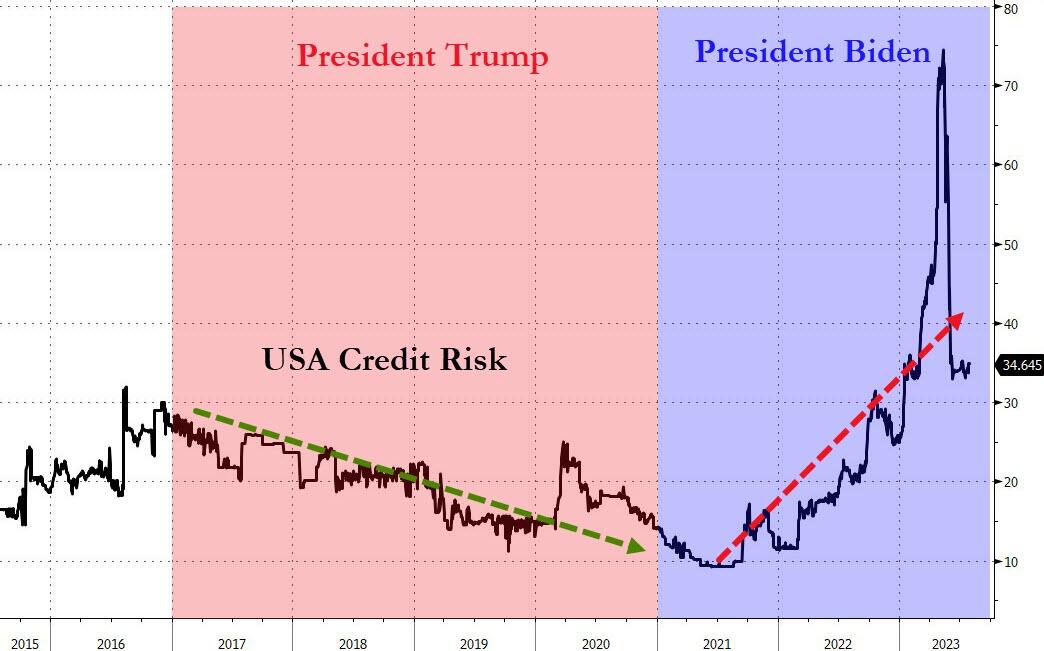
Except that's the exact opposite of what happened. According to the 100% non-partisan "market", the creditworthiness of US Treasury debt improved almost constantly under President Trump and worsened dramatically almost immediately upon President Biden's inauguration:

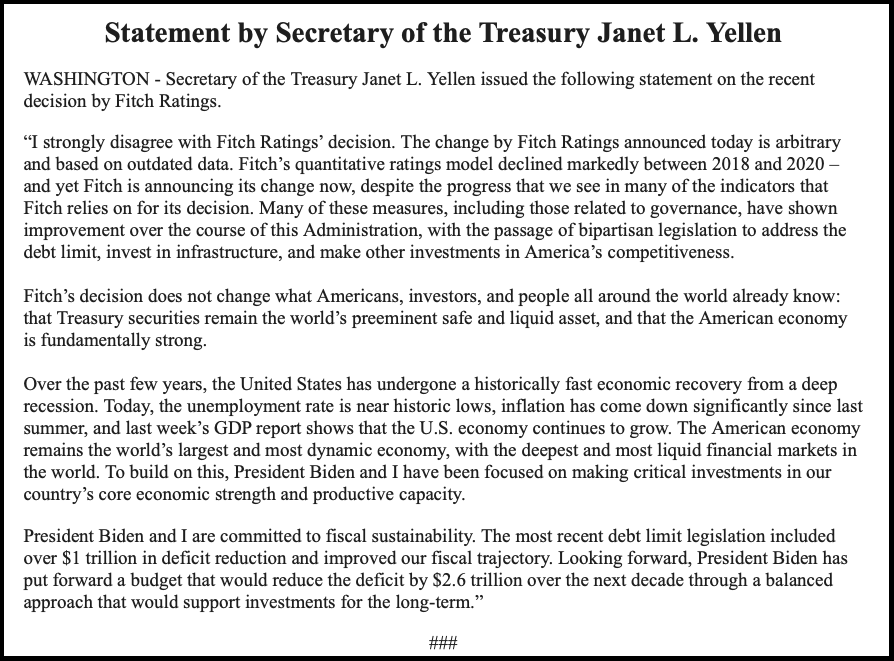
Treasury Secretary Janet Yellen said that the downgrade was "arbitrary and based on outdated data," adding "Today, the unemployment rate is near historic lows, inflation has come down significantly since last summer, and last week’s GDP report shows that the U.S. economy continues to grow."

CNN also blamed Trump, penning the headline: "Fitch downgrades US debt on debt ceiling drama and Jan. 6 insurrection."

Meanwhile, some light reading for premium ZH subscribers.

 https://www.zerohedge.com/political/biden-blames-downgrade-trump

Why Shares of Blueprint Medicines Are Falling

 Shares of Blueprint Medicines (BPMC -13.55%) were down more than 12% as of 12:45 p.m. on Wednesday after the healthcare company announced second-quarter earnings. The stock is still up more than 27% so far this year.

Blueprint focuses on precision medicine to fight cancer and hematologic disorders. The company released second-quarter earnings and the numbers were generally positive. The company said that revenue, driven by increased sales from Ayvakit (Ayvakyt overseas) was $57.6 million, compared to $36.5 million in the same period last year.

Blueprint also narrowed its losses to $132.8 million, or an earnings per share (EPS) loss of $2.19, compared to a net loss of $159.7 million for the second quarter of 2022, or an EPS loss of $2.68. Analysts had expected an EPS loss of $2.54, so it was a slight earnings surprise.

Ayvakit was approved in 2020 to treat gastrointestinal stromal tumors and in 2021, it added the rare blood disorder systemic mastocytosis as an indication. Just this past May, it was approved to treat indolent systemic mastocytosis. 

Knowing the numbers were improved, why did the stock swoon? Two likely reasons. Investors like to sell on good news, taking advantage of a positive announcement, but the selling got out of hand.

Also, investors were likely hoping for even better sales numbers for Ayvakit, but its indications are all quite rare. The cost of the therapy may be slowing its sales. According to a report in JAMA Oncology, the therapy had the highest wastage cost per patient ($27,200) of 22 anticancer therapies it reviewed, due to a high cost per bottle and limited pill strength availability. A 25-milligram oral tablet of Ayvakit is around $39,087 for a supply of 30 tablets. 

The company's other approved therapy is Gavreto, used to treat adults with metastatic non-small cell lung cancer.

https://www.fool.com/investing/2023/08/02/why-shares-of-blueprint-medicines-are-falling-wedn/

Cereval: Data delayed for Phase 2 schizophrenia trial

 Emraclidine EMPOWER data now expected second half 2024


Darigabat ADAPT trial in panic disorder initiated

Cash, cash equivalents, and marketable securities of $825.1 million as of June 30, 2023, expected to support a data-rich 2024 and fund operations into 2025

Conference call today at 8:00 a.m. ET

Cerevel will host a conference call and webcast today, August 2, at 8:00 a.m. ET to discuss its second quarter 2023 financial results and key pipeline and business updates. To access the call, please register at this link. Once registered, you will receive the dial-in information and a unique PIN number.

A live webcast of the call, along with supporting slides, will be available on the investors section of Cerevel’s website at investors.cerevel.com. Following the live webcast, an archived version of the call will be available on the website.

https://finance.yahoo.com/news/cerevel-therapeutics-reports-second-quarter-103000270.html

The Medical Establishment Has Succumbed to Gender Madness

 The following essay is an adapted excerpt from Miriam Grossman's new bookLost in Trans Nation: A Child Psychiatrist's Guide Out of the Madnessout now from Skyhorse Publishing.

I was contacted by lawyers in Salt Lake City about a 13-year-old boy whose divorced parents were in litigation over his social transition. Zach had recently declared himself a girl, and his mother was 100 percent on board—new name, pronouns, dresses. His father wasn't going along with it.

I reviewed the records from Zach's recent psychiatric hospitalization. Staff listed gender dysphoria as one of his diagnoses and consistently used his girl's name and female pronouns, but the reasoning for those clinical decisions was absent. The hospital records indicated Zach heard voices and saw "ghosts." I searched for more information about the voices and the ghosts but found none.

Was it possible no one had asked? Psychotic symptoms such as auditory or visual hallucinations always warrant further questions. An obvious one: what did the voices say? Was Zach hearing voices telling him he's a girl?

These were questions that demanded attention from his clinicians prior to affirming a new identity. Maybe Zach's gender dysphoria was related to his disordered thinking and hallucinations. Perhaps instead of lip gloss he needed Risperdal (anti-psychotic medication).

I found similar problems in the care of 17-year-old Nicole in Boston. Nicole's life had been chaotic; her father left when she was two, her mother had five other kids with two other men, she was sexually abused by a neighbor, and her family had been homeless for months on several occasions. She had an IQ of 68 and was on three psychiatric medications to treat hallucinations, ADHD, and depression. When she discovered her mother was pregnant, Nicole came out as a boy.

At the time I was consulted, Nicole was in foster care due to charges of physical abuse by her mother.

Nicole wanted testosterone. I was asked by the court to provide my professional opinion regarding "gender-affirming" care, including testosterone, for her.

Having read this far, I trust you can figure out what I said. No testosterone for Nicole.

Zach lives in Utah and Nicole in Massachusetts—both states that ban "conversion therapy" for minors. That means any approach that fails to immediately affirm a child's new identity is prohibited.

I put myself at l risk when I argued that Zach and Nicole should not be affirmed but instead have their long-term mental health issues treated.

At least with those two consultations, my role was to provide my professional opinion. But that wasn't the case with David, a patient in Colorado with whom I worked directly.

One day David told his parents that he is transgender and asked to be called Zoe, "she," and "her." He wanted blockers because the hair sprouting over the corners of his lips and his cracking voice reminded him he's a boy. If only he could take estrogen, he told me, having breasts and wider hips would make him feel confident and secure.

The medical establishment, the DSM-5, and the state of Colorado say the only permissible response is to act as if he was a girl. David must be in the driver's seat—forget about "do no harm." If he picks a different gender identity, name, and pronouns next week, I must use those. I am to instruct parents to tell everyone—family members, school staff, his piano teacher and dentist—to do the same. His mom, dad, and I are all supposed to celebrate what doctors at Johns Hopkins call David's "evolving sense of self."

Celebrating an evolving sense of self sounds fine and dandy. But I happen to know that when David first appeared at a family event in a dress, his mother—a strong feminist and lifelong liberal who supported gay marriage and survived 9/11 and breast cancer—had to flee to a restroom, where she had the first panic attack of her life. I also know puberty blockers might be followed by estrogen and perhaps even orchiectomy—castration. He could end up disfigured and infertile and still not be satisfied with his body.

When David is ready, I must share those dangers with him. I took an oath to prevent harm, no matter what the gender medical establishment or the state of Colorado might say.

For refusing to validate the opposite-sex identities of David and many others, I risk an investigation, but I'll live with that. I'm going to do what's best for my patients.

Miriam Grossman MD is board certified in child, adolescent and adult psychiatry. The author of five books, Dr. Grossman's work has been translated into eleven languages. She has testified in Congress and lectured at the British House of Lords and the United Nations.

https://www.newsweek.com/medical-establishment-has-succumbed-gender-madness-opinion-1816436

The fentanyl crisis is worsening under Joe Biden

 Over 100,000 people died by drug overdose last year, preliminary statistics from the CDC show. That death toll, essentially unprecedented in American history, is driven by the rise of the synthetic opioid fentanyl, a far-deadlier cousin of heroin responsible for the lion’s share of the fatalities. The problems are new and dramatic, and media stories in recent days have drawn attention to the crisis. So why are politicians acting like everything is fine?

Take the Biden administration’s response. In the Government’s 2022 National Drug Control Strategy, the bible of its drug policy approach, it aims for a 13% reduction in deaths by overdose. If achieved, this would be only slightly below 2020 figures. To reach that unambitious goal, the administration mostly plans to continue what it has been doing up until now, only at greater scale. 

Further evidence the Government struggles with policy creativity comes in its response to the emergence of xylazine, the horse tranquilliser filtering into the opioid supply. Despite having years to prepare a response — xylazine has been an issue in some places since at least 2018 — its proposal earlier this month mostly offers plans to make plans. New tests and tools will be developed, new treatment capacity created. How? Who’s to say. 

Of course, the Biden administration is not alone in failing to do enough on the drug crisis. Congress has taken a few steps, primarily expanding the availability of the drug treatment medications buprenorphine and methadone, and the overdose-reversing drug naloxone.  

These are vital steps, and worth applauding. But it’s hard not to see them as band-aids. Naloxone access does not significantly reduce overdose death. And moderately expanding the availability of medication-assisted treatment does little when people are not being identified for and aggressively shifted into treatment, by court order if necessary. 

There’s a classic line from an old episode of The Simpsons, in which a distressed character cries out, “We’ve tried nothing, and we’re all out of ideas!” A similar dynamic applies to the drug crisis: we’ve tried very little, and ideas are not forthcoming. 

This lack of action is arguably because policymakers still haven’t internalised the monumental scale of the crisis. For decades, policy was concerned with preventing the health harms associated with drug use and addiction. Treatment systems were patchwork, funding sparse, and most attention was dedicated to what are basically philosophical questions: what addiction is, whether drugs should be illegal or legal, and so on. 

It is important not to get bogged down in such disputes amid an unprecedented crisis. Drugs constitute the leading cause of death among Americans under 50: asking about their philosophical status is missing the point. 

Rather, policymakers need to make unprecedented commitments to treating addiction and deterring drug use. The former means continuing to expand funding for treatment, medication-assisted and otherwise, but also working with municipalities to identify those most at risk of overdose and proactively getting them into treatment, before they take the dose that kills them.  

The latter means communicating clearly and unambiguously to the public that the drug supply is poisoned, and that no amount of drug use is safe. It means shutting down open air drug markets and going after drug dealers who kill their clients.  

Such steps may stem the ever-rising tide of deaths. What’s apparent is that what we’re doing now isn’t working. And until policymakers understand that, no change will be possible. 


https://unherd.com/thepost/the-fentanyl-crisis-is-worsening-under-joe-biden/

NYC Dem official ID’d as ‘straw donor’ in alleged fundraising scheme involving Eric Adams’ campaign

 A Manhattan Democratic Party official has been identified as a “straw donor” who dealt with at least one of the defendants in the alleged criminal campaign-finance scheme that has rocked Mayor Eric Adams’ 2021 campaign. 

William Smith, a Democratic district leader from East Harlem, was revealed as “straw donor 16” who had conversations with defendant Shamsuddin Riza in the case, according to court papers filed by Manhattan District Attorney Alvin Bragg’s office.

Six defendants in the case were charged with allegedly using the names of relatives and friends as straw donors to Adams’ mayoral campaign to cash in on the city’s generous 8-to-1 public-matching-fund system for political donations, as well as to try to curry favor with the mayor-to-be.

Smith, 36, is not listed as a defendant in the case and neither is Adams or anyone from his campaign staff.

“On or about August 5, 2021, in a telephone conversation with Straw Donor-16, a Manhattan Democratic Party District Leader, Shamsuddin Riza stated in substance he intended to make a contribution to the Campaign in the name of Straw Donor-16: `I’m putting up the money for you, all you have to do is fill out the contribution form and whatnot, right,’ ” the initial indictment filed early last month said.

Manhattan Democratic Party official William Smith was identified as the "straw donor" who dealt with at least one of the defendants involved in an alleged campaign finance scheme from Mayor Adams' 2021 campaign.
Manhattan Democratic Party official William Smith was identified as the “straw donor” who dealt with at least one of the defendants involved in an alleged campaign finance scheme from Mayor Adams’ 2021 campaign.
William Smith / Facebook
Six defendants allegedly used names of relatives and friends as straw donors for Adams' campaign.
Six defendants allegedly used the names of relatives and friends as straw donors for Adams’ campaign.
Leco Viana/TheNEWS2 via ZUMA Press Wire

Smith is later referred to as “straw donor-16” whose name was used fraudulently as donating to Adams, in count 16 of the indictment. In straw-donor cases, contributions are secretly given by someone under the name of another.

Smith denied any wrongdoing and told The Post on Tuesday, “I’m a highly ethical person.

“It’s a disappointing chain of events. I’m disappointed that any individual would not follow the rules for fundraising.” 

He declined further comment on specifics regarding an active criminal case.

Smith is a Democratic district leader from East Harlem.
William Smith / Facebook

Adams campaign spokesman Evan Thies referred to a previous statement issued after the July 7 indictment.

“There is no indication that the campaign or the mayor is involved in this case or under investigation. The campaign always held itself to the highest standards and we would never tolerate these actions,” Thies said.

Adams acknowledged he knew the ringleader of the straw donor scheme — Dwayne Montgomery — from their days in the NYPD and that Montgomery had attended events at Gracie Mansion, the mayor’s residence.

According to an Adams campaign spokesperson, the mayor or his campaign are not involved or under investigation for the alleged scheme.
Leco Viana/TheNEWS2 via ZUMA Press Wire

Rachel Atcheson, Mayor Eric Adams’ deputy director for food policy and a fellow vegetarian, was also identified as organizing a fundraiser with accused ringleader Dwyane Montgomery, a former NYPD inspector and head of integrity for a municipal workers union who was friendly with Adams. She is not accused of wrongdoing.

One campaign finance lawyer speculated there may be more coming out of the straw-donor case.

“A criminal investigation is not complete until the trial is over. It’s not uncommon to shake the trees and see if any public officials are involved,” said lawyer Lawrence Mandelker.

https://nypost.com/2023/08/01/nyc-dem-official-idd-as-straw-donor-in-alleged-fundraising-scheme/