Search This Blog

Monday, August 28, 2023

Hawaiian Electric Soars After Statement: Power Lines "De-Energized" When Fire Started

 Hawaiian Electric Industries Inc. surged as much as 43% in premarket trading in New York after the utility released a statement: their power lines were de-energized for more than six hours in Lahaina when the "Afternoon Fire" broke out on Aug. 8 that ultimately leveled the resort town in West Maui.

Just last week, Maui County slapped Hawaiian Electric with a lawsuit, accusing the utility of negligence that sparked the devastating wildfire that leveled Lahaina and killed more than 100 people, with hundreds still missing. 

"We were surprised and disappointed that the County of Maui rushed to court even before completing its own investigation," said Shelee Kimura, president and CEO of Hawaiian Electric. 

Kimura said, "We believe the complaint is factually and legally irresponsible. It is inconsistent with the path that we believe we should pursue as a resilient community committed and accountable to each other as well as to Hawaiʻi's future. We continue to stand ready to work to that end with our communities and others. Unfortunately, the county's lawsuit may leave us no choice in the legal system but to show its responsibility for what happened that day."

Shares of Hawaiian Electric surged as much as 43% in premarket trading. 
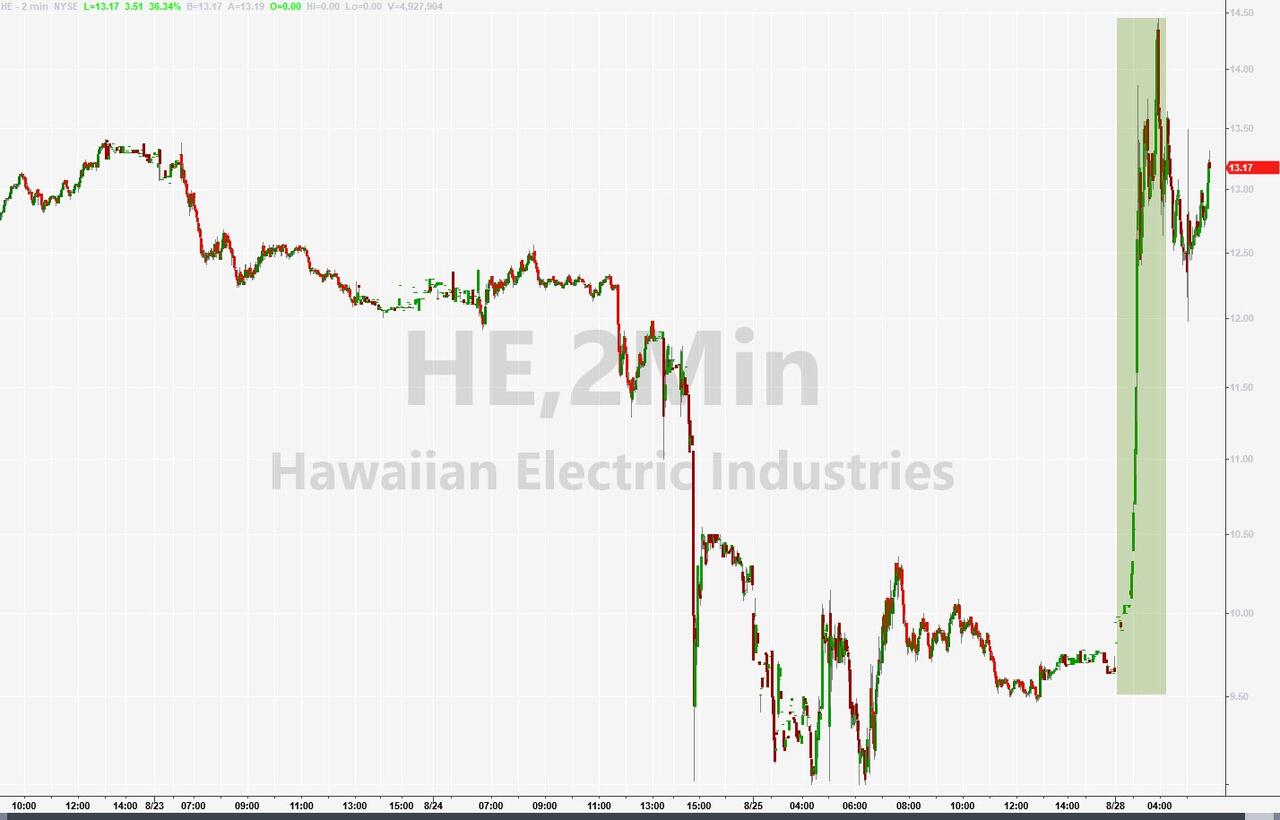
But still well down from the start of the fire...
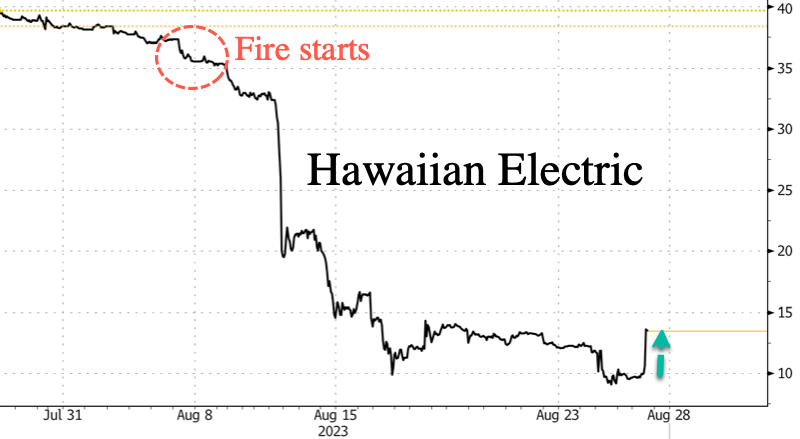
Hawaiian Electric outlines important facts about what happened on Aug. 8: 

  • A fire at 6:30 a.m. (the "Morning Fire") appears to have been caused by power lines that fell in high winds.

  • The Maui County Fire Department responded to this fire, reported it was "100% contained," left the scene and later declared it had been "extinguished."

  • At about 3 p.m., a time when all of Hawaiian Electric's power lines in West Maui had been de-energized for more than six hours, a second fire (the "Afternoon Fire") began in the same area.

  • The cause of the devastating Afternoon Fire has not been determined.

The utility provided more details about the fire: 

  • The records conclusively establish that Hawaiian Electric power lines to Lahaina were not energized when the Afternoon Fire broke out shortly before 3 p.m. on Aug. 8, in a field near Lahaina Intermediate School. Power had been out for more than six hours by that time. There was no electricity flowing through the wires in the area or anywhere else on the West Maui coast. Hawaiian Electric has informed ATF investigators of the availability of records that demonstrate these facts.

  • The small Morning Fire, seen in videos taken by local residents, began more than eight hours earlier. Those videos show that power lines had fallen to the ground in high winds near the intersection of Lahainaluna Road and Hoʻokahua Street at approximately 6:30 a.m. A small fire that can be seen by the downed lines spread into the field across the street from the Intermediate School.

  • The Maui County Fire Department responded promptly to the Morning Fire. According to the Department's public statement that morning, by 9 a.m. the Morning Fire was "100% contained." The Maui County fire chief subsequently reported that the Fire Department had determined that the Morning Fire was "extinguished," and the Fire Department left the scene by 2 p.m.

  • Once the fire was out, Hawaiian Electric emergency crews arrived at Lahainaluna Road in the afternoon of Aug. 8 to make repairs; they saw no fire or smoke or embers. All lines to Lahaina remained de-energized and all power in the area remained off.

  • Shortly before 3 p.m., while the power remained off, our crew members saw a small fire about 75 yards away from Lahainaluna Road in the field near the Intermediate School. They immediately called 911 and reported that fire.

  • By the time the Maui County Fire Department arrived back on the scene, it was not able to contain the Afternoon Fire and it spread out of control toward Lahaina.

"The county's lawsuit distracts from the important work that needs to be done for the people of Lahaina and Maui," said Scott Seu, president and CEO of Hawaiian Electric.

What distraction could that be? 

Here are the following eight questions that we should all be asking about the fires in Hawaii right now…

#1 How did the fires start?  Governor Green is convinced that they were caused by a confluence of factors.  Do you buy his explanation?

Echoing wildfire experts, Gov. Green said Friday that he believes a confluence of weather conditions contributed to the ignition and spread of the blazes.

“It is a product, in my estimation, of certainly global warming combined with drought, combined with a super storm, where we had a hurricane offshore several hundred miles, still generating large winds,” Green told CNN.

#2 How did the fires spread so rapidly?  According to multiple news reports, people were literally jumping into the ocean to escape because the fires were moving so rapidly…

With fires raging on Maui, two men felt there was nowhere to escape the flames – except for the ocean.

The two men live in Lahaina, a historic part of Maui loved by tourists, which appears to be heavily damaged by this week’s raging fire. They described a terrifying scene as they evacuated from Prison Street, right in the heart of Lahaina.

“I saw a couple people just running, I heard screams out of hell … explosions. It felt like we were in hell, it really was. It was just indescribable,” one of the men told Nexstar’s KHON.

#3 How did a fire that was supposedly “out” end up causing the most damage of all?  According to  Governor Green, the Lahaina fire was supposedly given new energy “by far-off Hurricane Dora”

After first erupting early Tuesday, the fire was initially deemed to be out, but winds whipped up by far-off Hurricane Dora that reached up to 81 mph fanned the flames and spurred the blaze to travel about 1 mile every minute, Green said.

#4 According to U.S. Representative Jill Tokuda, the alarm system that is supposed to warn residents that a disaster is happening appears to have failed.  How is that possible?…

We know everybody who’s ever lived in Hawaii knows the warning sirens. It goes off once a month at the beginning of the month at 12 noon, and it blares and if it doesn’t, it gets fixed, because that is our first line of defense. Unfortunately, in this situation, sadly, tragically in this situation, those sirens likely did not go off. The warning signals that were on cell phones, we had no cell coverage or electricity in some of these areas. And the reality is with those warning signs, it tells all of us to turn on the television or look at our phones or turn on the radio. The reality is was how fast this burn was. And you could see it in the videos that survivors were showing me. You could see it in the wreckage. If you turned on your phone, you turned on a radio, if you even could. Remember things were out at that particular point, you would not know what the crisis was.

#5 Why are emergency supplies not getting to the people that desperately need them?  It is being reported that a “telecommunications blackout” has been one of the factors that has been hampering relief efforts…

But an enduring telecommunications blackout hampered government and grassroots efforts to distribute those supplies in the worst-affected neighborhoods, especially for an unknown number of survivors waiting out the aftermath in the few buildings still standing in the historic town of Lahaina and neighborhoods on the outskirts.

With their vehicles burned to a crisp, some sheltering at home have no way to drive to distribution centers miles away, or their cars have run out of gas. Others simply don’t know where to go for help. Toxic fumes and downed power lines with live wires make venturing outdoors dangerous.

#6 Why are people that have just had their homes burned down in the fires already being bombarded with calls with offers to purchase their properties?

The vultures are circling, and it appears that there are some people out there that are extremely interested in scooping up land inexpensively.

#7 Why has the FBI moved a “mobile refrigerated morgue” into Lahaina?…

A mobile refrigerated morgue has been brought to the devastated town of Lahaina as Maui officials continue their search for victims of the worst U.S. wildfire in 100 years.

The death toll on Sunday rose to 96, but Hawaii officials said it was likely to rise significantly.

John Pelletier, the Maui police chief, said only three percent of Lahaina – home to more than 9,000 people – had been searched so far.

#8 Why is Joe Biden lounging on the beach while all of this is happening?…

Outraged Americans blasting President @JoeBiden after he said ‘no comment’ when asked about the catastrophic Maui wildfire, now the deadliest US blaze in over a century. Despite the death toll climbing to about 100, Americans were outraged that Biden remained sunbathing on a beach near his Delaware home.

Before the fire, locals feared billionaires would transform their town into a "Satellite City" for elites. How the elites would acquire the land remained a mystery, but now not so much. 

https://www.zerohedge.com/markets/hawaiian-electric-soars-43-after-statement-power-lines-de-energized-amidst-afternoon-fire

Legal Concerns Halt NIH $154 Million "False Information" Program

 by Benjamin Rothove via TheCollegeFix.com,

Federal court case takes aim at Biden-Big Tech partnership...

The National Institutes of Health halted a $154 million research program intended to study “equitable health communication” and combat alleged medical misinformation.

The “pause” came “in the context of the current regulatory and legal landscape around communication platforms,” according to a website for the initiative.

A spokeswoman for the NIH did not answer direct questions about the reason for the pause.

A federal court is considering a lawsuit brought by plaintiffs who allege the federal government colluded with Big Tech companies to silence their speech, often critical of COVID policies or the integrity of the 2020 presidential election.

“The project was still in concept phase and is being paused to reconsider its scope and aims in the context of the current regulatory and legal landscape around communication platforms, as noted on the website,” Emily Ritter told The College Fix via email.

“Our overall assessment will determine the future direction of the concept in terms of if or how it will move forward.”

Discovery in the case, Missouri v. Biden, found federal officials communicated with Big Tech platforms and pressured them to remove content, including a parody Anthony Fauci Instagram account.

The Fix asked how the NIH ensures its programs do not violate the First Amendment and if Missouri v. Biden played a role in the decision to pull the program.

The Fifth Circuit Court of Appeals allowed the federal government to continue to work with Big Tech while the lawsuit continues.

The initiative appears to have come from comments made by departing NIH Director Francis Collins in 2021.

“We basically have seen the accurate medical information overtaken, all too often, by the inaccurate conspiracies and false information on social media. It’s a whole other world out there,” Collins said.

“The concept envisioned the development, testing, and sharing of new approaches for effective and equitable health communication,” the NIH website stated.

“Planning for the concept was informed by input from a request for information in April 2022 and a workshop held in May 2022.”

The College Fix contacted the New Civil Liberties Alliance to ask if the cancellation of the initiative was a positive development, if they were concerned about the lack of transparency from the NIH and if they thought Missouri v. Biden played a role in the decision. NCLA is representing plaintiffs in the federal lawsuit.

The legal group said it “won’t be able to comment on this at this time.”

Alta Charo, a bioethicist and University of Wisconsin Law School professor who has advised the NIH, told KFF Health News that the NIH “is caught up in a larger debate about who gets to decide what is truthful information these days.”

The Fix contacted Charo to ask if she was concerned about why the study was canceled, if she knew of previous instances where medical research was halted due to political pressure and the importance of similar projects. She was on vacation and unable to comment.

The Fix also twice contacted Dean Schillinger, a researcher at the University of California San Francisco, in the past two weeks with the same questions. Schillinger has not responded to requests for comment.

Schillinger co-authored an article in JAMA Network Open, which is published by the American Medical Association, criticizing the NIH for canceling the program.

“The NIH’s unfortunate decision to halt the program, which took place in the face of mounting political pressures related to the study of misinformation, represents a serious threat to the integrity of science and to its successful translation,” he wrote.

“With so much at risk, this is precisely the wrong time to back away from research into a critical threat to the health of our country,” Schillinger wrote.

“The chilling effect of the recent political actions to block the NIH and other government agencies from combating all types of health-related misinformation has very broad repercussions.”

“The program was deemed potentially so important that it would be supported through the agency’s Common Fund: a designation for high-priority programs that cut across normal institutional boundaries,” according to the NIH.

While representatives for the NIH have said that the project is on pause, it is listed under “former programs” on the website.

However, the pause does not mean an end to all “misinformation” research.

The NIH grant database lists millions of dollars in funded projects for 2023 alone that deal with “misinformation” and communication.

Projects include “Mitigating the Spread of Misinformation and Disinformation about COVID-19 Prevention and Treatment Initiatives among Hispanics” and “Investigating and identifying the heterogeneity in COVID-19 misinformation exposure on social media among Black and Rural communities to inform precision public health messaging.”

https://www.zerohedge.com/political/legal-concerns-halt-nih-154-million-false-information-program

Complicated Mess to Restart Student Loan Payments Is On Purpose

 President Biden does not want student loan payments to start. The easiest way is to make it an understaffed, complicated mess.

Purposeful Student Loan Mess

Interest on student loans restarts on September 1 with payments starting in October. Few are prepared. If you are a student with questions, good luck getting answers.

And who is the servicer one needs to call?

Transferred to a New Servicer

About four-in-10 borrowers’ loans transferred to a new servicer during the pause that began in March 2020, according to government data.

Why was anyone transferred to a new servicer when literally nothing was getting serviced?

Borrowers Confused by Complicated Process

The Wall Street Journal reports Student Loans Are Emerging From Deep Freeze, and Borrowers Are Confused

‘Most complicated process I’ve ever been involved in’

Geri Critchley, a 75-year-old former nonprofit employee, is among those attempting to navigate the system. She paid graduate-school loans for more than 20 years. She has $14,000 left, but no clarification as to what she will owe each month and how to pay.

After three years of no payments, she called her loan servicer and the Education Department to ask about forgiveness options, payment deadlines and amounts. But getting through to a human at each place took some work. Critchley encountered what many borrowers fear: long hold times, constant redirections and dropped calls. When she finally got through to her loan servicer, the voice on the other end of the line suggested she call back in January when call volume would be lower—three months after repayment is set to start.

“The Department of Education person said to me, ‘I’ve been working in this field for many years, and I admit it’s the most complicated process I’ve ever been involved in,’ ” Critchley said.

Beyond answering questions about the payment restart, servicers also advise borrowers about complex financial decisions such as whether to consolidate loans or enroll in the income-driven program, called Saving on a Valuable Education, or SAVE.

A complication for the administration is that some features of the plan, such as cutting monthly payments from 10% to 5% of discretionary income, won’t be available until next summer, after the regulatory process concludes.

“A lot of folks just have no idea where to start,” said Meagan McGuire, a consultant at Student Loan Planner, a financial-advisory firm. “With the website and servicers not being super helpful right now, that’s leading to more confusion—newer borrowers are just throwing their hands up.”

Call Back in January

“Call back in January” but payments start in October. What a hoot.

Why any of this is complicated would normally be a mystery. But 1) we are talking about the government and 2) the last thing Biden wants is for a smooth restart.

If it’s complicated, it’s complicated on purpose. Who picked the start date for SAVE?

Biden does not want payments to start at all. And the bigger the mess, the more he is likely to extend forgiveness for as long as he can, by decree of course.

Urging Biden to Ignore the Supreme Court

The Journal notes “Senate Majority Leader Chuck Schumer, wrote to Biden last week about their repayment concerns and urged him to try again on mass cancellation using other legal authorities.”

There are no other legal authorities and even Nancy Pelosi understood that.

Who’s Impacted?

More than 16 million borrowers who thought their loans would be forgiven have to repay.

Please consider Who’s Impacted by the Supreme Court’s Student-Loan Forgiveness Ruling

Once payments resume, the typical student-loan payment will be between $210 and $314 a month, according to a new report from Wells Fargo. Overall, more than 40 million borrowers would have qualified for loan forgiveness through a required application. Before legal challenges halted the plan, borrowers in every state were approved for loan cancellation. Big states such as California, Texas, Florida and New York had the most approvals overall. The District of Columbia had the most approvals in proportion to its adult population, followed by Georgia and Ohio.

That’s a free link courtesy of the WSJ. It contains lots of charts on the 43 million people who collectively owe $1.6 trillion in federal student-loan debt as of March 31.

https://mishtalk.com/economics/the-complicated-mess-to-restart-student-loan-payments-is-on-purpose/

BioVie Data at International Congress of Parkinson’s Disease and Movement Disorders


  • New preclinical data characterizing NE3107 mechanism of action featured in oral presentation
  • Phamacokinetic data from Phase 2a study supports potential co-administration of NE3107 with carbidopa/levodopa
  • Separate analysis of Phase 2a study data shows evidence of motor effects of NE3107 independent of levo-dopa/ carbidopa, supporting further investigation of NE3107 as first line therapy in Parkinson’s Disease

Praxis to Present on Study of Ulixacaltamide in Essential Tremor at MDS International Congress

  Praxis Precision Medicines, Inc. (NASDAQ: PRAX), a clinical-stage biopharmaceutical company translating genetic insights into the development of therapies for central nervous system (CNS) disorders characterized by neuronal excitation-inhibition imbalance, today announced that it will be presenting analyses highlighting patient-focused endpoints from its Essential1 study of ulixacaltamide (PRAX-944) in essential tremor (ET) at The International Parkinson and Movement Disorder Society’s (MDS) International Congress of Parkinson's Disease and Movement Disorders®, taking place in Copenhagen, Denmark.

https://www.biospace.com/article/releases/praxis-precision-medicines-to-present-analyses-of-patient-focused-clinically-meaningful-endpoints-from-essential1-study-of-ulixacaltamide-in-essential-tremor-at-the-2023-mds-international-congress/

KalVista Data at 2023 HAEi Regional Conference EMEA

 KalVista Pharmaceuticals, Inc. (NASDAQ: KALV), a clinical stage pharmaceutical company focused on the discovery, development, and commercialization of oral, small molecule protease inhibitors, today announced the acceptance of multiple abstracts at the 2023 HAEi Regional Conference EMEA meeting taking place in Munich, Germany from September 1-3. KalVista is a Silver-level sponsor of the meeting. The presentations are:

  • In Their Own Words - Patient Descriptions of the Earliest Recognition of HAE Attack Onset: Michael E. Manning, Autumn F. Burnette, Sally van Kooten, Markus Heckmann, Sherry Danese, Ledia Goga, Mar Guilarte, Anna Valerieva (presenter only). Results shared as a poster presentation and Q&A
  • Recognizing the Importance of Early On-Demand Treatment in the HAE Attack Journey: Douglas H. Jones, Princess Ogbogu, Sally van Kooten, Markus Heckmann, Sherry Danese, Ledia Goga, Markus Magerl (presenter). Results shared as a poster presentation and Q&A

All poster presentations will take place on Friday, September 1 starting at 7:15 p.m. CEST in the Foyer on the 1st floor of the Westin Grand Hotel.

KalVista will also be launching a new patient-focused site called “Mind the HAE Attack” at HAEi EMEA on September 1. Mind the HAE Attack has been developed with the HAE community to address the psychological and physical burdens of HAE attacks, and to create tools that support treatment at the onset of an attack. You can find the site at MindtheHAEattack.com.

https://www.biospace.com/article/releases/kalvista-pharmaceuticals-to-present-hae-attack-journey-data-at-2023-haei-regional-conference-emea/

ImmunoGen, Takeda to Develop and Commercialize ELAHERE® in Japan


  • ImmunoGen to Receive $34 Million1 in Upfront and Near-Term Milestone Payments and is Eligible to Receive Potential Regulatory and Commercial Milestone Payments as well as Double-Digit Royalties
  • Collaboration Further Supports Strategy to Bring ELAHERE to Eligible Patients with Folate Receptor Alpha (FRα)-Positive, Platinum-Resistant Ovarian Cancer Globally