Search This Blog

Tuesday, September 5, 2023

Stryker upped to Buy from Neutral by B of A

 Target to $315 from $310

https://finviz.com/quote.ashx?t=SYK&p=d

Biggest Threat To Global Liquidity Is China

by Simon White, Bloomberg macro strategist,

Global money growth will remain under pressure while China refrains from comprehensive easing, posing a potential secular headwind for risk assets and economic growth around the world.

Money makes the world go round. Nowhere is that more true than in markets. No money, no liquidity, no transactions. Any impediments to money are thus a big deal for asset prices and economies.

Money has been in great abundance for most of the last 20 years. But that is in large part due to China. Its current travails therefore pose a significant risk to money’s path in the coming months and years.

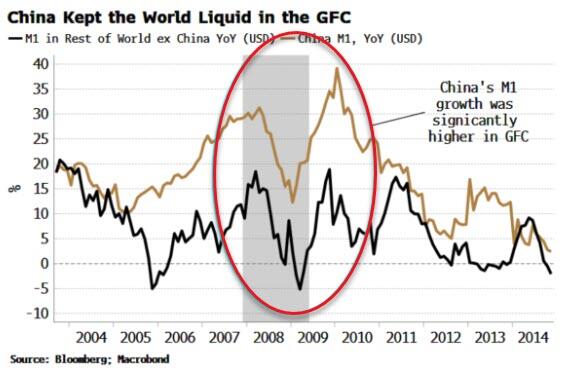
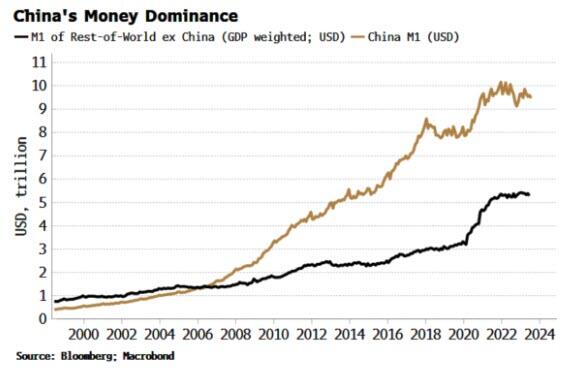
China’s dominance in global money trends can be seen in the chart below. Since 2007, China’s M1 in dollar terms has hugely outpaced GDP-weighted M1 in the rest of the world. M1 in China is 67 trillion CNY, or $9.5 trillion, while M1 in the US, the country with the second largest stock of narrow money after China, is 30% lower, despite an economy that is a third bigger than China’s.

That’s without including the demand deposits of households. They’re not part of M1 in China as they are in most other countries. Adding them in would enlarge China’s M1 by more than half again.

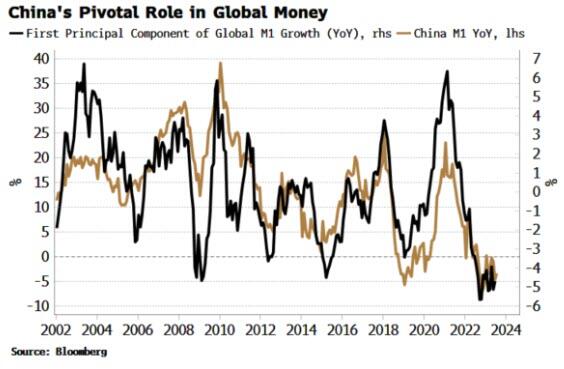
Even without this adjustment, China has been pivotal for global money growth over the last 15 years. That can be seen clearly if we look at the first principal component of global money growth (i.e. where there is maximum variation). This component is very close to China’s money growth (and no other country’s, including the US), showing that China has been the primary driver of global money trends for the last two decades.

At no time was China’s global monetary significance more critical than in the aftermath of the GFC. While the US was hesitating in providing large-scale fiscal and monetary stimulus, China’s money growth exploded. Between 2008 and 2011, it was on average about twice the rate than in the rest of the world.

In percentage terms, M1 in the rest of the world rose by 30% in 2008-11, while in China, adjusted for household deposits, it climbed by almost 110%. It’s no overstatement to say a deep recession could well have become a global depression if it were not for China’s largesse.

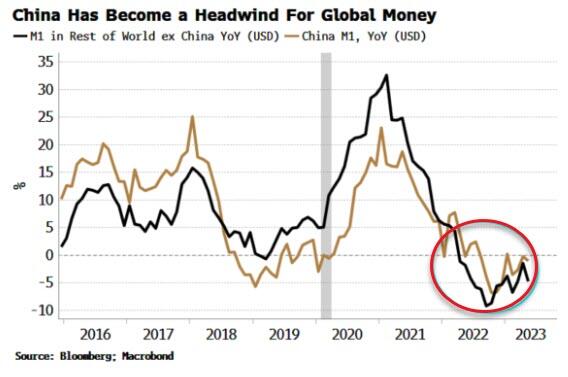
In the pandemic the situation was reversed, but less dramatic. The US expanded its money supply more than China as the latter refrained from supporting its household sector, while the US handed out stimulus checks. But to put things in perspective, the gap between M1 growth in the pandemic was much smaller than in the GFC, at 14% for China compared to only 38% for the rest of the world. The rest of the world is not providing the money leadership China once did.

Why is M1 is so important? Principally as it’s the most cyclical of the monetary measures. The monetary base, which is currency in circulation and bank reserves, is too narrow a measure. Central-bank reserves can be created but remain locked up in the financial system, and thus have a muted impact on risk assets and especially the real economy.

M2 and M3, on the other hand, are too broad measures of money. They are typically counter-cyclical as they are dominated by items like savings deposits, which tend to rise in periods of risk aversion and fall when economic optimism rises.

M1 is in a sweet spot. It’s primarily made up of the monetary base and demand deposits. Banks create deposits when they lend money, thus it is an excellent sign of forthcoming economic activity. Why borrow unless you are going to spend or invest?

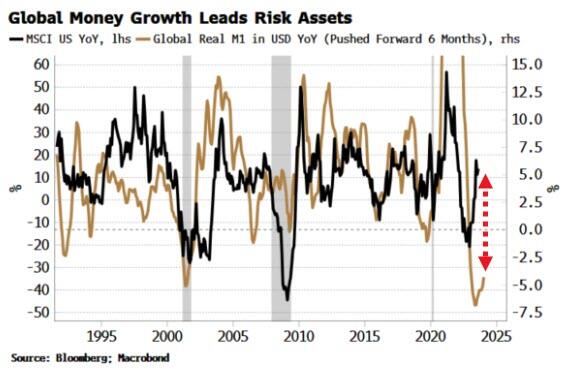
M1’s evolution, therefore, has significant implications for risk assets and global economic activity. We can see in the chart below the strong leading relationship between global M1 growth and US equities, with rises and falls in M1 growth leading stocks by about six months.

But since the pandemic, China has been faltering. For the first time since it entered the global financial system, China has been a persistent drag on global money growth. Its M1 growth has stalled as it imposed some of the most draconian lockdowns in the world, and since then it has resisted engaging in so-called flood-like stimulus to reflate its economy.

Without China, global money supply is likely to remain depressed, especially as growth is unlikely to come from the US et al when they are in the midst of rate-hiking cycles and reducing the size of their central-banks’ balance sheets.

The pressure is mounting on China to stimulate broadly to resuscitate its property market and avert a debt-deflation. But that doesn’t mean it will definitely happen, and happen in time. If resistance to such measures turns into outright recalcitrance, then it’s not just China that will face the consequences.

https://www.zerohedge.com/markets/biggest-threat-global-liquidity-china

Olema Oncology Announces Combined Financing for Up to $180 M

 $130 million equity private placement led by Paradigm BioCapital with participation by Lightspeed Venture Partners, Deep Track Capital, BVF Partners L.P., Cormorant Asset Management, Vivo Capital, Logos Capital, and Woodline Partners LP

Senior secured credit facility for up to $50 million provided by Silicon Valley Bank

Financing provides sufficient capital to fund Olema beyond OPERA-01 clinical trial top-line data and into 2027

https://www.biospace.com/article/olema-oncology-announces-combined-financing-for-up-to-180-million/

'Deciding Who Is Dead: Physician Group Issues New Statement'

 A single word clarification is the only revision the Uniform Determination of Death Act (UDDA) needs, the American College of Physicians (ACP) stated.

In a new position paper, the ACP joined the ongoing debate that could reshape the cardiorespiratory and neurologic standards determining death.

The ACP supported replacing the word "irreversible" in the UDDA with "permanent" to define circulatory determination of death, wrote Matthew DeCamp, MD, PhD, of the University of Colorado in Aurora, and Kenneth Prager, MD, of Columbia University Irving Medical Center in New York City, in Annals of Internal Medicineopens in a new tab or window.

The group otherwise affirmed the UDDA and its principles. It backed maintaining separate, independent cardiorespiratory and neurologic standards of determining death, and supported retaining the whole brain death standard as opposed to "higher brain" function standards. It called for aligning medical testing with standards of determining death, and not the reverse.

The ACP statement also advocated separating issues about determination of death from organ transplantation and affirmed the importance of the dead donor rule, which says that organ procurement cannot cause death.

"We don't believe the UDDA is fundamentally broken," DeCamp, a consultant to ACP, said in an interview with MedPage Today.

"In the past 5 years or so, there's been increasing attention to the concept of brain death by ethicists, legal scholars, and others," he pointed out. Complicated disagreements about the determination of death have gained widespread media attention, and "there have been proposals for changing the UDDA itself," he said. "Together, these made it important for ACP to analyze this issue now."

In 2020, the Uniform Law Commission, which advises states about determination of death laws, appointed a committee to study whether the 40-year-old UDDA needed revision. Several groups have proposed changes, including ways to clarify death by neurologic criteria

opens in a new tab or window.

In July 2023, Neurology published a series of articlesopens in a new tab or window outlining the most important brain death controversies the Uniform Law Commission faces.

'Irreversible' versus 'Permanent'

Questions have emerged about the use of the word "irreversible," the ACP committee said.

The UDDA statesopens in a new tab or window that an "individual who has sustained either (1) irreversible cessation of circulatory and respiratory functions, or (2) irreversible cessation of all functions of the entire brain, including the brain stem, is dead. A determination of death must be made in accordance with accepted medical standards."

The ACP called for replacing the word "irreversible" with "permanent" in the first clause, so it would read that an individual "who has sustained either (1) permanent cessation of circulatory and respiratory functions, or (2) irreversible cessation of all functions of the entire brain, including the brain stem, is dead."

"Permanent" would apply only to circulatory and respiratory functions; "irreversible" would remain for brain death, the ACP proposed.

The terms "permanent" and "irreversible" are not synonymous, observed James Bernat, MD, of Dartmouth Geisel School of Medicine in Hanover, New Hampshire, who wasn't involved with the ACP paper.

The distinction was proposedopens in a new tab or window in 2010 to clarify death in organ donors after circulatory determination of death (DCDD), Bernat told MedPage Today.

Prevailing DCDD protocols permit donors to be declared dead once their heartbeat and circulation completely ceased for 5 minutes, he explained. Critics pointed out that, even when donors have do-not-resuscitate orders, it might be possible to successfully resuscitate them after their heartbeat and circulation had stopped for 5 minutes, he added.

"If the circulatory criterion of the UDDA were revised by substituting the adjective 'permanent' for 'irreversible,' it would make explicit that current death determination practices in DCDD donors are lawful," Bernat said.

Advances in re-establishing postmortem circulation through extracorporeal membrane oxygenation

opens in a new tab or window (ECMO) or normothermic regional perfusionopens in a new tab or window -- a transplant protocol emergingopens in a new tab or window in U.S. hospitals -- have made the relationship between the circulatory and brain criteria of the UDDA more consequential, Bernat noted in a recent essayopens in a new tab or window.

More Education, Better Communication

The ACP also called for more education about how death is determined. Training for medical students, residents, and fellows may help improve communication skills over the long term, the committee suggested. Broad public education about determining death also is needed.

"The determination of death is something that happens every day. It is a profound and solemn act that physicians and other clinicians engage in," DeCamp said.

"We hope the ACP paper helps practicing physicians understand, even more clearly than they already do, just how important the standards for the determination of death are," he added. "They intersect the fundamental values of the profession -- values like honesty, transparency, integrity, and respect."

Disclosures

The ACP provided financial support to develop the position paper from its operating budget.

DeCamp acknowledged a relationship with the American Transplant Congress, the joint annual meeting of the American Society of Transplant Surgeons and the American Society of Transplantation.

Prager had no disclosures.

Primary Source

Annals of Internal Medicine

Source Reference: opens in a new tab or windowDeCamp M, Prager K "Standards and ethics issues in the determination of death: A position paper from the American College of Physicians" Ann Intern Med 2023; DOI: 10.7326/M23-1361.


https://www.medpagetoday.com/neurology/generalneurology/106177

Naloxone Use in Novel Potent Opioid and Fentanyl Overdoses

 Alexandra Amaducci, DO1Kim Aldy, DO2,3Sharan L. Campleman, PhD2et al

 doi:10.1001/jamanetworkopen.2023.31264

Key Points

Question  What are the naloxone requirements and clinical sequelae of emergency department patients with novel potent opioid (NPO) overdose exposures?

Findings  In this cohort study of 537 patients, all patients with NPO overdose presented with opioid overdose symptoms and received multiple doses of naloxone. Compared with fentanyl overdose, patients with NPO overdose had a higher number of naloxone doses administered in-hospital; metonitazene overdose was associated with cardiac arrest and more naloxone doses overall.

Meaning  These findings suggest that NPOs may have a higher potency than fentanyl due to the observed naloxone administration in the clinical setting of overdose.

Abstract

Importance  Synthetic opioids, such as the fentanyl analogue and nitazene drug class, are among the fastest growing types of opioids being detected in patients in the emergency department (ED) with illicit opioid overdose (OD). However, clinical outcomes from OD of novel potent opioids (NPOs), specifically nitazenes, are unknown aside from small case series.

Objective  To determine naloxone administration and clinical sequelae of patients who were in the ED with NPO overdose compared with fentanyl OD.

Design, Setting, and Participants  This is a cohort study subgroup analysis of adults admitted to the ED and tested positive for NPOs among in the ongoing nationwide ToxIC Fentalog cohort study from 2020 to 2022. Patients who were in the ED with a presumed acute opioid OD and residual blood samples were included, and those testing positive for NPOs were analyzed. Patients were included in this analysis if their confirmatory testing was positive for an NPO analyte, such as brorphine, isotonitazene, metonitazene, and/or N-piperidinyl etonitazene. A comparison group included patients that were positive for fentanyl and devoid of any other analytes on toxicologic analysis.

Exposures  Patients were exposed to NPOs, including brorphine, isotonitazene, metonitazene and/or N-piperidinyl etonitazene.

Main Outcomes and Measures  The primary outcome was the total number of naloxone doses and total cumulative naloxone dose administered as part of routine clinical care following the OD. Naloxone requirements and clinical sequelae of NPO-positive patients were compared with those testing positive for fentanyl only.

Results  During the study period, 2298 patients were screened, of whom 717 met inclusion criteria, 537 had complete laboratory testing data, with 11 (2.0%) positive for only fentanyl and 9 (1.7%) positive for NPOs (brorphine, isotonitazene, metonitazene, or N-piperidinyl etonitazene). The age range of patients was aged 20 to 57 years (4 males [44.4%] and 5 females [55.6%]). The NPO group received a statistically significantly higher mean (SD) number of naloxone boluses in-hospital (1.33 [1.50]) compared with the fentanyl group (0.36 [0.92]) (P = .02), which corresponded to a moderately large effect size (Cohen d = 0.78). Metonitazene overdose was associated with cardiac arrest and more naloxone doses overall. Metonitazene cases had a mean (SD) number of 3.0 (0) naloxone doses, and 2 of 2 patients (100%) with metonitazene overdoses were administered cardiopulmonary resuscitation.

Conclusions and Relevance  In this cohort study of patients admitted to the ED with confirmed opioid overdose testing positive for NPOs, in-hospital naloxone dosing was high compared with patients who tested positive for fentanyl alone. Further study is warranted to confirm these preliminary associations.

https://jamanetwork.com/journals/jamanetworkopen/fullarticle/2808868

NJ Gov No Longer Wants Immigrants After Earlier Advocating For Sanctuary State

 by Naveen Athrapully via The Epoch Times,

New Jersey’s Democrat Gov. Phil Murphy has changed his stance on border policies after refusing to take in immigrants as proposed under a Biden administration scheme, even though the governor had earlier insisted on building a “sanctuary state.”

The Biden administration recently proposed that some of the 60,000 asylum seekers in New York City could be moved to the Atlantic City International Airport in Egg Harbor Township, New Jersey. The decision triggered a sharp reaction from New Jersey politicians.

“I don't see any scenario where we're going to be able to take in a program in Atlantic City or frankly elsewhere in the state,” Mr. Murphy said during News 12 New Jersey’s “Ask Gov. Murphy” show.

“We are already seeing folks in New Jersey that have probably swelled into Jersey from New York City or from other locations, but you need scale, enormous amount of federal support—resources that go beyond anything that we can afford—putting everything else aside.”

Mr. Murphy’s concerns about housing illegal immigrants and asylum seekers comes despite the fact that he has been a vocal supporter of liberal immigration policies over the past years. In 2017, while he was a candidate, Mr. Murphy insisted on making New Jersey a “sanctuary state.”

New Jersey Gov. Phil Murphy gives a victory speech to supporters at Grand Arcade at the Pavilion in Asbury Park, N.J., on Nov. 3, 2021. (Eduardo Munoz Alvarez/Getty Images)

At the time, his competitor, the Republican nominee for governor, warned about the dangers of providing sanctuary to undocumented immigrants and accused Mr. Murphy of seeking to “violate” the federal law and putting people at risk.

However, Mr. Murphy insisted that sanctuary policies were about “inclusiveness” and the election was about the “nation’s moral compass” and “the goodness of America,” according to Politico.

In a joint statement, a group of Republican legislators from New Jersey’s 13th district said, “New Jersey should not in any way, shape or form be used as a scapegoat to bear the fallout of failed Democrat Policies which continuously impact Americans and immigrants.”

“It is well past time for the Governor and our U.S. Senators to make it clear to New York City and Washington, D.C., that New Jersey will not tolerate their inabilities to implement real, effective changes to address the immigration crisis facing this nation.”

“The State of New Jersey should not become a tool to gloss over the gross ineptitude of federal politicians to produce a fair resolution.”

In an interview with the outlet, Republican Atlantic County Executive Dennis Levinson said that he will do his “best to prevent” migrants from being sent to the region. Atlantic County is one of the poorest counties in the state.

“We can’t afford it. We’re a poor county. We’re one of the poorest counties in New Jersey. It’s not a burden I can put on our taxpayers.”

Democrats Fight Over Immigrants

While New Jersey is rejecting the Biden administration's proposal to send some of New York's illegal immigrants to their state, New York's leaders are facing heat over the impacts of their own party's border policies and the resulting immigrant surge, with Democrats blaming each other for the situation.

NY Democrat Governor Kathy Hochul is pushing the blame onto the Biden administration.

“This crisis originated with the federal government, and it must be resolved through the federal government … The borders and decisions about who can work are solely determined by the federal government,” she said.

New York Gov. Kathy Hochul gives a speech in New York on Jan. 31, 2023. (Michael M. Santiago/Getty Images)

Meanwhile, New York City Mayor Eric Adams is blaming Ms. Hochul for the crisis. “I think the governor's wrong. She's the governor of the state of New York. New York City is in that state. Every county in this state should be part of this,” he said during a recent speech.

Over the past year, more than 55,000 foreigners have sought asylum in New York City, claiming to be at threat of violence and persecution in their home nations, according to the City Hall.

The Mayor’s Office of Management and Budget calculates the cost of providing shelter and other services to these illegal immigrants and asylum seekers at $1.4 billion in 2023 and $2.8 billion in 2024.

Last month, comedian commentator Bill Maher slammed progressive leaders for their handling of the immigration crisis. “Don’t pretend that you love migrants so much and then, when [border states] send them to you, you don’t like them,” he said during a podcast.

“Yeah, you liked them when it wasn’t your problem because you’re not a border state. And then when they show up in Chicago, in New York, you’re like ... 'What are we going to do with these people?’”

Immigrant Numbers Jump Under Biden

The migrant crisis in New York is happening as the number of illegal immigrants crossing into America across the southwest land border has surged under the policies of the current administration.

Illegal immigrants wait to be taken by Border Patrol to a processing facility to begin their asylum-seeking process in Eagle Pass, Texas, on June 25, 2023. (Suzanne Cordeiro/AFP via Getty Images)

In 2020, the U.S. Customs and Border Protection (CBP) reported 458,088 encounters in the southwest land border. This jumped to 1.73 million in 2021 and then to 2.37 million in 2022. As of July, the encounters have already exceeded 1.97 million.

In an interview with Breitbart last month, presidential hopeful Sen. Tim Scott (R-S.C.) highlighted the need to complete President Donald Trump's border wall.

“The number one thing we should do is finish the border wall. The second thing that we should do is use the available technology to stop the fentanyl from killing another 70,000 Americans per year.”

Mr. Scott also stressed the need to “crush the cartels.”

“We cut off their blood support, so to speak, by taking away their money. If we do that, we’ll save tens of thousands of American lives.

“I wrote the legislation to get that done. It was passed through the Senate,” he said. The bill is yet to become law.

https://www.zerohedge.com/markets/new-jersey-governor-no-longer-wants-immigrants-after-earlier-advocating-sanctuary-state

Wave Life Sciences Submits 1st Trial Application for First-ever RNA Editing Clinical Candidate

 WVE-006 is the first-ever RNA editing program to enter clinical development and is designed to restore production and circulation of functional, wild-type alpha-1 antitrypsin (AAT) protein and reduce levels of mutant Z-AAT protein, thereby addressing alpha-1 antitrypsin deficiency-related lung disease, liver disease or both

Wave expects to initiate dosing in the first-in-human clinical program in 4Q 2023 and deliver AAT protein restoration data from AATD patients treated with WVE-006 in 2024

Under its collaboration with GSK, Wave is eligible to receive substantial milestone payments for WVE-006 in 2023 and beyond

Wave plans to host a virtual “R&D Day” on September 28, 2023; topics to include the WVE-006 clinical program and how Wave is extending its leadership in RNA editing with additional programs

https://www.biospace.com/article/releases/wave-life-sciences-announces-submission-of-first-clinical-trial-application-for-wve-006-the-first-ever-rna-editing-clinical-candidate-and-plans-for-upcoming-virtual-r-and-d-day-/