Search This Blog

Saturday, October 7, 2023

Covid rapid antigen test kits can show degrees of infectiousness

 At-home rapid COVID-19 tests can reveal more about viral load than a simple positive/negative result, according to experts.

"By definition, the basic technology suggests that you somehow have to go from a negative 'zero' line to a dark line, and within that window -- that 0 to 100% -- there's obviously a gradient," Michael Mina, MD, PhD, chief science officer for eMed and a well-known public health expert who shares his expertise and views on the social media site known as Xopens in a new tab or window and in numerous publicationsopens in a new tab or window, told MedPage Today.

Mina recently shared a schematicopens in a new tab or window of rapid COVID test results and the potential implications of their variability. Mina has been a vocal proponentopens in a new tab or window of this testing technology, so people can better understand their own infection, and he has not been alone in highlighting these ideas. Researchers have shown that variations in COVID test results can reveal different aspects about an individual's infection and, critically, how contagious they are at a given moment.

2021 studyopens in a new tab or window showed that rapid antigen tests were sensitive and specific enough to detect a person's viral load, whether they were symptomatic at the time or not. The authors noted that their study results "indicate a clear relationship between relative viral load and test positivity and provide a practical, real-world criterion to assist calling results in this setting."

Other studiesopens in a new tab or window also showed that rapid antigen tests were capable of showing more detail about viral load than has been widely promoted.

Jeremy Faust, MD, editor-in-chief of MedPage Today, also wrote about the nuances of rapid antigen test resultsopens in a new tab or window, emphasizing that a major problem with these tests is "they often don't mean what people think."

While a positive test result means the person has COVID, negative tests are not as conclusive, he noted.

How to Decipher a Rapid COVID Test

Mina said the first thing to consider about the rapid antigen tests is that they are built like virus traps. To show whether a person has enough virus to be considered contagious, the tests are designed to catch all the virus available in a test sample, which then appears on the test line.

Another important fact about the tests, he added, is that they do not include an amplifying step, which means the virus captured on the test line is a true representation of an individual's viral load.

"It's very intuitive when you start thinking about it," he said. "If you see a line right away, I think a lot of people just intuit for themselves: 'Wow, I have a lot of virus in my nose.' If it takes 15 minutes for you to start to see a line ... then it makes you realize you probably don't have a lot of virus, and everything in between is that gradient."

This means that people can interpret their test results in two simple ways: time to test line appearance and test line darkness after 15 minutes, he explained.

The basics of these variations come down to showing how much viral load a person has at one point in time. A darker test line or a faster test line mean a higher viral load. Mina noted that a person with a dark line that appears quickly has a very high viral load, and he or she is likely near the peak of their infectiousness. Conversely, a lighter line that appears closer to the 10- to 15-minute mark means viral load is low, he added.

 In addition to measuring viral load at one specific time, Mina said that a series of tests could be used over a few days to determine where a person is in their infection. For example, if someone has a lighter test line on day 1 and a darker test line on day 3, then they are entering into their most contagious phase of their infection.

If a person used this information correctly, they could understand their infection better than just monitoring their symptoms, which are not necessarily correlated with their viral load, Mina explained. This would help an asymptomatic person know how long to isolate, and it could also help someone who continues to see a dark test line to understand that they need more medical attention to address their infection.

He emphasized that if an individual is in doubt about the meaning of their test results, then the simplest approach is to consider any positive test line as a sign of contagiousness.

"These tests are really good indicators of how infectious you are," Mina said. "There's so much anxiety around having this virus that I think it helps people to know what's happening inside their body. There is some real public health utility to it."

https://www.medpagetoday.com/special-reports/exclusives/106679

Stunning Drop in Consumer Credit Due to Student Debt Repayments, What’s Next?

 There’s a huge drop in consumer credit but it’s related to student debt repayments. Otherwise, nonrevolving is flat as credit card spending soars. So, what’s next for the economy?

Consumer Credit from Fed monthly report, chart by Mish

The Fed’s Consumer Credit report shows a huge $30 billion plunge in nonrevolving consumer credit. $27 billion of it was due to restarting student debt repayments. Otherwise nonrevolving debt went down $3 billion.

Otherwise, consumers kept racking up credit card debt to the tune of another $15 billion making the overall decrease counting government debt -16 billion.

Revolving Consumer Credit in Billions of Dollars

On a real (inflation-adjusted) basis, credit card debt is still below the 2008 peak. But the slope of the spending is not sustainable, especially in nominal terms.

Consumers have spent all of their pandemic free money handouts and have nowhere to turn other than credit cards to maintain standards of living.

Consumer Credit in Billions of Dollars Since 1969

Consumer Credit from Fed monthly report, chart by Mish

That chart shows the results of Fed maneuvers, cheapening interest rates to fight recessions.

None of this matters until it matters but it seems like it’s finally starting to matter as interest on $33 trillion in national debt soars out of sight.

Nonrevolving debt appears to be rolling over and even went negative excluding student loans.

Residential housing is extremely weak due to mortgage rates approaching 8.0 percent. Expect housing to worsen.

What’s Next?

My standard answer applies: I don’t know, nor does anyone else.

However, we can discuss the inflationary and deflationary forces in play.

Deflationary Forces in Play

  • Residential housing is in the gutter and will remain that way.
  • Commercial real estate losses are mounting.
  • Banks are curtailing credit.
  • Student debt repayments will take a bite out of spending that would have gone elsewhere.
  • The pandemic savings have likely been spent.

Inflationary Forces in Play

  • Bidenomics is highly inflationary as are Biden’s regulations attempting to force people into EVs they cannot afford.
  • Union contracts are highly inflationary
  • The Inflation Reduction Act is highly inflationary.

Stagflation Anyone?

If you change “deflationary forces in play” to “recessionary forces in play” you arrive at recession plus inflation which is stagflation.

How the Fed Destroyed the Housing Market and Created Inflation in Pictures

On October 5, I commented on How the Fed Destroyed the Housing Market and Created Inflation in Pictures

Mortgage payments are the least affordable in history but it’s even worse than it looks because the chart does not show property taxes or insurance.

There’s eleven charts in the above link, please give it a look.

Let’s Discuss Excess Pandemic Savings

How long the consumer can hang on may depending on the answer to this question: How Much Pandemic Savings Is Still Unspent?

My guess is none.

Factor in Bidenomics and union wages vs the recessionary forces and it appears we are headed for stagflation.

Hello Fed. What will you do for an encore?

https://mishtalk.com/economics/stunning-drop-in-consumer-credit-due-to-student-debt-repayments-whats-next/

Sutro Ovarian Cancer Candidate Is A Game Changer: Oppenheimer

 Oppenheimer initiated coverage on Sutro Biopharma Inc STRO, representing around 200% potential upside. 

The analysts Jay Olson and Matthew Hershenhorn view Sutro as a unique clinical-stage company pioneering the development of next-generation antibody-drug conjugates (ADCs), a growing area of strategic interest. 

Lead asset luveltamab tazivibulin (luvelta) is a FolRα-targeting ADC for platinum-resistant ovarian cancer (PROC), competing against ImmunoGen Inc's IMGN Elahere.

The analysts initiate with an Outperform rating and a price target of $10.

Luvelta represents a promising ADC (Antibody-Drug Conjugate) aimed at targeting folate receptor alpha (FolRα) and potentially gaining a competitive edge over IMGN's Elahere in prostate-resistant ovarian cancer patients. 

Luvelta leverages the advantages of site-specific conjugation of a toxic payload, made possible by STRO's proprietary XpressCF platform. This approach enhances the efficient delivery of the payload to tumor cells, potentially resulting in more predictable pharmacokinetics (PK) and stability.

Phase 1 data for Luvelta demonstrates its competitive efficacy in high-FolRα PROC patients when compared to Elahere's Phase 1 data. 

Luvelta shows a 40% objective response rate (ORR) and a median duration of response (mDOR) of 5.5 months, while Elahere records a 39% ORR and an mDOR of 4.9 months. 

Moreover, in low/mid-FolRα patient subgroups, Luvelta exhibits superior performance with a higher ORR than Elahere. Luvelta boasts a more favorable safety profile, notably lacking the ocular toxicity associated with Elahere. Additionally, using prophylaxis with Luvelta results in an 85% reduction in neutropenia.

https://www.benzinga.com/general/biotech/23/10/35129935/sutro-biopharmas-lead-ovarian-cancer-candidate-is-a-game-changer-analyst-sees-huge-upside

Watch: Palestinians Use Drones To Attack And Cripple Israeli Tanks

 In a scene which has become familiar in Ukraine but not so much in the Middle East until now, Palestinian fighters released video footage of an attack on an Israeli Merkava Mk4 tank using a drone armed with what appears to be a mortar round.  The round strikes the engine compartment, which unlike most tanks sits at the front of the Merkava, and the vehicle immediately catches fire from the inside.

The Merkava Mk4 is a very distinct tank that is only fielded by the Israeli military.  The vehicle in the footage is no doubt a Merkava:

The tank strike is part of a comparatively well coordinated attack on southern Israel by a large contingent of Palestinian soldiers following a barrage of up to 5000 missiles into highly populated areas according to reports.  The level of tactical sophistication on display during the event is unusual for the Palestinians, which will inevitably lead Israeli leadership to suggest outside influences (including Iran). 

Small drones are becoming a game changer in modern warfare, making million dollar hard targets such as large tanks easy to strike using a few hundred dollars in equipment.  While the incursion into Israel is in its infancy and all new information is difficult to confirm, there is clearly an updated style of warfare being used among the Palestinians that has, for now, given them a level of effectiveness that is surely disturbing to Israeli security officials.

https://www.zerohedge.com/geopolitical/watch-palestinians-use-drones-attack-and-cripple-israeli-tanks

Feds Spent $3.3 Billion On Furniture During Pandemic Years

 by Adam Andrzejewski via Open The Books,

KEY TAKEAWAYAs Congress fights overspending, we want to show that members are appropriating, wasting and sometimes hiding massive amounts of money from the taxpayers.

For instance, in 2021, at the peak of the pandemic, the Centers for Disease Control and Prevention spent $237,960 on solar powered picnic tables. We wonder if they included a social distancing app.  The State Department dialed up nearly $120,000 brand-new Ethan Allen leather recliners for its embassy in Islamabad. 

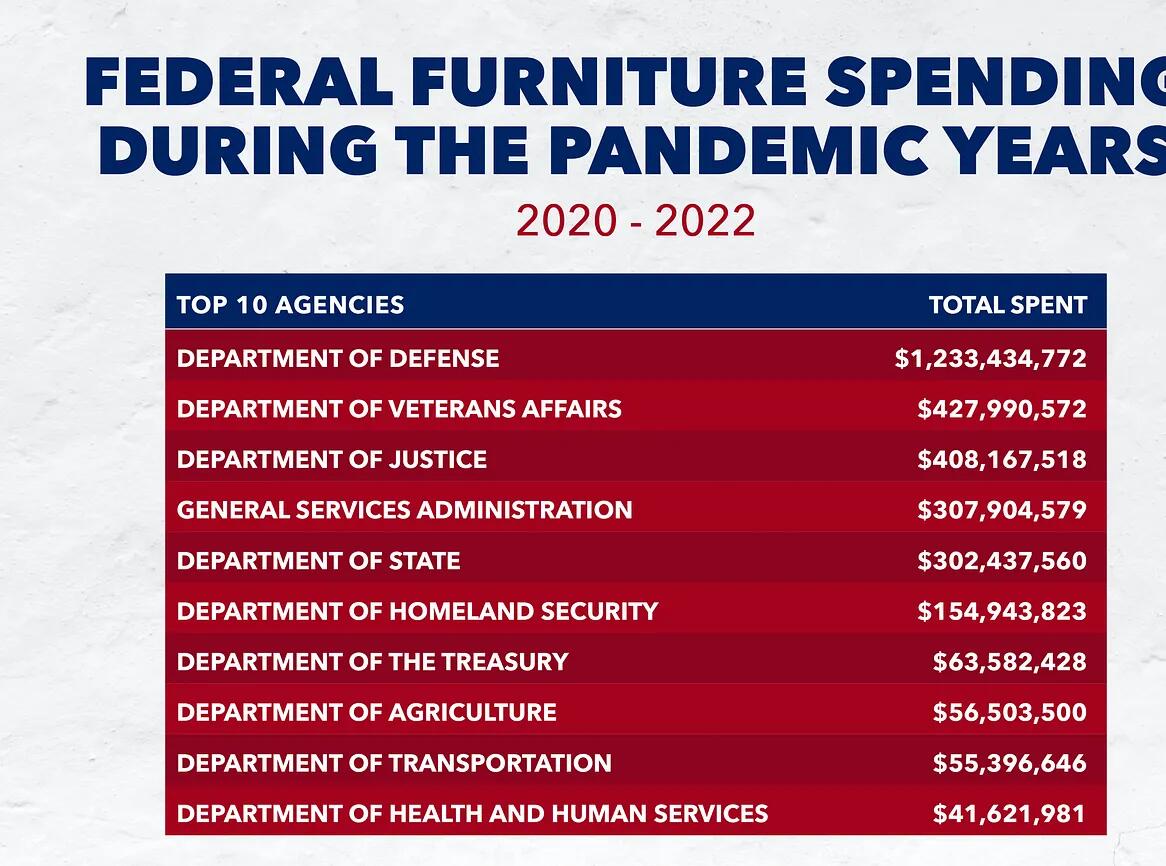
Top 10 federal agencies spending on furniture during the pandemic years.

The feds spent $26 million on furniture for their conference rooms, while their meetings were held on ZOOM. Spending included $700,000 by the Securities and Exchange Commission for their New York regional office conference room.

The Defense Advanced Research Projects Agency (DARPA) spent nearly $250,000 on a conference room “refresh” with expensive, high-end Herman Miller furniture. The Federal Emergency Management Agency (FEMA) purchased $284,000 in Herman Miller furniture for their headquarters conference center.

The Pension Benefit Guaranty Corporation spent $14.4 million on new furniture for its 1,000 employees – that’s $14,400 per employee.

Environmental Protection Agency downsized its 300,000 square foot office space in Philadelphia -- but upsized the furniture. It used relocation as a license to redecorate $6.5 million on high end furniture when moving into smaller space at Four Penn Central.

WHAT WE FOUND: Despite federal employees working from home, the agencies continued to splurge on furniture purchases.

There was no material difference in the amount federal agencies collectively spent on office furniture between the years 2018 and 2022.

Kept spending on furniture during pandemic despite work from home mandates.

Here is how individual agencies break out:

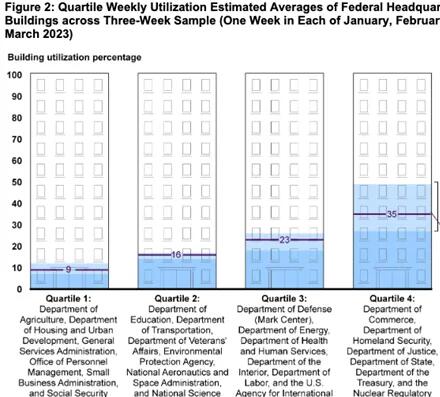
  • Transportation used just 9% of its office space – but spent $55 million on furniture.

  • Agriculture used just 9% of its office space as well. It spent $57 million on furniture. 

  • General Services Administration also hit 9% usage. And it found… $308 million for furniture.

  • Veterans Affairs used just 16% of its office space but spent $428 million on furniture.

  • Defense used 23% of its space and spent $1.2 billion on furniture. Had it occupied 100%, would it have spent $4.8 billion?

  • Justice used 35% of its offices yet spent $408 million on furniture. State spent $302 million. Homeland Security spent $156 million. 

Low utilization rates were attributable to the following factors: increased number of staff working remotely, outdated building configurations, historic utilization problems, and a reluctance for agency leaders to share space with other agencies.  

Most of the major federal agency headquarters are one quarter full or less, and none are at 50 percent capacity or more, according to the report.  

Remote work has surged at federal agencies since the pandemic began. A Federal News Network survey conducted in November 2022 found 60 percent of federal employee respondents were working completely remotely, 33 percent had a hybrid situation, and the rest worked in office.  

The Biden administration has urged agencies to reduce telework ‘aggressively’ in a recent email from White House chief of staff Jeff Zients to Cabinet officials.

Congressional Republicans have renewed requests for information from agency officials about telework policies.

In May 2022, House Republicans introduced the Stopping Home Office Work’s Unproductive Problems (SHOW UP) Act, which would have required agencies to return to pre-pandemic telework levels.

Time To Tell America's Climate Cult "Stop!"

  by J.G.Collins via The Epoch Times,

Describing the mission of his National Review magazine in its inaugural edition of on Nov. 19, 1955, the then not-yet 30 year-old conservative icon William F. Buckley wrote that his new magazine "stands athwart history, yelling Stop, at a time when no one is inclined to do so, or to have much patience with those who so urge it."

Rishi Sunak, Britain's Tory prime minister, seems to have bravely adopted at least some of that mission by challenging Britain's radical climate agenda. It is a lesson for the United States.

Addressing Britain's sanguine climate policy Sunak said, "there’s nothing ambitious about simply asserting a goal for a short-term headline without being honest with the public about the tough choices and sacrifices involved and without any meaningful democratic debate about how we get there."

Mind you, Mr. Sunak is not what the climate cult types calls a "climate change denier"; far from it. But he understands that aspirations without means are merely pipe dreams. And he also understands that imposing climate mandates without public discourse or debate is antithetical to the democratic principles that underlies his republic, as it does ours.

What Are We Doing?

Unfortunately, the mismatch between means and aspirations, as well as the disregard for democratic principles, characterizes much of what passes for the national climate policies of both the United Kingdom and the United States.

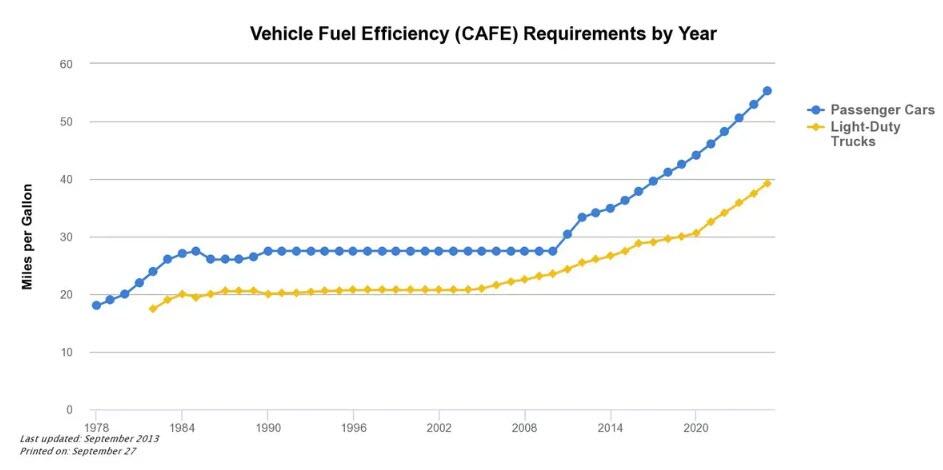
In the United States, the Environmental Protection Agency (EPA) mandated that automobiles in the Model Year 2026 CAFE (corporate average fuel economy) standards at 55 miles per gallon for sedans and 39 mpg for trucks and light duty trucks/SUVs.  Those are enormous increases of 25 percent and 28 percent, respectively, just since 2020.

(Source: Environmental Protection Agency/CAFE Standards by Year 1978–2025)

The clear intention in raising the CAFE standards so quickly is to force consumers into buying new cars that are either fully or partially electric, hybrids, or fully electric. But there is clear resistance, as reflected in this comment even from Kyle Bass, an avid environmentalist and chief investment officer of Conservation Equity Management, a private equity fund focused on "facilitating conservation investment.

State and local governments in so-called "blue" states have been even more aggressive in forcing radical lifestyle changes on the people in their jurisdiction. In New York, for example, it is something of a race to "make history," with elected officials lauding the city's status as "the first city in America to [insert costly, new, crackpot, "green" energy notion here]. See this example lauding an expensive "congestion pricing" tax scheme the city will impose next year, whereby drivers who go below 6oth Street in Manhattan will have to pay a congestion pricing toll of $26 to "reduce fuel consumed and pollutant emissions."

Another "green" initiative bans new construction in New York City from having natural gas hookups, even though natural gas reserves are estimated at 300 years and natural gas burns far cleaner than many alternatives. New York's legendary pizzerias, some serving pizza from coal-fired ovens for more than a century will likely be forced to adopt to electric pizza ovens. Another initiative will force New Yorkers to hold onto  their garbage for up to a week for mandatory composting of organic waste, since the city's plan only allows for compost pick-ups just once a week. Imagine the smell. And the vermin!

At least two council members are starting to pay attention to the mismatch between means and ends, and the enormous costs of compliance to their constituents, but they are well in the minority in the council.

Got Democracy?

Prime Minister Sunak stated, simply, that "it cannot be right ... to impose such significant costs on working people, especially those who are already struggling to make ends meet, and to interfere so much in people’s way of life without a properly informed national debate."

We should all cheer, "Hear! Hear!"

These new CAFE standards and other climate-related mandates weren't decisions arrived at by referendum or consensus; they were decreed by bureaucrats. In New York, the City Council imposing mandate after mandate is dominated overwhelmingly by Democrats, and most of those are "woke" progressives whose principal life experience is working in politics or at not-for-profits funded by the city. Their inexperience and inability to see anything beyond their altruistic objective personify the kind of thinking that overstates aspirations without regard to means—exactly as Prime Minister Sunak described in his talk.

The Means to Ends

So let's look at means.

Few would argue that it is better to reduce hydrocarbon emissions, if we can, for the general health of the people, if not to achieve climate goals. But we also need to maintain an economy to feed, clothe, and house hundreds of millions of people and ensure our national security.

We cannot do those things if we overburden the nation's electric grid. We cannot do those things relying on "renewables" like wind  and solar power—not even with the best of those technologies we have available today. And we cannot do that with Americans abandoning their gasoline-powered internal combustion engines in favor of electric vehicles (EVs) that most of them cannot afford and that require a charge from an overburdened electrical grid. We might be able generate all the required electricity the climate cult demands with nuclear energy and a massive investment in the electrical grid, but progressive abhor the former and have made no provisions at all to pay for the latter.

At an average cost of $64,000, the cost of EVs the climate cult would have us all adopt are now, and will likely continue to be, well beyond the financial means of most Americans. They're also extraordinarily heavy, going from hundreds to thousands of pounds more than gasoline-powered cars. That makes EV crashes far less survivable than their gas-powered counterparts, and raises concerns about the structural integrity of roads, bridges, and vertical parking garages.

That's to say nothing of how vulnerable an "all EV" economy would make us. First, the inputs necessary to make EVs are at risk as they come largely from a geopolitical adversary, China. Other EV inputs depend on mining in countries in the Third World where China is aggressively developing geostrategic advantage, but where we have no other interest except for EV inputs. The United States simply cannot rely on that supply chain. Nor can we afford to further exacerbate our balance of payments deficit with China by buying their batteries or to go tit-for-tat with China for aid and investments in countries where we have no other geopolitical interests. Challenging China for these EV supplies could present grievous fiscal, geopolitical, and geostrategic challenges, even war. And for what?  EVs?

Prime Minister Sunak, who accepts the hypothesis that human activity is responsible for climate change, may not be yelling "Stop!" in the manner Mr. Buckley described; he may simply be saying "slow down." And reasonably so. For now, though, it is enough.

We need to ensure that the technology we have to fulfill the climate cult's ambitious agenda is viable, affordable, and secure from a geostrategic perspective. Major elements of the "green" supply chain cannot be in the hands of those who would use it to force their political ends upon us. We learned that lesson with OPEC oil shock in the 1970s.

But we are just starting to do that. NASA has developed a prototype for a light battery for use in aircraft. Small modular reactors—technological cousins of the type we use in our nuclear navy that have been used safely for nearly 70 years—are less costly, more efficient, and more easily deployed—as well as arguably safer—than their large counterparts.

But bringing those and other technologies to bear to power cities, factories, and, yes, EVs, will require another 30–50 years. In the meantime, we will have wasted trillions on technology that is effectively obsolescent the moment it comes online.

Listen to William F. Buckley: "Stop!"

Nestle shares at two-year low as investors weigh Wegovy rollout

 Nestle shares were under pressure on Friday as investors weighed the potential impact of Novo Nordisk's blockbuster weight-losing drug Wegovy and how it could reduce spending on food.

The KitKat and Nescafe coffee maker's shares were down 2% and headed for their lowest level in more than two years. The pan-European food, beverage, and tobacco index fell 1.7%.

Nestle declined to comment on the stock performance. Peers Danone and Unilever were also down, 1.5% and 2% lower respectively.

"I think it comes after Walmart's comments regarding the impact on weight loss drug consumers perhaps buying less," the head of European consumer equities at Kepler Cheuvreux, Jon Cox, said.

Walmart's U.S. branch CEO John Furner told Bloomberg on Wednesday that the company saw a slight pullback in food consumption with people taking appetite-surpressing drugs such as Wegovy.

However, Cox does not regard this as a substantial risk to Nestle and the broader food industry in the long term.

Bruno Monteyne from Bernstein also pointed to the Wegovy impact, but saw little logic in the sell-off.

"Danone sells water, baby milk powder, and yogurt: not sure how those would be negatively impacted by GLP1 / Wegovy?" he said, referring to a broader class of drugs.

Vontobel analysts also only see limited risks for some categories of Nestle's products.

"We see some potential risks in some of the company’s product categories, such as frozen food in the US or confectionery, but less so in the other key categories, such as coffee, pet food, infant nutrition, culinary, water, or Nestlé Health Science," they wrote a note.

https://finance.yahoo.com/news/nestle-shares-two-low-investors-094125306.html